QQQ has regained the yearly line, but the true market of AI has just entered a stage of differentiation. The index has completed its repairs, and individual stocks are beginning to be tested. Under the same AI theme, the answers given by the market have already become completely different: some have risen above the yearly line with cash flow, while others have increased by a quarter yet remain 30% below the yearly line. This article unfolds along a main line; after the index level repair is completed, who can pass this exam depends on whether the performance fulfillment can outpace the valuation pressure.
1. QQQ regains the yearly line in four days, but the real pressure is still above the yearly line
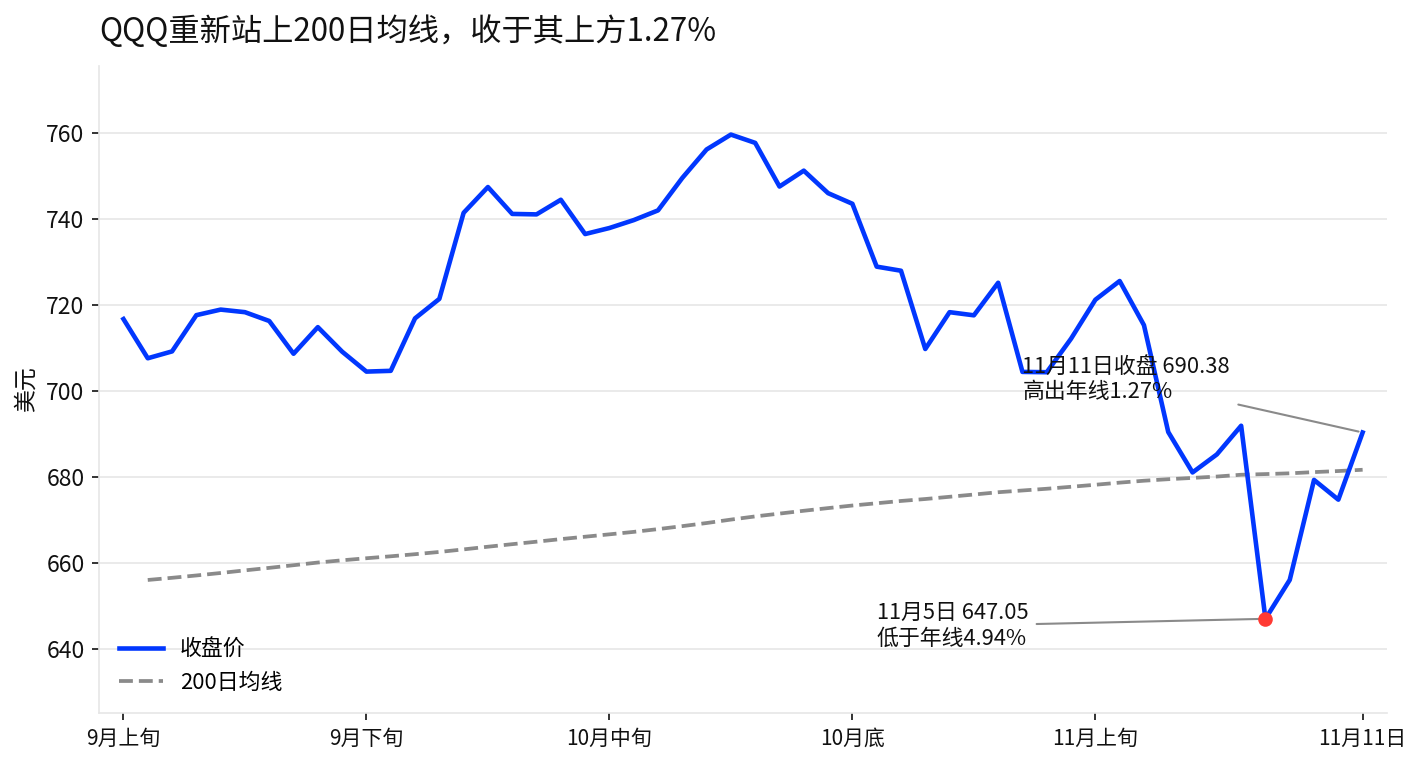
On November 5, QQQ closed at $647.05, which is 4.94% lower than the 200-day moving average at the time. On November 6 and 9, it regained most of its losses, and on November 10, it slightly retreated; on November 11, it closed at $690.38, which is 1.27% higher than the yearly line.
Historically similar trends have shown significant differentiation after regaining the yearly line. This statistic only reflects historical cases and does not indicate which path will be preferable moving forward, so we will not elaborate here. The real challenges ahead are the two fronts at hand.
The first challenge is NVIDIA. This round of QQQ's rebound was driven by storage, optical communication, and CoreWeave. The largest weight, NVIDIA, rose by 2.87% to close at $173.73 on the 11th, still 15% below the yearly line. It will release its earnings after hours on November 17, and if governance concerns cannot be clarified before then, the structure of the index above the yearly line will lack an important confirmation.
The second challenge is interest rates. The yield on the 10-year U.S. Treasury bond closed at 4.998% on November 10, just below the 5% mark. Long-term interest rates determine the discounting mechanism of high-valuation future cash flows, which is a more fundamental variable than the index level.
2. The index has returned, but AI has already divided into three tiers
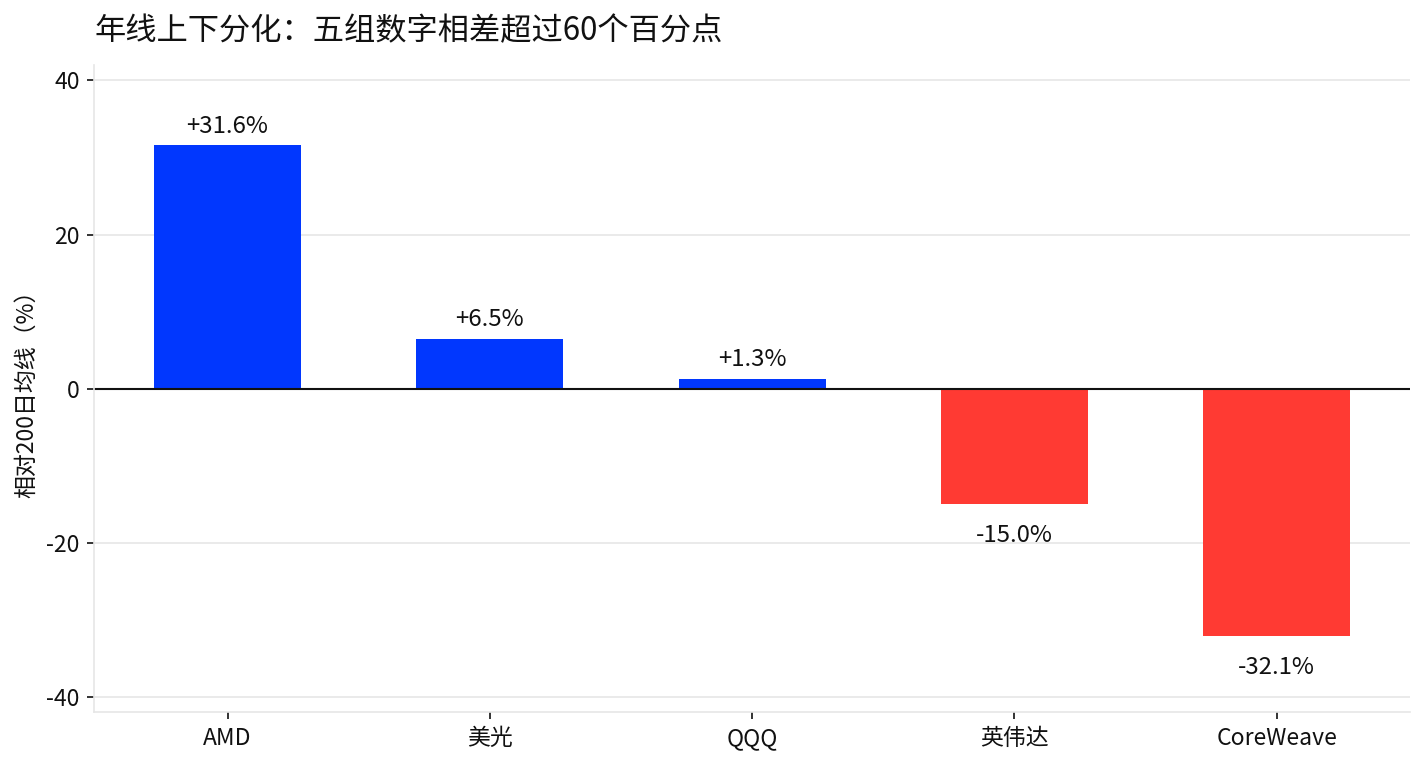
Putting the positions of five main lines against the 200-day moving average in one chart actually reveals three states.
- AMD closed at $552.90, 31.6% above the yearly line, with high expectations already priced in.
- Micron closed at $811.30, 6.5% above the yearly line, with fundamentals being fulfilled, rising by 11.89% on the 11th.
- QQQ itself is 1.27% above the yearly line, and the index has just completed its repair.
- NVIDIA is 15.0% below the yearly line, and the core weight has yet to be confirmed, with a 28.6% drop from its 52-week peak.
- CoreWeave closed at $60.77, surging 24.71% on the 11th, but is still 32.1% below the yearly line, with high volatility and high financing risk coexisting.
This set of data leads to an important judgment: the index returning to the yearly line does not necessarily equate to a broad rally in AI. Funds may be shifting from "buy AI" to "buy realization," and the position of the yearly line is not random; it is the market’s grading of growth quality. The following question is not whether "AI will rise" but which entities' fulfillment speed can outpace valuation pressure.
3. The next challenge for NVIDIA: the uncertainty of earnings and board investigations
NVIDIA closed at $173.73 on the 11th, up 2.87%. Looking back over a longer period, it has retraced 28.6% from its 52-week peak of $243.37 and closed several days below the yearly line in early November.
According to reports from multiple media outlets in early November, discussions about management arrangements at the board level were escalating, although the company has not officially confirmed this. The earnings expectations are not low; according to analysts' expectations reported by the media, the market consensus for third-quarter revenue is around $108.8 billion, representing a nearly 90% year-on-year growth. The expectations are high, but the stock price is still 15% below the yearly line. These two numbers together indicate that the market's concerns extend beyond just performance.
The earnings report on November 17 needs to address two matters: the performance figures and how management addresses governance arrangements, forward guidance for the next quarter, and capital expenditures in AI. According to media reports, firms like Citigroup have lowered their price targets ahead of the earnings report, although their ratings have not changed; this reflects a common stance on Wall Street of discounting valuations first.
The observation points after the earnings report are also becoming clearer. If governance concerns are resolved and performance is fulfilled, the previous retracement level around $181, as conveyed through third-party technical analysis, will serve as the first verification point for valuation recovery. Conversely, if the earnings exceed expectations but the stock price cannot recapture the vicinity of $181, this would indicate that governance and valuation discounts have not been resolved, and the revenue figures alone do not constitute a sufficient condition for pricing.
4. Micron returns to the yearly line: HBM prices are more worthy of attention than low PE
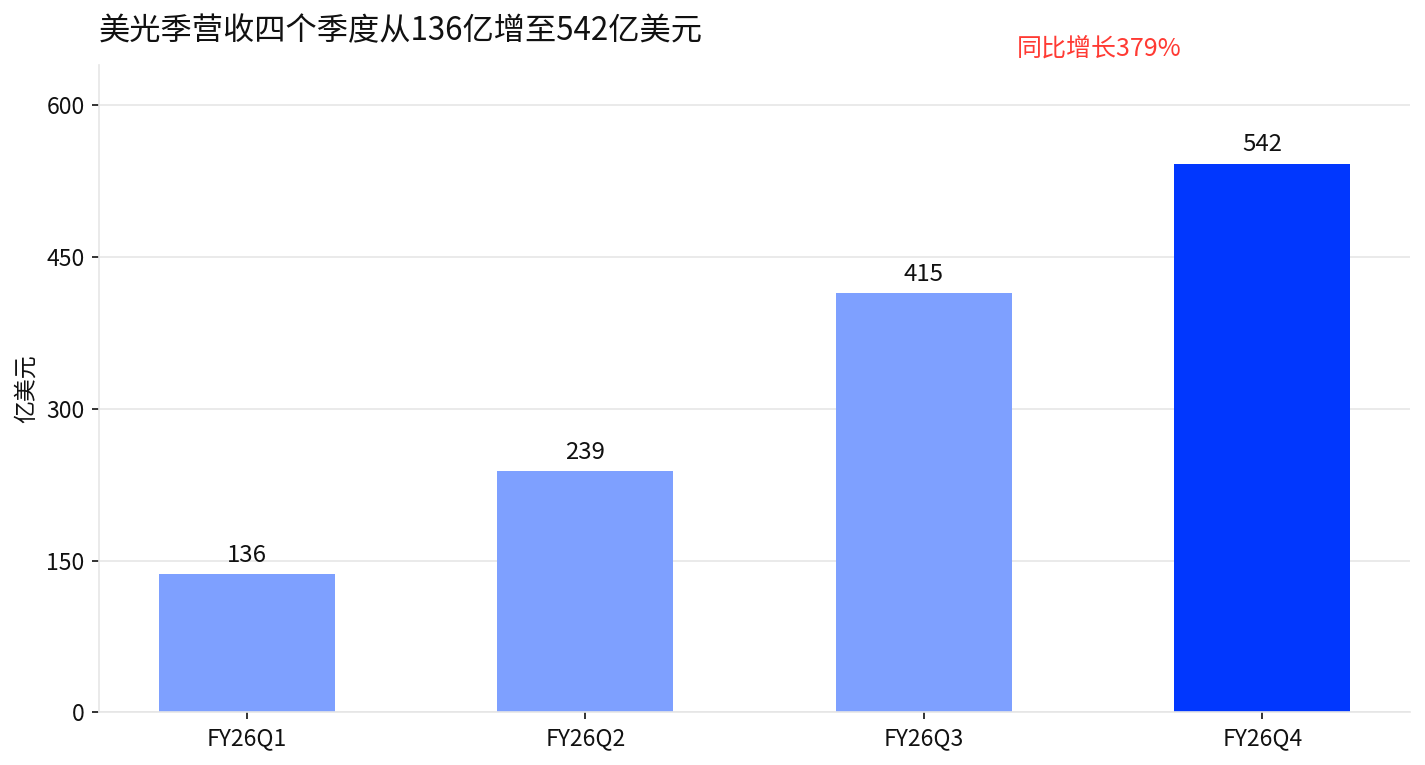
Micron's revenue for the fourth quarter of fiscal year 2026 was $54.229 billion, compared to only $11.315 billion in the same period last year, marking a 379% year-on-year increase. The total revenue for the year was $133.188 billion, with a net profit of $84.969 billion, translating to an earnings per share of $75.38 for the year, which gives a current price-to-earnings ratio of approximately 10.8 times.
The question is how to interpret this low PE ratio. Is the market mispricing, or is it pricing in a peak cycle in advance? Micron has retraced 35.4% from its 52-week high of $125.5 and regained 6.5% above the yearly line on the 11th. The price has indicated a "stop loss," but an answer for "trend reversal" is not found in past revenues.
The answer lies in the price and supply of HBM. According to third-party technical analysis, there is dense positioning in the $800 to $900 range above $811. If the pricing guidance for HBM in the next quarter continues to rise, and the supply of HBM4 from Samsung and SK Hynix does not significantly exceed expectations, a price-to-earnings ratio around 10 could more easily be seen as undervalued. If HBM4 supply increases rapidly and prices begin to loosen, a lower PE ratio is more likely to be interpreted as a preemptive pricing of a peak cycle. The same valuation data can mean two completely different interpretations, with the dividing line being HBM prices.
5. CoreWeave up 25% still hasn't regained yearly line: rebounding from payment concerns, not financing risk
CoreWeave's stock rose 24.71% after its earnings report, but it still closed at $60.77, 32.1% below the yearly line and 56% below its 52-week peak. Why has it risen by a quarter yet remains 30% below the yearly line? The answer lies in the earnings report proving strong business growth, but it has not fully demonstrated that financing costs have decreased. The core of CoreWeave's valuation is not the single quarter's revenue; it is whether it can continuously secure financing at acceptable costs. This round of price increase is primarily reflecting a alleviation of short-term payment concerns, more than the realization of a successful business model.
Looking at AMD's situation provides clarity. Its third-quarter revenue was $13.377 billion, a quarter-over-quarter growth of about 16%, and the data center business reportedly nearly doubled to $8.5 billion. Its test is whether revenue can convert into cash; according to media reports, its free cash flow dropped from $1.56 billion in the previous quarter to $554 million, meaning the quality of growth will depend on future quarterly cash flow verification.
Each of the four stocks has its own question. NVIDIA's is whether its performance can once again support valuation. Micron's is whether profits can be sustained. AMD's is whether revenue can be converted into cash, and CoreWeave's is whether revenue can cover financing. The internal ranking within AI is based on the answers to these four questions.
6. December rate hikes have been anticipated by the market; the 10-year Treasury yield is the total switch for AI valuations
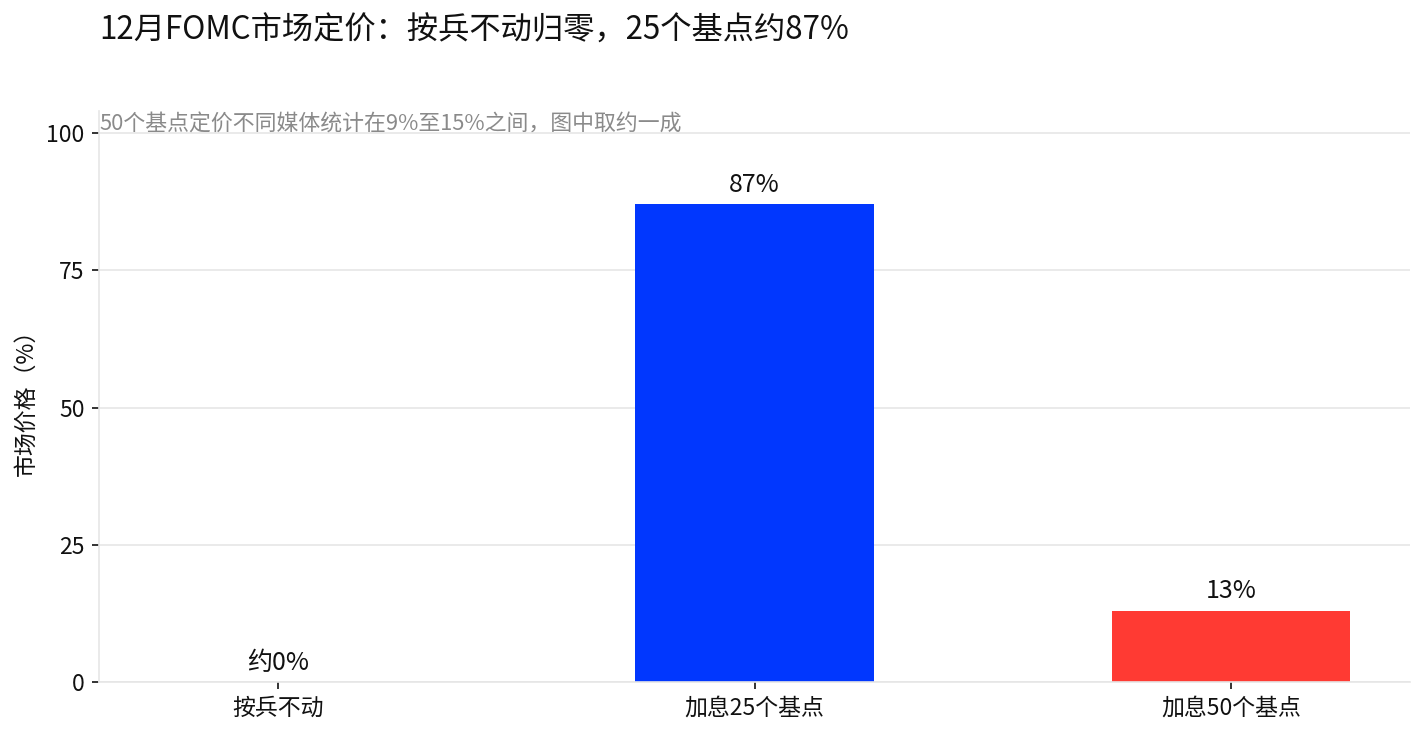
After the October CPI was released, according to market data from CME FedWatch (as reported by multiple media outlets from November 10 to 11), the probability of holding steady on December 9 has dropped to zero, with approximately an 87% chance of a 25 basis point hike, and around a 10% chance of a 50 basis point hike, with different media reports estimating between 9% to 15%. Some institutions have included another rate hike early next year in their predictions, although these opinions only represent the judgments of those institutions. The December rate hike itself has been anticipated by the market; short-term interest rates may not be the largest variable moving forward.
The true influence on AI pricing comes from long-term yields. The yield on the 10-year Treasury note closed at 4.998% on November 10, just below the 5% mark; it is the benchmark for discounting growth stock valuations. Therefore, the criteria for judgment is very specific: if the 10-year Treasury yield falls and QQQ stabilizes above the yearly line, AI assets could conditionally recover their discounts. If the 10-year yield breaks through 5% again, the pressure of discounting high-valuation future cash flows will once again increase, necessitating a re-examination of the structure above the yearly line. Monitoring the 10-year Treasury yield is more useful than just focusing on a 25 or 50 basis point change.
7. Don't just focus on QQQ: five signals determine who continues to run within AI
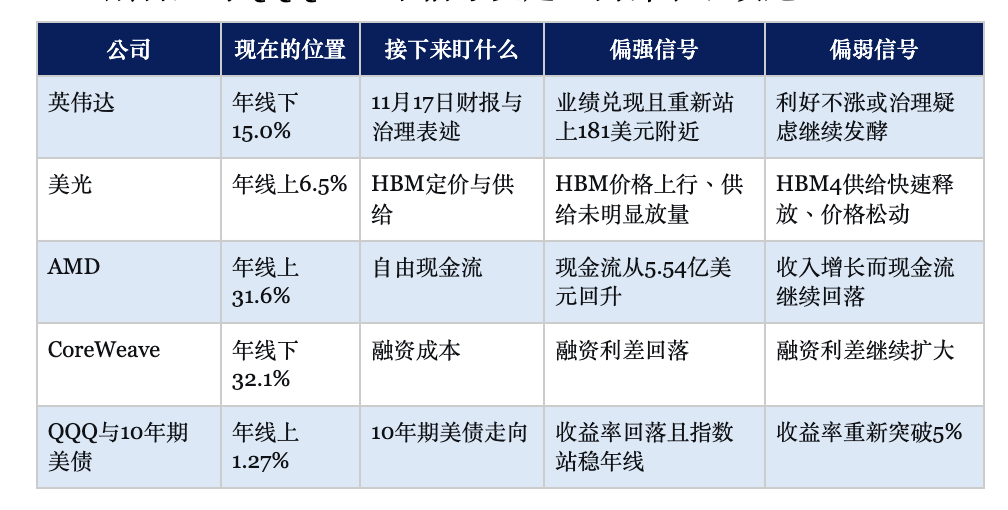
Final note: QQQ returning to the yearly line does not represent a broad AI rally
What truly deserves attention in this round of rebound is not just that QQQ has finally recaptured the 200-day moving average but that AI internally has already started to reprice. AMD stands 31.6% above the yearly line, Micron is 6.5% above, while NVIDIA and CoreWeave remain 15.0% and 32.1% below the yearly line, respectively. Under the same AI theme, the responses from the funds have become completely different.
Moving forward, do not use "whether AI will rise" as the sole judgment. NVIDIA's governance and earnings report are to be observed for their ability to support valuation again, Micron will be watched for whether HBM prices can prove profits are not at a cycle peak, AMD will be evaluated for whether revenue growth can once again translate into free cash flow, and CoreWeave will be assessed based on whether financing costs can improve along with business growth. If these signals strengthen progressively, a stabilization of QQQ above the yearly line may transition from technical repair to trend recovery. If the index continues to rise while these fundamental signals do not follow suit, we need to be cautious of another instance where the index is stronger than individual stocks. The index has completed its repair, and individual stocks are beginning their examination; this sentiment will likely dominate the AI market before the monetary policy decisions in December.
Disclaimer:
The content of this article is for general informational and market commentary purposes only, compiled from publicly available information up to the time mentioned in the text. Relevant market data, expectations, and probabilities may change in response to market conditions. The views and investment strategies attributed to third-party institutions, analysts, or other individuals mentioned in this article represent only those third parties' positions at a specific time and do not represent BIT's views or recommendations. This article does not constitute investment advice, investment research, an invitation, solicitation, or recommendation of any securities, investment products, or trading strategies and should not be relied upon as the basis for any investment decisions. Financial markets carry risks, and securities prices and market performance may fluctuate; past performance and historical market trends do not represent or guarantee future results. Investors should independently assess relevant risks based on their own circumstances and seek professional advice when needed.
免责声明:本文章仅代表作者个人观点,不代表本平台的立场和观点。本文章仅供信息分享,不构成对任何人的任何投资建议。用户与作者之间的任何争议,与本平台无关。如网页中刊载的文章或图片涉及侵权,请提供相关的权利证明和身份证明发送邮件到[email protected],本平台相关工作人员将会进行核查。


