After hours of trading in the US stock market, The Wall Street Journal reported that the board is preparing to dismiss CEO Jensen Huang, with the stock price dropping approximately 8%, reaching a low of $158.76, falling below the one-year low of $164.27. The current price corresponds to about 13.1 times the consensus expected EPS for FY2028 and a market capitalization of $383 billion. After falling more than 34% from a peak of $240, is it time to buy the dip for Nvidia?
13 Times Forward P/E, Is That Enough Odds?
Closing at $173.73 on November 11, and dropping to $158.76 after hours, this represents a 34.8% retracement from the October peak of $243.37. The market is trading on two factors: Will the board replace the CEO, and will AI capital expenditures slow down in 2027?
Odds: Benchmark at $240 corresponds to a 20 times FY2028 EPS of $12. Bear market $97.50. Bull market $364, corresponding to 26 times EPS of $14.
Probability is 45/35/20, with a probability-weighted estimate of $214.93, expected return of 35.4%, bear market downside of 38.6%, odds of 0.92. The expected return is sufficient, but until the board reaches a conclusion, any precise target price is a false precision. $145 is a condition for a 2:1 price, not a prediction.
The Biggest Current Issue: AI Demand Is Not Bad, Governance Is
Q2 FY2027 revenue is $96.2 billion, with data centers accounting for $89 billion, or 92.5%. Gross margin is 75%, operating profit margin is 66.2%. Operating cash flow is $24.08 billion, free cash flow is $21.34 billion, with no new bad news at the business level.
TTM free cash flow is $127.06 billion, with a conversion rate to net profit of about 66%; FY2026 free cash flow is $96.7 billion, FCF profit margin is 44.8%. The balance sheet has $23.2 billion in net cash and $33.37 billion in debt; this net cash figure excludes $42.78 billion in marketable equity securities, not counting strategic holdings as cash.
What to watch is working capital. Inventory is $31.58 billion, an increase of 47.5% compared to the end of FY2026; accounts receivable is $63.06 billion, up 64%, with days sales outstanding around 60 days. Whether inventory and receivables can keep pace with the Q3 guidance of $108 billion is more indicative of the authenticity of demand than even the highest gross margin.
Only Three Days from Investigation to Dismissal Agenda
On November 8, Jensen Huang admitted infidelity to employees, the board announced an independent investigation, stating there is no reason to believe national security or company secrets have been compromised, and expressed confidence in the management team. On November 9, the stock price fell 4.27%, and shareholders filed a securities class action lawsuit in the Federal Court for the Northern District of California. On November 10, the stock price fell another 5.47%, as the board hired former federal prosecutor Joon H. Kim and Wachtell Lipton to advance the investigation.
On November 11, during regular trading hours, the stock price rose 2.87% to $173.73. After hours, The Wall Street Journal cited informed sources saying the board is preparing to dismiss Jensen Huang as early as that evening, and has reached out to external headhunters to find a successor; The New York Times also reported the second extramarital affair with a company executive. Nvidia declined to comment, and as of pre-market on November 12, there was no official decision. This is media reporting, not a fact disclosed by the company.
On the same day, Baird downgraded the rating from outperform to neutral, cutting the target price from $500 to $200; Morgan Stanley removed Nvidia from its preferred stock list while maintaining an overweight rating and a target price of $300. Baird’s reasons include government investigations, potential actions following congressional briefings, potential financial impacts, and the possibility that spending on data centers may slow to 40% or below in 2027.
The market is betting on the governance conclusion, not the next quarter's GPU shipments. 62 analysts give an FY2027 revenue estimate of $412 billion, with EPS of $9.32; the average target price is $311.51, snapshot date November 12. This average includes target prices before the scandal, while Baird's $200 and Morgan Stanley's $300 are closer to current information.
Cash and Valuation: 16.4% FCF Growth Requirement
Using DCF reverse calculations with $158.76, 2.415 billion shares, and $23.22 billion in net cash.
TTM free cash flow is $127.06 billion, over 5 years, with WACC at 9% and perpetuity at 3%. Implied annualized free cash flow growth rate is 16.43%, sensitivity range from 9.6% to 22.1%.
This requirement is below FY2027 consensus expected revenue growth rate of about 91%, and also below FY2028 EPS growth rate of about 29%. The market is not pricing for unlimited growth; it is pricing for slowing growth and governance discounts.
A benchmark of 20 times is the multiple after governance discount, lower than the pre-crisis 22 times; if the board changes, a 13 times bear market multiple is more reasonable; if the investigation clarifies and the CEO remains, a 26 times bull market multiple becomes valid.
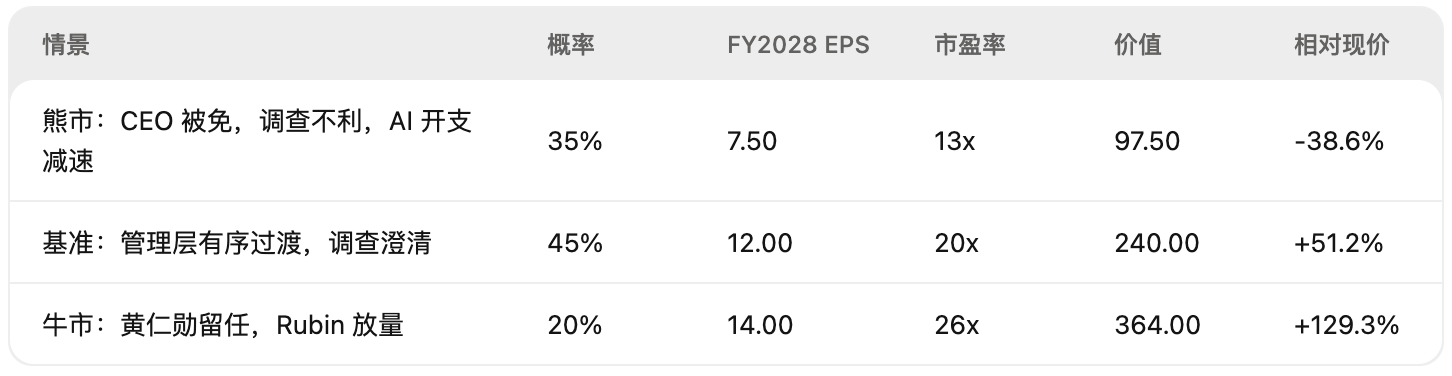
Probability-weighted at $214.93, with an expected return of 35.4%, bear market downside of 38.6%, odds of 0.92.
Buying the Dip? Wait for the Board or $145
The current price is $158.76, do not chase. To return odds to 2:1, based on a benchmark of $240 and bear market of $97.50, the price needs to drop below $145. Alternatively, if the board clearly retains leadership, or if Q3 earnings exceed expectations, raising the benchmark value above $280, then the current price would be worth reevaluating.
Hard failure conditions:
- The board dismisses the CEO and there is no credible successor plan;
- The investigation finds evidence of national security or company secrets being leaked;
- Q3 guidance is below $100 billion, with gross margin falling below 70%;
- Export controls expand to allied supply chains.
Risk Points: Three Downward Paths
Governance is the top priority. If the board dismisses the CEO, the strategic continuity, customer relationships, and lobbying for export controls of the successor will all be impacted. Dan Ives warns that Huang's departure could result in a further 30% drop in market value. Leading indicators include board statements, 8-K filings, congressional briefings, and investigation progress.
National security is the second priority. The core of the investigation is whether Huang leaked confidential information. The company currently states there is no evidence, but the investigation is ongoing. If any adverse conclusions arise, export controls and customer trust will be simultaneously compromised.
AI capital expenditures are the third priority. Baird estimates that growth in AI spending by large cloud providers may drop to 40% or lower in 2027; if Q3 guidance is below $100 billion, or if Q4 guidance does not show quarter-over-quarter growth, the benchmark EPS of $12 becomes invalid.
Operational working capital and valuation must also be monitored. Inventory and accounts receivable growth rates far exceed revenue; if Q3 continues to deteriorate, it indicates potential issues with channel stocking or quality of receivables. Analyst target prices are being revised downwards, with Baird's $200 and Morgan Stanley's $300 already incorporating governance discounts into their models.
What to Do in the Coming Week? Be Patient!
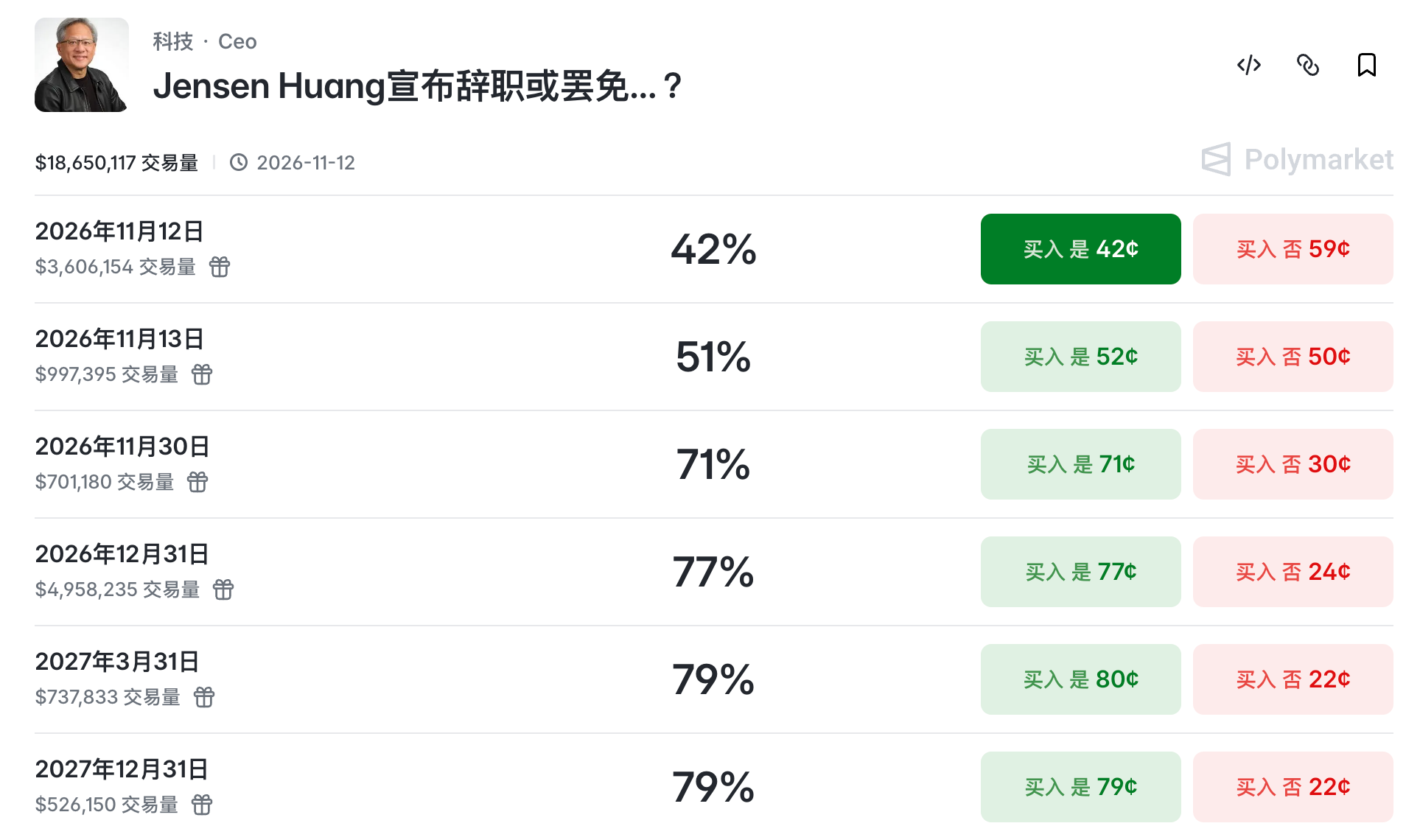
The board may meet on November 12, but as of pre-market on November 12, there is no announcement. Any conclusion will impact prices ahead of earnings reports. However, the probability of Jensen Huang resigning or being dismissed on Polymarket is approaching 80%, which is not good news for Nvidia's stock price.
After hours on November 17, Q3 FY2027 earnings report. Three things to watch: Will revenue reach $108 billion? Will Q4 guidance continue to show quarter-over-quarter growth? Will gross margin hold above 73%? This guidance does not include revenue calculations from data centers in Mainland China and Hong Kong.
On November 18, media reports indicated that the House committee has requested Huang to attend a closed-door briefing. This is the first public test point for governance risk.
免责声明:本文章仅代表作者个人观点,不代表本平台的立场和观点。本文章仅供信息分享,不构成对任何人的任何投资建议。用户与作者之间的任何争议,与本平台无关。如网页中刊载的文章或图片涉及侵权,请提供相关的权利证明和身份证明发送邮件到[email protected],本平台相关工作人员将会进行核查。


