Many people think of "Hyperliquid arbitrage" as a simple action when they hear about it for the first time:
Buy low in cheap places and sell high in expensive places, then close the position when the price returns.
Those who have actually done it a few times usually quickly discover that the most challenging part of arbitrage is not finding the price difference, but judging what kind of opportunity this price difference truly represents: whether it is a mispricing of the same asset in the market or fundamentally different contract rules, oracle, funding rates, and contract amounts across different platforms.
Three levels of Hyperliquid arbitrage:
- Arbitrage Example One: The price difference between pre-IPO contracts for Anthropic on Binance and Hyperliquid;
- Arbitrage Example Two: How Backtrade on HyperEVM transforms liquidation losses into token and USDC distribution;
- Arbitrage Example Three: The historical data of Unitree reminds everyone between Bybit and Hyperliquid that the profit from price differences may be completely consumed by funding rates and transaction fees.
When these three pieces of information are put together, the conclusion drawn is not "there is risk-free profit everywhere on Hyperliquid," but rather:
Hyperliquid provides more trading structures that can be priced, hedged, and backtested, but arbitrage profits must go through quadruple validation of contract caliber, funding costs, execution slippage, and liquidation risks.
First Type of Arbitrage: The Same Event, Different Contract Standards
The pre-IPO contract for Anthropic is a representative type of opportunity.
When a company has not yet gone public, there is not a publicly quoted stock price that can be referenced directly. Different platforms can only create a tradable price expression based on their respective product designs.
Binance quotes the pre-IPO contract for Anthropic based on “total market capitalization,” with an example price of about $1700, corresponding to an estimated valuation of about $1.7 trillion; the contract provided by the XYZ market on Hyperliquid quotes it based on “price per share,” with an example price of about $110, corresponding to an estimated valuation of about $1.4 trillion.
On the surface, these two numbers appear to represent significant discounts and premiums for the same company.
However, they may not represent the same unit.
The pre-IPO contracts on Binance have a rebase mechanism post-listing. According to dynamic explanations, if the platform assumes 1 billion shares, a contract can be adjusted to 12.8, 13, or even 16.9 shares based on the actual equity post-listing. The XYZ contract on Hyperliquid cannot undergo the same quantity rebase; the price after listing remains fixed based on the original quantity.
This means traders genuinely need to compare not "the $1700" and "the $110," but rather:
1. Which equity standard Binance ultimately adopts;
2. How many Binance contracts will be converted into after listing;
3. What economic unit a XYZ contract on Hyperliquid corresponds to;
4. Whether the settlement prices, settlement times, and triggering conditions of both platforms are consistent.
After dividing $1700 by a rebase factor of 15.45, it is approximately equal to $110. This is seen as the "deadly line" where both sides break even. If the final rebase multiple is less than 15.45, the dynamic inference of "shorting Binance, going long XYZ" may yield the price difference; if the multiple is above this level, the outcome may reverse.
However, it must be emphasized: this is not an already achieved certain gain, but rather a conditional inference based on the platform's final rules and equity standard judgment.
The dispute between 12.8 and 16.9 stems from different interpretations of "actual circulating equity after issuance" and "fully diluted equity."
This is precisely where the arbitrage with pre-IPO contracts becomes most dangerous: traders may correctly perceive the company's valuation direction, but misjudge the settlement unit.
Core Formula for This Type of Arbitrage
One can simplify pre-IPO contract arbitrage into a unit conversion problem:
Equivalent price of platform A post-listing = Current price of platform A ÷ Final rebase factor
Price difference space = Equivalent price of platform A post-listing − Price of platform B
However, the actual realizable profit must continue to deduct:
Net arbitrage profit
= Price difference profit
− Transaction fees for both platforms
− Deposit and withdrawal costs
− Funding rate
− Borrowing interest
− Slippage
− Timing difference risk of settlement
− Risk of rule changes
As long as one of these variables is not confirmed, the so-called “price difference” does not equate to lockable profits.
Second Type of Arbitrage: Inter-platform Perpetual Price Difference and Funding Rate
The Unitree case is closer to the inter-platform arbitrage familiar to ordinary traders: observing the same asset price on Bybit and Hyperliquid, looking for the process of price difference expansion and rapid convergence.
Theoretically, four combinations can be designed:
- Long on platform A, short on platform B;
- Short on platform A, long on platform B;
- Profit from price difference regression, not holding obvious direction;
- Sacrifice part of the price difference for a more favorable funding rate on one side.
The issue is that perpetual contract price differences are usually not static.
When the prices of the two platforms diverge, the funding rates may also change simultaneously. The direction of expanding price differences may correspond exactly to the side that needs to pay funding fees; when the price difference regresses, the funding rates may again be deducted.
In Unitree's past instances of price difference expansion and rapid convergence, the profit from price differences counteracted the costs of funding rates. Even considering all four directional combinations, profits may not cover the price difference, funding fees, and execution costs.
This is a valuable reminder:
Inter-platform arbitrage is not just about looking at two price lines, but integrating price differences and funding rates into the same cash flow model.
Why "Hedging" May Also Lead to Losses
Assuming a trader goes long $10,000 on Hyperliquid and shorts $10,000 on another exchange. From the price direction perspective, it theoretically hedges.
But if the funding rates on the two platforms are different, and the long platform continuously charges funding fees, then losses occur with each settlement period.
If the mark price, index price, or oracle source differs between the two platforms, the so-called "same asset" may experience different liquidation paths. If one platform triggers liquidation first while the other has not completed the hedge, the arbitrage position may transform from market-neutral to one-sided exposure.
Furthermore, arbitrage requires simultaneous opening, adjusting, and closing positions on both sides. When market conditions change rapidly, the first side to execute a trade may leave an exposed position; if the other side's order book is not deep enough, slippage can directly consume the theoretical price difference.
Therefore, cross-platform arbitrage at least needs to monitor simultaneously:
- The executable prices on both platforms, rather than the latest prices displayed on their webpages;
- The direction, settlement frequency, and actual deductions of funding rates;
- The slippage of market depth and target position;
- Time for deposits, withdrawals, cross-chain transactions, and fund dispatch;
- Margin rates, liquidation prices, and the risk engines of each platform;
- Whether trading fees and rebates are sufficient to cover high-frequency adjustments.
Why Hyperliquid's Funding Rate Must be Calculated Separately
According to Hyperliquid's official documentation, funding rates are a point-to-point payment between long and short positions, and the platform does not take a cut from this funding fee.
When the price of perpetual contracts exceeds the spot oracle price, the funding rate is usually positive, with longs paying shorts; when perpetual prices are below spot prices, the funding rate is typically negative, with shorts paying longs.
The funding fee on Hyperliquid settles every hour. The official documentation further explains that the funding rate is calculated by combining premium and interest rates; for HIP-3 perpetuals, a more responsive premium formula is used, with a funding rate cap of 0.5% per hour.
This has three direct implications for arbitrage.
First, one cannot directly treat the "annualized funding rate" in screenshots as collectible profit. Funding rates fluctuate, and the actual rate sequence during the holding period is what forms the final cash flow.
Second, funding rate profits generally imply that the other leg bears price or borrowing risks. The party earning funding fees does not equate to receiving risk-free interest.
Third, the funding rate mechanism for HIP-3 markets may differ from native crypto perpetuals. Even if the trading interface appears similar, one should not directly apply the historical experience of BTC perpetuals.
Third Type of Opportunity: Combined Margin and Carry Trade
Hyperliquid's official combined margin documentation includes spot and perpetuals into a unified account and clearly mentions carry trade: users can hold spot while shorting the corresponding perpetual, allowing the spot balance to serve as collateral for the perpetual position.
This is a type of transaction that is closer to "structured arbitrage."
For instance, a user holds BTC in spot while shorting the BTC-USDC perpetual of equal nominal value. When prices rise, profits from spot can offset short losses; when prices fall, short profits can offset spot losses. If the funding rates are favorable for the short position, traders may also earn funding income.
However, this is not a risk-free fixed income product.
Hyperliquid officially reminds that carry trades still need to consider funding fees, borrowing interest, and price drifting between spot and perpetual.
The advantage of combined margin is to enhance capital efficiency, not to eliminate risk. Accounts are still subject to borrowing limits, LTV, margin rates, and liquidation rules. Official documentation indicates that the combined margin account will revert to non-combined margin behavior once it reaches relevant limits; if the overall account falls below the maintenance margin requirement, it may trigger combined liquidation.
Thus, the correct understanding of carry trade is:
Using a set of offsetting positions to reduce directional risk; however, funding fees, borrowing interest, price drift, and margin risks still exist.
Backtrade Illustrates Another Type of "Arbitrage": Yield Structure Arbitrage
Backtrade is not traditional cross-platform price difference arbitrage but rather a high-leverage perpetual product and yield distribution design on HyperEVM.
Backtrade's BTC and ETH perpetuals support leverage up to 1000 times; $BACK is primarily minted through user liquidation losses or forced liquidations, with each qualifying loss of up to $1 enabling the minting of 100 BACK until the LP reaches $500,000 for the first time.
It also mentions that when the LP is below $500,000, the platform will allocate 50% of the transaction fees in USDC to qualifying BACK holders.
This mechanism can be termed "yield structure arbitrage": users are not capturing price differences between two exchanges but analyzing the relationships among transaction fees, liquidation losses, token minting, and LP distribution.
However, the risks of such products are generally higher than traditional price difference arbitrage.
The maximum leverage of 1000 times means even slight price reversals may trigger liquidations. The $500,000 LP threshold implies that liquidity may be thin, making liquidation orders more susceptible to significant slippage.
Moreover, the minting speed of BACK, distribution rules, LP size, and platform contract realizations will all affect final yields. One should not equate "losses can mint tokens" with turning trading losses into sources of profit.
A more reasonable analytical approach is to treat it as a protocol economic model to be validated:
Expected allocation income
= Qualifying fee share
+ Potential token value gained
− Trading losses
− Liquidation losses
− Slippage
− Token price volatility
− Smart contract and liquidity risks
If independent verification of contracts, minting conditions, distribution snapshots, and LP depth is not done, it should not be seen as a stable arbitrage opportunity.
Standard Workflow for Hyperliquid Arbitrage
If you want to upgrade arbitrage from "placing orders upon seeing price differences" to a verifiable method, you can execute in the following order.
First Define the Arbitrage Target
First clarify what type of mispricing you are trading:
- Price differences of the same asset in different platforms, either spot or perpetual;
- Differences in settlement units for the same event across different platforms;
- Basis between spot and perpetual;
- Carry between funding rates and borrowing rates;
- Yield structure agreements between transaction fees and token distributions.
If the arbitrage target is not clearly defined, subsequent yield calculations are usually just comparing multiple different numbers side by side.
Second, Conduct Unit and Settlement Verification
For pre-IPO stock contracts, verify how many shares each contract corresponds to, whether there is a rebase, and what the final reference documents and prices are.
For cross-platform perpetuals, check the contract face value, index sources, marked prices, funding fee settlement times, and liquidation rules.
The HIP-3 market also needs to confirm deployers, oracles, collateral assets, and whether cross-margining is enabled. Hyperliquid's official documentation shows that each HIP-3 DEX has independent margin, order books, and deployer settings.
Finally, Calculate Net Profit
An arbitrage opportunity is only worthy of further study when the following result is positive:
Net Profit
= Profit from price difference or funding income
− Transaction fees for opening and closing positions on both sides
− Expected slippage
− Cost of funding schedule
− Borrowing interest
− Expenditure on funding rates
− Possible liquidation losses
If using the AiCoin mobile client, different platform market data, funding rates, OI, liquidations, and large order movements can be placed into the same observational workflow. For arbitrage, AiCoin's value lies not just in "finding a cheap price," but in assisting your judgment on whether the price difference is accompanied by changes in position, funding rates, and liquidity.
For instance, if a price difference expands while OI increases rapidly, it might indicate new leverage entering; if the price difference widens but OI remains unchanged, it could simply mean price distortion or thinning liquidity. The execution risks in both situations are wholly different.
The combined margin on Hyperliquid can also help users reduce the friction of moving capital back and forth between spot and perpetual, but combined margin does not equal automated arbitrage, nor does it mean the account will not get liquidated.
Fees May Determine Whether Arbitrage is Valid
According to Hyperliquid's official fee documentation, perpetual transaction fees are tiered based on the past 14 days' weighted trading volumes, with a base perpetual taker fee rate of 0.045% and a maker fee rate of 0.015%; makers may also receive rebates depending on conditions.
For low-frequency arbitrage with larger price differences, fees might just be a secondary cost; for high-frequency strategies capturing just a few basis points, bilateral fees, slippage, and funding rates are often the entirety of profit.
The official documentation also states that trading volumes of perpetuals and spot will jointly affect fee tier levels, but spot volume counts as double in the weighted trading volume. HIP-3 deployers can also set up additional deployer fee sharing.
This means arbitragers cannot only look at the base rates displayed by the platform, but also need to confirm their current account's actual fee tier, whether they are using maker orders, and if the specific HIP-3 market has any additional fees.
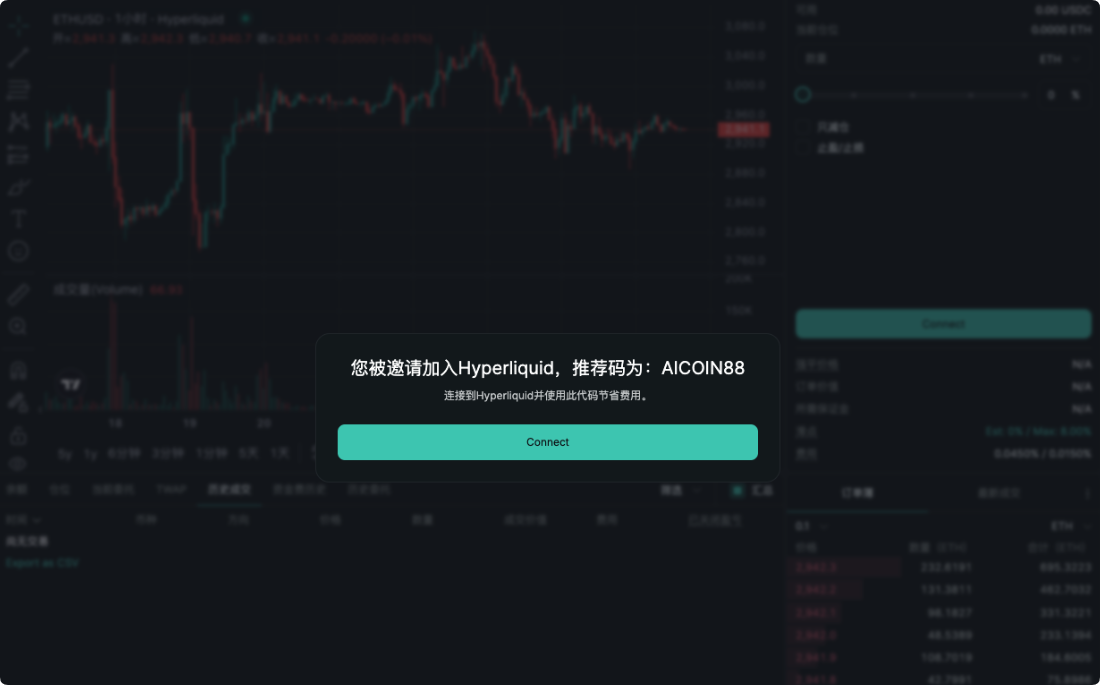
If connected through a dedicated link to Hyperliquid, you can use: Connect to Hyperliquid.
Invitation Code: AICOIN88. Qualifying transactions can receive 4% fee rebates, with specific rebate eligibility, calculation standards, and fund arrival times subject to activity rules.
Rebates can only lower trading costs, not turn a negative expected strategy into a positive expected strategy. Especially in high-frequency price difference trading, rebates should be included in the net profit formula rather than treated as a separate source of income.
Conclusion: The Essence of Arbitrage is to Break Apart Risk, Not Eliminate It
Where do the profits you see actually come from? Price misalignments, funding rates, rule differences, or taking on risks that others have overlooked?
The advantage of Hyperliquid lies in providing a rich range of perpetual markets, combined margin, and observable on-chain data. Users can see prices, OI, funding rates, and liquidation statuses more quickly, and can analyze spot, perpetual, and HIP-3 markets within the same analytical framework.
However, transparency does not mean risk-free, and on-chain execution does not equate to cost-free transactions.
A truly mature arbitrage process should first verify contract units and settlement rules, then estimate funding fees, transaction fees, slippage, and liquidation space, and finally decide whether to open a position.
Exclusive Benefits for AiCoin Users
👉 Enter the invitation code AICOIN88 when binding your Hyperliquid account to enjoy 4% fee rebates.
🔗 Exclusive Registration Link:
https://app.hyperliquid.xyz/join/AICOIN88
📖 New User Guide:
- "AiCoin PC Client Hyperliquid Authorization Trading Tutorial":
https://www.aicoin.com/zh-Hans/article/514197
- "AiCoin Mobile Client Hyperliquid Authorization Trading Tutorial":
https://www.aicoin.com/zh-Hans/article/541383
- "Beginner's Guide! Super Detailed Text and Image Tutorial for First Trade on Hyperliquid":
https://www.aicoin.com/zh-Hans/article/510225
📖 Community Interaction:
- Telegram:
- Discord:
- AiCoin Group Chat:
https://www.aicoin.com/link/chat?cid=N6OVMor5g
The content of this article solely represents the author's personal views and does not reflect the platform's position. The opinions, conclusions, and recommendations in the text are for investors' reference only and do not constitute any investment advice related to this platform. Investment in U.S. stocks still requires self-bearing of market risks, regulatory risks, and compliance with local laws and regulations (especially foreign exchange controls, offshore investment declarations, etc.).
免责声明:本文章仅代表作者个人观点,不代表本平台的立场和观点。本文章仅供信息分享,不构成对任何人的任何投资建议。用户与作者之间的任何争议,与本平台无关。如网页中刊载的文章或图片涉及侵权,请提供相关的权利证明和身份证明发送邮件到[email protected],本平台相关工作人员将会进行核查。