The official Chinese account of Binance recently released an update on its wallet product, covering multiple modules including user search, address tracking, opinion translation, DeFi API, token profit and loss analysis, wallet plugins, and Meme Rush.

The most noteworthy aspect of this update is not the addition of a specific feature, but rather that the Binance wallet has begun to connect "finding people, viewing opinions, tracking addresses, checking data, making analyses, and managing accounts."
For ordinary users, the use of the wallet has become smoother; for traders, tracking on-chain addresses and determining cost basis has become more convenient; for information media and data analysis platforms, the added API and profit and loss data mean that the wallet is gradually becoming a more complete on-chain data entry point.
1. Wallet search supports finding plaza users by username
This update allows wallet search to support finding plaza users by username.
In the past, if users wanted to find a specific trader, they might have to rely on complex wallet addresses, social platform nicknames, or external links. Now they can directly search for plaza users by username, reducing the cost of information retrieval.
The significance of this feature lies in the increased discoverability of content and user relationships within the wallet:
- Users can directly find traders they follow;
- They can view the opinions published by others;
- They can further track their public holdings and trading performance;
- They can link user identities with on-chain behaviors.
For data analysis platforms, the username search also helps establish clearer user profiles. In the future, more comprehensive public data analysis can be formed around traders’ opinions, holdings, profits, drawdowns, and activity levels.
Of course, the username is just an entry point for identification, and it does not equate to proof of trading ability. Users still need to assess based on historical performance, trading frequency, asset scale, and risk control.
2. App and web versions launch BSC and Solana address tracking
This update also added BSC and Solana address tracking features, covering both the App and web versions.
The core of address tracking is not to let users mechanically copy each transaction but to help users continuously observe the on-chain behavior of a specific address or trader.
Users can focus on:
- What assets a specific address holds;
- Whether it frequently buys or sells;
- Which chain transactions mainly occur on;
- Whether it participates in Meme, DeFi, or other protocols concentrically;
- Whether changes in assets align with market trends.
BSC and Solana are both ecosystems with active on-chain activities, especially in Meme, DEX, and trading of new projects, where address behaviors have high reference value. Bringing the tracking feature to the App and web means users can quickly check on mobile while also conducting more comprehensive research and operations on the web.
What is address tracking more suitable for?
A more prudent usage approach is to treat address tracking as an observation and research tool:
1. First observe the historical behavior of the address;
2. Analyze its asset structure and trading frequency;
3. Check whether profits depend on random transactions;
4. Observe performance under different market conditions;
5. Then decide whether to reference their trading ideas.
Address tracking does not equate to automatically copying profits. On-chain addresses may use multiple wallets, and public addresses might only be part of a trading strategy. Users need to pay attention to slippage, liquidity, transaction fees, and time differences.
3. Tracked opinion posts support automatic translation
The wallet has also updated its automatic translation feature for opinion content. Tracked opinion posts can now be automatically translated into the language used by the App.
This feature seems simple, but it is very important for the flow of global on-chain information.
On-chain opportunities and trading opinions come from different regions, and content may be in Chinese, English, or other languages. Language barriers create three problems:
- Users cannot timely understand opinions;
- Key risk alerts are easily overlooked;
- Content from the same trader is hard to continuously track.
Automatic translation can lower the barrier to information acquisition, allowing users to more quickly understand the opinions of overseas traders, developers, and researchers.
However, automatic translation is suitable for aiding reading and should not replace checking the original text. When it involves token names, protocol names, conditional restrictions, risk descriptions, and trading rules, it is recommended to check the original text simultaneously to avoid misunderstandings caused by translation.
4. DeFi API adds Solana chain, covering data of 10+ protocols
For information media and data analysis platforms, one of the most valuable contents in this update is the addition of the Solana chain to the DeFi API, covering data from over 10 protocols.
The value of the API is that it allows developers and data platforms to directly access structured data without fully relying on manual browsing and screenshot organization.
The Solana ecosystem is characterized by fast transaction speeds, numerous protocols, and frequent asset changes. After adding Solana data, it can support more analytical scenarios:
- Tracking changes in liquidity across different protocols;
- Observing the scale of lending, staking, and trading pools;
- Analyzing the flow of funds between different protocols;
- Identifying hot assets and highly active addresses;
- Studying changes in protocol yields, number of users, and trading volumes;
- Comparing funding efficiency across different ecosystems like BSC and Solana.
Covering more than 10 protocols also means that the wallet data services are moving from single-chain, single-protocol observation to multi-protocol data integration.
For information media, the API can help quickly generate market trends, fund flows, protocol rankings, and hot project analyses; for data analysis platforms, it can further build address labels, protocol profiles, and on-chain behavior models.
5. Token detail page adds unrealized and total profit and loss
The wallet's token detail page now supports viewing unrealized and total profit and loss of addresses.
This is a very important analytical upgrade.
Many users only see the current value of their holdings but do not know:
- Whether this asset is profitable or at a loss compared to the purchase cost;
- Whether current profits have been realized;
- How much revenue past transactions have contributed;
- What percentage the floating profit and loss of a single token occupies in overall assets.
What is unrealized profit and loss?
Unrealized profit and loss refers to the book profit and loss calculated based on the current price while the user still holds the asset. As long as it has not been sold, the profit and loss may continue to change.
What is total profit and loss?
Total profit and loss usually need to comprehensively consider buying, selling, current holdings, and historical trading costs to observe the overall results of a specific address on a particular asset.
Having these two data points on the token detail page allows users to better judge whether an address is truly skilled in a certain area rather than just looking at whether its current holdings have increased.
For example, an address may currently hold a Meme coin and show a profit, but if it has previously bought high and sold low multiple times, the overall total profit and loss may still be negative. Looking solely at current holdings could lead to incorrect conclusions; reviewing unrealized profit and loss alongside total profit and loss will provide a more accurate analysis.
6. Shift from "looking at increases" to "looking at trading outcomes"
The rise in token prices can only reflect changes in market value and cannot directly represent how much a specific address has earned.
More valuable analyses need to combine the following data:
- Average buying price;
- Current holding quantity;
- Realized profit and loss;
- Unrealized profit and loss;
- Trading fees;
- Buying and selling times;
- Holding period;
- Proportion of assets in the portfolio.
With the addition of the profit and loss view in the Binance wallet, users can move from “How much did a certain coin rise?” to “How much did a certain address earn from this coin?”
This is especially important for tracking and trader analysis. A trader might frequently hit on popular coins, but if they are often chasing highs and their trading costs are too high, the final total profit and loss may not be favorable.
7. Wallet plugin supports batch account creation and address export
The wallet plugin now supports batch account creation and address export functionalities.
This update mainly targets users needing to manage multiple accounts, multiple addresses, or different trading strategies.
Batch account creation can be used for:
- Distinguishing between long-term holdings and short-term trades;
- Separately managing different on-chain strategies;
- Conducting project research and address observation;
- Isolating different funding purposes;
- Managing team or development testing accounts.
Address export facilitates user data organization, label management, and analysis with external tools.
However, with an increase in the number of accounts, management responsibilities will also increase. Users need to pay particular attention to:
- Backup of mnemonic phrases and private keys;
- Correspondence between addresses and accounts;
- Security of exported files;
- Do not send sensitive information via chat tools;
- Do not upload private keys, mnemonic phrases, or exported files to unknown websites.
Batch management improves efficiency but does not diminish the importance of private key management.
8. Meme Rush adds Agent ID Exclusive and Sender protocol
Meme Rush has added Agent ID Exclusive and Sender protocol.
This indicates that the Meme ecosystem is forming more connections with AI Agents, identity systems, and protocol-based trading tools.
Agent ID Exclusive can be understood as exclusive assets and activity entries built around specific Agent identities or AI ecosystems; Sender represents a protocol direction aimed at on-chain interaction and asset distribution.
For users, before participating in such new protocols, it is essential to pay attention to:
- The official source of the protocol;
- Whether the token contract is authentic;
- Trading depth and liquidity;
- Whether high authorizations exist;
- Token distribution and unlocking mechanisms;
- Whether it is just a short-term hot topic;
- Whether the wallet provides risk alerts.
The strength of Meme Rush lies in helping users discover new projects, but “newly launched” does not equate to “low risk.” The earlier an asset appears, the higher the price volatility and liquidity risk typically are.
9. What does this update mean for data platforms?
In terms of product structure, this update further divides the data capabilities of the Binance wallet into five categories:
User data
Forming relationships between users and content through username searching, plaza users, and opinion content.
Address data
Tracking multi-chain address activities through BSC and Solana tracking.
Protocol data
Accessing structured data of over 10 protocols through DeFi API.
Profit and loss data
Measuring the real trading results of addresses through unrealized and total profit and loss.
Account data
Supporting more complex address management and analysis processes through batch account creation and address export.
Connecting these five categories of data can build a more complete on-chain research model:
Who is trading, on which chain, participating in which protocols, how much they've ultimately earned, and whether these behaviors are sustainable.
This has more analytical value than simply viewing price increases or a single address balance.
10. How can ordinary users use this update?
Users can gradually experience the following path:
1. Search for plaza users of interest in the Binance wallet;
2. View their opinions and translated content;
3. Track BSC or Solana addresses;
4. Check unrealized and total profit and loss on the token detail page;
5. Compare the long-term results of multiple traders;
6. Understand related protocols and fund changes through DeFi data;
7. Research new protocols like Agent ID Exclusive and Sender in Meme Rush.
It is advised to first use the wallet as a research tool, to fully understand address, protocol, and token data before considering actual trading.
Conclusion: The wallet is transforming from a trading tool to an on-chain research workstation
The functionalities covered in this update seem dispersed but actually point in the same direction: the Binance wallet is continuously enhancing users' ability to discover, validate, track, and analyze on-chain information.
Search helps users find people more easily, tracking makes address behaviors easier to observe, automatic translation facilitates the flow of global opinions, DeFi API makes protocol data easier to call, profit and loss analysis allows trading results to be more easily verified, and batch accounts and address export serve more complex management scenarios.
For ordinary users, the wallet is not just for trading; it can also be used for research; for information media and data analysis platforms, the wallet is becoming a more enriched multi-chain data infrastructure.
Truly valuable on-chain analysis is not just about discovering who bought hot assets but also seeing who can manage risks long-term and leave behind verifiable trading results.
AiCoin Exclusive Benefits for Users
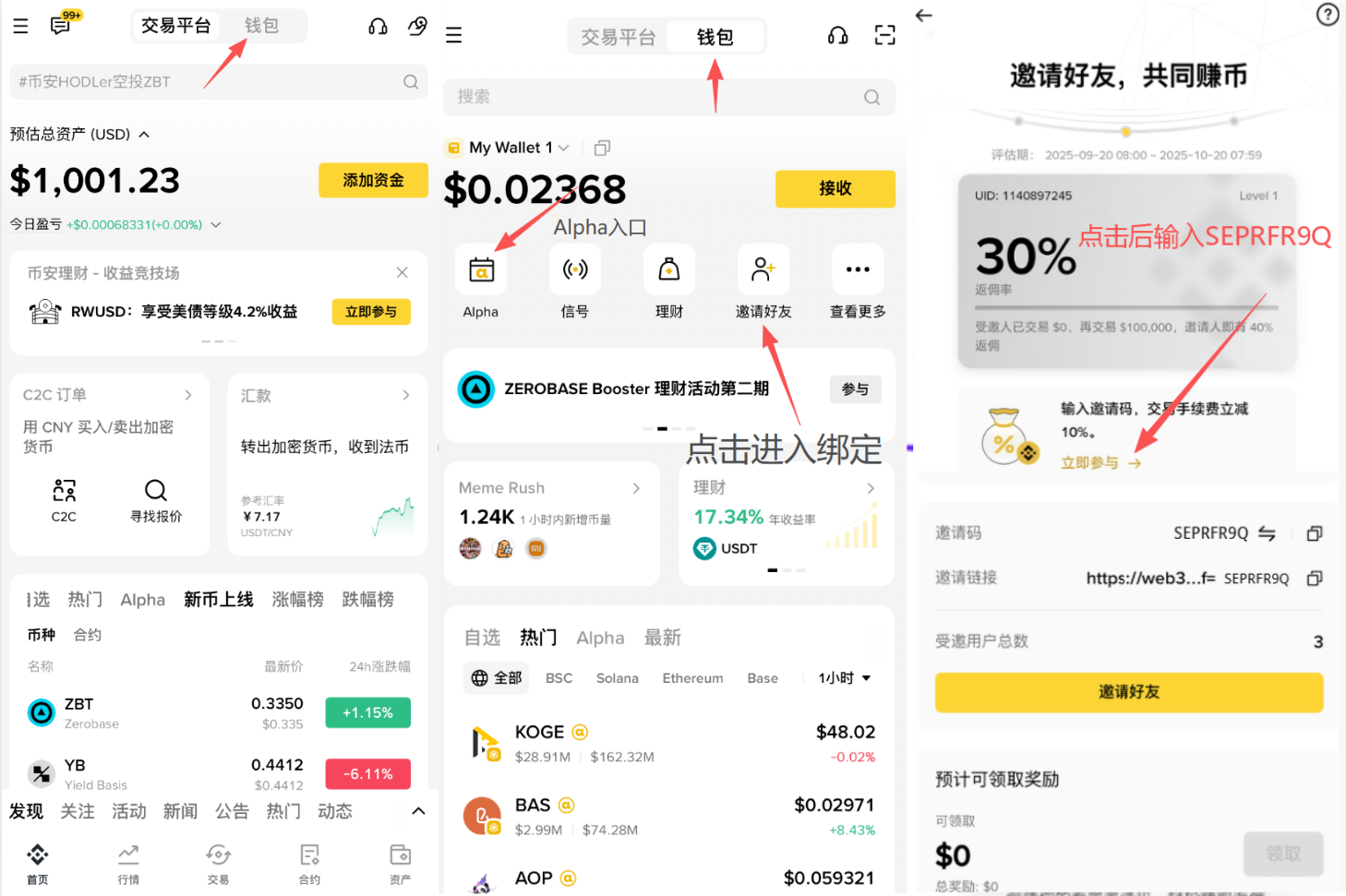
👉 Enter invitation code SEPRFR9Q when using the Binance wallet to enjoy a 10% rebate on transaction fees, making meme plays cheaper and more profitable
🔗 Exclusive link:
https://web3.binance.com/referral?ref=SEPRFR9Q
免责声明:本文章仅代表作者个人观点,不代表本平台的立场和观点。本文章仅供信息分享,不构成对任何人的任何投资建议。用户与作者之间的任何争议,与本平台无关。如网页中刊载的文章或图片涉及侵权,请提供相关的权利证明和身份证明发送邮件到[email protected],本平台相关工作人员将会进行核查。