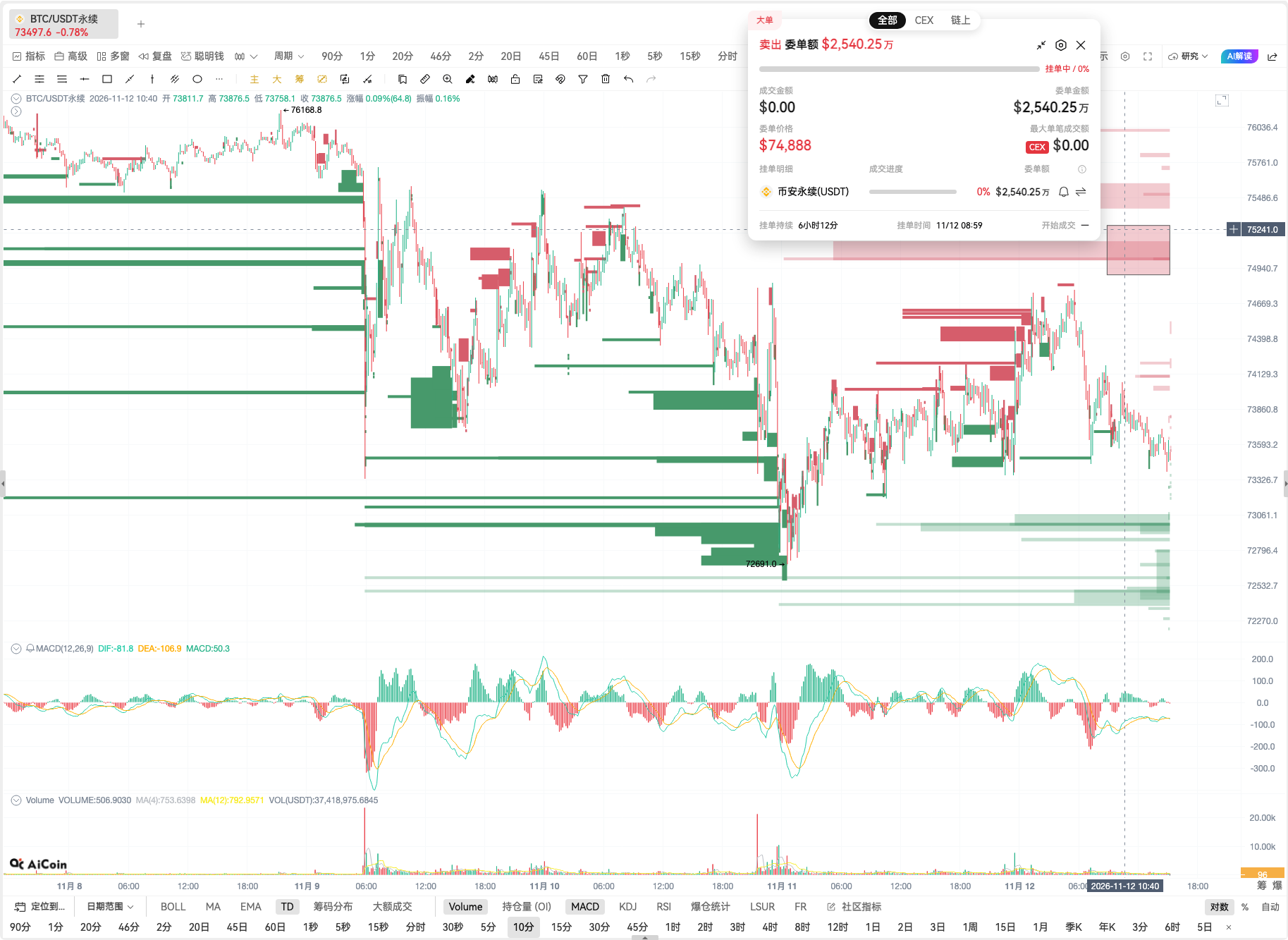
A sell order of approximately $25,402,500 appears above BTC. The BTC/USDT perpetual quotation is about $73,497.6, down approximately 0.78% from the previous period; the sell order amount is about $25,402,500, and the duration of the order shows about 6 hours and 12 minutes. It has not been executed, with a transaction amount of 0 and an order progress of 0%.
Let’s clarify the judgment: this is not evidence that “a certain major player is definitely opening a $25 million short position,” but it should not be regarded as irrelevant information. Such a scale of sell orders, continuously present above the current price, combined with BTC's previous sharp drop and subsequent rebound still under pressure, forms a clear signal of short risk: there is heavy potential supply above, and if buyers cannot absorb it, the rebound may be hindered, increasing the risk of a price retest at lower levels. For those holding long positions, this is a reminder to actively manage risk.
1. Why is this a short risk signal worth caution?
Firstly, the scale of the sell order is enough to change the focus of short-term supply and demand observations. An order of approximately $25,402,500 is not an ordinary small market fluctuation. The amount alone cannot determine that it can necessarily lower the price, but it requires the market to absorb this visible supply. If the price rebounds to this supply area and buyers cannot keep up with transactions, sellers can more easily take the initiative, potentially limiting the upward space for the rebound.
Secondly, the order did not appear suddenly and immediately disappear. The panel shows that the order has been live for about 6 hours and 12 minutes, indicating that the selling pressure observed in the screenshot has at least some persistence. Ongoing sell orders will affect traders’ judgment about upper liquidity and the difficulty of breaking through; if it remains or continues to increase as the price approaches, the risk signal becomes even more significant.
Thirdly, the background of the order's appearance is weak. In the chart, the local high of BTC is around $76,168.8, and then the price briefly dropped to about $72,691; the latest quote is about $73,497.6. Although there is a recovery from the low, it has not regained the significantly lost ground. In other words, the market is in a recovery phase after a sharp drop, rather than having confirmed a strong upward phase. In this structure, large sell orders above are more likely to become a “ceiling” for the rebound, rather than being treated lightly as isolated market data.
Fourthly, momentum is still in a weak range. In the chart, the MACD's DIF is about -81.8, and DEA is about -106.9, both still below the zero axis; the positive column indicates there is some easing in short-term downward momentum, but this is more like a recovery in a weak environment, not a signal that the medium-term trend has turned bullish. If rebound momentum is insufficient and the sell orders above continue to press, the risk of continued weakness persists.
Therefore, the professional expression is not “this order will definitely lead to a crash,” but: the large sell orders, combined with the weak price structure, increase the short risk, especially to guard against a hindrance in the rebound followed by another drop. Risk signals do not guarantee outcomes but are enough to require bulls to reduce blind optimism and reassess positions and stop losses.
2. What truly needs to be monitored is not just the standing orders but the price's reaction to the orders
If the price rebounds upward and encounters multiple obstacles near the area of the sell orders, forming lower rebound highs, and subsequently drops back toward approximately $72,691, then the judgment of “supply above suppressing the rebound, with shorts regaining initiative” would strengthen. If recent lows are effectively broken, the market might trigger more stop-losses or leveraged reductions, amplifying downward volatility. This path is the “short risk” that requires serious prevention.
Conversely, if the sell orders are withdrawn before reaching the price or are gradually absorbed by buyers, and the price remains stable in recovering the upper areas while forming higher lows, then the suppressive effect of the sell orders needs to be reassessed. An increase in short risk does not mean that the shorts have already prevailed; the key validations still are: whether the selling pressure remains, whether the price is pressured during transactions, and whether the breakdown is confirmed.
It is worth emphasizing that the standing order has not been executed; thus, we cannot directly refer to the $25,402,500 as an accomplished sell transaction, nor can we identify the order placer’s identity or strategy based on this. However, “not executed” only limits our assertions about trading intentions and does not negate its analysis significance as potential supply and risk warnings. Advanced analysis should do two things simultaneously: not exaggerate the facts and not underestimate the risks.
3. What should long position holders focus on now?
Firstly, prevent misjudging a low-level rebound as a trend reversal. A price recovery from around $72,691 can only indicate that support has occurred at lower levels; it cannot prove the end of the downward structure. If selling pressure continues above, and the rebound highs gradually lower, bulls should not relax risk control merely due to short-term pullbacks.
Secondly, prevent rapid volatility after losing support. If the price returns near recent lows, it is necessary to observe whether the buying volume can still effectively support; once important lows are breached and rebounds fail to recover, the existing long logic should be reassessed. Leverage positions, in particular, should preemptively consider stop losses, margin, and liquidation distance, and should not wait until volatility increases to address them.
Thirdly, prevent multiple accounts from accumulating risk in the same direction repeatedly. If multiple accounts are holding BTC long positions, having many accounts does not mean risk is dispersed; it may only be a repeated exposure of the same market risk in different accounts. Total positions and aggregated risks should be calculated first before deciding on reductions, hedging, or waiting for confirmation.
4. After confirming short conditions, use multiple accounts to improve execution efficiency
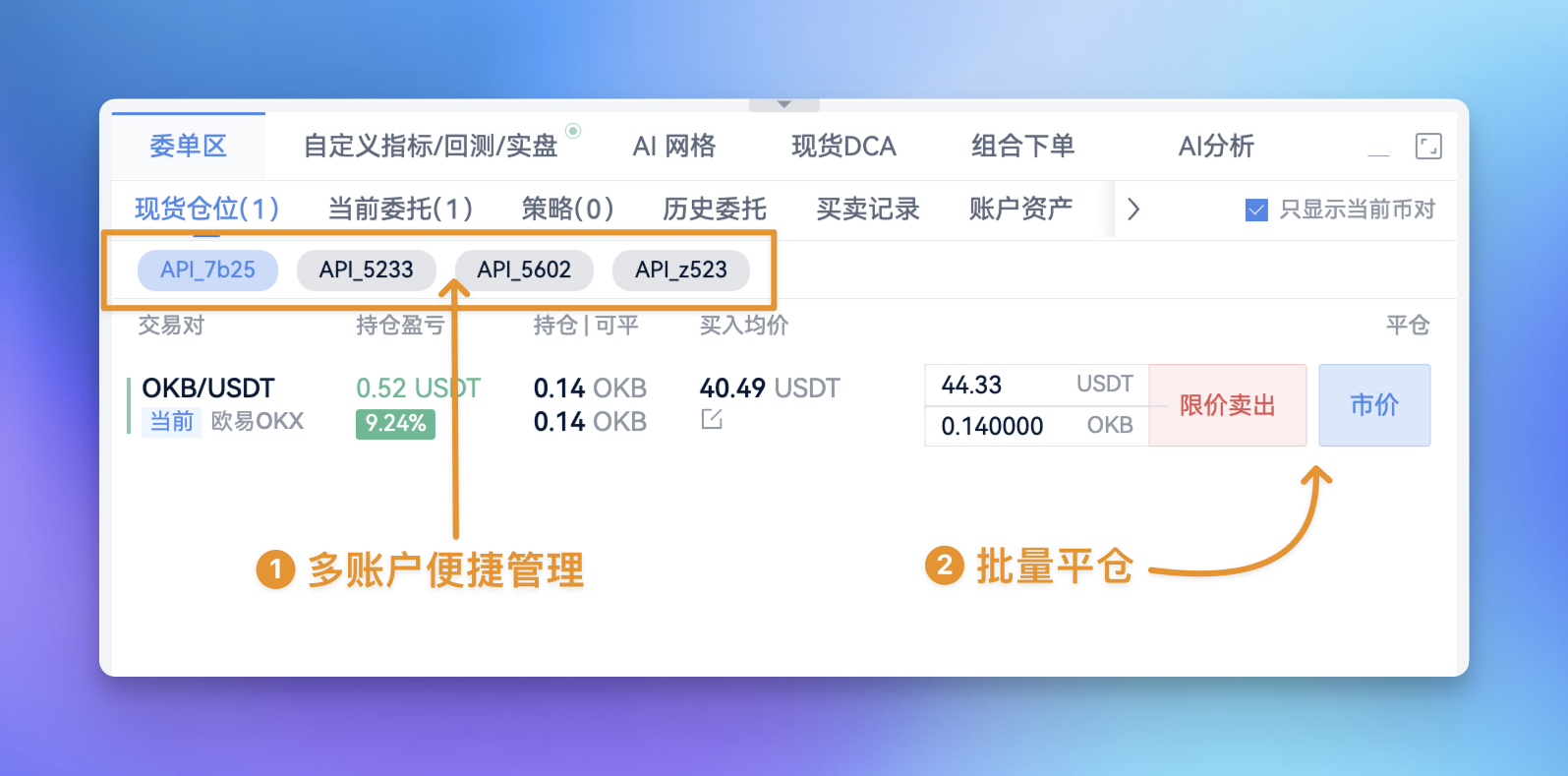
When traders have formulated clear risk management or short trading plans, switching and repeatedly selecting trading pairs and quantities across multiple accounts may slow down operations and increases the likelihood of selecting the wrong account, inconsistent orders, and missing orders. The actual value of AiCoin's multi-account ordering is to include multiple API accounts within the same operational process, reducing redundant switches and inputs, and executing collaboratively according to pre-set account ratios. It is an execution tool, not the source of short signals, nor does it decide whether users should short.
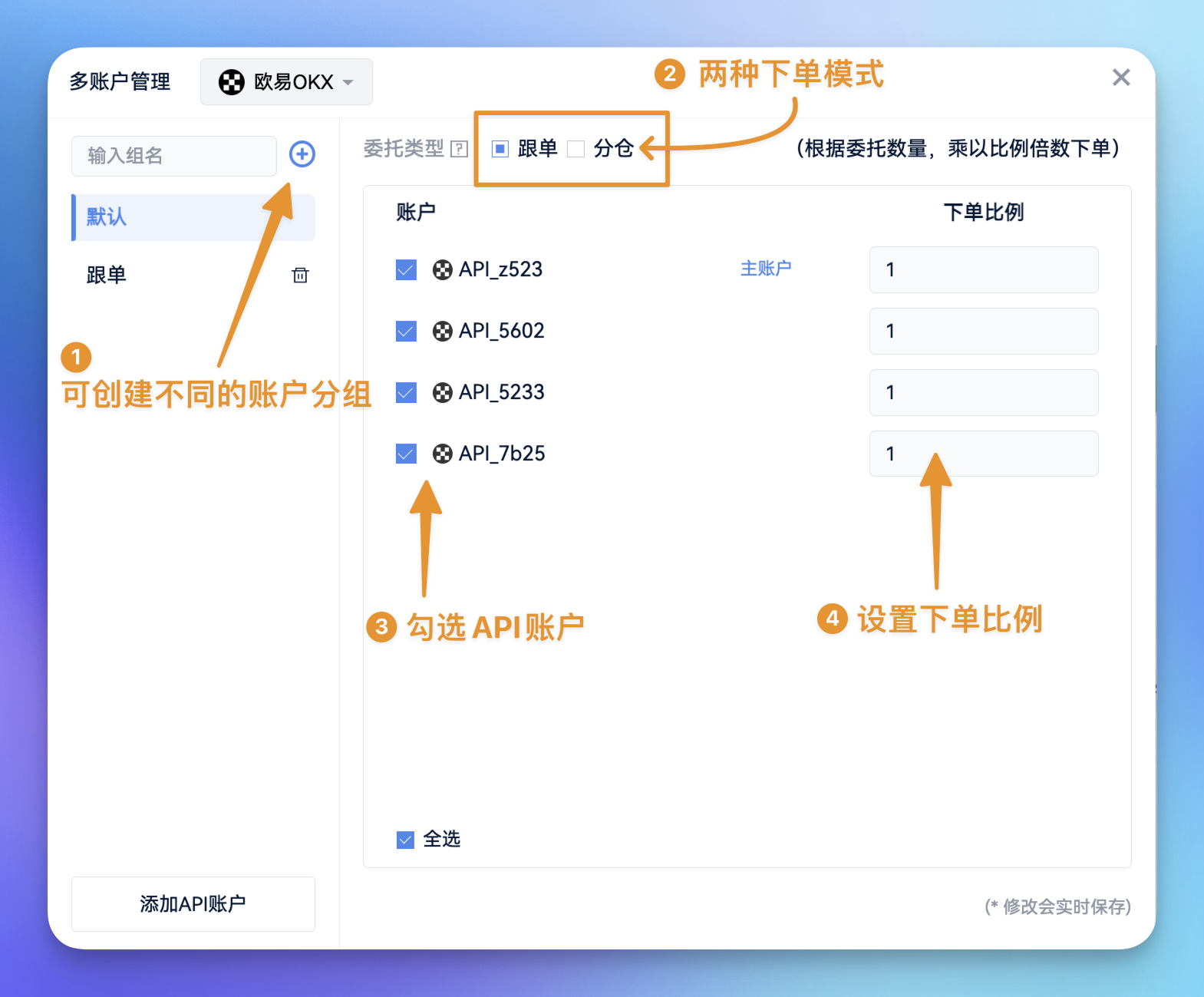
The follow-order mode is suitable for setting a basic order quantity first, then allowing other accounts to follow according to their respective ratios or multiples. If a risk management plan needs to proportionately reduce, hedge, or execute the same strategy across multiple accounts, predefined follow relationships can reduce on-the-spot calculations.
The split-order mode is suitable for first determining the total order amount among multiple accounts, then allocating it proportionally to each account. If a trader wants to control the overall risk scale first and then determine how much each account should take on, the split-order mode is easier for unified management. Simply put, following orders emphasizes how accounts follow the basic quantity, while split orders emphasize how the total amount is divided. Product documentation also details operations related to multi-account synchronous ordering, batch order cancellation, etc.; actual functionalities are subject to client version, exchange support, and account permissions.
5. Execution Process: Turning Risk Alerts into Actionable Plans
1. First set the trigger conditions: for example, consistent obstacles during rebounds, loss of key low areas, or clear price pressure after sell orders are executed. Do not chase shorts based solely on an order from the screenshot.
2. Clarify the failure conditions, stop-loss positions, and aggregate risk limits. For existing long positions, first assess whether risk needs to be reduced; for accounts planning to short, calculate the total positions and margin across multiple accounts in advance.
3. Activate multi-account ordering on the AiCoin order panel, select the participating API accounts, and confirm the account, exchange, and authorization status.
4. Based on the plan, choose follow-order or split-order options, set account ratios or multiples; check the trading pair, direction, order type, and quantity before submission. If the strategy is risk management or reduction, the direction and execution scale should be confirmed according to each account's actual positions.
5. After submission, review the order status, transaction prices, position changes, and overall risk exposure of each account. If market conditions reverse or preset conditions fail, reduce positions, withdraw orders, or stop losses as planned; synchronous ordering does not guarantee all accounts will execute at the same price, nor does it eliminate liquidity and execution risks.
The advantage of multi-account ordering is that when risk signals turn into clear actions, it helps traders operate multiple accounts faster and more consistently; true risk control still depends on trigger conditions, position management, and timely reviews.
Conclusion: This is not a confirmed "big short position," but it is an alert that longs cannot ignore
With a sell order of approximately $25,402,500, a standing time of about 6 hours and 12 minutes, and a transaction progress of 0%, it appears during the rebound phase after BTC's sharp drop, and the price is still below the previous downward structure. Considering the order size, persistence, price position, and the weak background of being below the MACD zero axis, short-direction risks deserve increased vigilance: if selling pressure continues and buyers cannot absorb it, the rebound may be hindered, increasing the risk of lows retesting or breaking.
For the longs, position management and the risk of lost lows should be emphasized; for those considering shorting, they should wait for price action confirmation and avoid blindly chasing shorts based solely on standing orders. Once trading conditions are clear, use AiCoin's multi-account ordering to execute according to follow-order or split-order plans, letting tools manage operational coordination rather than replacing analytical judgment.
AiCoin users' exclusive "Multi-account Ordering" super tool
One-click synchronized ordering across multiple accounts with AiCoin allows for operations at the speed of seconds; it also supports multi-account ordering across different exchanges:
https://www.aicoin.com/zh-Hans/tg/multi-account

免责声明:本文章仅代表作者个人观点,不代表本平台的立场和观点。本文章仅供信息分享,不构成对任何人的任何投资建议。用户与作者之间的任何争议,与本平台无关。如网页中刊载的文章或图片涉及侵权,请提供相关的权利证明和身份证明发送邮件到[email protected],本平台相关工作人员将会进行核查。