Author: AiPlot Research Institute
Focus: RWA / Digital Assets / In-depth Analysis of Financial Infrastructure
Website: https://aiplot.com/?utm_source=aicoin
Real World Assets (RWA) are often misunderstood as a technical concept of "moving stocks, bonds, gold, or real estate onto the blockchain."
However, focusing solely on whether assets are on-chain makes it difficult to explain why government bond funds, gold, money market funds, and tokenized stocks have gained market adoption first, nor does it explain why the Hong Kong Monetary Authority, asset management companies, banks, and digital asset platforms are simultaneously advancing relevant infrastructure.
The true value of RWA lies not in assets simply having a token but in whether traditional financial assets can obtain new issuance, distribution, settlement, collateral, and portfolio methods.
The Web3Caff report "Latest Research Report on RWA Tracks Q4 2025" provides an important framework: the development of RWA must simultaneously address three variables: technology, regulation, and market. Combined with AiPlot's current market data, a relatively clear structure for RWA has emerged: U.S. government bonds remain the largest non-stablecoin asset class, gold and other commodities demonstrate strong on-chain demand, the growth rate of stocks and active strategies is faster, while real estate, private equity, and some physical assets are still limited by legal rights and liquidity issues.
Therefore, the next opportunity for RWA is not just about finding "which assets will be tokenized" but also about identifying projects and infrastructure that can solve the following issues:
- Who is responsible for legally representing the underlying assets;
- Who is responsible for issuing and managing tokens;
- Who is responsible for investor access and transfer restrictions;
- Who provides stablecoin or bank deposit settlement;
- Who can enable assets to enter the secondary market or DeFi;
- Who can consistently disclose asset, price, and cash flow data.
1. First Look at the Data: The RWA Market is Not Growing Uniformly but is Clearly Layered
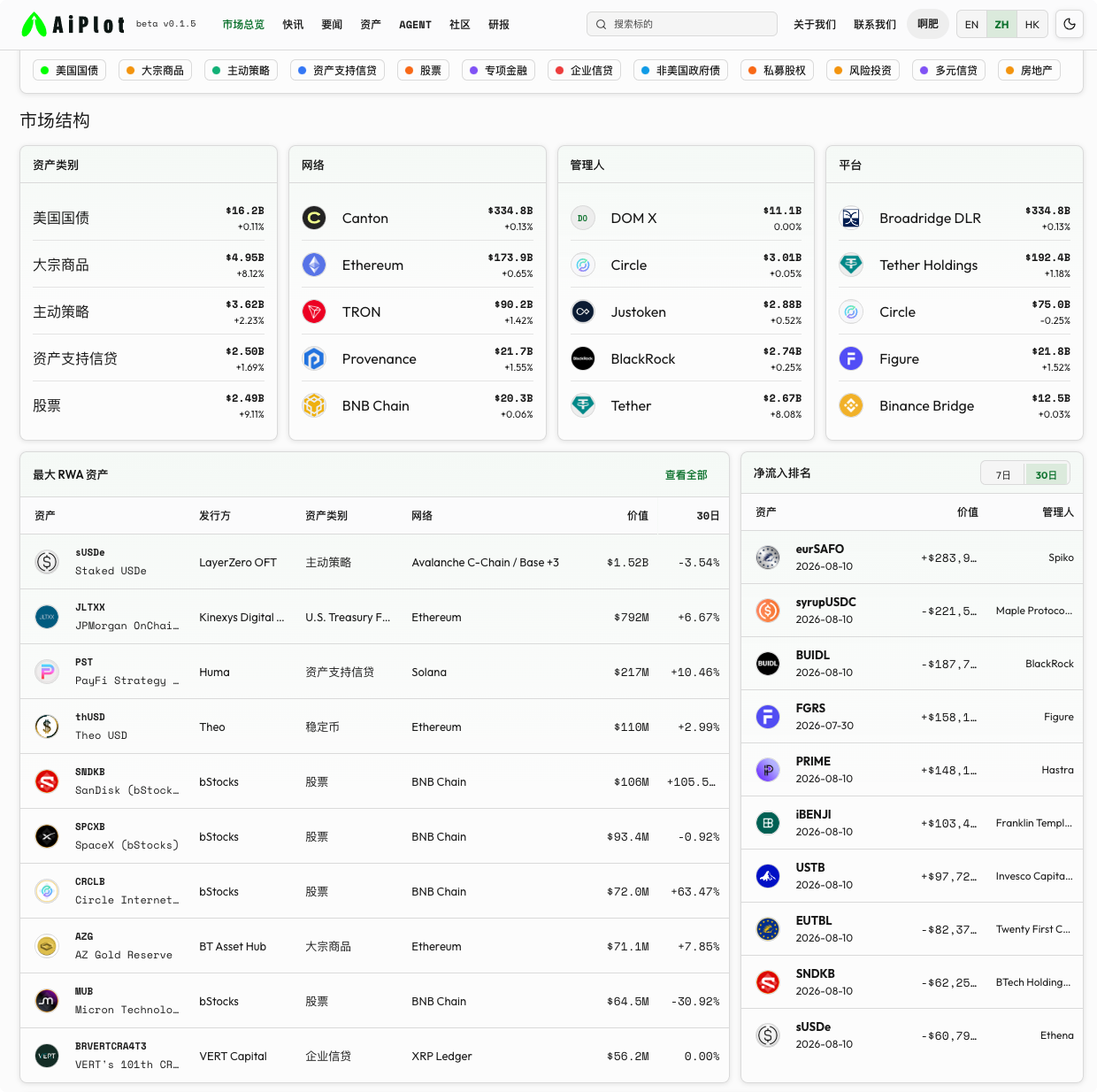
As of November 12, 2026, AiPlot's RWA market page shows that, by asset class, the scale of U.S. government bonds is approximately $14.6 billion, ranking first; commodities are around $5.15 billion, active strategies about $4.34 billion, stocks about $3.61 billion, and asset-backed credit approximately $2.89 billion.
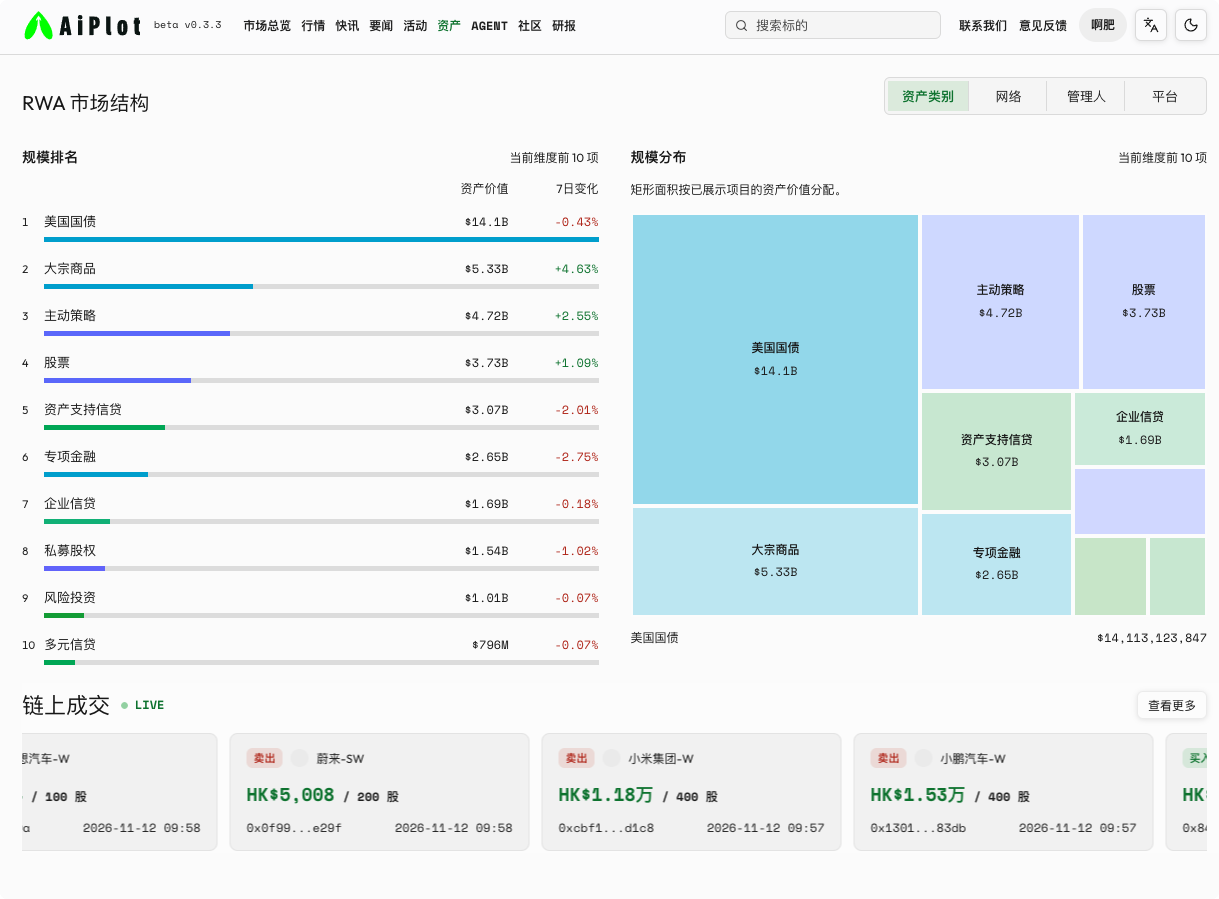
Structurally, U.S. government bonds account for about 40% of the total scale of the top ten asset classes shown by AiPlot, significantly higher than other categories. This indicates that the initial choice for on-chain funds remains standardized assets with high credit quality, transparent valuations, and relatively stable cash flows.
However, the speed of market changes is not solely determined by existing scales. AiPlot's 7-day change data shows that the scale of stock assets increased by approximately 4.26%, active strategies rose by about 1.57%, and U.S. government bonds increased by about 0.93%; while commodities decreased by around 2.79%, and private equity fell by approximately 4.14%.
There is an important difference here:
U.S. government bonds represent the core of the RWA stock, while stocks and active strategies are more like testing grounds for new financial demands.
Government bond products are likely to attract institutional funds because their underlying assets are highly standardized, with relatively mature valuation and custody. Stocks and active strategies are closer to the trading needs of on-chain users, have higher asset volatility, but are also more likely to enable cross-market trading, all-weather trading, and combinable financial products.
As a result, competition in RWA is shifting from "who issues assets first" to "who can keep assets continuously in use."
2. Why Government Bond Assets Breakthrough First
The Web3Caff report regards the tokenization of government bonds as a compliance experiment led by institutions, and this assessment still holds.
U.S. government bonds possess several inherent advantages: standardized underlying assets, deep market depth, price transparency, relatively easy assessment of credit risk, and the ability to form stable yield products through money market funds, short-term government bond funds, or repurchase agreements.
These conditions are very suitable for on-chain finance:
- Can be split by shares;
- Can be subscribed and redeemed based on net asset value;
- Can automatically handle holding registration and income distribution through smart contracts;
- Can connect with stablecoins, lending protocols, and trading platforms;
- Can serve as a low-volatility allocation tool for on-chain funds.
In AiPlot's current asset list, tokenized government bonds or government bond fund products like USYC, USDY, BUIDL, iBENJI are all in relatively large scale ranges. Public data also indicate that the scale of distributed tokenized assets is approximately $39.87 billion, while the scale of represented assets is around $418.1 billion; among them, Ethereum, BNB Chain, and Solana are the top networks by distributed RWA value ranking.
It is important to note that the definitions of distributed assets and represented assets differ and cannot simply be summed up and understood as the "total market value of freely traded assets" under the same parameters. When analyzing market size, it is essential to differentiate:
- Whether the token represents direct or indirect economic interests in the underlying asset;
- Whether the asset allows for public transfer;
- Whether holders need KYC;
- Whether valuation is calculated based on net asset value, issuance volume, or nominal value;
- Whether stablecoins are included in the statistics.
3. Why Gold Follows Closely: It Connects On-Chain Liquidity and Traditional Safe-Haven Demand
Gold tokenization is one of the directions in RWA that is easiest for ordinary users to understand. It has a clear real asset anchoring relationship on one side and the demand for cross-market trading and global liquidity on the other.
The competitive advantages of gold RWA mainly stem from three aspects.
First, gold is a global asset. Investors do not need to understand the financial statements of a specific company nor rely on the credit system of a single country.
Second, gold has a clear price benchmark. Token prices can be cross-verified against spot gold, exchange quotes, and custody inventories.
Third, gold can connect payment and collateral scenarios. Theoretically, users holding gold tokens can transfer, pledge, or combine with stablecoins on-chain, but actual use still depends on compliance restrictions, custody arrangements, and secondary market depth.
Therefore, the real difficulty in gold tokenization is not in issuance but in three questions:
- Whether the on-chain token corresponds one-to-one with the off-chain gold bar inventory;
- Whether custody, auditing, and redemption mechanisms are transparent;
- Whether financial institutions and trading platforms are willing to accept it as an available asset.
If these links are not resolved, gold tokens remain merely price mapping tools and not complete on-chain financial assets.
4. Stocks and Active Strategies: RWA Begins to Transition from "Savings Assets" to "Trading Assets"
Government bonds and gold address the needs for allocation and preservation of on-chain capital, while stocks and active strategies start to introduce stronger trading attributes.
AiPlot shows that the scale of stock-based RWA is approximately $3.61 billion, with a 7-day growth of about 4.26%; the scale of active strategies is about $4.34 billion, with a 7-day growth of about 1.57%.
The significance of these assets lies not only in replicating traditional securities on-chain but in potentially offering investment exposures that native on-chain markets lack:
- Exposure to prices of U.S. stocks, Hong Kong stocks, or other markets;
- Continued on-chain trading or derivatives trading during traditional market closures;
- Using stocks, ETFs, or fund shares as collateral;
- Including assets from different markets in the same on-chain investment portfolio;
- Automatically rebalancing and distributing income through smart contracts.
However, stock tokenization is also one of the directions with the most complex legal structures.
What investors actually hold could be shares of listed companies, custodial receipts, trust beneficiary rights, contracts for differences, or synthetic assets linked to stock prices? Different structures correspond to completely different rights: whether there are voting rights, whether dividends can be obtained, whether redemption is possible, whether the issuer must hold sufficient underlying stocks, and whether investors have direct recourse to custodial assets.
Therefore, evaluating a stock RWA product cannot rely solely on the token name and price movement; it also requires examination of product documents, custodians, issuers, redemption conditions, and regional restrictions.
5. Why Real Estate, Private Equity, and Carbon Assets Are Harder to Scale
The Web3Caff report's analysis of real estate and carbon credits reveals another side of RWA: not all real assets are suitable for rapid tokenization.
Real estate has characteristics of high value, low liquidity, and clear cash flows, making it theoretically very suitable for split ownership. However, real estate rights do not equal an ERC-20 token. Underlying property rights, SPV, rent distribution, taxes, liens, local registrations, and investor qualifications all need to be clearly defined within the legal structure.
Carbon credits similarly face asset quality issues. The price of carbon credit tokens is determined not only by on-chain supply and demand but also affected by the authenticity of projects, emission reduction effects, certification standards, duplication calculations, and cancellation mechanisms. Blockchain can enhance the transparency of transaction records but cannot automatically prove the actual occurrence of underlying carbon reductions.
Private equity and venture capital assets encounter problems such as low frequency of valuation, strict transfer restrictions, and limited holder scope. On-chain issuance does not equate to immediate liquidity. Tokens can only become products with real financial functionality when valuation, redemption, transfer, and information disclosure mechanisms are simultaneously established.
This indicates that the technological value of RWA has boundaries:
Blockchain can improve registration, settlement, and combinability but cannot replace property law, asset assessment, auditing, and regulatory permissions.
6. Hong Kong's Breakthrough Point: Moving from Asset Tokenization to Tokenized Settlement
Hong Kong is a key market to watch in current RWA research, not only because it has launched several tokenized asset pilot projects but also because it is building a settlement system that connects bank funds and on-chain assets.
The Hong Kong Monetary Authority announced in November 2026 that EnsembleTX has entered a new phase supporting 24×7 settlement of tokenized central bank currencies. The number of participating banks has increased to 12, with Industry Pioneers rising to 20.
The Monetary Authority stated that tokenized central bank currencies can support tokenized trading settlements beyond traditional business hours; tokenized deposits have already been used for corporate treasury management and tokenized money market fund transactions.
The significance of this step lies in the fact that Hong Kong RWA is no longer just focusing on "how assets are issued" but is starting to address "how funds move between on-chain assets."
If a money market fund can be tokenized, but investors still have to wait for traditional banks to process their purchases; if a stock token can trade around the clock, but redemption funds are only credited on bank working days, then the efficiency of on-chain finance will be restricted by off-chain settlement.
EnsembleTX is attempting to solve this timing mismatch issue. In the future, purchases, redemptions, corporate funding transfers, and secondary market transactions of on-chain assets may be completed within a longer time window.
For RWA projects, the importance of the settlement layer may even exceed that of the issuance layer. Asset issuance can be completed by one project, but only by entering the daily workflows of banks, brokerages, trading platforms, and asset management institutions can a sustainable demand for assets be formed.
7. The Core Competition of RWA Shifts from "Asset Issuers" to "Full Lifecycle Service Providers"
The description by HashKey CaaS of the asset tokenization process basically represents the complete requirements of institutional-level RWA: first determine the legal and economic structure of the asset, then proceed with on-chain issuance, smart contract auditing, investor access and post-investment management, and only then will there be expansion into the secondary market and DeFi.
This means that the commercial value of RWA will gradually concentrate on four types of infrastructure.
1. Asset Structure Design
Helping issuers determine who holds the underlying assets, what rights the tokens represent, how investors obtain returns, and how to recourse in the event of default.
2. Compliance Issuance and Investor Management
Establishing KYC, AML, whitelisting, regional restrictions, and investor classification mechanisms to ensure the transfer scope of tokens aligns with product licensing.
3. Asset and Fund Settlement
Connecting bank deposits, stablecoins, tokenized central bank currencies, custodial accounts, and on-chain asset transactions while reducing manual reconciliation and settlement wait times.
4. Data Disclosure and Post-Investment Services
Continuously disclosing asset net values, underlying collateral, returns, redemptions, dividends, and exceptional events to enable investors to assess whether tokens still have sufficient asset backing.
In the future, truly competitive RWA platforms may not be the ones issuing the most assets but rather the ones capable of standardizing and replicating the aforementioned processes.
8. Stablecoins Are the Payment Layer of RWA, but Not All Stablecoins Have the Same Financial Value
The scale expansion of RWA relies on stablecoins, as stablecoins are the most commonly used tools for pricing, subscription, and settlement of on-chain assets.
However, two concepts need to be distinguished: the circulation scale of stablecoins themselves and the effective demand that stablecoins generate in the RWA market.
Large-scale stablecoins can be used for trading, payments, cross-chain transactions, and fund reserves, as well as for purchasing government bond funds, gold, and stock tokens. Only when stablecoins truly enter the asset subscription, redemption, collateral, and settlement processes will they convert into effective funds for RWA.
From a product structure perspective, stablecoins, tokenized deposits, and tokenized central bank currencies are not the same thing. The commercial use case report from Hong Kong's Monetary Authority Project Ensemble states that tokenized deposits are on-chain digital expressions of commercial bank deposits and fall under commercial bank liabilities; regulated stablecoins need to be backed by isolated high-quality liquid assets; CBDCs or tokenized central bank currencies correspond to central bank liabilities.
These differences can affect asset safety, finality of settlement, regulatory responsibilities, and institutional adoption willingness.
Therefore, in future analyses of RWA, it is essential to simultaneously track:
- The scale of asset tokens;
- The type of settlement currency;
- Whether funds come from a compliant banking system;
- Whether stablecoins have sufficient reserves;
- Whether asset subscriptions and redemptions have truly occurred.
9. How to Determine If an RWA Project Is Truly Creating Value
The value of RWA projects cannot be judged solely by the amount of financing, the list of partners, or token prices. Five questions can be used for screening.
First, Is the Underlying Asset Clear?
Has the project disclosed the asset type, custodian, valuation source, auditing arrangements, and asset scale? If it can only describe "high-yield real assets" without specifying asset composition, it is difficult to assess risk.
Second, What Rights Does the Token Represent?
Does it represent equity, debt, fund shares, income rights, trust beneficiary rights, or merely track a particular price index? The product structure determines whether investors can receive cash flows and legal recourse.
Third, Are Real Subscriptions and Redemptions Allowed?
Many projects have issuance volumes but lack ongoing redemption mechanisms. Truly useful products must explain how investors can enter, exit, and the time required to exit.
Fourth, Are There Verifiable On-Chain Transactions?
One should observe the number of holders, transaction counts, transfer volumes, net asset inflows, and changes in institutional wallets. One-off test transactions should not be equated with ongoing market demand.
Fifth, Does It Enter Other Financial Scenarios?
Are assets accepted by other protocols as collateral, can they enter lending, trading, payments, or corporate treasury management processes? The stronger the combinability, the higher the usual financial efficiency of assets, but they must also undertake more complex risk transmissions.
Conclusion
Web3Caff's research framework reveals the global common contradiction of RWA: technology can enhance efficiency but cannot automatically solve issues related to legal ownership, regulatory permissions, asset quality, and liquidity.
AiPlot's current data illustrates that RWA has formed clear market tiers: U.S. government bonds are the largest standardized asset, gold is the strongest commodity asset with cross-market demand, stocks and active strategies are driving on-chain finance towards trading and portfolio management, while credit, real estate, and private assets still require more complex legal and risk control structures.
The advancement of Hong Kong's EnsembleTX further illustrates that the next stage of RWA will shift from "issuing more assets" to "connecting bank funds, asset tokens, and around-the-clock settlements."
Thus, the truly noteworthy RWA opportunities can be summarized into three main lines:
1.On-chain Distribution of Standardized Assets: Assets such as government bonds, money market funds, gold, and stocks will continue to expand their on-chain coverage;
2.Institutionalization of Financial Infrastructure: Bank deposits, tokenized central bank currencies, custody, compliant trading, and asset services will become competitive focal points;
3.Transparency of Asset Data: Issuance scale, net inflows, holders, redemptions, and on-chain transaction data will determine whether a project has real value.
The ultimate goal for RWA is not to turn real assets into speculative tokens, but to ensure that real assets have lower friction in issuance, more consistent settlements, clearer holding records, and broader financial combinability.
For investors, the most important judgment is no longer "does this project have an RWA label?" but rather:
Does it have real underlying assets, does it possess a compliant rights structure, can it continuously generate cash flows and trading demands, and has it accessed verifiable on-chain financial infrastructure?
For more data and analysis, please follow Aiplot:
https://aiplot.com/?utm_source=aicoin
📖 Community Communication:
-Telegram:
https://t.me/+IIYMcJigBAo4Mjg1
This content only represents the author's personal views and does not reflect the platform's position. The views, conclusions, and suggestions in the text are for investors' reference only and do not constitute any investment advice related to the platform. The market has risks, and investment requires caution.
免责声明:本文章仅代表作者个人观点,不代表本平台的立场和观点。本文章仅供信息分享,不构成对任何人的任何投资建议。用户与作者之间的任何争议,与本平台无关。如网页中刊载的文章或图片涉及侵权,请提供相关的权利证明和身份证明发送邮件到[email protected],本平台相关工作人员将会进行核查。