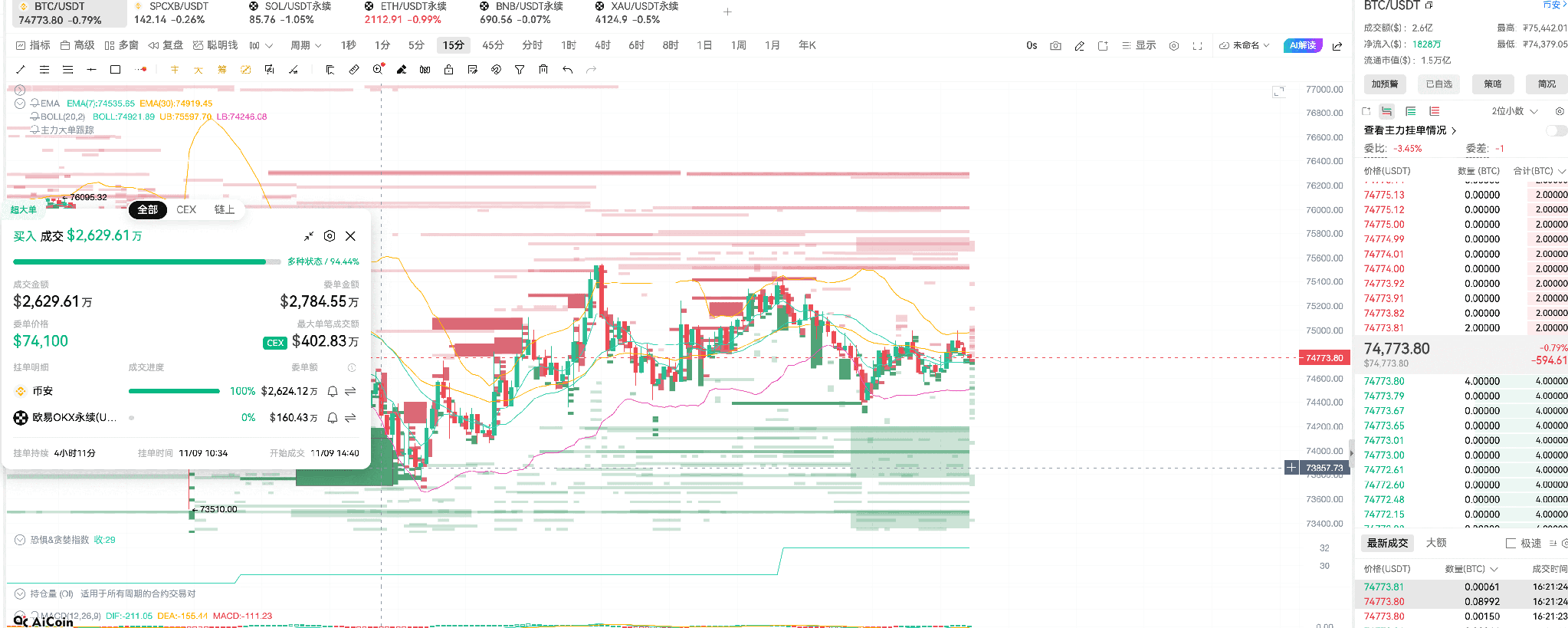
At 76,000, I will continue to maintain the judgment that BTC is at the beginning of a bull market. Now that this line is broken, the originally observable short bottom of 74,000 has also not held, and the price once touched 72,000. The market has changed, and the plans in hand must change accordingly.
The price increase has slowed down a bit, but the market still finds it fast
At 9:30 PM Beijing time on November 10, the United States announced the October CPI. Overall prices rose by 0.4% month-on-month, lower than last month's 0.6%, and core CPI rose by 0.3%. During the live broadcast, the market expectations mentioned were 0.3% and 0.2%, both slightly higher than actual figures. The market hoped for a faster cooling, but this data did not give that signal.
If the price increase rate continues to decline, the Federal Reserve may maintain a tight policy for a longer time, and even consider raising interest rates. If the cost of borrowing cannot decrease, how much the market is willing to pay for risk assets must be recalculated. According to the market monitored during the live broadcast, after the data was released, U.S. Treasury yields rose, the Nasdaq was down about 0.7%, and Nvidia fell about 5.5%. BTC had already weakened before the data announcement, and this CPI added some pressure to the already tight market.
Where has BTC declined to
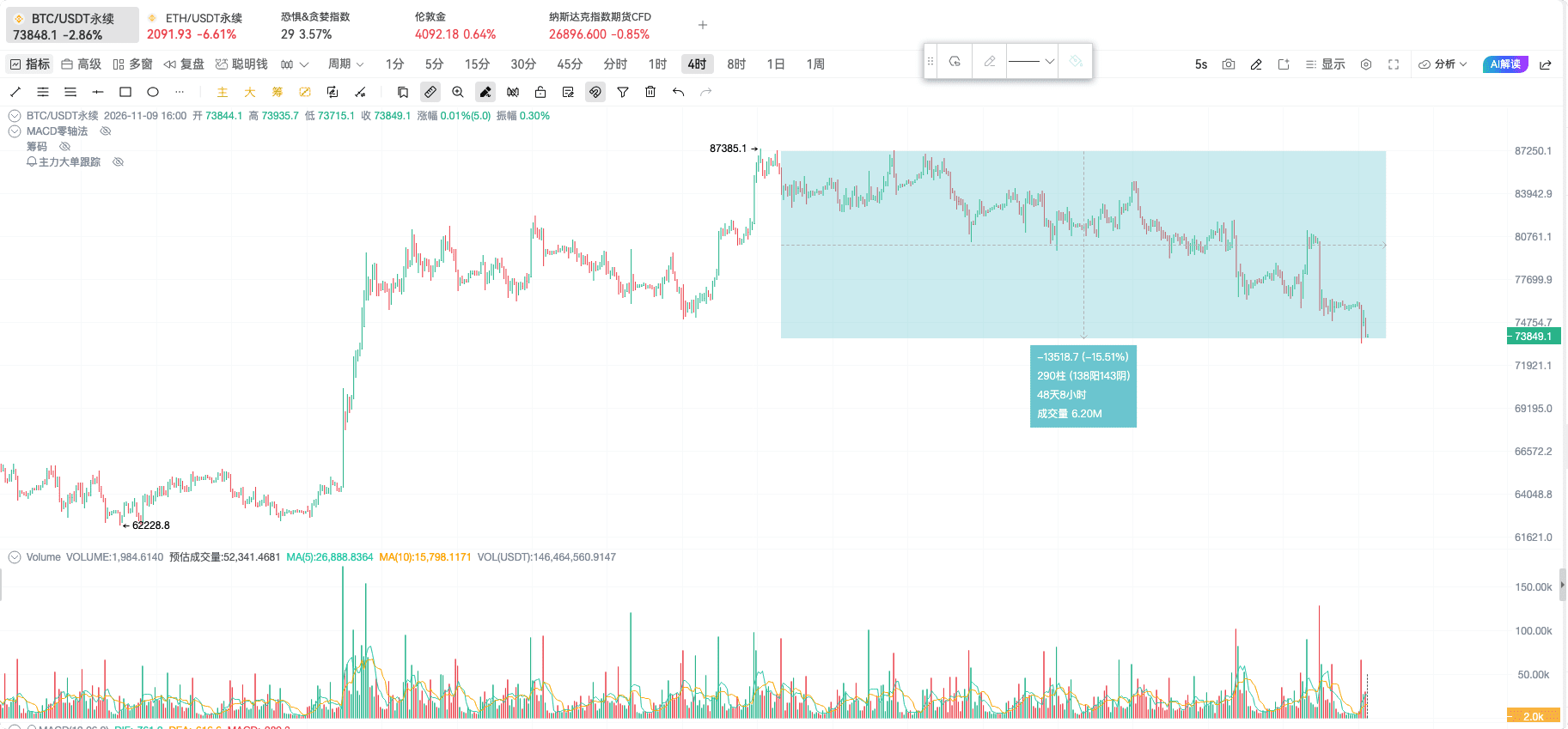
Looking at this BTC daily chart. When taking the screenshot, the price was around $73,500, about 16% lower than the peak of $87,399. Each rebound peak is lower than the previous one, and the lows are also trending downward. The two lines of the daily MACD have already dropped below the zero axis.
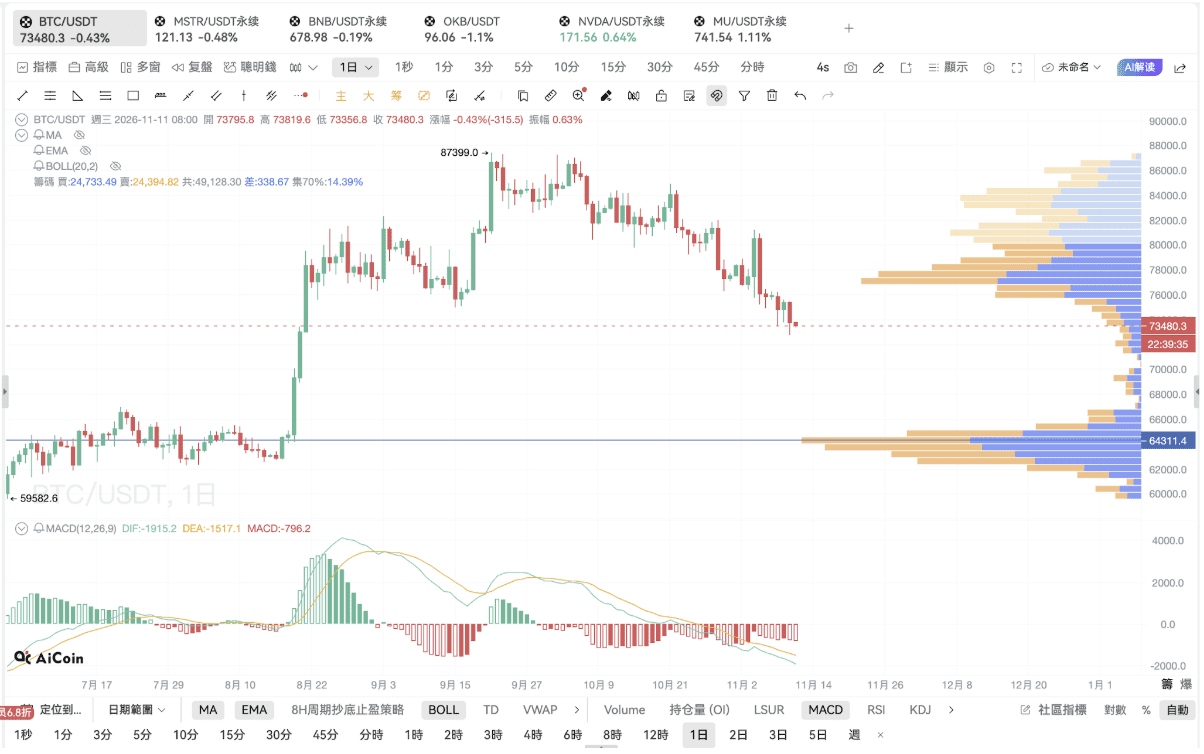
Previously, we discussed the adjustments from the three-day line to the five-day line, noting that this round of adjustments might extend to a larger cycle. Now that 76,000 has breached, the premise for judging the beginning of the bull market is invalidated. 74,000 was subsequently breached as well, and I will reassess the positions initially arranged based on the short bottom. For long-term holdings, I will follow my own cycle, and for contract positions, first consider how to control the drawdown. As for when the adjustment will end, I will first observe whether the weak structure has changed; there is no need to mark the bottom day on the calendar in advance.
Shifting focus to the U.S. stock market
The Nasdaq has retreated about 9.6% from its peak; although there was a rebound after the sharp drop, it remains below the previous highs. According to the market data used in the live broadcast, on November 5, the Nasdaq fell about 5.5% in a single day. This wave of decline prompts me to recalculate the investment in AI, especially when the construction of data centers slows down; how long will it take to recoup the earlier investment?
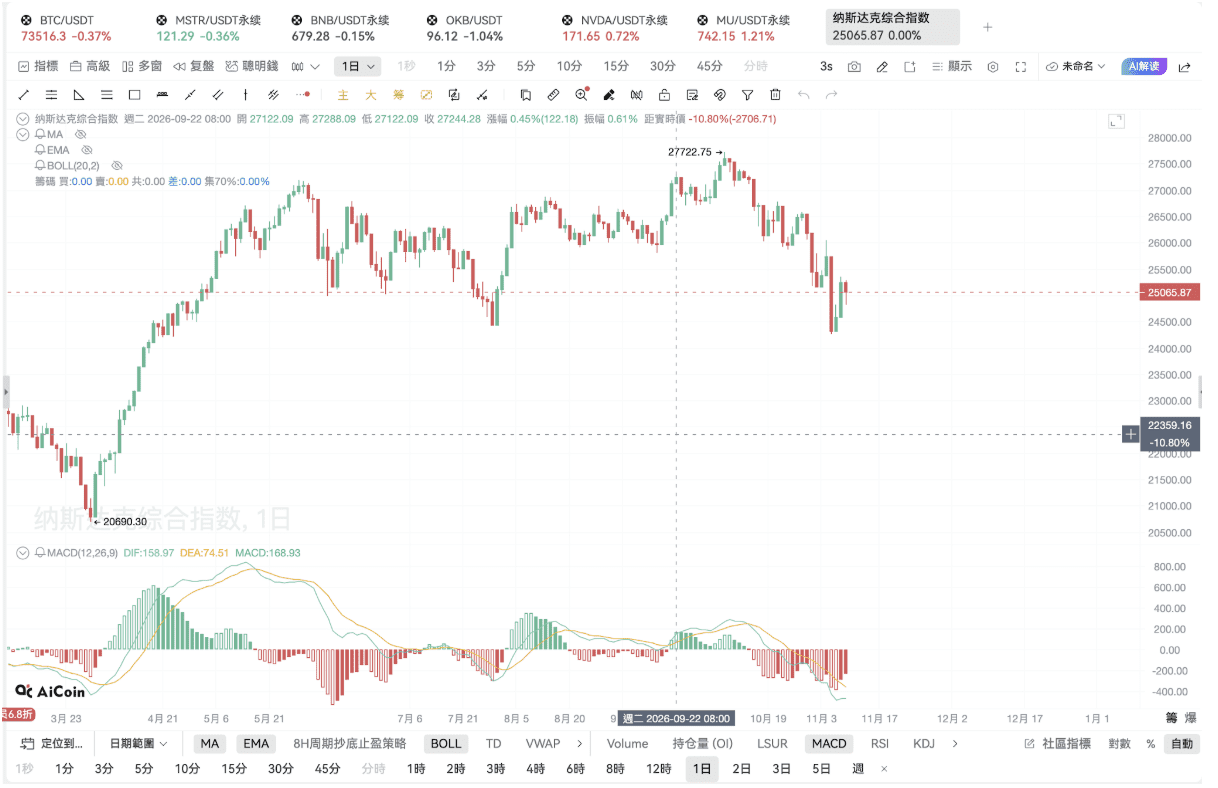
Model companies buy computing power, cloud vendors build data centers, and chip companies take orders. For this business to keep rolling forward, there must be continuous payments from customers, and there must also be someone willing to continue investing. If financing becomes expensive and returns slow down, the market's valuations may trend downward. Even if a company's income continues to rise, if the growth rate does not keep up with what the share price has anticipated, the stock price may still fall.
Nvidia during this period is worth looking at separately. The chart shows the daily chart of NVDA/USDT perpetual contracts, which has retreated nearly 30% from its peak, and the rebound after the sharp drop is also limited. Switching to the actual stock, according to the market data quoted during the live broadcast, on November 9, the Nasdaq rose about 2.7%, but Nvidia's stock dropped about 4.3%.
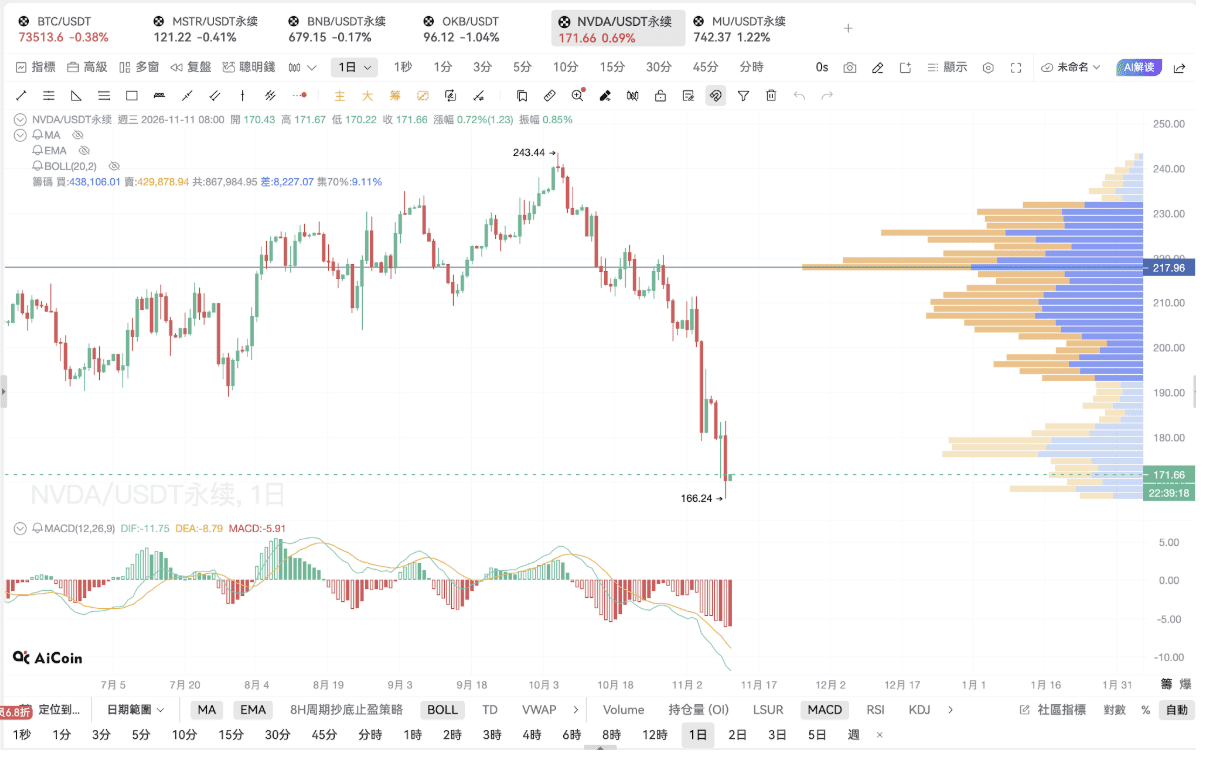
On November 8, Nvidia's board announced the launch of an independent investigation, stating that there was no reason to believe national security or company secrets had been compromised and expressed trust in the management team. The investigation's results will take time. For Nvidia, with industry valuations adjusting downward, the company itself faces an additional layer of uncertainty. Looking at it alongside the market, you can see how the two layers of pressure stack up.
How much capital will Anthropic's IPO absorb
On November 10, Anthropic announced the launch of its proposed IPO roadshow, with a proposed issue price range of $70 to $78 per share. Around a trillion dollars is the valuation level discussed during the live broadcast, and the final issue price and market performance will depend on developments. For me, what I want to clarify now is where the money for subscriptions will come from.
Let’s do a simple calculation. A fund with a scale of 10 billion yuan has 500 million yuan in cash and wants to subscribe for 1 billion yuan in new shares, so there’s a shortfall of 500 million yuan. It can sell some existing assets or postpone the original planned purchases. If it sells BTC, the market gets an additional sell order; if it keeps the money intended for BTC for new shares, the market loses a potential buy order. This is why I’m including the large IPO in the short-term observation; whether there is actual diversion depends on the data.
I will focus on three things. The U.S. spot BTC ETF, looking at the net daily inflow the week before and during the subscription, and checking if the cumulative net flow has changed direction. Stablecoins on exchanges, examining the net inflow and balances together, particularly noting if there are indeed enough buy orders after the funds have flowed in. Anthropic itself, tracking the final pricing, issuance scale, subscription enthusiasm, and then observing trading and high-level support after listing. Single-day inflows and outflows are sometimes just large redemptions, but changes over consecutive days are more worthy of attention.
No matter how good the business is, the purchase price must be calculated
Assuming a company is expected to earn 1 yuan per share next year, with a share price of 50 yuan, it would be a 50 times expected price-to-earnings ratio. If the market later is only willing to give 35 times, even if the earnings per share expectation is still 1 yuan, based on this valuation, the share price will fall back by 30%. Applying this to Anthropic, I will continue to look at how much customers are willing to spend and how much profit can remain after deducting computing power and research and development costs from this income. The more expensive it is to buy, the more growth must be realized later.
Returning to BTC, I will prepare for this round of adjustments over a longer period. First, keep the positions within a range that I can bear, and then observe if the lows can stabilize and if buying interest is willing to return. If there is any change in the market, I will adjust my judgment accordingly.
There are daily live broadcasts now; welcome to continue following the AiCoin friends! Make an appointment early 👇
https://www.aicoin.com/zh-Hans/live/list?tab=upcoming
Join our community to discuss and become stronger together!
Official Telegram community:
AiCoin Chinese Twitter:
Hype Rebate:
https://app.hyperliquid.xyz/join/AICOIN88
Binance Rebate 【Invitation code: aicoin668】:
https://jump.do/zh-Hans/xlink-proxy?id=3
Coinbase Rebate 【Invitation code: Y8L23JL】:
https://jump.do/xlink?checkProxy=true&proxyId=25
免责声明:本文章仅代表作者个人观点,不代表本平台的立场和观点。本文章仅供信息分享,不构成对任何人的任何投资建议。用户与作者之间的任何争议,与本平台无关。如网页中刊载的文章或图片涉及侵权,请提供相关的权利证明和身份证明发送邮件到[email protected],本平台相关工作人员将会进行核查。