On September 23, I rated SiTime (SITM) as a "Buy." Subsequently, AI stocks underwent this round of adjustment. Since then, SITM has dropped about 34%, while the PHLX Semiconductor Index (SOX) has dropped about 25% during the same period.
At that time, I believed Wall Street underestimated SiTime's profitability, and the third-quarter financial report proved this point. SiTime met or exceeded all metrics in the previous guidance, and the fourth-quarter EPS guidance is $4.76, about 26% higher than the initial market forecast. TPD revenue reached $86.3 million, and management still stated that the company is facing supply constraints, not a lack of demand. This is different from memory chip companies, whose growth heavily relies on price increases.
Based on these circumstances, I believe the company's business is stronger now than when I first wrote about this stock, and the stock price is much cheaper.
Therefore, I am maintaining my "Buy" rating.
Third Quarter Performance Summary
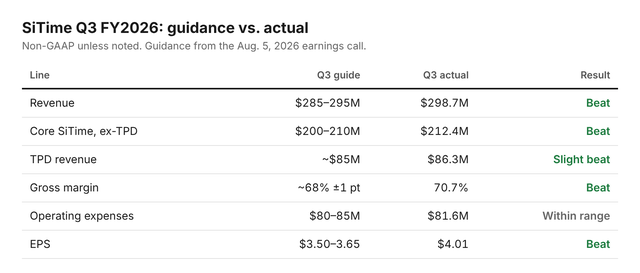
In the third quarter, the company met or exceeded all guidance provided by management in August. This was also the first complete quarter for Renesas' timing business (TPD) since the acquisition was completed on July 1.
[Original image location: SiTime Q2 and Q3 FY2026 earnings report and call]
As you can see, almost all of the company's metrics exceeded expectations, and the fourth-quarter guidance continues this trend. Management expects fourth-quarter revenue to be between $331 million and $341 million, with a gross margin of approximately 70% ±1 percentage point, operating expenses remaining flat, and EPS around $4.76. Based on the midpoint of the guidance, this translates to a 12.5% quarter-over-quarter revenue growth, with both SiTime's core business and TPD continuing to grow.
Adding the fourth-quarter guidance to the performance of the first three quarters, full-year revenue for FY2026 is expected to reach between $901 million and $911 million, compared to only $327 million for FY2025.
Another point worth noting: SiTime announced a 1-for-3 stock split, effective December 7. All per-share data in this article is prior to the split.
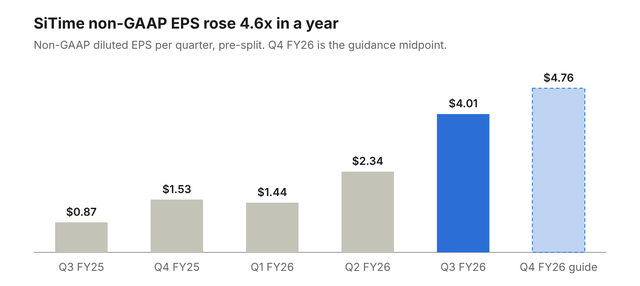
SiTime's non-GAAP EPS increased from $0.87 in the third quarter of FY2025 to $4.01 in the third quarter of FY2026, with the fourth-quarter guidance reaching $4.76.
[Original image location: SiTime EPS (SiTime Earnings Releases)]
Therefore, I believe this quarter was a great performance, and the future guidance is also promising. However, this has not stopped the stock price from continuing to decline—since the high in May 2026, the stock price has cumulatively dropped 53%.
Due to market concerns about slowing AI growth, all AI stocks have been punished.
Recently, I have been writing about semiconductor companies like Micron and STX and have given them "Hold" ratings.
So the question now is: what is different about SiTime?
Because if SiTime's prospects are so bright, then Micron's prospects should theoretically also be bright.
Why SiTime Is Not Micron
In my recent analysis of Micron, Sandisk, and Seagate, I rated all three companies as "Hold," and the reason is quite simple: growth is primarily driven by price increases, and margins are largely due to supply shortages, while the upcoming new supply will ultimately end both of these benefits. But SiTime's situation is different.
First, where does the growth come from? In the storage industry, it mainly comes from price increases. Micron's DRAM prices have risen by nearly 20%, but bit shipment volumes have only increased in the single digits. In contrast, SiTime's growth comes from higher product shipments. In the most recent earnings call, the CFO clearly stated when explaining margin improvement:
This improvement reflects the products we are selling and not price increases.
Second, there are the profit margins. In the storage industry, margin largely comes from supply shortages.
Seagate's gross margin surged from 19.5% at the bottom of the 2023 cycle to 57.8%. Market supply tightened, and margins shot up accordingly.
However, SiTime's margins have been built over many years: approximately 45% at the time of its IPO in 2019, 59% by 2025, and now 70.7%, primarily through product mix improvement and economies of scale.
Third, what factors will end this cycle?
In the storage industry, this follows a classic cyclical logic: competitors increase supply, and then product prices fall.
But for SiTime, the upcoming increased supply is actually its own supply. Currently, TPD is unable to produce enough products because production is still handled by Renesas and customers are waiting in line.
Once this supply bottleneck is relieved, I expect SiTime will simply sell more products to those customers who already have demand. To me, this means more revenue, not a price war.
Fourth, do customers have a reason to cut back on procurement? For storage products, the answer is yes.
Storage is a significant component of AI server costs, and NVIDIA and AMD have begun to optimize memory configurations as memory costs are squeezing their own margins.
But for timing products, such issues are almost nonexistent. Each timing product on a board only costs a few dollars, even when calculated across an entire rack, it amounts to at most about $1,000. I don't see anyone redesigning an entire server just to save this little money.
As we further examine valuations, the situation becomes even more interesting.
Valuation
SITM's forward P/E ratio has dropped from 55 times in September to about 23 times based on 2027 forecasts, while third-quarter revenue grew 257% year-over-year.
At first glance, this presents a huge opportunity. But I must analyze it fairly.
This P/E ratio does not account for future tax burdens. SiTime has previously accumulated losses, so it currently has little to no tax obligations as it just transitioned to profitability. But this advantage won't last forever.
That is the first issue. The second issue is SBC, or stock-based compensation. The company pays about $35 million in stock each quarter as part of employee compensation, which is a real cost for shareholders.
Considering all these factors, when annualizing the fourth-quarter earnings, I estimate the P/E ratio to be approximately 33 times. The specific calculations are as follows:
Fourth-quarter guidance: $4.76 EPS × 4 = annualized $19.04
Subtract SBC (approximately $1.07 per share each quarter): $14.76
Then subtract 15% tax rate—this is my assumption; the company did not provide a tax rate guidance: $12.55
$417 ÷ $12.55 = 33 times
That's right, this indeed looks more expensive, which is why I haven’t upgraded the rating to "Strong Buy."
However, let's assume the company can achieve the market forecast for 2027, which I will explain why I believe it can.
Given the projected growth rate for 2027 and 2028, even considering the 33 times P/E ratio after taxes and SBC deductions, I still find this stock very attractive.
Analysts currently expect 2027 EPS to be around $18.25, growing about 43% compared to 2026, and further rising to about $20.30 in 2028.
Therefore, if this growth can continue, or even accelerate again, there remains a good investment opportunity here.
For a complete analysis, I also looked at the balance sheet. SiTime currently has $1.33 billion in debt; however, these are all 0% coupon convertible bonds maturing in 2031, and they will only convert if the stock price exceeds about $1,040. Therefore, from the current perspective, this effectively amounts to regular debt that does not incur any interest costs for the company. The company has $324 million in cash, so its enterprise value is approximately $13.6 billion.
In terms of EV/EBITDA, this stock does seem expensive, with a forward EV/EBITDA of about 34 times while the industry average is only 12.5 times. But looking back over the past 12 months, this figure surged to 90 times, which showcases how quickly the company's earnings are catching up with the current valuations.
If I annualize the fourth-quarter guidance, the operating profit reaches about $615 million, meaning an EV/Operating Profit of approximately only 22 times.
Currently, the real weakness is cash flow. The Price-to-Cash-Flow ratio is as high as 140 times, and the operational cash flow for the third quarter was even negative at -$6.6 million, primarily due to delayed payments from TPD customers. Management indicated that these payments were received at the beginning of the fourth quarter, so this will be the first item I check in the next financial report.
Why Growth Can Continue
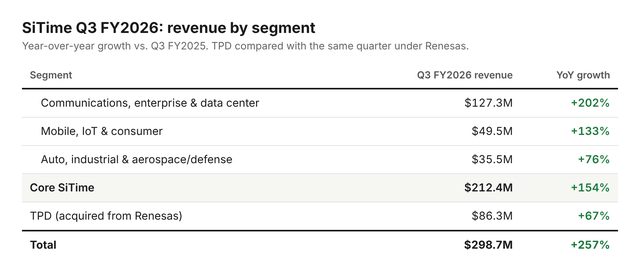
As I mentioned earlier, I believe SITM does not exhibit the same evident cyclicality as the storage sector, and the current stock price is already quite cheap. Now let’s take a look at the year-over-year growth for each business segment this quarter:
[Original image location: SiTime Q3 revenue by segment (SiTime Q3 FY2026 Earnings Release and Call)]
Therefore, it’s not just AI; every business segment is growing rapidly.
Several reasons lead me to believe this growth can continue.
First, quartz is being replaced by silicon-based timing products. Management believes the entire timing market is currently about $11 billion to $12 billion in size and will expand to $20 billion to $22 billion by 2030, with the vast majority of oscillators on the market still using quartz technology. Based on SiTime's current annual revenue level of around $1.3 billion, the company still has significant growth potential.
Second, quartz supply cannot keep up with demand. Quartz manufacturers are currently facing supply issues; according to procurement data, lead times for Epson and NDK components are about 14-22 weeks, while SiTime only has about 6-10 weeks. Once customers complete the switch, going back is not easy since it requires weeks to redesign and re-certify. Thus, once engineers turn to SiTime, that chip usually stays.
Third, as technical specifications demand increases, SiTime’s market share actually rises. In the 400G optical modules, SiTime’s market share is about 40%, and the CEO expects it to nearly double at the 1.6T level. Management anticipates associated revenue from 1.6T will double by 2027, and 3.2T products have already won design wins.
Now let's look at the entire market.
Additionally, there are capital expenditures:
Alphabet expects CapEx to "significantly increase" in 2027.
Amazon has stated that capital expenditures will "increase significantly," and Microsoft expects FY2027 CapEx to be around $170 billion.
Analysts currently anticipate that the four major hyperscalers will have capital expenditures of about $935 billion in 2027, representing a year-over-year increase of 28%; if Oracle is included, it could reach approximately $1.2 trillion.
In the optical communication field, the world's largest optical module manufacturer Innolight stated this week that orders from major customers have basically covered the entire 2027 year, while demand for 800G and 1.6T is still expected to grow rapidly.
Considering all these factors, I believe SiTime has the ability to achieve the current market predictions. If it truly does, then in my view, this stock is now cheap.
Risks
The biggest risk here is still the slowdown in AI growth.
About 66% of the company's revenue depends on data center capital expenditure, and a round of inventory destocking in 2023 once caused a 49% drop in the company's revenue. However, currently, hyperscalers are guiding for further increases in capital expenditure for 2027, while channel inventories are still below the target levels set by SiTime itself. Therefore, at least for now, this risk remains limited.
Another risk is competition. Texas Instruments (TXN), Skyworks (SWKS), and Kyocera are all vying for the same market, and Skyworks has already secured a timing socket with a large cloud service provider. Currently, SiTime still maintains its lead in the highest-spec products, and 3.2T has already won design wins, but this remains a risk I will continue to monitor.
As mentioned earlier, the final risk is cash flow. The third-quarter operational cash flow was -$6.6 million. Management stated that the delayed TPD payments have now been received at the beginning of the fourth quarter, so I will confirm this in the upcoming February earnings report.
Conclusion
SiTime delivered an excellent financial report, but the stock price completely ignored it. It has fallen alongside the entire AI sector, even though the company’s business condition is significantly better than when I first wrote about this stock. Profits are growing rapidly, every business segment is expanding, and unlike the storage sector, its growth is not driven by price increases.
When considering future tax burdens and SBC, this stock does indeed appear more expensive than it first seems. And indeed, if AI capital expenditures start to slow down, SiTime will certainly be affected. But even with a P/E of about 33 times after deducting taxes and SBC, coupled with this growth rate, I still find the current price very attractive. Therefore, I am once again maintaining my "Buy" rating.
免责声明:本文章仅代表作者个人观点,不代表本平台的立场和观点。本文章仅供信息分享,不构成对任何人的任何投资建议。用户与作者之间的任何争议,与本平台无关。如网页中刊载的文章或图片涉及侵权,请提供相关的权利证明和身份证明发送邮件到[email protected],本平台相关工作人员将会进行核查。