If the staking activity primarily rewards "deposited assets," then liquidity incentives focus more on: whether users can provide effective liquidity for trading pairs and generate fees through actual trading.
OKX Wallet Boost has recently launched X Liquidity Incentive·Phase 6, sponsored by X Layer, with a total reward pool reaching 250,000 USDG. This phase covers 10 liquidity pools, mainly revolving around tokenized US stocks, gold, Bitcoin-related assets, and stablecoins.
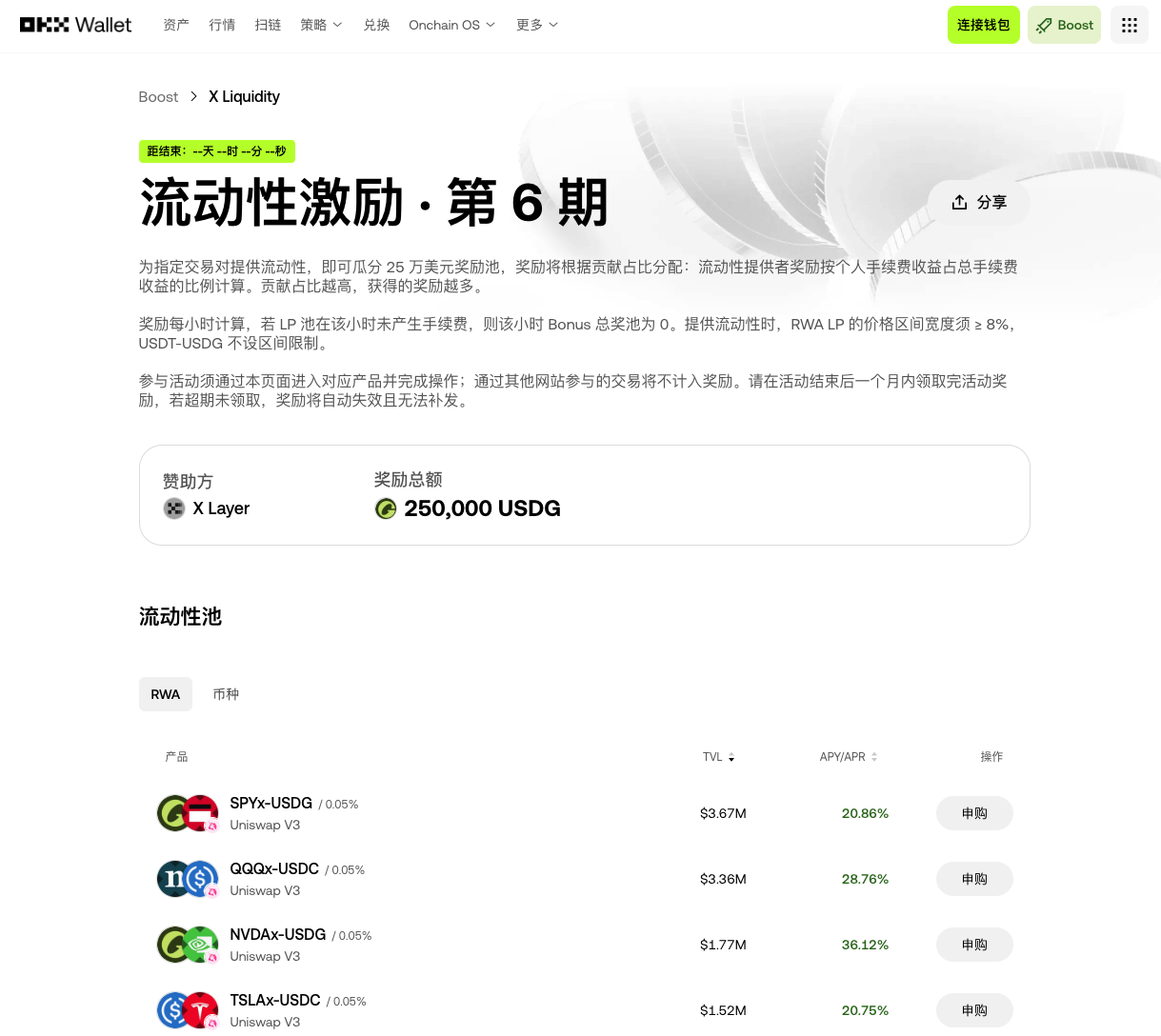
This activity is expected to end on December 1, 2026, at 15:00 (UTC+8). According to the activity page, rewards are distributed according to the proportion of personal fee earnings from liquidity providers to total fee earnings, calculated hourly.
This rule is very crucial:
It is not that the larger the deposit amount, the more rewards one must receive; rather, it is about how much effective fee your liquidity position contributes to the pool.
Therefore, this phase is more suitable for filtering based on "trading activity, pool TVL, price range, impermanent loss, and reward efficiency," rather than just looking at the highest APY listed on the page.
Overview of Core Event Information
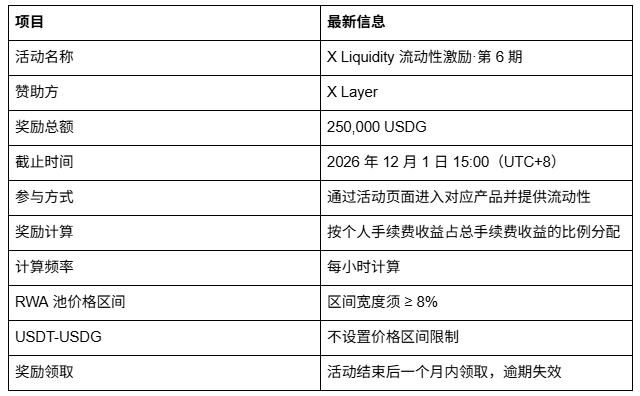
The official page clearly states that transactions participated in through other websites are not counted towards the activity rewards.
Ten Liquidity Pools: Total TVL Approximately 15.09 Million USD
The official page currently displays 10 liquidity pools. According to the page data, the total TVL is approximately 15.09 million USD.
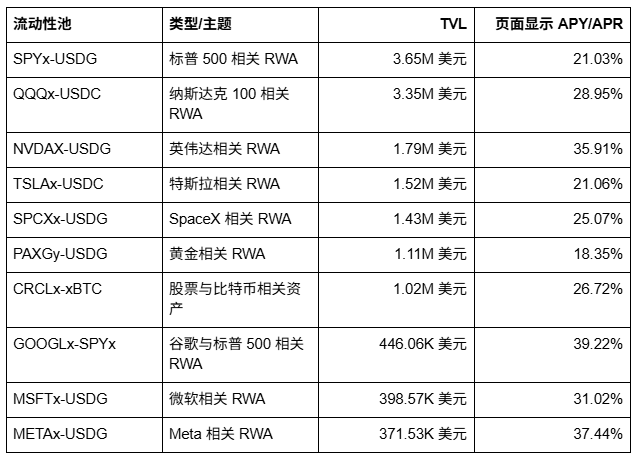
The above TVL, APY/APR will vary with market changes and should not be regarded as fixed data or fixed income guarantees.
Which Pools Are Currently Holding Most of the Funds?
Based on a simple calculation of the current TVL on the page:
- SPYx-USDG accounts for approximately 24.19% of the total TVL of the ten pools;
- QQQx-USDC accounts for approximately 22.21%;
- NVDAX-USDG accounts for approximately 11.87%;
- TSLAx-USDC accounts for approximately 10.08%;
- SPCXx-USDG accounts for approximately 9.48%.
The top five pools together account for approximately 77.83% of the current page's TVL. This indicates that funds are primarily concentrated in index assets, tech giants, and highly watched special asset trading pairs.
However, a large TVL does not automatically mean the highest yield. The reward efficiency of the liquidity pool also depends on actual transactions, fee rates, price ranges, and the number of competitors.
Rewards Are Not Distributed Based on Principal, But Based on Fee Contribution
The official rule for this phase is: the rewards for liquidity providers are calculated based on the proportion of personal fee earnings to total fee earnings; the higher the contribution ratio, the more rewards earned, calculated hourly.
A simplified example can help understand this:
- All LPs generate fee earnings of 10,000 USDG in one hour;
- One user's position contributes 100 USDG to the pool's fee earnings;
- That user's fee contribution makes up 1%;
- If the corresponding Bonus reward pool for that hour is 1,000 USDG, theoretically that user can receive about 10 USDG.
This is just an example to aid understanding; actual rewards are still based on the official activity accounting.
Therefore, users need to focus not just on the scale of the principal, but on:
- Whether the pool has ongoing trading;
- Whether the trading volume is real;
- Whether individual liquidity is within an effective price range;
- Whether positions are diluted by other LPs;
- Whether fees are generated every hour;
- Whether the rewards are sufficient to cover impermanent losses and operational costs.
No Fees in an Hour, Bonus Reward is 0
The activity page clearly states: if a certain LP pool does not generate fees in that hour, the total Bonus pool for that hour will be 0.
This is one of the most important differences compared to simple deposit activities.
Even if a pool shows a relatively high APY, if actual trading activity is insufficient, and some hours generate no fees, then no Bonus will be created for that time period. Users cannot simply multiply the annualized figure on the page by the principal and assume a stable hourly reward.
The core variables for liquidity mining are usually:
Actual trading volume × Fee rate × Effective liquidity ratio.
No transactions mean no fees; without fees, there may be no Bonus for that hour.
Six Key Directions: How to View These Ten Pools?
1. Index Assets: SPYx-USDG and QQQx-USDC
SPYx-USDG and QQQx-USDC are the two pools with the highest current TVL, approximately 3.65 million USD and 3.35 million USD, with page APY/APR shown as 21.03% and 28.95%, respectively.
Both have a characteristic of relatively clear market themes:
- SPYx is closer to expressing the S&P 500's large-cap assets;
- QQQx leans towards the Nasdaq 100 and technology growth themes;
- The stablecoins on each side are USDG and USDC;
- A higher TVL usually indicates more funds participating and may also mean more intense reward competition.
The focus on index pool research is not only APY, but also includes tracking the price of RWA tokens against index performance, trading activity, and liquidity on the stablecoin side.
For users looking to reduce the risk of single stocks, these pools offer more diversified thematic exposure; however, LPs may still incur impermanent losses due to changes in token prices.
2. AI and Semiconductor Direction: NVDAX-USDG
NVDAX-USDG currently has a TVL of about 1.79 million USD, with page APY/APR around 35.91%.
It is one of the pools displayed on the current page with a high APY. Transactions related to Nvidia's assets are often influenced by AI, data center, GPU demand, capital expenditures, and market valuation changes.
The high APY comes with the potential for greater volatility. If NVDAX rises or falls sharply in a short time, concentrated liquidity positions may deviate from the price range faster, affecting fees and impermanent losses.
Users should not ignore just because 35.91% is a high number on the page:
- Whether the price range is wide enough;
- The price correlation between tokens and USDG;
- Whether trading volume can be sustained;
- Whether the pool may see unidirectional trends;
- Whether the APY includes activity incentives or other dynamic components.
3. High Volatility Tech Asset: TSLAx-USDC
TSLAx-USDC currently has a TVL of about 1.52 million USD, with page APY/APR around 21.06%.
The market attention on Tesla-related assets is high, and prices are easily affected by quarterly reports, delivery volumes, autonomous driving, robotics, energy business, and market sentiment.
For TSLAx-USDC, users should particularly observe whether trading volume surges during news periods. Increased trading volume may boost fee income but could also accompany larger price shocks and short-term volatility.
4. Private Placement/Special Asset Themes: SPCXx-USDG
SPCXx-USDG currently has a TVL of about 1.43 million USD, with page APY/APR around 25.07%.
It is necessary to emphasize that SPCXx is not an interchangeable symbol with the previously listed SPCX. Before participating in SPCXx-USDG, one should confirm in the current asset details of the OKX Wallet:
- Asset contract address;
- Asset mapping and price sources;
- Trading pool liquidity;
- Redemption and exchange paths;
- Applicable regions and restrictions for tokenized assets.
The popularity of special asset themes may be high, but the transparency, tradability, and liquidity conditions may not be the same as those of large publicly listed companies.
5. Gold-related Direction: PAXGy-USDG
PAXGy-USDG currently has a TVL of about 1.11 million USD, with page APY/APR around 18.35%.
The characteristic of gold-related RWAs is that their asset logic differs from tech stocks. They are more susceptible to gold prices, US dollar movements, real interest rates, inflation expectations, and risk aversion sentiments.
PAXGy-USDG is suitable for inclusion in thematic asset diversification analyses, but users still need to confirm PAXGy's asset support, price tracking, redemption mechanisms, and liquidity, and should not directly assume “gold-related” means no price volatility.
6. CRCLx-xBTC: Correlation and Dual Volatility
CRCLx-xBTC currently has a TVL of about 1.02 million USD, with page APY/APR around 26.72%.
This is a pool that includes both stock-related RWAs and Bitcoin-related assets. Compared to RWA and stablecoin trading pairs, both sides of CRCLx-xBTC may experience price volatility.
The potential advantage is that both parties in the trade may generate demand; however, the risks are also more complex:
- Company or industry news risks related to CRCLx;
- Price tracking and packaging asset risks associated with xBTC;
- Position changes due to simultaneous volatility of both assets;
- Price ranges for LPs may deviate more easily;
- Impermanent loss might exceed that of stablecoin trading pairs.
High APY needs to be assessed alongside the risks of bilateral assets.
7. GOOGLx-SPYx: High APY and Small TVL Coexist
GOOGLx-SPYx currently has a TVL of about 446.06K USD, with page APY/APR around 39.22%, making it one of the highest APY/APR listed on the current page.
But its TVL is relatively small compared to the overall ten pools, accounting for about 2.96% of the total TVL. This "high APY + small TVL" combination is noteworthy but cannot be directly interpreted as high certainty returns.
A small TVL may imply:
- Less competitive liquidity;
- Limited trading depth;
- More significant price impact per trade;
- Annualized data easily affected by short-term fee fluctuations;
- Potentially easier slippage when exiting.
Users should first check real trading volume, pool depth, and price range, rather than just comparing APY numbers.
8. MSFTx-USDG and METAx-USDG: Tech Thematic Opportunities in Small Pools
MSFTx-USDG shows a TVL of about 398.57K USD and an APY/APR of about 31.02%; METAx-USDG has a TVL of about 371.53K USD and an APY/APR of around 37.44%.
Both of these pools have a TVL below 400K USD, but the page shows a high APY. For data analysis users, it is crucial to track:
- Whether APY is driven by short-term fee contributions;
- Whether the share of activity incentives is high;
- Whether trading volume exists continuously over multiple hours;
- Whether large trades cause significant price shocks;
- Whether positions move quickly out of range after providing liquidity.
Small pools do not equate to no opportunities, but require stricter checks on liquidity and exit risks.
Key Threshold for RWA Pools: Price Range Width Must Not Be Less Than 8%
The official page explicitly states that when providing RWA LPs, the price range width must be ≥ 8%; there are no price range restrictions for USDT-USDG.
This means that users cannot set the price range too narrow when setting up RWA trading pairs in concentrated liquidity products like Uniswap V3.
The width of the price range affects three aspects:
Effective Trading Time
If the price moves outside the established range, liquidity may no longer effectively participate in trading, consequently affecting fee earnings.
Price Volatility Adaptability
A narrower range may improve the efficiency of fund usage but is also more likely to become ineffective after market changes. 8% is the minimum width required by the activity rules and does not necessarily mean all assets are suitable for exactly an 8% range.
Impermanent Loss and Position Structure
When prices change on both sides of the trading pair, the asset ratio of the LP will change. The narrower the range, the quicker the position may shift from bilateral assets to leaning towards a single asset; users must understand the risks of concentrated liquidity.
How to Understand Page APY/APR?
The APY/APR shown on the page is an important reference but cannot be directly equated to the actual earnings users receive.
The main reasons include:
- Page data will change with fees, trading volumes, and liquidity;
- Some high APYs may be influenced by short-term trading activities;
- If concentrated liquidity leaves the price range, it may not continue to generate the same fees;
- Asset price volatility and impermanent loss may exceed fee earnings;
- 250,000 USDG in rewards needs to be dynamically distributed based on fee contributions;
- Transaction costs, cross-chain fees, and exit slippage will reduce net earnings.
A more reasonable analytical approach is:
Expected Net Earnings ≈ Trading Fees + Activity Rewards − Impermanent Loss − Price Volatility Loss − Transaction and Network Costs.
Participation Path: Must Enter Through the Official Activity Page
The activity rules require users to enter the corresponding products through the activity page to complete operations; transactions participated in through other websites do not count towards rewards.
Recommended operational process is as follows:
- Open the X Liquidity Incentive·Phase 6 official page;
- Connect OKX Wallet;
- Select a target trading pair from RWA or other liquidity pools;
- Check real-time TVL, APY/APR, pool depth, and fee rates;
- Set a price range for RWA pools of not less than 8%;
- Confirm asset, network, price range, and expected trading costs;
- Complete liquidity operations through the activity page;
- Check hourly or daily if positions are still within effective ranges;
- After the activity ends, claim rewards within a month.
Which Users Are More Suitable to Focus on This Phase’s Activity?
Users Who Already Hold Related RWA Assets
If a user already holds SPYx, QQQx, NVDAX, TSLAx, SPCXx, PAXGy, CRCLx, GOOGLx, MSFTx, or METAx, and is willing to bear LP risks, they can explore whether the liquidity incentive is suitable for their asset allocation.
Users Who Can Actively Manage Price Ranges
Concentrated liquidity is not something that can be completely ignored after depositing. Users need to observe whether prices move outside of the range and adjust positions according to market fluctuations.
Users Who Can Distinguish Between APR, Fees, and Activity Rewards
If users cannot distinguish between page annualization, fee earnings, and Bonus rewards, it is not recommended to participate just because of high numbers. First understand the rules, then decide on the scale of funds.
Three Situations That Are Not Suitable for Blind Participation
Simply Wanting Fixed Returns
The rewards for this phase depend on fee contributions and trading activities; they are not a fixed deposit interest rate.
Not Willing to Bear RWA Price Volatility
RWA token prices may fluctuate, and LPs will incur impermanent losses; even if the page APY is high, it cannot guarantee that the USD value of the principal does not decline.
Unable to Continuously Manage Price Ranges
If users cannot monitor the status of positions, prices, and liquidity, concentrated liquidity may become ineffective after market changes, leading to missed fee opportunities or significant changes in asset ratios.
Conclusion: The Opportunities in Phase Six Lie in "High Rewards + RWA Trading Demand", and the Risks Are Also There
The X Liquidity Incentive·Phase 6 provides a reward pool of 250,000 USDG, covering ten RWA and related asset liquidity pools. On the current page, SPYx-USDG and QQQx-USDC have the largest TVL, while NVDAX-USDG, GOOGLx-SPYx, METAx-USDG, and other pools have higher page APY/APR.
However, the true logic of earning in this phase is not "depositing principal for fixed rewards," but rather:
Providing effective liquidity for designated trading pairs to generate fees through real trading, then distributing activity rewards according to fee contribution ratios.
Users need to remember three key rules:
- Rewards are calculated hourly; in hours without fees, the Bonus total pool for that hour is 0;
- The price range width for RWA LPs must be no less than 8%, while USDT-USDG has no range restrictions;
- Must access products through the official activity page and claim rewards within a month after the activity ends.
Exclusive Benefits for AiCoin Users
Use OKX Web3 Wallet to "Invest in Assets Worldwide"!
Bind invitation code 【AICOIN88】 to enjoy 20% savings on transaction costs (Gas optimization and other benefits)!
Download/upgrade the OKX Web3 Wallet now to catch the opportunity:
https://jump.do/xlink?checkProxy=true&proxyId=24
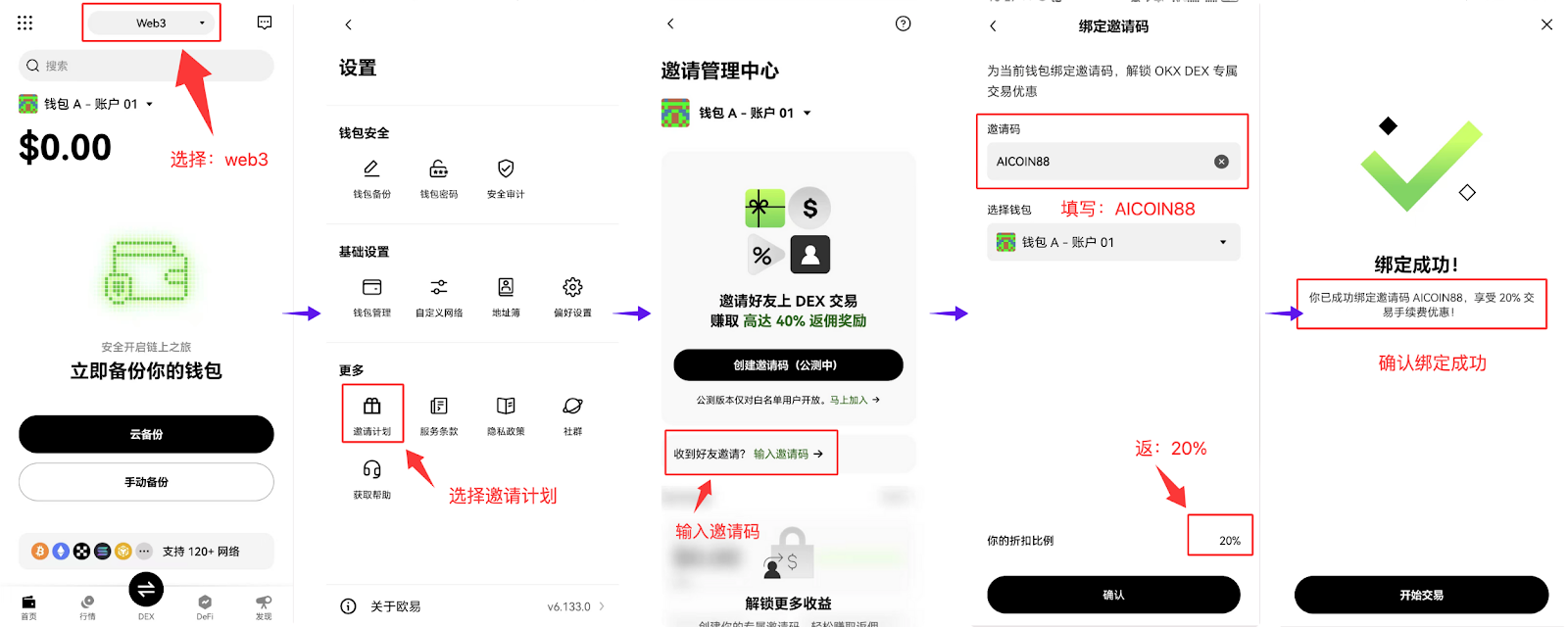
Use the exclusive invitation code 【AICOIN88】 to bind OKX Wallet, the web version can also be easily operated!
https://web3.okx.com/ul/joindex?ref=AICOIN88
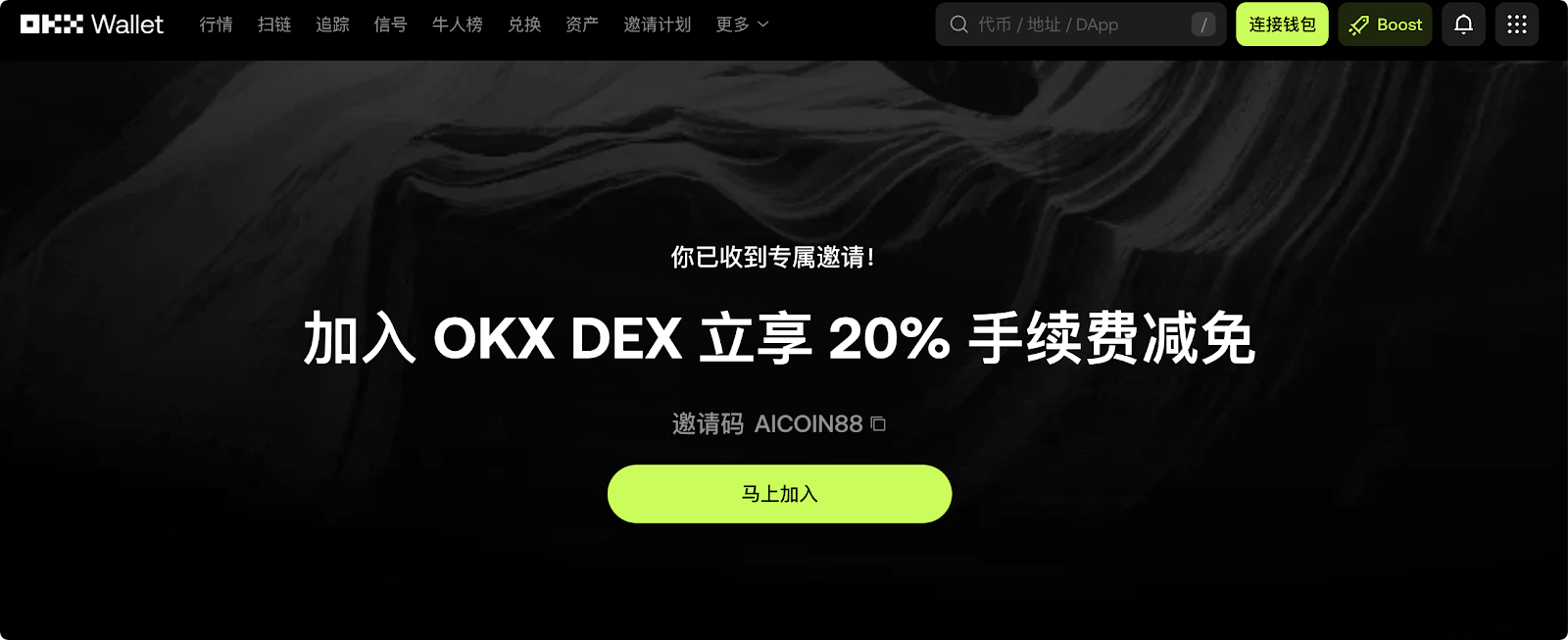
Don’t wait, set up your OKX wallet, bind to the offer, and gain new wealth!
免责声明:本文章仅代表作者个人观点,不代表本平台的立场和观点。本文章仅供信息分享,不构成对任何人的任何投资建议。用户与作者之间的任何争议,与本平台无关。如网页中刊载的文章或图片涉及侵权,请提供相关的权利证明和身份证明发送邮件到[email protected],本平台相关工作人员将会进行核查。