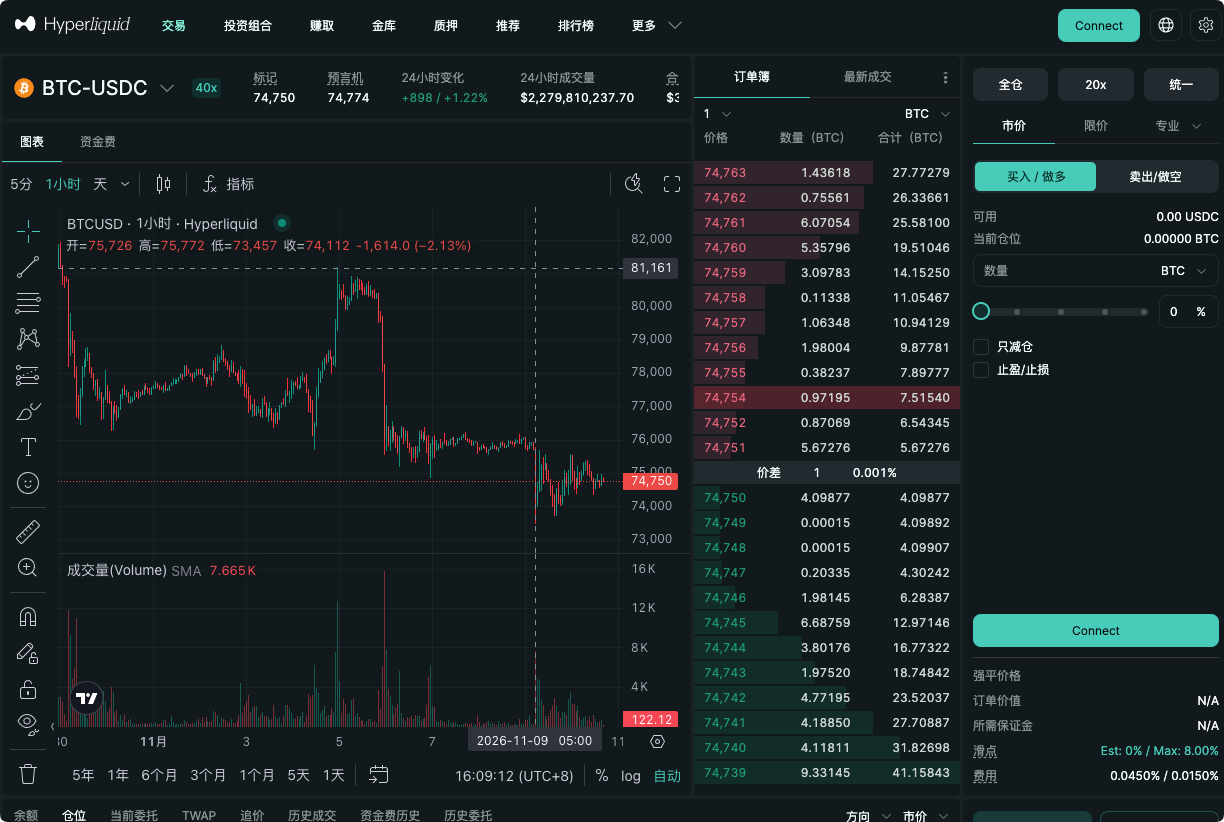
For a long time, when users opened Hyperliquid, their first reaction was usually to look at BTC, ETH, and HYPE.
But now, market attention is shifting.
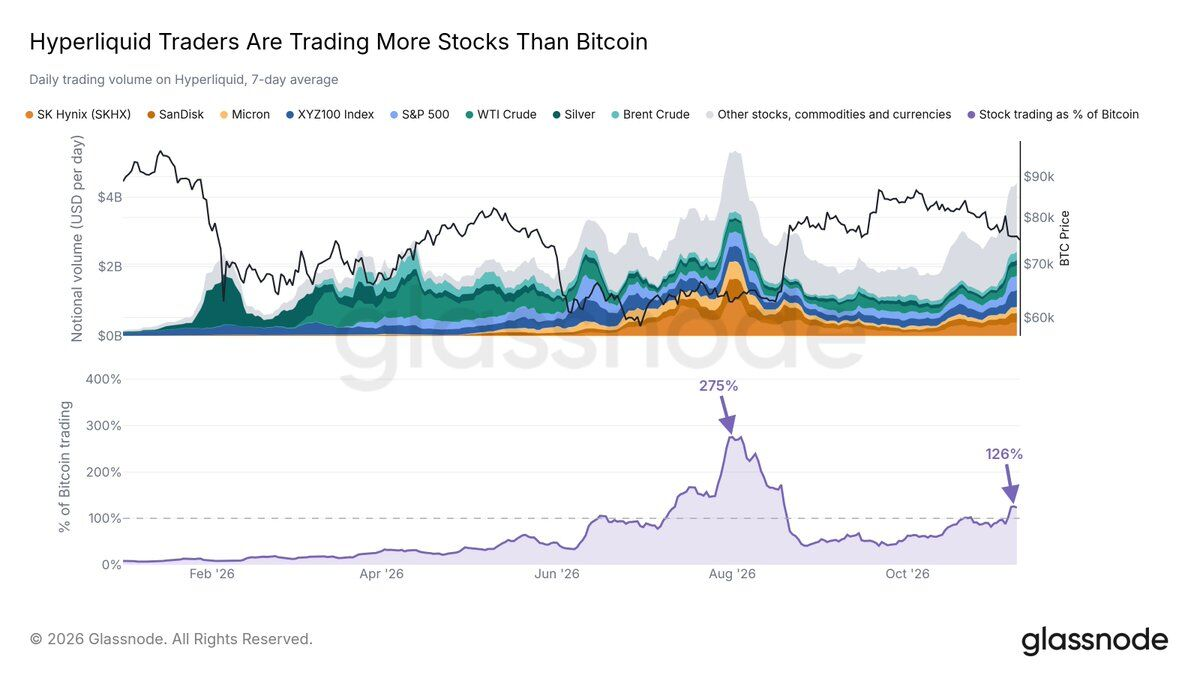
According to data from Glassnode, equity-related trading volume on Hyperliquid has once again surpassed BTC trading volume. Glassnode also pointed out that both BTC and the stock market have been weak for several weeks, but crypto-native traders seem to be “bottom-fishing” in the stock market.
This is not just an ordinary "RWA good news."
It indicates that Hyperliquid is transforming from a blockchain trading platform focused on crypto perpetuals into an all-weather derivatives market that allows crypto users to trade stocks, indices, and commodity price exposures.
More notably: the equity trading volume surpassing BTC does not mean that users have given up on crypto assets, but rather indicates that traders are starting to use the same margin account as a cross-market risk expression tool.
First, let's look at the data: equities have indeed surpassed BTC, but the comparison is for perpetual trading volume
According to Glassnode dynamics, the Equities volume on Hyperliquid has once again surpassed BTC volume. It uses relative trading volume data from within Hyperliquid and does not state that the real stock spot trading volume has surpassed the global BTC spot or futures markets.
More specific time windows:
- As of the week ending October 28, 2026, the daily average trading volume for the HIP-3 market was about $2.6 billion;
- During the same period, the daily average trading volume for BTC perpetual contracts was about $2.4 billion;
- As of November 9, 2026, the HIP-3 market accounted for about 44% of Hyperliquid's trading volume over the past 7 days;
- In the 24 hours leading up to November 9, the Hyperliquid perpetual trading volume approached $13.73 billion.
Here, the most important point is not that "stocks will always surpass BTC," but rather that the stock-related market has become large enough to compete directly with BTC perpetuals at certain stages.
This also requires two qualifications to be retained.
First, Glassnode is discussing relative trading volume within Hyperliquid, not a comparison of the total scale of the stock market versus the global market for BTC.
Second, the stock-related market primarily consists of perpetual contracts under the HIP-3 framework. What they offer is price exposure, which does not equate to the user actually buying stocks, nor does it automatically convey voting rights, dividend rights, or company equity.
Therefore, a more accurate title should be:
The perpetual trading volume of stocks on Hyperliquid has once again surpassed BTC perpetuals, indicating that cross-asset derivatives are becoming an important entry point for on-chain trading.
Why crypto traders are trading stock perpetuals
On the surface, this seems a bit counterintuitive.
Crypto users came to Hyperliquid to trade perpetual contracts, and now they are trading SK Hynix, the S&P 500 index, and crude oil. These markets have become some of the most active categories for non-crypto asset trading on Hyperliquid.
However, from a trading logic perspective, this change is not surprising.
Crypto traders are used to using leverage, around-the-clock market information, and bidirectional trading. The traditional stock market, on the other hand, has trading time restrictions, and stocks, indices, commodities, and foreign exchange are often dispersed across different brokers, exchanges, and margin systems.
HIP-3 incorporates these market types into similar order books and perpetual trading frameworks.
Users do not need to relearn an entirely different set of ordering logic simply because the trading target has shifted from BTC to an index. They can utilize familiar limit orders, stop-loss, leverage, and margin management methods to express their views on tech stocks, indices, commodities, or macro events.
A more realistic reason is that both the stock and crypto markets have weakened recently. Crypto-native traders "seem to be chasing the downturn in the stock market."
This may include several different strategies:
- Traders believe some stocks are approaching a phase low;
- Going long on stocks via perpetual contracts, rather than waiting for traditional markets to open;
- Hedging BTC, tech stock, and commodity risks through the same account;
- Looking for short-term opportunities by taking advantage of volatility differences across markets.
Just because trading volume has increased does not mean that all traders are bullish on stocks. Volume only indicates stronger trading activity; it does not directly indicate net direction.
The significance of HIP-3: The market is no longer determined by a single platform
Hyperliquid officially defines HIP-3 as Builder-deployed perpetuals, or perpetual markets created and operated by deployers.
Deployers are responsible for defining the market, including oracles and contract specifications; they are also responsible for market operations, including setting oracle prices, leverage limits, and settling markets when necessary.
Each HIP-3 DEX has its own independent margin, order book, and deployer settings.
This architecture explains why Hyperliquid can quickly expand to more equity, index, and commodity-related markets.
The native trading platform does not need to personally define every set of market rules for all assets. As long as there are deployers willing to stake HYPE and take on the corresponding responsibilities, they can establish independent perpetual trading markets around new assets.
This represents a change in the way market supply works.
In the past, what users could trade was largely determined by the coin listing teams of centralized exchanges. Now, market deployers, oracle providers, and distribution applications can all participate in the asset trading chain.
However, open deployment does not mean all markets are of the same quality.
HIP-3 deployers need to maintain a staking requirement of 500,000 HYPE, and the market is also subject to validator voting, penalties, and risk control mechanisms.
Users need to pay special attention to the following issues:
- Whether the oracle has reliable external price sources;
- How the marked prices are updated during the traditional market's off-hours;
- Whether the order book depth for individual stocks or niche assets is sufficient;
- Whether deployers can pause or settle the market in the event of abnormal volatility;
- Whether the market uses independent margin or has a cross-margin relationship with other markets.
The trading interface for stock perpetuals may resemble that of BTC perpetuals, but the market risks are not the same.
Stock perpetuals are not stock spot: the most easily overlooked boundary
When users trade a company's stock perpetual on Hyperliquid, they essentially hold a price contract. Hyperliquid's official documentation categorizes such products as perpetual assets and states that the maximum leverage for different assets may vary.
This introduces three important differences.
First, there is no ownership of stocks
Perpetual contracts do not represent ownership of company shares. Users typically do not have voting rights and will not automatically receive dividends or corporate governance rights due to their positions.
Second, prices depend on oracles and market rules
Outside of normal US stock trading hours, the stock spot market may not have continuous transactions, but perpetuals on Hyperliquid can still be traded. How prices form at this time, how external indices are updated, and how marked prices prevent manipulation will all affect position risk.
The HIP-3 official documentation emphasizes that deployers are responsible for defining and operating oracles, and market deployers may face staking penalties due to malicious or inappropriate market operations.
Third, funding rates will not disappear just because "the direction is right"
Perpetual contracts do not have fixed expiration dates, but users need to continuously bear funding rates, margin, and liquidation risks. Even if stock prices eventually move as expected, the long-term holding costs may diminish trading returns.
Therefore, stock perpetuals are suitable for expressing price views, making short-term trades, or performing risk hedging, but cannot be packaged as a complete substitute for traditional stock investments.
This time, the volume exceeding BTC: Is it a structural change or a market bottom-fishing?
Since the HIP-3 market was launched in October 2025, trading volume has consistently remained between 20% and 50% of Hyperliquid's total trading volume; in July 2026, real-world assets briefly exceeded the trading volume of the crypto market for the first time over the course of a week.
If this proportion maintains a high level for a long time, the perpetuals for equities, indices, and commodities exceeding BTC may no longer be an occasional event.
However, if the volume increase is simply due to a rapid decline in the stock market, a quick rise in volatility, and traders concentrating on bottom-fishing, then once the situation stabilizes, the share of HIP-3 may also retreat.
To determine if this is a structural change, three indicators can be observed.
First, whether HIP-3 trading volume still maintains a high proportion during stable market phases. True product migration should not only occur during panic or crash periods.
Second, whether the volume is distributed across multiple assets and multiple deployers, rather than concentrated in one or two hot targets. An explosion in a single market cannot equate to the maturity of a cross-asset trading ecosystem.
Third, whether open interest and funding rates are synchronously changing with trading volume. High trading volume without a sustained increase in OI may simply be short-term turnover; if OI and funding rates shift quickly to one side, caution should be exercised regarding crowded trades.
Glassnode noted that the last time the ratio of stock volume to BTC volume reached a high point in August, BTC was near a phase low, after which it experienced a breakout.
This historical observation can serve as market context, but should not be taken as a signal that BTC is about to break through. Similar volume structures might arise from similar market sentiments, or they could just be two points in time where a similar shift in risk preferences happened to occur.
For Hyperliquid, the real change is that "crypto users are beginning to trade the entire market"
Hyperliquid's strongest product recognition in its early days was on-chain perpetual trading.
Now, HIP-3 is expanding that recognition: users are no longer just trading crypto assets on-chain, but are trading different types of price risks within the same margin and order book environment.
This may be a more significant change than simply adding a few stock trading pairs.
Once users start framing BTC, the Nasdaq index, semiconductor stocks, and crude oil within the same observation framework, Hyperliquid's competitors will no longer be limited to other perpetual DEXs, but will also include traditional brokerages, CFD platforms, commodity trading platforms, and the derivatives business of some exchanges.
Its advantages include:
- The market can operate around the clock;
- Trading and margin status are recorded on-chain;
- Third-party deployers can create markets;
- Different assets can be compared within the same trading terminal;
- Applications can connect to existing liquidity through Builder Codes without having to build a complete matching backend from scratch.
But its challenges are also clear:
- Equity, index, and commodity oracles must remain reliably consistent;
- The liquidity of niche markets may be significantly weaker than that of BTC;
- The market rules of different deployers might differ;
- Price discovery during traditional market off-hours could increase the risk of price jumps and liquidations;
- Users may easily confuse price contracts with true asset ownership.
Thus, Hyperliquid's next phase of competition is not simply about "adding more stocks," but about whether it can ensure that different markets continue to maintain interpretable prices, adequate liquidity, and clear risk responsibilities under extreme market conditions.
How ordinary users should observe this cross-asset migration
For ordinary traders, the most valuable lesson is not to chase after news regarding a particular stock, but to observe where capital and leverage are flowing.
When using the AiCoin mobile app to observe Hyperliquid, a simple cross-asset check sequence can be established:
First compare the changes in trading volume for BTC, the overall HIP-3, and popular stock markets, and then see if open interest is synchronously increasing. Rising volume but unchanged OI may indicate rapid capital turnover; sustained increases in OI indicate that more leverage risk is entering the market.
Next, look at funding rates and long/short positions. While the trading volume for stock perpetuals exceeding BTC does not indicate that the overall market is bullish on stocks; if funding rates have remained positive for an extended period, the so-called "bottom-fishing" may have turned into a crowded long position.
Then check the order book depth and market sources. The liquidity of benchmark assets like the S&P 500 and crude oil cannot be directly compared to that of small-cap stocks. The HIP-3 market is managed by deployers concerning oracles and market operations, and users should confirm the market parameters before deciding on leverage multiples and holding durations.
Finally, pay attention to the trading objects themselves. The stock perpetuals on Hyperliquid are price exposures, not stock spots. For long-term holdings, it's even more vital to incorporate funding rates, marked prices, off-market periods, and liquidation prices into calculations.
The AiCoin mobile app can help users place candlestick charts, OI, funding rates, liquidations, large orders, and the market conditions of different assets within the same observational framework. Its value is not in judging "whether to bottom-fish now," but in helping users first confirm: is this trade expressing a view on stocks, a view on BTC, or is it bearing a collective downside risk of related assets?
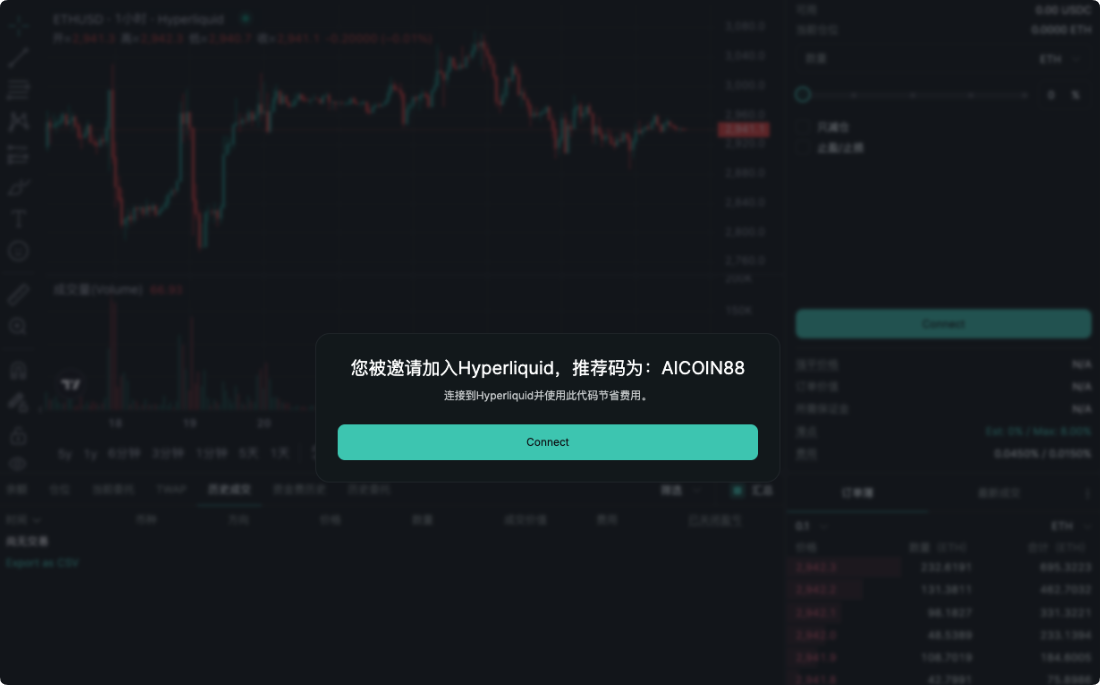
If you need to connect to Hyperliquid, you can use the exclusive entry point:
https://app.hyperliquid.xyz/join/AICOIN88
Invite code: AICOIN88. Eligible transactions can receive a 4% fee rebate, with specific qualifications, rebate calculations, and arrival times subject to the activity rules.
The rebate can only reduce part of the trading costs and cannot offset funding rates, slippage, oracle, cross-market correlation, leverage, and liquidation risks.
Conclusion: BTC is no longer the only traffic entry point for Hyperliquid
The stock perpetual trading volume surpassing BTC does not necessarily mean that crypto traders have abandoned BTC.
It is more like stating: users on Hyperliquid have begun to view BTC as just one of many trading objects, rather than the sole trading center.
Today it is stocks surpassing BTC, and next it could be crude oil, indices, forex, or other real-world assets taking the lead. What is truly noteworthy is not which market ranks first in the short term, but whether Hyperliquid can continuously provide liquidity, reliable prices, and manageable risks for different assets within the same on-chain infrastructure.
The charts from Glassnode captured a volume crossover; what HIP-3 truly aims to establish is a cross-asset market layer.
If this market layer can endure through several rounds of market conditions, stocks surpassing BTC will no longer be news, but will become a norm in Hyperliquid's trading structure.
Exclusive benefits for AiCoin users
👉 When binding Hyperliquid accounts, enter the invite code AICOIN88 to enjoy a 4% fee rebate
🔗 Exclusive registration link:
https://app.hyperliquid.xyz/join/AICOIN88
📖 Beginner tutorials:
“AiCoin PC Hyperliquid Authorization Trading Tutorial”:
https://www.aicoin.com/zh-Hans/article/514197
“AiCoin Mobile Hyperliquid Authorization Trading Tutorial”:
https://www.aicoin.com/zh-Hans/article/541383
“Zero-Basis Introduction! Hyperliquid First Trading Detailed Tutorial”:
https://www.aicoin.com/zh-Hans/article/510225
📖 Community Communication:
Telegram:
Discord:
AiCoin Group Chat:
https://www.aicoin.com/link/chat?cid=N6OVMor5g
The content of this article only represents the personal views of the author and does not reflect the position of this platform. The opinions, conclusions, and suggestions in the text are for investors' reference only and do not constitute any investment advice related to this platform. Investing in US stocks still requires independent assumption of market risks, regulatory risks, and compliance risks with local laws and regulations (especially foreign exchange controls, overseas investment declarations, etc.)
免责声明:本文章仅代表作者个人观点,不代表本平台的立场和观点。本文章仅供信息分享,不构成对任何人的任何投资建议。用户与作者之间的任何争议,与本平台无关。如网页中刊载的文章或图片涉及侵权,请提供相关的权利证明和身份证明发送邮件到[email protected],本平台相关工作人员将会进行核查。