Claude Fable 5.2 has been out for a day, and all the social media and communities have gone crazy.
My X timeline is almost entirely filled with Claude Fable 5.2.
Of course, I know you might ask, didn't Gemini 4 Carbon officially launch early this morning? How does it compare to Fable 5.2? I have indeed tested it myself and ran a number of cases.
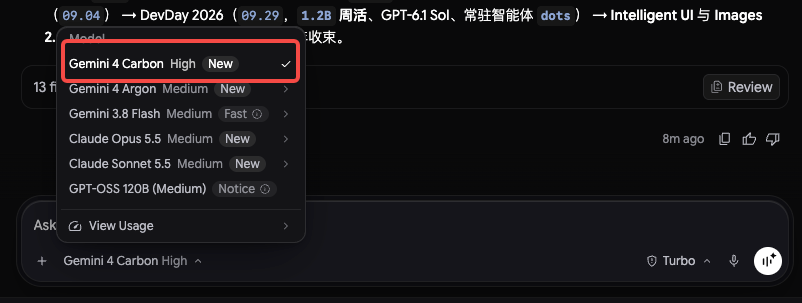
However, compared to Claude Fable 5.2, I feel like it's still missing something very important.
That is something that cannot be evaluated using any Benchmark, but everyone seems to vaguely feel it.
Aesthetic.
If I casually present two comparative cases, everyone will see it.
This is the birthday celebration video I made for ChatGPT's 4th anniversary using Claude Fable 5.2, and I believe many people have seen it.
The rhythm is great, and the visuals strictly follow my Prompt, referencing the main visuals of every generation of OpenAI models. This visual of GPT 4o is very typical and incredibly beautiful.
And this is the video generated by Gemini 4 Carbon high in Antigravity, I feel like no words are needed, and a direct comparison can be made.
To be frank, it has made progress in aesthetics compared to Gemini 4 Argon. If I didn't look at the content produced by Fable 5.2, I would think it's fine, but after watching, it does leave one feeling slightly disheartened.
Additionally, I tested a Three.js webpage case of a lighthouse fishing port with Claude Fable 5.2, and I captured static frames, which makes the comparison even more intuitive.
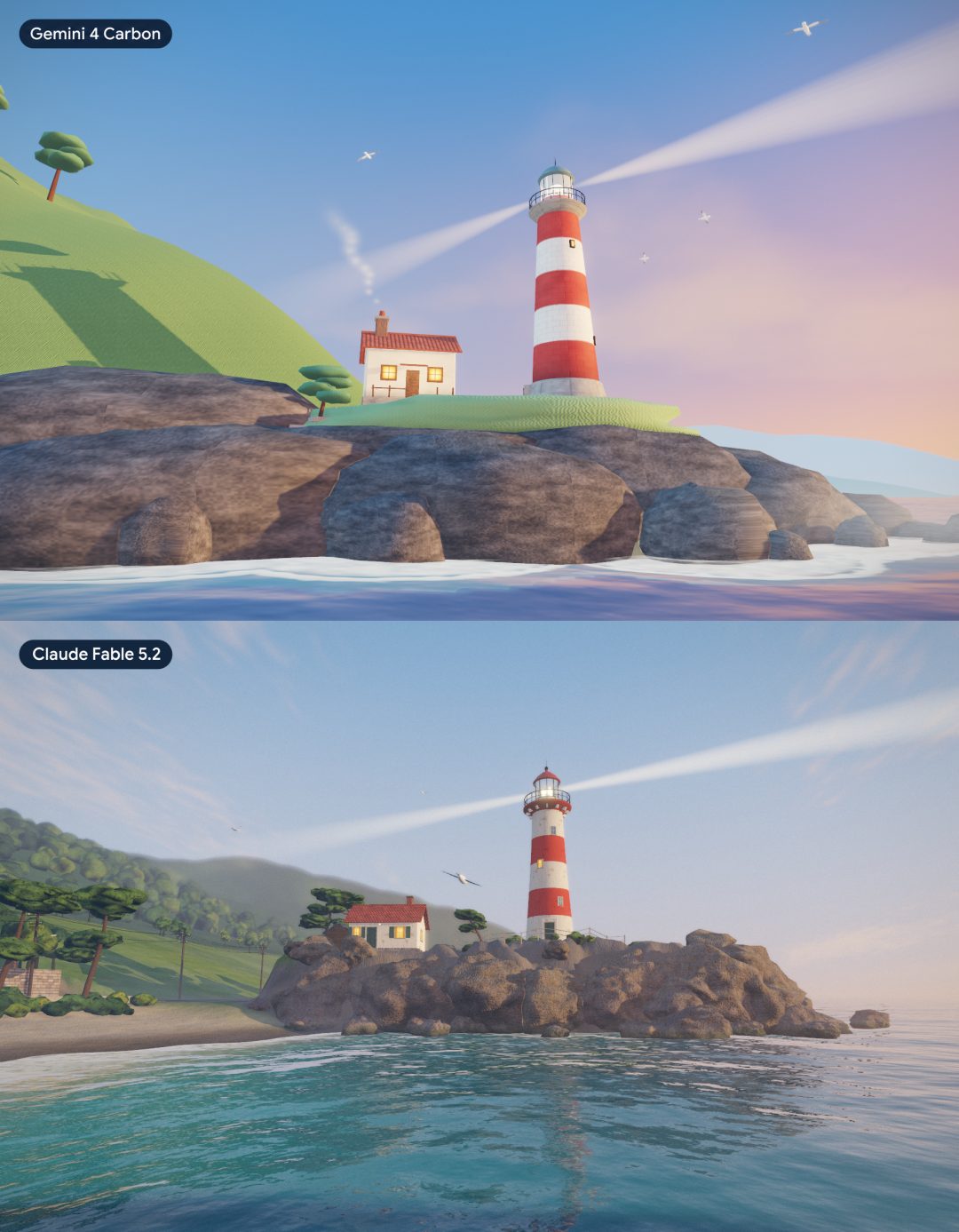
This is just the tip of the iceberg for Claude Fable 5.2.
I also want to show everyone some outrageous things that have been created in the community.
For example, the overplayed pelican riding a bike, @Tech Friend AJ made a 3D version with Fable 5.2, which wrote 4,800 lines of Python code, calling Blender's API, to complete the creation of the entire 3D scene, animation production, and rendering without operating the graphical interface...
Aside from being outrageous, I can't think of any words to describe it because, in fact, my previous profession was a designer. Back in 2018, C4D was very popular, and I had done 3D design for quite some time. I can clearly say that the modeling, feather details, skeleton binding, car animation, lighting, overall light and shadow control, and the framing of the storyboards in this video are truly comparable to a full-process designer with strong aesthetics for over 5 years. Note my wording: a full-process designer, and it must have strong aesthetics. This is a dual result of technical skill and aesthetic overlay.
Similarly, another even more outrageous case, @Jeremy Berman directly wrote Python to control Blender using Fable 5.2, without using any Computer Use, purely a video made from coding ability.
At the moment I saw it, my first reaction was to think this guy had taken another video for a parody.
Not limited to 3D modeling videos, even, an 8-hour design game done by hand.
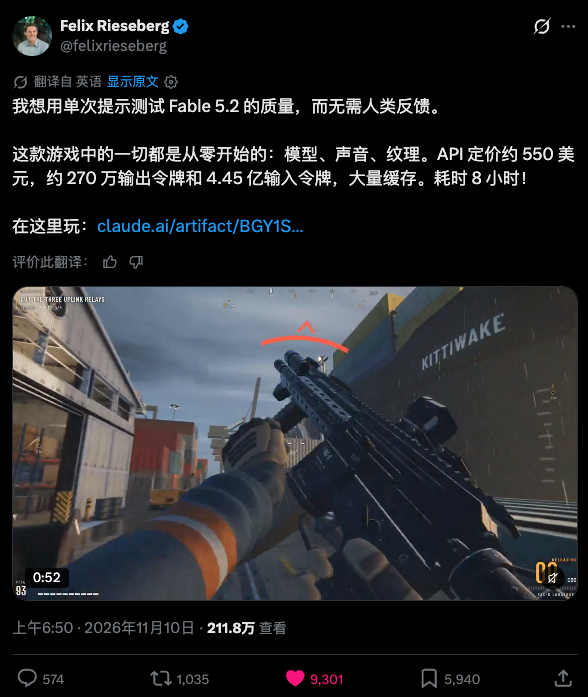
The result is like this.
Sometimes I truly feel ashamed when I see the works created by others using models, and then look at my own... the gap between people is still too large.
Also, @camperaigg used Three.js, wrote 2,000 lines of code, took 83 minutes, and produced an animation video.
And in the character performance of actions, the aesthetics are also outrageously strong.
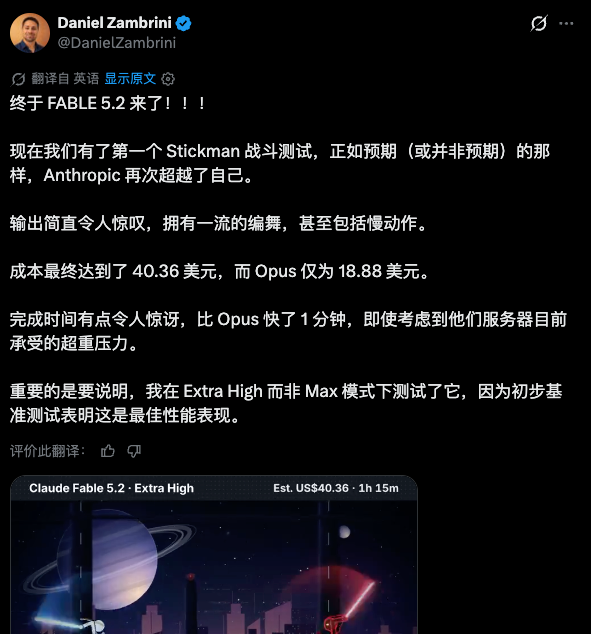
Combat in Claude Fable 5.2 looks like this.
Besides videos, the aesthetic of using code is consuming everything.
For instance, music.
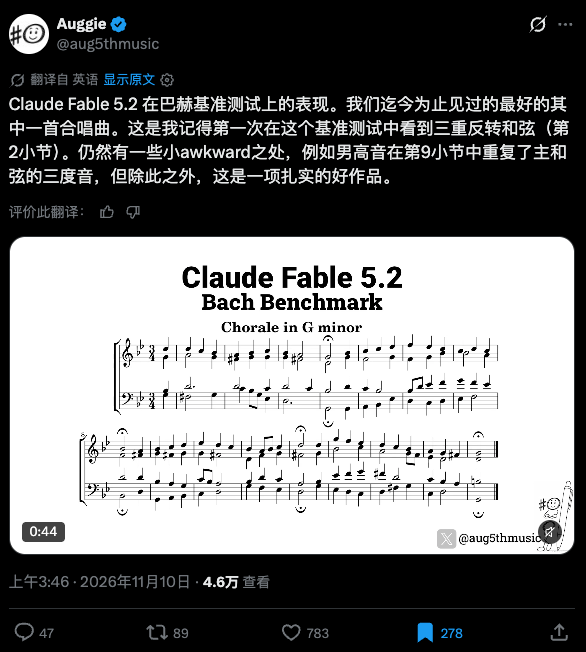
Who says big models cannot compose music directly? Of course, now they cannot compete with Suno, but... what about a year later?
Of course, the most outrageous of all is painting...
That's right, Claude Fable 5.2 can directly write code to paint, which is what makes me feel dizzy and collapse.
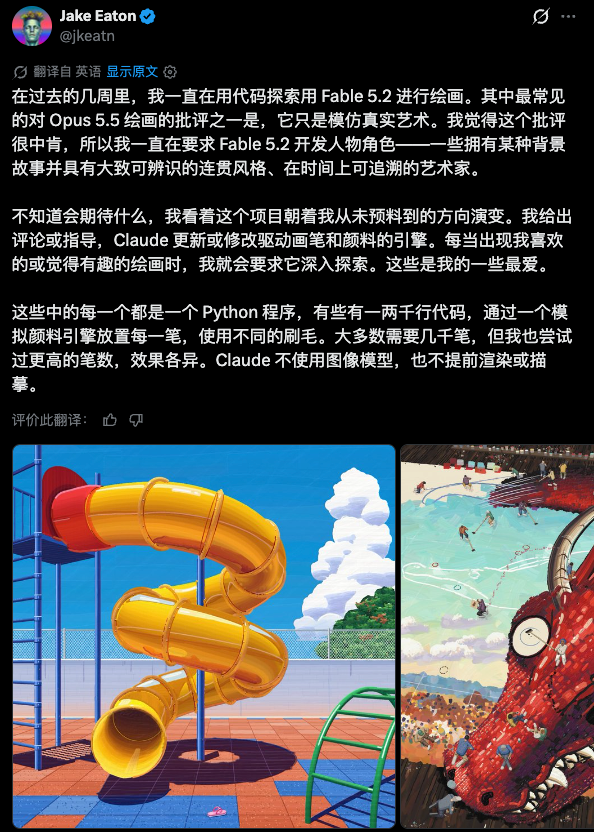
Note that this is not calling image models for generation in Claude Fable 5.2; Claude did not use any image models in this matter, nor did it pre-render or sketch. Each painting is a Python program, about one or two thousand lines of code. The program has a simulated paint engine with different brush bristles, and each stroke must go through this engine before landing on the canvas.
You can understand it as purely using code to simulate a brush for painting.
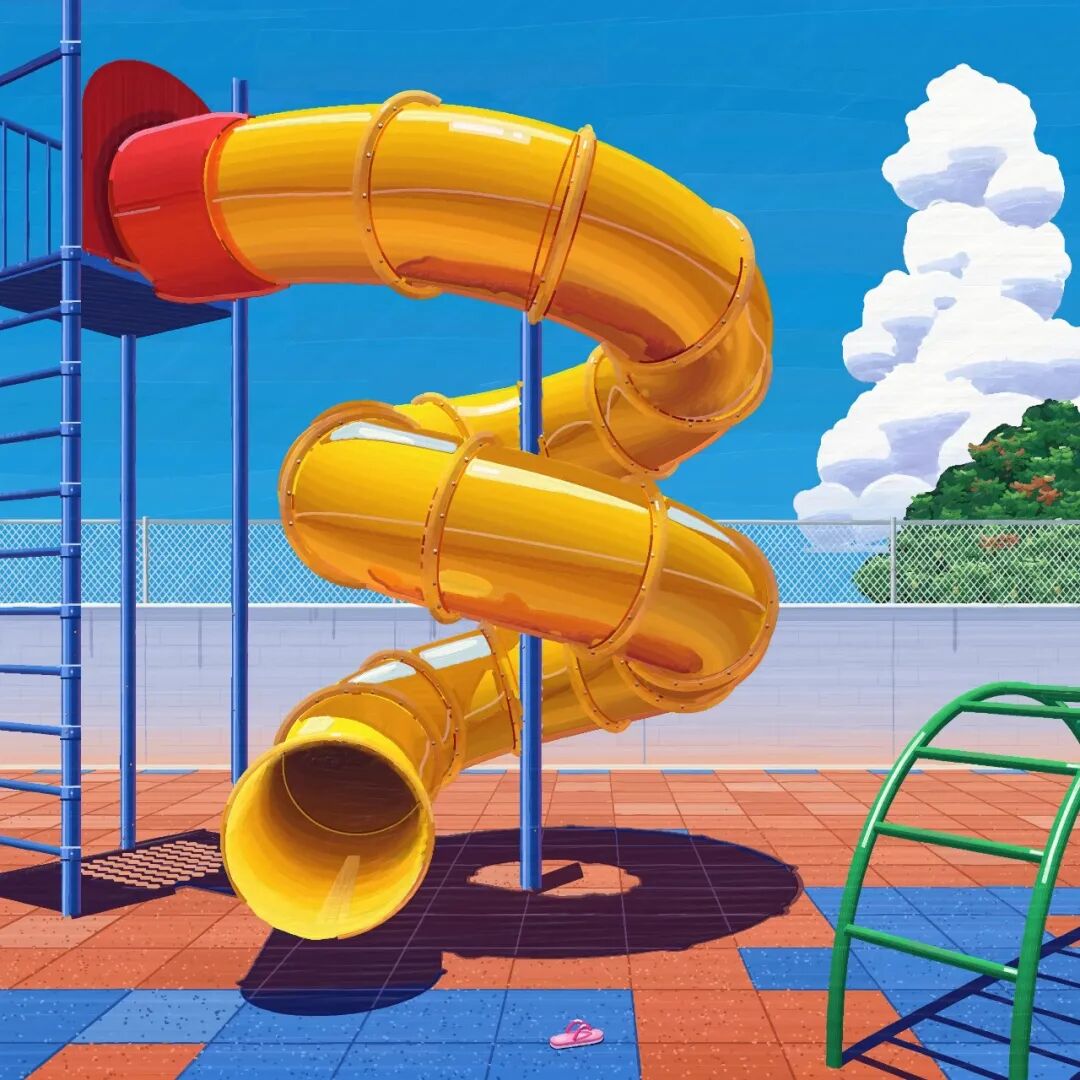
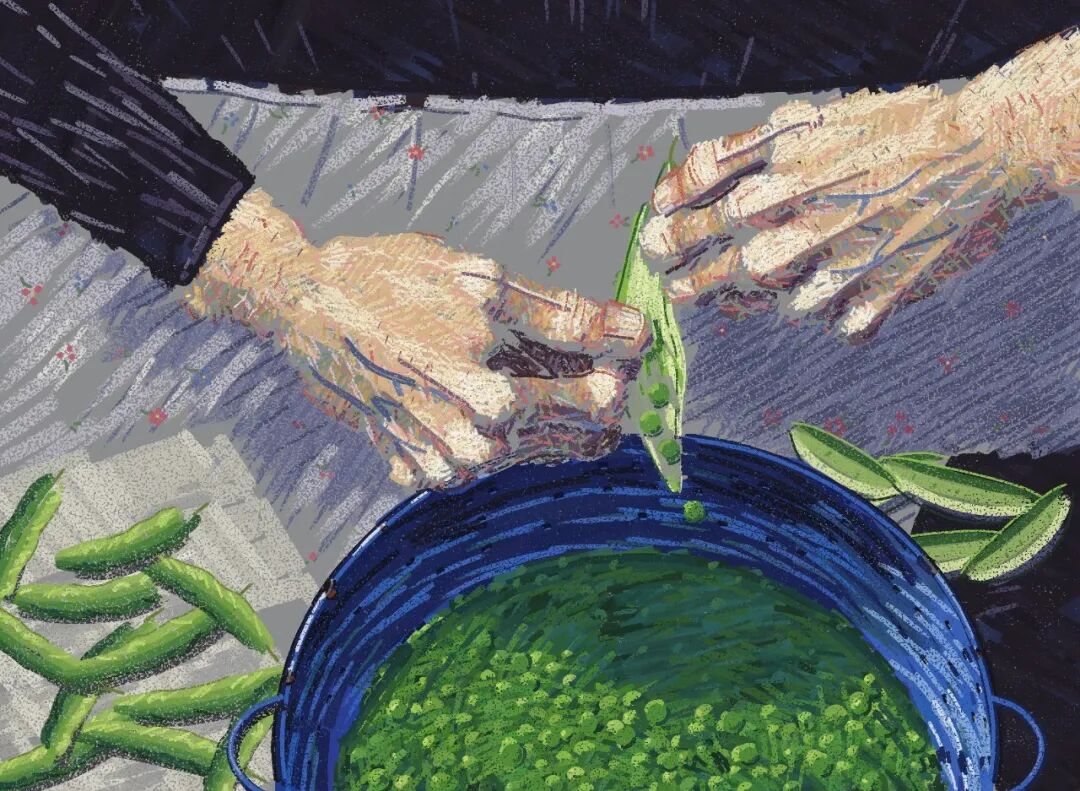
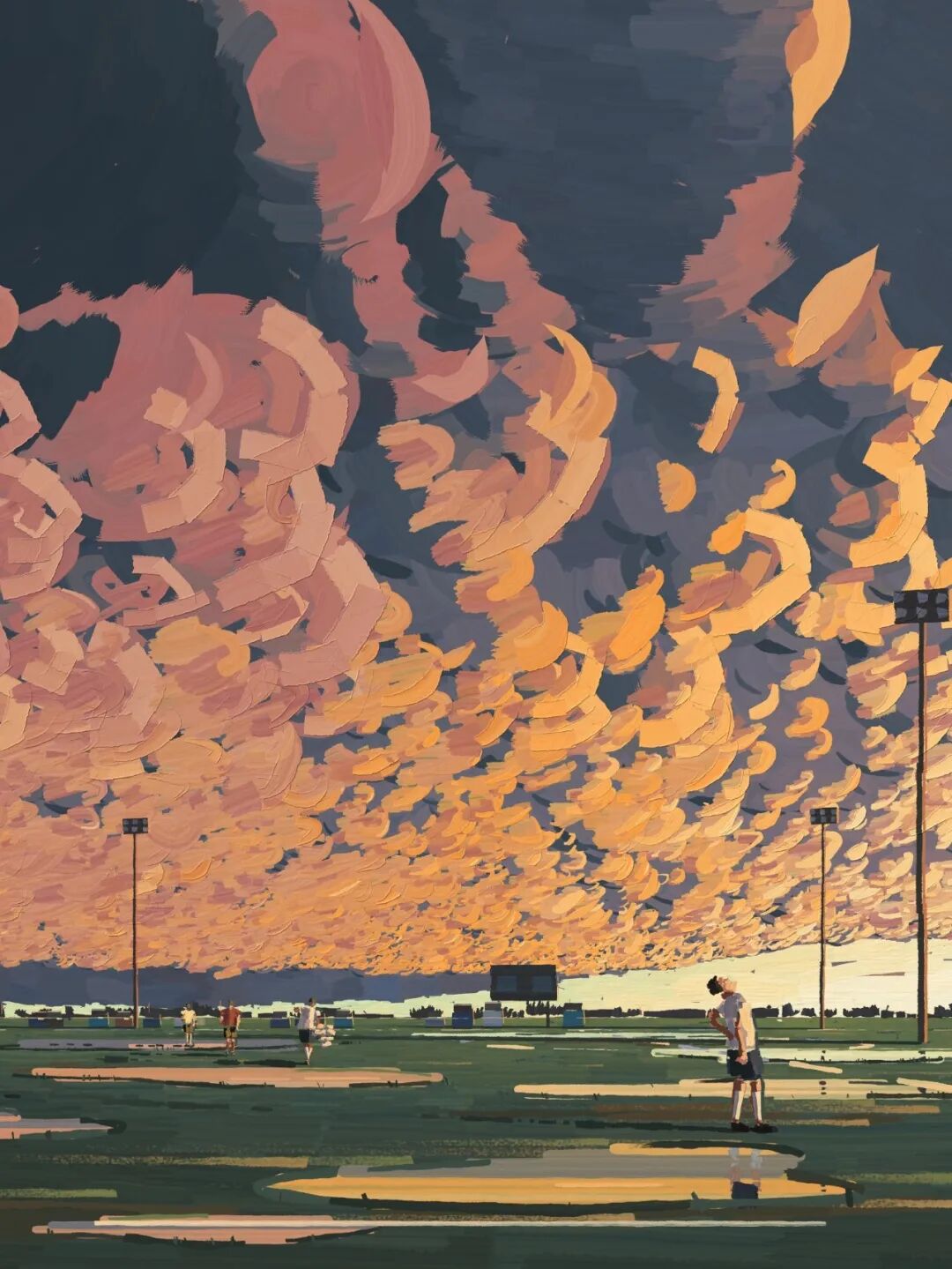
Of course, these images are not the most outrageous.
The most outrageous is this image.
An image that is as close to reality as possible, drawn with 700,000 strokes by Claude Fable 5.2.

I want to emphasize again, this is not a photo; this was drawn by Fable 5.2 using code with 700,000 strokes.
If you zoom in, you can see the details of the brush strokes completely.

I actually looked at this image for a long time.
When a person reaches a certain level of shock, they may not know what to say.
Creating on paper, stroke by stroke on the canvas, seems to have always been exclusive to humans. Even in today's booming field of live image models, painting stroke by stroke with a brush seems to carry a craft feeling that is fundamentally different from generating it directly using AI.
Many people say that the artworks generated by live image models cannot be called artworks. From a philosophical standpoint, I partially agree.
But when a model paints a piece of work stroke by stroke just like a human, can this work be considered a piece of work?
Believe me, if this had happened a few years ago when I was still a designer, and I told my colleagues that in the future you can directly create VI by coding, be able to paint and render videos, believe me, everyone would think I was a fool.
But now, it seems to be just like that; large models are using code to consume everything in the virtual world.
Moreover, they are consuming areas that seem to have nothing to do with code, belonging to the realm of artistic aesthetic.
For a long time, there has been an implicit division in everyone’s mind.
Code is science, is engineering, it’s for programmers; art is another matter, it’s inspiration, it’s feeling, it’s those things that cannot be clearly articulated.
I still remember when I was in high school, the first significant choice I made in life was the division between humanities and sciences.
If you choose science, you will study mathematics, physics, and chemistry; if you choose humanities, you will memorize politics, history, and geography; I was a bit special as I studied fine arts and took the art examination path.
It seems that since our teenage years, we have been forced into different categories.
People naturally feel that technology and art are often opposing.
But looking back now, I increasingly feel that this division is a kind of inertia left over from the industrial age.
Because human energy is limited, and the cost of learning a skill is indeed very high.
So we can only specialize.
You are responsible for coding, I am responsible for designing, he is responsible for making animations, and another person is responsible for composing music. Everyone masters a small piece of ability and then collaborates to piece together a complete work.
This system has indeed greatly improved the productivity of human society over the past few centuries.
But the core question is, do we need such fine division of labor because these abilities inherently belong to different fields, or is it because the cost of learning these abilities is just too high for humans?
After Claude Fable 5.2, the answer is self-evident.
Because for computers, many things we perceive as vastly different can actually be transformed into the same thing at a fundamental level.
Code.
Code is the thing that comes closest to a universal language in the digital world.
Moreover, code has a terrifying advantage; it can be executed repeatedly, modified infinitely, controlled precisely, and even adjusted based on the execution results.
If you ask a designer to adjust the positions of 10,000 feathers, they might think you are crazy, but for code, 10,000 feathers and 100,000 feathers are essentially just differences in computing volume.
Of course, the premise is that you must know how these 100,000 feathers should be arranged to look good.
And this is precisely what past AI lacked the most.
Aesthetic.
Although the aesthetic sense of large models led by Claude Fable 5.2 is still far from perfect, many works still need constant human guidance, but I believe nobody will question whether AI has aesthetic sense anymore.
Once large models begin to have aesthetic sense, they can use code to consume everything: images, videos, music, and so on; do you think these things cannot be made with code? What cannot be produced? In the digital realm, these things are code itself.
These are just formats; at the core, they are all code.
As long as something can be expressed, executed, and fed back in the computer, it has the potential to become a task that AI can accomplish. Those things that can be created will, in the future, almost inevitably be consumed by AI.
It’s quite ironic to think about it; last year, a large model struggled to even draw an SVG, and back then, the pelican riding a bike looked like this.
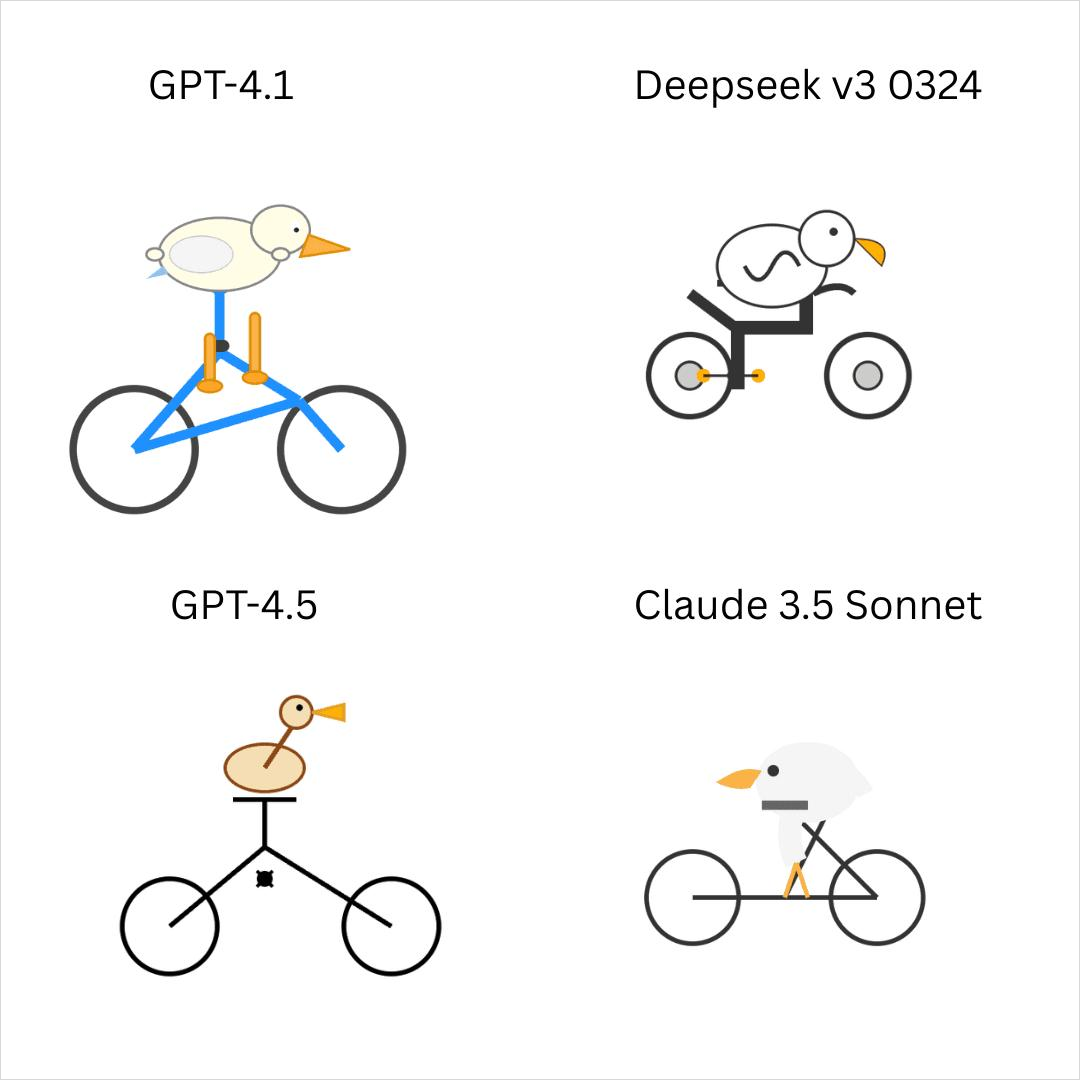
What we might be witnessing is that it is finally starting to consume things that were once considered incalculable by humans.
Including beauty.
I don’t know if this counts as AGI.
But if one day, AGI really appears, I think when we look back, we may find that its initial form is not as mysterious as we imagined.
It could just be a model, open a terminal, write a piece of code.
And then, start to create the world.
免责声明:本文章仅代表作者个人观点,不代表本平台的立场和观点。本文章仅供信息分享,不构成对任何人的任何投资建议。用户与作者之间的任何争议,与本平台无关。如网页中刊载的文章或图片涉及侵权,请提供相关的权利证明和身份证明发送邮件到[email protected],本平台相关工作人员将会进行核查。


