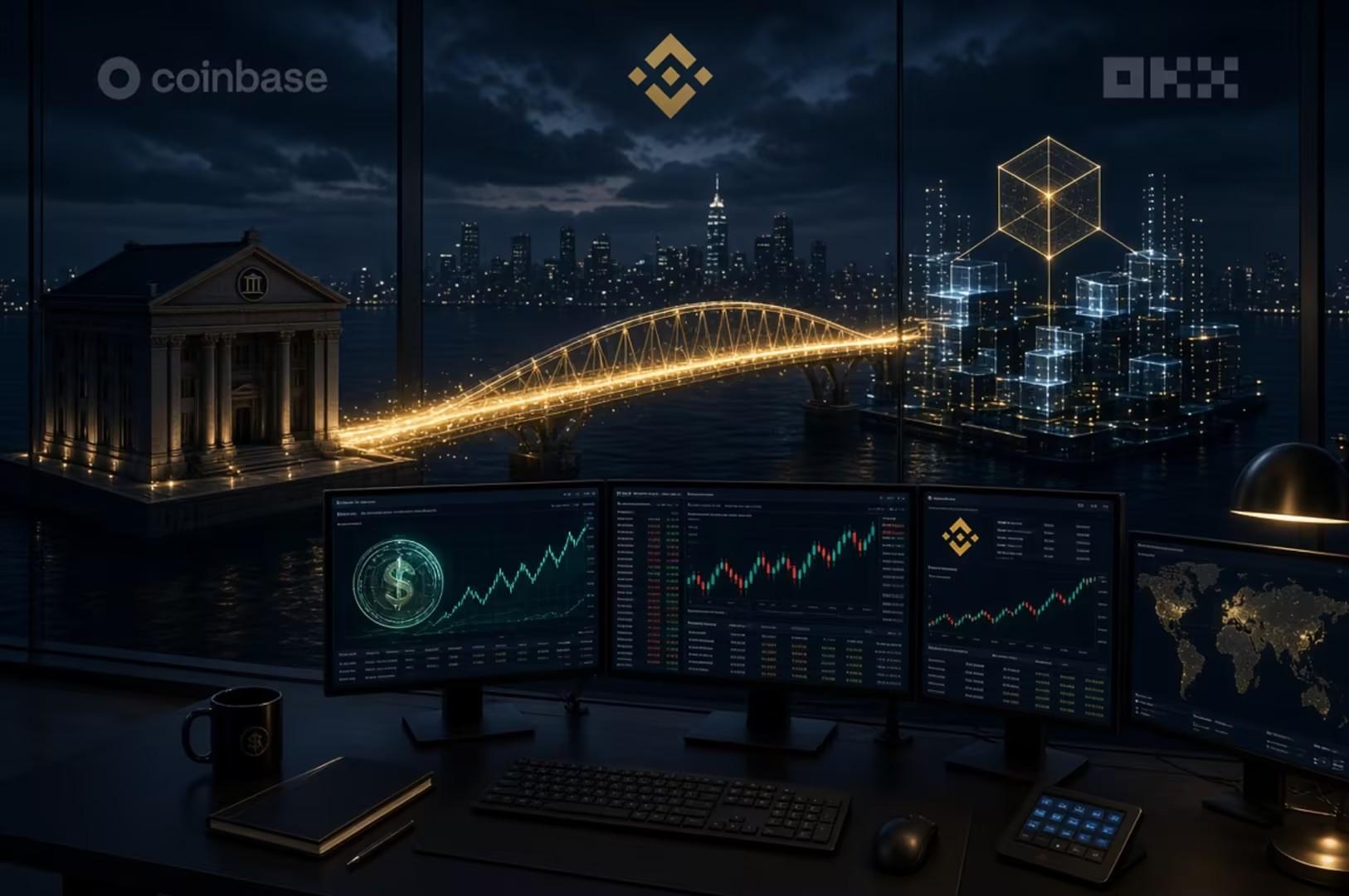
There is something worth paying attention to recently.
On November 9, PNC Bank in the United States announced a limited pilot with Coinbase: selected corporate and institutional clients can receive payments in USDC, which will automatically convert to U.S. dollars at a 1:1 rate, eventually going into the corporate bank account.
Note one detail: Corporations do not need to hold USDC or manage a crypto wallet to use stablecoins for payments.
What does this imply?
Traditional businesses may not need to enter the crypto market, but crypto infrastructure has begun to integrate into traditional financial workflows.
This may be more worthy of attention than a short-term rise of a token.
If we consider the recent actions of Binance, OKX, Bitget, and Coinbase together, an increasingly evident trend can be observed:
Exchanges are transitioning from simple cryptocurrency trading platforms to comprehensive financial infrastructures that connect traditional finance, stablecoin payments, and tokenized assets.
This change may be redefining the crypto market for the coming years.
1. PNC and Coinbase's Collaboration: What is Truly Worth Noticing?
Let’s look at this collaboration.
The limited pilot between PNC and Coinbase mainly addresses the problem of corporate payments:
- Corporations can receive funds via USDC;
- USDC automatically converts to U.S. dollars;
- Ultimately, the U.S. dollars enter the existing corporate bank account;
- Corporations do not need to directly hold or manage crypto assets.
This model appears simple but effectively connects three aspects:
- Payment Side: Using stablecoins for fund transfers.
- Conversion Side: Converting USDC to U.S. dollars using Coinbase's infrastructure.
- Bank Side: Ultimately entering the corporation's existing bank account system.
Why is this important?
In the past, stablecoins were primarily used for fund transfers between exchanges, crypto asset trading, and on-chain settlements.
Now, traditional businesses are also beginning to explore using stablecoins directly for payments, returning to traditional bank accounts.
This indicates that the value of stablecoins is extending from being transactional mediums to payment infrastructures.
Of course, this is still a limited pilot, does not represent all businesses being open, nor does it mean that the traditional banking system has fully embraced stablecoins.
However, the direction is worth attention.
2. Why Are Binance, OKX, and Bitget Changing?
If Coinbase is working to bridge traditional banks, other leading exchanges are also seeking their next growth curve.
1. Coinbase: Transitioning from Trading Platform to Financial Infrastructure
Coinbase's core advantages lie not only in trading but also in institutional custody, stablecoin services, and payment infrastructure.
The collaboration with PNC embeds its stablecoin payment capabilities into traditional banking operations.
It aims to do more than just enable users to buy and sell crypto assets; it wants corporations to be able to use blockchain financial services through its platform.
2. Binance: Continuing to Consolidate Trading Liquidity and Compliance Capabilities
Binance's advantage remains its global trading liquidity and user base.
At the same time, the platform continues to invest in compliance, proof of reserves, institutional services, and wallet ecosystems.
The recent restrictions on fund transfers related to MEXC reflect that in a regulatory environment, the flow of funds and compliance requirements for trading platforms are becoming increasingly important.
3. OKX: Exploring Tokenized Assets and Connections to Traditional Finance
OKX is advancing explorations related to tokenized stocks and expanding services for conversion between local currencies and stablecoins.
The underlying logic is that assets provided by exchanges in the future may no longer be limited to native crypto assets like BTC and ETH.
Traditional assets such as stocks, bonds, and gold may also enter a new trading and settlement system through tokenization.
4. Bitget: Expanding Wallet and Stablecoin Usage Scenarios
Bitget continues to promote wallet ecosystems, stablecoin functionalities, and compliance in different regions.
The significance of wallets lies in allowing users not only to trade assets but also to access on-chain applications, payments, and other financial services.
When looking at these actions together, the competition in the industry is changing.
In the past, exchanges primarily competed on:
- Who has the larger trading volume;
- Who has the lower fees;
- Who can attract more new users;
- Who can list more popular tokens.
In the future, they will also compete on:
- Who can secure more stable banking channels;
- Who can offer more reliable stablecoin payment services;
- Who can onboard more tokenized assets;
- Who can meet different regulatory requirements of regions;
- Who can truly bring on-chain funds into the real economy.
The next competition among exchanges is not just for trading users but for the entire financial ecosystem's entry point.
3. Regulation is Becoming the Key to the Next Round of Industry Restructuring
Industry development does not mean that regulatory pressure will lessen.
Especially in the U.S. market.
The changes in congressional power after the U.S. midterm elections will affect the legislative and investigative direction of future crypto regulation.
If the Democrats gain control of both houses in the new Congress, the investigatory powers and agenda-setting of related committees may change.
The market needs to focus on three aspects:
First, the promotion of market structure bills.
Legislation on market structure, such as the CLARITY Act, involves the regulatory boundaries between the SEC and CFTC, the classification of digital assets, and the regulation of trading platforms.
If the divisions between the two parties widen, advancing relevant bills may face more resistance.
Second, examination of political conflicts of interest.
Crypto businesses related to presidential families, the TRUMP token, and projects like World Liberty Financial may face increased investigations and inquiries.
This will make political relations, funding sources, and conflicts of interest important topics for industry regulation.
Third, stablecoin regulation still has space for independent advancement.
Rules related to the GENIUS Act and stablecoin regulatory frameworks are still worth continuous attention.
It is essential to distinguish one concept:
Stricter regulation does not equate to the crypto industry losing development opportunities.
The real change may be a shift from rapid expansion in the past to a stronger emphasis on compliance capabilities, funding transparency, and collaboration with financial institutions.
For ordinary users, this means that when choosing a platform, one should not only look at fees and trading volume but also consider the operational stability of the platform, withdrawal capabilities, and the regulatory requirements of the area it operates in.
4. What Should Ordinary People Focus on When Investing?
Turning from the industry back to ordinary investors.
The connection between traditional finance and the crypto market is tightening, but this doesn’t mean all assets will rise.
Different assets have different driving logic.
1. U.S. Stocks: Focus on Corporate Profits, Not Just AI Stories
AI remains a key investment narrative in U.S. stocks, but attention must be paid to actual corporate profits, capital expenditure, and valuations.
If AI investment continues to grow but does not translate into corresponding profits, the market may reassess the value of related companies.
It is more suitable to focus on long-term fundamentals rather than merely chasing hot concepts.
2. Hong Kong Stocks: Pay Attention to Policy and Liquidity Changes
Hong Kong stocks are significantly influenced by economic policies in mainland China, corporate profits, and global capital flows.
Technology and consumer sectors may present temporary opportunities, but volatility can be substantial.
Investors should set a position limit in advance.
3. Gold: Focus on Real Interest Rates and Safe-Haven Demand
The core logic of gold is safe-haven demand, the performance of the U.S. dollar, and real interest rates.
It can serve as a diversification tool within an asset portfolio, but gold itself does not generate interest and its price may experience significant pullbacks.
4. BTC and ETH: Monitor Macro Liquidity and Market Funds
The market positioning of BTC is gradually extending towards digital scarcity assets and institutional allocation assets.
ETH should also consider network utilization, ecosystem development, fund inflows, and on-chain financial applications.
However, it must be clear: the price volatility of crypto assets is typically much higher than that of traditional assets; one should not assume that risk has vanished just because of increased institutional participation.
For ordinary people, there is no need to buy into every asset.
More importantly, first clarify:
- How long will this money not be used?
- How much of a loss can be tolerated?
- Is it for long-term accumulation or short-term trading?
- If the market drops by 30%, will I still be able to live normally?
These questions are more important than predicting when the next bull market will arrive.
5. If You Want to Enter the Crypto Market, First Do These Three Things
First, control the scale of funds.
Do not keep adding funds because the market is rising.
First determine the range of losses you can bear and only use spare money that will not affect your living, emergency, and daily expenses.
Do not borrow money to trade crypto, nor use high leverage lightly.
Second, choose a platform with relatively mature liquidity and compliance conditions.
Top platforms like Binance and OKX have certain advantages in trading depth and product integrity, but it does not mean they have no risks.
Also, consider whether it is legal to use relevant services in your area, the platform's withdrawal rules, and asset custody arrangements.
Do not keep all assets long-term on the same trading platform.
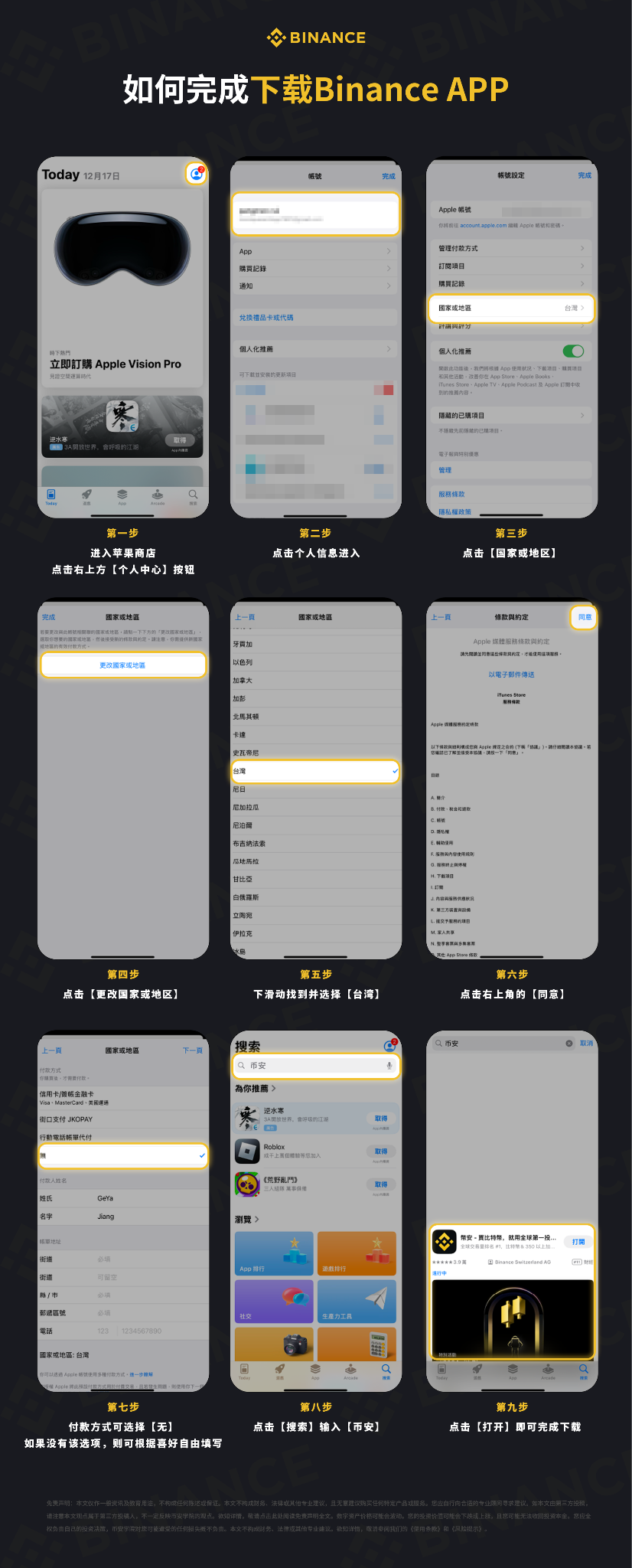
Binance Registration Link:
https://jump.do/zh-Hans/xlink-proxy?id=3
Or log in through the APP for Binance and directly fill in the invitation code aicoin668, here are the exclusive generous registration benefits of AiCoin invitation codes::
Benefit 1: New customer maximum of 440U
1. Deposit 100U + trade 100U → get 100U position voucher
2. Deposit 1,000U + trade 50,000U → get an additional 300U position voucher
3. Deposit 3,000U + trade 200,000U → get an additional 40U cash voucher
The three tiers are cumulative, and you can get the first tier with a deposit of 100U
Benefit 2: Open blind boxes, up to 25 RE
1. Register + deposit 50U + trade 100U + log into the App
2. After completing this, you will receive one activity blind box, randomly drawing RE tokens, up to 25 pieces
Equivalent to a new user completing tasks can enjoy double benefits
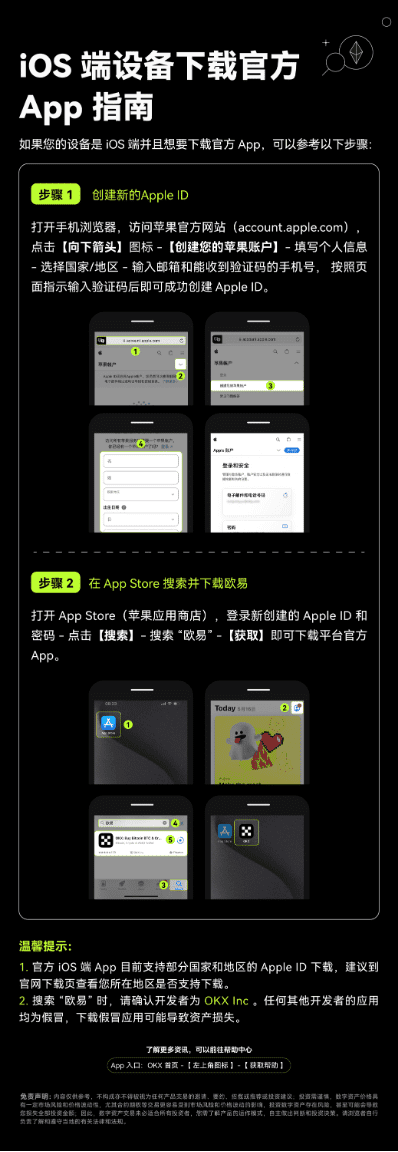
OKX Registration Link
https://jump.do/zh-Hans/xlink-proxy?id=2
Or log in through the APP for OKX and directly fill in the invitation code aicoin20, enjoying a permanent 20% fee rebate.
Third, ensure account security management.
At a minimum, ensure the following:
- Enable two-factor authentication;
- Set a withdrawal address whitelist;
- Do not click links sent by strangers;
- Do not disclose private keys and mnemonic phrases to anyone;
- Do not trust so-called guaranteed investment opportunities.
In the crypto market, earning money is essential, but keeping that money secure is equally important.
6. What Should Really Be Focused on in the Next One to Two Years?
There are three directions worth tracking continuously.
1. Stablecoins: From Trading Tools to Payment Infrastructures.
If more and more banks, businesses, and payment institutions begin to incorporate stablecoins, the future use cases for stablecoins may no longer be limited to crypto trading.
Cross-border payments, corporate settlements, and fund management could all become new growth directions.
2. RWA: Can Traditional Assets Really Achieve On-Chain Circulation?
Tokenized assets such as stocks, bonds, and gold are exploring new methods for issuance, trading, and settlement.
However, it is essential to note that tokenization does not automatically confer ownership of an asset nor does it guarantee liquidity.
The issuing entity, legal rights, redemption mechanisms, and trading depth are crucial determinants of whether a product can genuinely develop.
3. Exchanges: Who Can Become the Connector Between Traditional Finance and On-Chain Worlds?
Future trading platforms may simultaneously take on roles including trading, custody, payments, asset issuance, and financial services.
However, not every exchange will be able to successfully navigate this path.
Compliance capabilities, banking relationships, user scale, and infrastructure development will become significant competitive barriers.
Lastly: The Investment Mindset Ordinary People Should Change
The collaboration between PNC and Coinbase appears, on the surface, to be just a stablecoin payment pilot.
But it reflects a more profound change:
Traditional finance does not necessarily have to fully embrace crypto assets but may begin using blockchain infrastructure; crypto exchanges are also not content with just transaction fees but hope to enter larger financial markets like payments, custody, and asset circulation.
What does this mean for the average person?
Opportunities worth paying attention to in the future may not only come from the rising prices of BTC and ETH but also from changes in the flow of funds, financial infrastructure, and asset trading models.
However, more opportunities do not imply more frequent trading.
First understand the direction of funds before choosing an investment direction; first control risks, then consider returns.
This may be the principle that ordinary investors should stick to in the face of the next round of financial changes.
Risk Warning: This article is based on publicly available industry trends for analysis and does not constitute investment advice. Crypto assets, stocks, and gold are subject to price volatility risk; stablecoin pilots do not represent full implementation, and relevant regulatory policies may also change. Please judge independently before investing.
免责声明:本文章仅代表作者个人观点,不代表本平台的立场和观点。本文章仅供信息分享,不构成对任何人的任何投资建议。用户与作者之间的任何争议,与本平台无关。如网页中刊载的文章或图片涉及侵权,请提供相关的权利证明和身份证明发送邮件到[email protected],本平台相关工作人员将会进行核查。