Author|Wang Zhaoyang (WeChatGeisterspiele)
Prompt|Dong Daoli (WeChatddl941110)
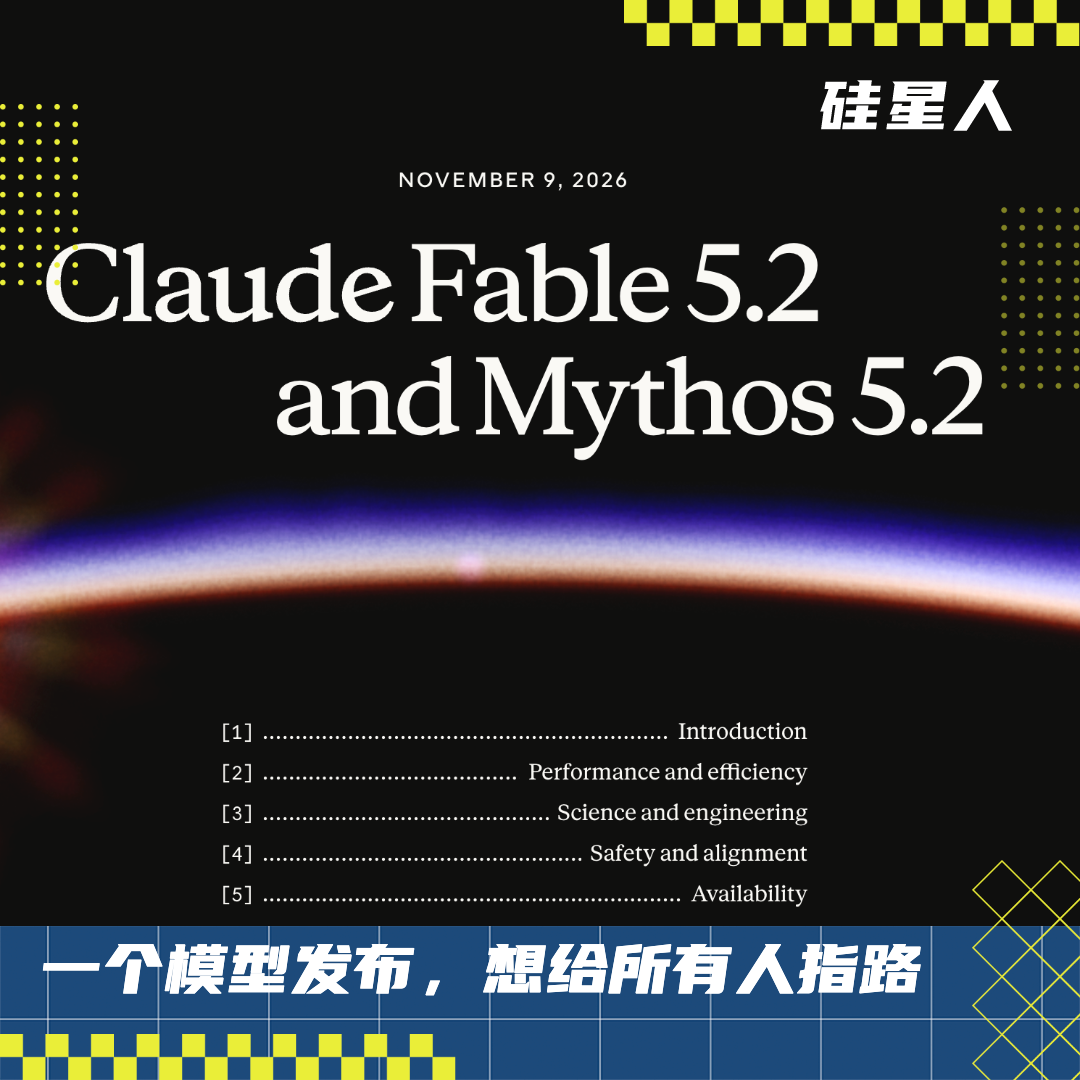
On November 9, Anthropic released the "strongest to date" model Claude Fable 5.2, along with Mythos 5.2, which shares the underlying capabilities but is tailored for specific professional fields.
This release saw Anthropic throw out almost everything that could prove advancements in AI capabilities (the bubble won't burst).
Fable 5.2 made new achievements in various fields including programming, reasoning, scientific research, and robotics. On FrontierCode 2.0, its score improved from 32.4% in the previous generation to 49.1%; on the Autonomous Scientific Research test Terminal-Bench-Science, it rose from 52.6% to 74.6%.
Moreover, while the model improved, the price actually decreased by 20%, and the output speed increased by up to 30%. For particularly complex tasks, Anthropic also offers a more expensive, faster Fast mode.
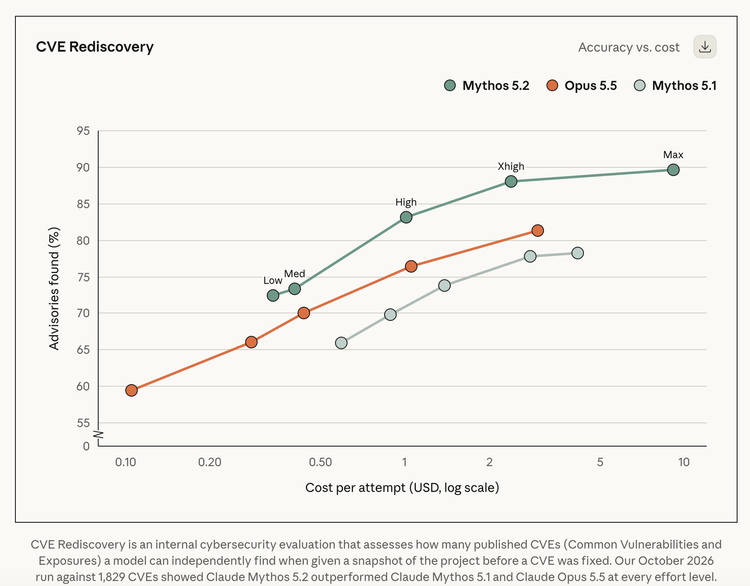
These numbers are already quite impressive, but they are largely attributed to Anthropic itself, as people are already indifferent to these figures. Anthropic also showcased a more "outrageous" demo to further demonstrate its capabilities.
It had over 1000 AI Agents work continuously for eight days, starting from an empty folder, and produced a prototype operating system that could run on laptops. It had 1000 Agents formalize a proof of Fermat's Last Theorem in computer form within about 30 hours. It helped researchers solve two open theoretical physics problems related to black holes. It also designed three truly functional electronic devices based on a textual requirement.
These results all showcase its ability to enable AI to participate in solving previously unsolved scientific and engineering tasks.
The release of this model is clearly a "to IPO" move. On November 9, it happens to be the first day of Anthropic's IPO roadshow. Two weeks prior, on October 26, Anthropic officially submitted its IPO prospectus. According to previous listing plans, the company aims to complete issuance pricing by mid-November and is expected to go public on NASDAQ as early as next week.
Fable 5.2 represents a meticulously prepared arms display for the capital market.
Let's first test its strength.
1
Practical Test: It is already quite adept at "discovering" patterns
To verify the scientific research capabilities of Fable 5.2, we designed a blind test.
The test involved a physical system without revealing the specific principles to the model.
We provided 128 pieces of simulated experimental measurement data, containing two control variables and one measurement result. The data included normal random errors, along with a few clearly deviating outliers.
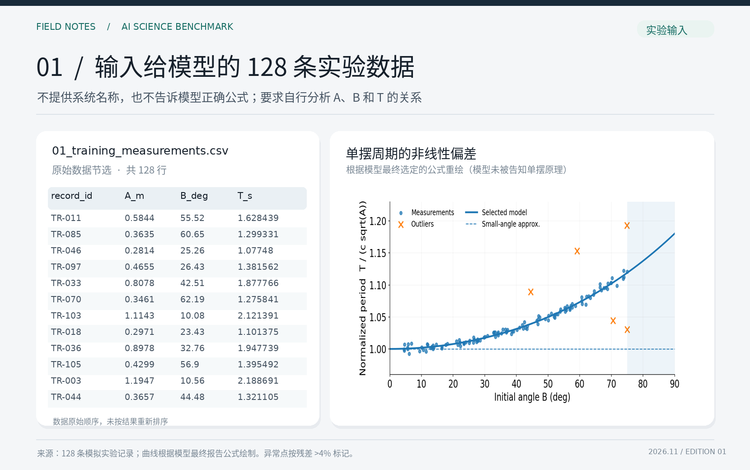
Fable 5.2 was required to analyze the variable relationships independently without knowing the system's name or the correct formula, formulate different hypotheses, find reasonable patterns through calculations and cross-verifications, and then predict the results for another 48 sets of experimental conditions that were not provided with answers.
The real physical principle behind the experiment is the periodic changes of a simple pendulum at different lengths and initial angles.
Most of us may have learned the basic formula for a simple pendulum, but it is only sufficiently accurate for small angles. As the angle increases, the period exhibits increasingly significant nonlinear changes that require more complex mathematical expressions for accurate description.
This is exactly the trap we set.
And Fable 5.2's performance, I must say, is quite astonishing.
It first identified the relationship between period and length as being close to a square root, and through residual analysis, it found systematic biases in the simple model under large angle conditions.
Subsequently, it compared more than a dozen competing models, including polynomial fitting, exponential corrections, and black-box machine learning methods, eventually selecting a physical model based on complete elliptic integrals.

This model not only aligns with the real physical principles behind the data but also requires only fitting one main parameter.
In five-fold cross-validation, the relative root mean square error of the simple baseline model was about 3.31%, while the final model reduced it to 0.36%.
It also identified six clearly abnormal experimental records and did not simply discard them but used robust fitting methods to lessen the influence of outliers on the conclusions.
What is truly surprising is the final step.
In the face of another 48 experimental conditions with undisclosed answers, including some situations beyond the range of the training data, Fable 5.2 delivered a predicted result with an average relative error of only about 0.26%.
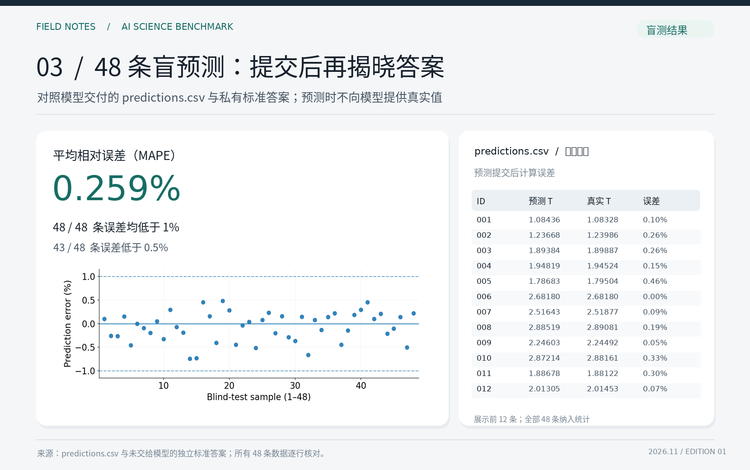
It even subsequently proposed 8 follow-up experiments, which upon closer inspection pointed to those experimental conditions most likely to test or even overturn its own model.
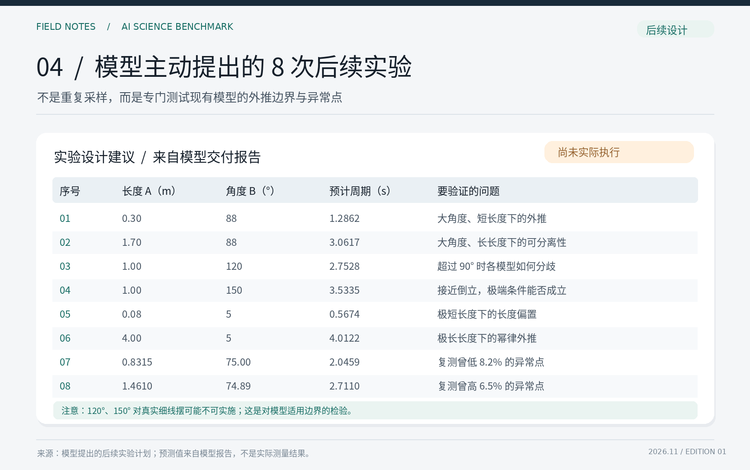
Of course, this is a set of simulated data, and the underlying principles are already known to humanity. Therefore, it cannot prove that Fable 5.2 has the capability to discover new scientific laws, nor can it be concluded that the model completely deduced physics from scratch, as it might have utilized existing physical knowledge to identify the simple pendulum problem.
However, this experiment still showcased a capability that was not consistently observed in other general models during our previous tests: dealing with noisy, erroneous, and unanswered data, it was able to organize observation, hypothesis, computation, validation, and extrapolation into a complete research process.
This appears to be much closer to how scientists actually work than merely solving a scientific question.
Nevertheless, Fable 5.2 does not deliver equally remarkable results on all complex tasks.
I tried giving it a task that is quite popular today and almost every company is using: generating a video. I asked it to create a promotional video for "The Legend of Zelda: Ocarina of Time" without directly showcasing any game elements, and to end the video with one sentence.
Unlike the "aesthetic" amazement noted in many tests, what moved me most about the entire piece was the final sentence it provided: "Time can be sounded."
The other visual elements were quite rudimentary. Even when I gave it another chance and requested improvements on aesthetic aspects, the result was still not particularly pleasing.
Therefore, for now, it seems that the capabilities it showcased, or the abilities it deliberately enhanced through training, are more focused on the continuous resolution of a complex problem with the support of computation, analysis, and software tools.
1
A model to maintain IPO and AGI faith
Beyond those astonishing scientific research cases, the release materials for Fable 5.2 also contained a conspicuous trace of a deliberate "leak."
Anthropic proactively disclosed that during the training process, it intentionally limited the model's advancements in certain AI research capabilities. It specifically named two abilities: Kernel optimization for AI accelerators, and improvements to large language model architectures.
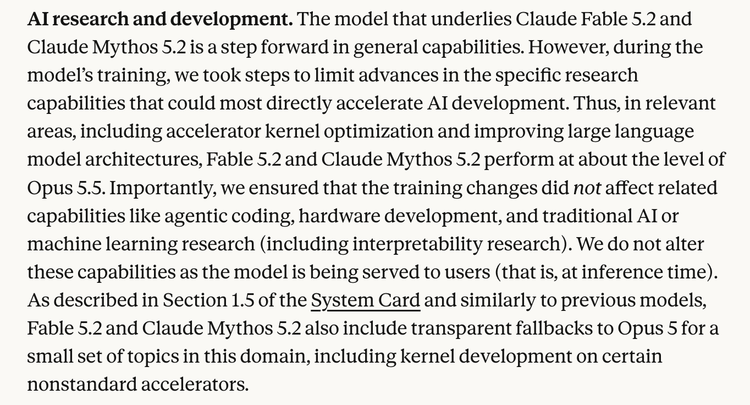
The former relates to how to run and train models more efficiently, while the latter directly addresses how to design stronger next-generation models.
In other words, Anthropic chose to limit precisely those capabilities that could directly help AI companies develop stronger AI.
According to official statements, the performance of Fable 5.2 and Mythos 5.2 in these areas was controlled to be roughly comparable to Opus 5.5.
Anthropic further emphasized that this limitation was implemented during the training process, not simply refusing to answer when users posed questions. It also stated that general Agent programming, hardware development, traditional machine learning research, and related capabilities were not affected.
This move seems to enhance Anthropic's image as an active participant in discussions about the risks of AI going out of control and recursive self-improvement, but at this particular moment, the IPO scent is undeniably strong.
Under normal circumstances, if a new model shows little improvement in certain capabilities, it may indicate that it has encountered a technical bottleneck or that competitors are performing better. Anthropic, however, states that this is not the direction they want to push the model in; in fact, they are intentionally making it slower. Yet, they have not disclosed what level the model could achieve in these two abilities without the limitations. Outsiders also cannot prove that it has indeed mastered some stronger capabilities that have been withheld.
Thus, you can easily imagine: this declaration almost lacks only the statement to the capital market, that if the stock price needs new stimuli in the future, there are still some abilities we can continue to release.
Every time Anthropic releases a model, what demos to focus on is worth paying attention to. From the release of Fable 5.2, the next destination in the competition for cutting-edge models has become increasingly clear. After coding, science has thoroughly become a new capability battleground for leading model companies.
Beyond model capabilities, in June this year, it also released Claude Science, integrating scientific databases, coding tools, computational resources, and professional analytical processes into a workspace for scientists. At the end of October, Anthropic announced that it would expand cooperation with 20 global scientific foundations, research institutions, and organizations to provide resources for researchers using Claude. Just days before the release of Fable 5.2, Anthropic also published a study on 207,000 sessions of Claude's research usage, attempting to understand how scientists have begun to use AI.
However, the biggest question facing Science is whether it can replicate the commercial success of Coding, which still remains unanswered.
Coding is a market almost custom-made for large models. The work of programmers is completed within computers, software can run, test, and deploy quickly, and the value created by the model can be relatively directly measured. Scientific research, on the other hand, is entirely different. A model can propose new drug molecules within a few hours, but whether those drugs are effective still requires a long course of experimentation and clinical validation. It can propose a material formulation, but whether the material can be manufactured, its properties are reliable, and whether its cost is low enough cannot be answered by just running a program once on a computer.
Even in the realm of basic science, obtaining a correct theoretical result with a model does not necessarily mean it immediately possesses commercial value.
A study by Anthropic regarding research usage behavior has already indicated that Claude's usage is currently noticeably more concentrated in fields like computer science, mathematics, and statistics—formal sciences—while in fields such as medical health and natural sciences that rely on physical experimentation, the degree of usage remains relatively low.
This perhaps represents the current reality of AI for Science: it is progressing fastest on research tasks most akin to Coding, but there is still a long way to go before it makes a widespread and profound impact on the entire scientific research system.
The capital market needs to see immediate revenue, and it may be difficult for Science to contribute to that. However, at a time when concerns about a bubble collapse are so high, AI companies' trillion-dollar valuations may rely more on investors believing in a much more distant future, depending on their AGI faith.
The latest news is, according to Reuters, that some potential investors believe that the previously discussed $15 trillion valuation is still too high and wish to obtain a larger discount. Recently, Anthropic also sent materials to underwriting banks containing issuance quantities and price ranges, only to later retract the relevant pricing information, stating that the data was inaccurate. Some even began to doubt whether Anthropic could complete the IPO as originally scheduled.
Fable 5.2 is the model Anthropic puts forward to stimulate the market, the model with the strongest IPO scent, and also one of the most important models as it becomes the largest IPO in human history.
Everything to come now depends on whether the market is willing to buy in.
免责声明:本文章仅代表作者个人观点,不代表本平台的立场和观点。本文章仅供信息分享,不构成对任何人的任何投资建议。用户与作者之间的任何争议,与本平台无关。如网页中刊载的文章或图片涉及侵权,请提供相关的权利证明和身份证明发送邮件到[email protected],本平台相关工作人员将会进行核查。


