Last week, the S&P 500 fell by 2.70%, QQQ dropped by 4.98%, but XLV remained basically flat. On the first trading day after the midterm elections, XLV rose by 3.07%, and Moderna surged by 14.64% in a week. As AI trading begins to exhibit severe divergence, the pharmaceuticals sector is gaining funds for reevaluation. For investors preparing to build positions, the most important thing now is not merely to assess whether "pharmaceuticals will rise," but to distinguish between large pharmaceuticals, biotech, and medical devices, and find the true catalysts for each's rise.
Core Highlights
- In a week of significant AI sell-off, the pharmaceuticals sector has completed a relative strength test. From November 2 to 6, SPY fell by 2.70%, QQQ dropped by 4.98%, and the Nasdaq fell by 5.52% on November 5. Meanwhile, XLV only dropped by 0.04%, XBI fell by 2.42%, and IBB decreased by 1.83%. Pharmaceuticals are not completely unaffected by market shocks, but funds have clearly not retreated as aggressively as they did from AI assets.
- The key to this round of market behavior is that as policy risk decreased, the market began to re-price performance certainty. After the midterm elections, drug price legislation temporarily fell to the back burner, easing the previously significant policy constraint on the pharmaceutical sector. At the same time, companies like Moderna have demonstrated through performance, profit, and cash flow that some pharmaceutical assets have entered a realization phase.
- However, do not treat "pharmaceuticals" as one stock. The upward logic for large pharmaceuticals, biotech, and medical devices is entirely different. Eli Lilly's revenue grew by 39%, yet the stock fell by 4.48% in a week, while Moderna's profit turned around significantly and rose by 14.64%. Individual medical device stocks like IDEXX and Baxter also displayed strong performance. The real opportunity has shifted from "buying the sector" to "picking companies."
- For ordinary investors, the most practical observation sequence going forward is: first use XLV to judge whether the sector has sustainability, then choose between large pharmaceuticals, biotech, or medical devices based on personal risk tolerance, and finally determine specific entry points using financial reports, FDA milestones, and valuations. If you simply chase into pharmaceuticals because they have shown resilience recently, you may end up buying stocks that are already fully priced. Conversely, if you wait until both funds and performance are confirmed before doing research, you may often miss the best prices.
1. Why has pharmaceuticals suddenly become strong? First, look at "where money is withdrawing from and where it is going to."
Last week, the most obvious trade in U.S. stocks was the concentration of withdrawals from AI assets. From November 2 to 6, SPY fell by 2.70%, QQQ fell by 4.98%, and the Nasdaq dropped by 5.52% on November 5. Chips, cloud computing, and high-valuation growth stocks became the primary selling direction, while XLV only fell by 0.04% for the entire week, XBI dropped by 2.42%, and IBB decreased by 1.83%.
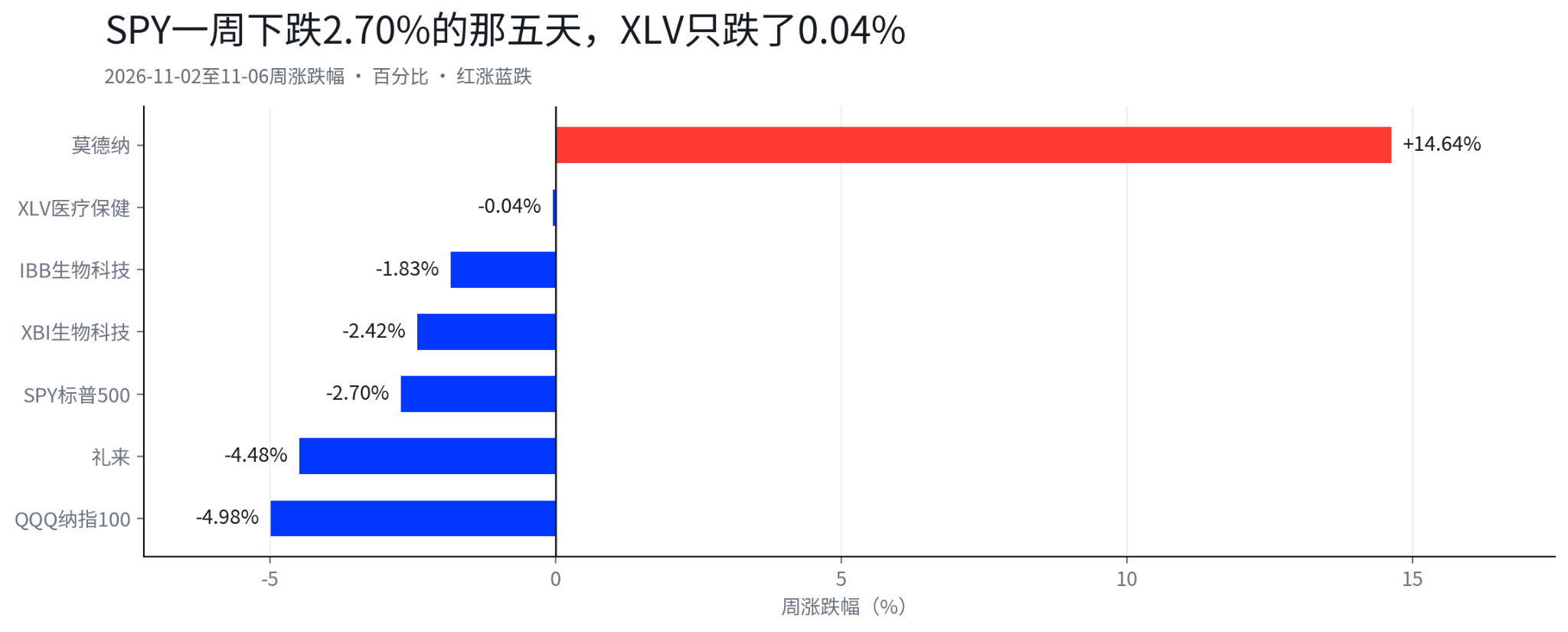
Caption: Weekly gain and loss comparison from November 2 to 6. Moderna and XLV approached flat, while QQQ and Eli Lilly had notable declines. Red represents an increase, blue represents a decrease.
The real value of this data lies in proving that when the market began to reduce positions in overvalued assets, pharmaceuticals achieved a higher retention of funds. On the same day the Nasdaq plummeted on November 5, XLV still dropped by 2.50%, XBI even fell by 6.73%, but in the two subsequent trading days, XBI rose by 2.57% and 3.08% respectively, and XLV increased by 1.91% on November 9. Funds did not treat pharmaceuticals as a completely independent safe haven from the market, but rather returned more quickly after the panic.
Caption: Daily gain and loss of XBI and XLV from November 2 to 9. Both rose on November 4 post-election, experienced a sharp drop on November 5, and then XBI led a recovery for two consecutive days.
The midterm election provided a new catalyst for this relative strength. On the first trading day after November 4, XLV rose by 3.07%, XBI climbed by 2.67%, and IBB increased by 2.63%. The rise on that day can hardly be fully explained by the companies' fundamentals; it is more akin to the market pre-pricing the decline in policy risk.
Capital flows also support this change. On November 2, XLV had a net inflow of approximately $175.3 million, and an approximately $284.5 million net buy again on November 4, with a total increase of around $1.1 billion for the week. In contrast, XBI had about $314 million in net outflows over the past five trading days. This difference is significant: the market is already willing to buy pharmaceuticals, but currently prefers certainty over an immediate full bet on high-risk biotech.
Caption: XLV saw net inflows at three points in time, with a total weekly increase of about $1.1 billion. XBI experienced cumulative net outflows of about $314 million over the last five trading days, but turned to net inflow of around $30 million on November 5. Blue represents net inflow, red represents net outflow, units are in billions.
Thus, the first layer of logic for this market behavior is quite clear: after the decline in AI trade congestion, capital is seeking new directions for absorption, while pharmaceuticals possess characteristics such as easing policy risk, certain strong performance from some leaders, and differentiated valuation structures, making it a sector that funds are willing to rethink.
But this only answers "why look at pharmaceuticals," and does not address the most critical question: if you are genuinely ready to buy now, which category should you buy?
2. Do not buy "pharmaceuticals" indiscriminately: three types of stocks, three observation methods
The most common mistake ordinary investors make is to see XLV outperforming the market and then directly assume all pharmaceutical stocks will rise accordingly. In reality, the risk-return characteristics of XLV, XBI, and medical devices are very different and can even exhibit completely opposite performances in the same week.
Large Pharmaceuticals: The Certainty Route, Look at "Can the Money Already Earned Continue to Grow?"
This category should first focus on large companies such as Eli Lilly (LLY), Johnson & Johnson (JNJ), and AbbVie (ABBV). Their strengths lie in established products, stable revenue, and robust cash flow, so their elasticity is not the greatest, making them more suitable for those looking to reduce portfolio volatility while still wanting to participate in the pharmaceutical market.
However, large pharmaceuticals are not a blind buy either. Eli Lilly is a very typical case. The company's Q3 revenue was $24.397 billion, a 39% year-over-year increase, with Mounjaro sales of $10.723 billion, a 65% year-over-year increase. The annual revenue guidance was raised from $85 billion to $87 billion to $91 billion to $92 billion. The performance itself is very strong, yet the stock still fell by 4.48% last week.
The reason lies in market trading around "how good the performance is relative to expectations," rather than simply "whether the performance is good or not." Before the financial report was released, Eli Lilly's stock price was already at historical high territory, with high market expectations for the sales, price, and future growth of GLP-1 products. The financial report showed a sales contribution of 53 percentage points but actual prices dragged down by 15 percentage points, indicating that in the next phase, the market will focus more on the quality of growth, rather than simply chasing revenue growth rates.
Therefore, if choosing large pharmaceuticals, ordinary investors should watch three numbers: core product sales growth, whether annual guidance continues to be raised, and whether the valuation has already reflected optimistic expectations. If performance continues to be upgraded, but after a price adjustment, the valuation has clearly decreased, it is usually more attractive than directly chasing after breaking historical highs.
Biotech: The Elasticity Route, Look at "Can the Catalysts Turn Future Value into Current Stock Price?"
XBI and IBB contain many companies without mature profits, and some are still in clinical stages, so they cannot be assessed mainly by price-to-earnings ratio like Eli Lilly. For such stocks, the determinants of stock price often include FDA reviews, clinical data, product approvals, commercialization progress, and cash reserves.
This is also why biotech cannot simply be assessed by "whether the industry is strong." If a company is a year away from key clinical data, and its cash can only last for a few quarters, then even if the entire XBI rises, it may significantly underperform due to financing needs, clinical failure, or commercial performance falling short of expectations.
Therefore, investors preparing to buy biotech should first create a very simple table: what is the next catalyst, when will it happen, how much revenue potential exists after a successful outcome, how much cash does the company have, and how much will it fall if it fails. As long as the answers to these five questions are not clear, it is not suitable to chase in just for a sudden sector rise.
Currently, XBI remains in a state where funds are waiting for confirmation, which actually indicates greater potential elasticity. If future cash flows from XBI transition from continuous net outflows to several consecutive trading days or weeks of net inflows, while the index breaks recent highs, then it means funds have truly begun to flow into high-elasticity biotech. For ordinary investors, this is much safer than chasing a suddenly surging clinical stock.
This week, companies with clear FDA or clinical milestones, such as TG Therapeutics, Scholar Rock, Liquidia, and Summit Therapeutics, can be put on the watch list. The key is to know in advance when events will occur and how much has already been priced in by the market. Buying directly upon seeing FDA dates can easily lead to losses; only when events happen can one cleverly judge whether to pursue, wait, or sell.
Medical Devices: Valuation Repair plus Demand Improvement, Not Betting on a Single Drug
Medical devices are another route worth noting, centering on "valuation repair plus demand improvement," rather than betting on a single drug.
In the past week, IDEXX rose by 22.65%, Baxter rose by 12.09%, indicating that funds have not only switched between traditional pharmaceuticals and biotech but also began to show clear relative returns in medical devices.
This type of company has a very practical advantage for ordinary investors: they typically do not rely completely on a single drug trial like clinical-stage biotech, nor do they require the market to constantly maintain extremely high growth expectations like leading GLP-1 companies. For those looking for risk-return balance within the pharmaceutical sector, focusing on medical device order numbers, hospital capital expenditures, product renewal cycles, profit margins, and free cash flow is essential.
Thus, if the investment objective is to seek a moderate-risk alternative after reducing AI positions, large pharmaceuticals and medical devices are often easier to understand than clinical-stage biotech. If the goal is higher elasticity, then prioritizing XBI and biotech companies with clear catalysts is advisable. These three directions do not contain an absolute superiority; the key lies in whether you are seeking stability, performance growth, or event-driven high elasticity.
3. The Policy Window is Improving, But Do Not Treat "Negative News Delayed" as a Long-Term Bull Market
One of the previous biggest valuation constraints on the pharmaceuticals sector was the uncertainty surrounding U.S. drug pricing policy. After the midterm elections, this variable is marginally improving. RBC's analytical framework believes that under the new political landscape, the Democrats have more prioritized policy agenda items to address, making drug pricing legislation unlikely to be at the forefront in the short term. Meanwhile, the IRA has already established the Medicare drug pricing negotiation mechanism, with the coverage scope gradually expanding, meaning that there is no immediate need to push through new large-scale legislation to advance drug pricing negotiations.
The market is now focusing more on ACA health insurance subsidies and Medicaid-related policies. If coverage and payment capabilities are maintained, it might actually provide support to the overall healthcare industry. For pharmaceutical companies, this means that some of the policy risks that previously weighed on valuations have not further deteriorated. However, this logic must have a time limit. Institutions like Leerink judge that drug pricing issues may still become a policy focal point before the next presidential election. In other words, the current situation resembles a valuation repair window following a decline in policy risk, rather than a permanent shift in drug pricing policy.
For investors, this means that there is no need to chase the entire sector all at once due to "policy goodwill"; it's more suitable to utilize the upcoming months' financial reports and policy nodes to filter the companies that can genuinely realize performance. One noteworthy policy node to study in advance is the reauthorization of FDA user fees. Related legislation needs to be completed by September 30, 2027. If the new bill mainly focuses on speeding up drug reviews and improving R&D efficiency—a direction where bipartisan consensus can relatively easily be formed—it could be a potential positive for biotech. However, if drug prices become an important component again, it would mean the current valuation repair logic needs reevaluation.
Therefore, the greatest value of policy now is that it provides pharmaceutical companies and investors with a time window to reprice. What ultimately determines how far this window can extend hinges on the companies' profitability and cash flow.
4. Why did Moderna rise by 14.64%, while Eli Lilly fell by 4.48%? Because of "Expectation Discrepancy"
If you want to truly understand how to select pharmaceuticals stocks in the next phase, comparing Moderna and Eli Lilly is more important than simply looking at ETFs:
Moderna reported Q3 revenue of $1.31 billion, a year-on-year increase of 29%, clearly exceeding the market's previous expectation of around $890 million. GAAP net profit reached $162 million, with a diluted earnings per share of $0.38, while the market had previously expected a loss of $1.09. The company also raised its full-year revenue growth guidance from a maximum of 10% to 15% to 25%, and increased its end-of-year cash guidance to $8.1 to $8.3 billion, with R&D expenses decreasing year-over-year by 27% to $583 million.
This is a very typical bottom-line turnaround earnings report: revenue exceeding expectations, losses turning into profit, increased cash, decreased costs, and an upward revision of annual guidance. For a stock that previously had low expectations, such changes are sufficient for the market to revalue it. Therefore, Moderna surged by 14.64% in a week, touching a 52-week high of $267.50 in intraday trading on November 6.
Caption: The left image shows the weekly gain and loss; Moderna rose by 14.64%, while Eli Lilly fell by 4.48%. The middle and right images present the actual Q3 revenue values versus market expectations, in millions. Light blue is market expectation, dark blue is actual value.
Eli Lilly is exactly the opposite. Its performance is also very strong, but the market already knew it was strong. Q3 revenue was $24.397 billion, a 39% year-over-year increase, with Mounjaro sales of $10.723 billion, a 65% increase year-on-year, and a significantly upgraded full-year revenue guidance. The problem is that the stock price was already at historical highs before the financial report, and the market required it to continue presenting a higher growth trajectory.
This indicates the most important stock selection logic among pharmaceuticals stocks now: do not just ask "Is the company good?" but also ask "How high a price has the market assigned to it as a good company?"
For leading companies already at high levels, if product sales continue to grow but prices begin to come under pressure, and market expectations are overly high while valuations do not decrease significantly, then even if the next financial report is still excellent, it may not necessarily drive the stock price higher. Conversely, a company that was previously undervalued, has just seen profit turnarounds, cash flow improvements, and has begun to upgrade guidance, is often much more likely to experience valuation reappraisals.
Thus, ordinary investors examining pharmaceutical earnings should focus on four questions:
- Did the revenue exceed expectations?
- Did the profit exceed expectations?
- Has there been continued upward guidance for the year?
- Is the valuation post-report still providing sufficient upside potential?
If the first three answers are "yes," but the fourth answer is "no," it could similarly lead to "good report, falling stock price."
5. If you are ready to build a position now, how should you proceed?
For investors who have decided to build positions in pharmaceuticals, putting all funds in one direction at once carries a high risk. Considerations should include first determining what kind of money you want to earn, and then deciding on the target.
If you prefer stability and primarily seek the profits from the sector regaining capital focus, you might first observe XLV and its large pharmaceutical heavyweights. The focus should be on waiting for stock prices to provide a better risk-return ratio after earnings reports, policies, or market adjustments; the single-day increase on November 4 itself is not worth chasing. For high-expectation leaders like Eli Lilly, if profit expectations still upgrade after a pullback, then it is more worth reevaluation, rather than assuming that any price is acceptable just because the company is excellent.
If you wish to take on moderate risk looking for valuation repair, medical devices deserve individual study. The recent strength of IDEXX and Baxter has already shown that this sector is beginning to attract fund attention. The true verification to follow is whether the rise is accompanied by fundamental support: are order numbers, revenue, profit margins, and free cash flow all improving synchronously? If it's just driven by funds without fundamental support, the faster the rise, the more caution is needed.
If you want to gain higher elasticity, you might use XBI as an observation tool and select companies with clear catalysts from within. Here, do not chase single-day surges, but instead research FDA, clinical data, or commercialization milestones in advance, and wait to decide on participation after stock price pullbacks, capital inflows, or confirmation of catalysts. For clinical-stage companies, how long the cash can last is equally important, for once financing is needed, stock prices could be diluted.
A truly executable building method is to divide funds into several stages, rather than trying to guess a lowest point. Confirmation of relative strength in the sector allows for observation positions to be established. Upon confirming company financial reports or policy catalysts, positions can be increased. If performance continues to be upgraded and funds persist in inflow, then consider raising positions to planned levels. If XLV begins to underperform SPY, XBI experiences persistent outflows, or individual companies' performance drops below expectations, then additional position building should be halted, rather than continuously averaging down due to prior purchases.
Caption: Three steps for sequential confirmation. The sector first provides signals, then use individual stock catalysts to add positions, and ultimately, increase to planned levels once the trend is confirmed. If any link weakens, stop adding positions.
The benefit of this approach is that you do not need to accurately predict the lowest point of the pharmaceutical sector; you just need the market to gradually prove your judgment through price, capital, and performance.
6. What to watch next? Turn the pharmaceutical trend into an executable observation table
Rather than "how much did pharmaceuticals rise today," it's more worthwhile to watch if the following signals appear simultaneously.
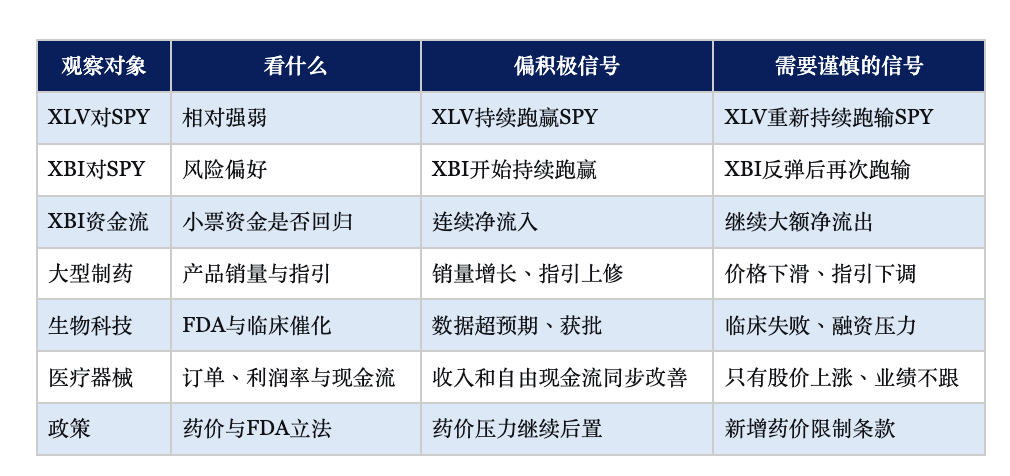
If only XLV lights up in this table, it suggests that it is currently more suitable to treat pharmaceuticals as a defensive and observational direction. If XLV, XBI, and individual company performances begin to improve simultaneously, it indicates that the trend is transitioning from "relative resilience" to "active upturn."
This is also what ordinary investors should avoid the most at present: do not mistake "resilience" for "the uptrend has been confirmed" just because pharmaceuticals have dropped less recently. The signals truly worth increasing positions on are the three overlapping factors of sector outperformance, capital inflow, and company performance improvement.
If you are already determined to build positions in U.S. pharmaceuticals, now can be the time to list target companies and price ranges, and to confirm account funds and trading authority in advance, rather than starting to search for stocks only after the earnings report or FDA results come out. Subject to applicable qualifications and jurisdictional restrictions, BIT provides U.S. stock trading services for qualified users, supporting trades in XLV, XBI, and U.S. pharmaceutical individual stocks, and allows funding via stablecoins and traditional wire transfers.
7. In conclusion: The Most Valuable Aspect of Pharmaceuticals Now is Repricing
Last week, pharmaceuticals only fell by 0.04%, which cannot directly prove that a pharmaceutical bull market has begun. However, it at least completed an important test: when AI and high-valuation growth stocks faced concentrated selling, funds did not massively flee from pharmaceuticals, but instead began looking for new certainties among large pharmaceuticals and some healthcare companies.
The midterm elections temporarily eased policy pressures, while the performance of companies like Moderna has begun to provide new fundamental catalysts, and medical devices and biotech await further capital confirmation. With several factors overlapping, pharmaceuticals are transitioning from purely a defensive sector into a next-round candidate for serious funding research.
However, this does not mean that now one can treat the word "pharmaceutical" as a buying reason. For a stable approach, look at the profits and valuations of large pharmaceuticals. For valuation repair, observe the orders, profits, and cash flow of medical devices. For high elasticity, monitor whether capital is genuinely flowing back into XBI, and select companies with clear FDA or clinical catalysts.
The signals for building positions may not be complex: XLV continues to outperform SPY, is a sector signal. XBI capital turning from outflow to continuous inflow is a risk preference signal. Consistent upgrades in individual company performance guidance provide a fundamental signal. The closer these three are, the higher the success rate.
Thus, the most trade-worthy logic of this pharmaceutical trend is that capital is actively searching for certainty, while the internals of pharmaceuticals are already beginning to signal where the next dollars should flow.
Disclaimer:
The content of this article is intended for general informational and market commentary purposes, compiled from publicly available information as of the time stated in the article, and related market data, expectations, and probabilities may change with market conditions. The views and investment strategies of the third-party institutions, analysts, or other individuals cited in the text only represent the views of the related third parties at a specific time and do not represent the views or recommendations of BIT. This article does not constitute investment advice, investment research, an offer, solicitation, or recommendation for any securities, investment products, or trading strategies, and should not be used as a basis for any investment decisions. Financial markets carry risks, and security prices and market performances may fluctuate; past performance and historical market trends do not represent or guarantee future results. Investors should independently assess related risks based on their own circumstances and seek professional advice when necessary.
免责声明:本文章仅代表作者个人观点,不代表本平台的立场和观点。本文章仅供信息分享,不构成对任何人的任何投资建议。用户与作者之间的任何争议,与本平台无关。如网页中刊载的文章或图片涉及侵权,请提供相关的权利证明和身份证明发送邮件到[email protected],本平台相关工作人员将会进行核查。


