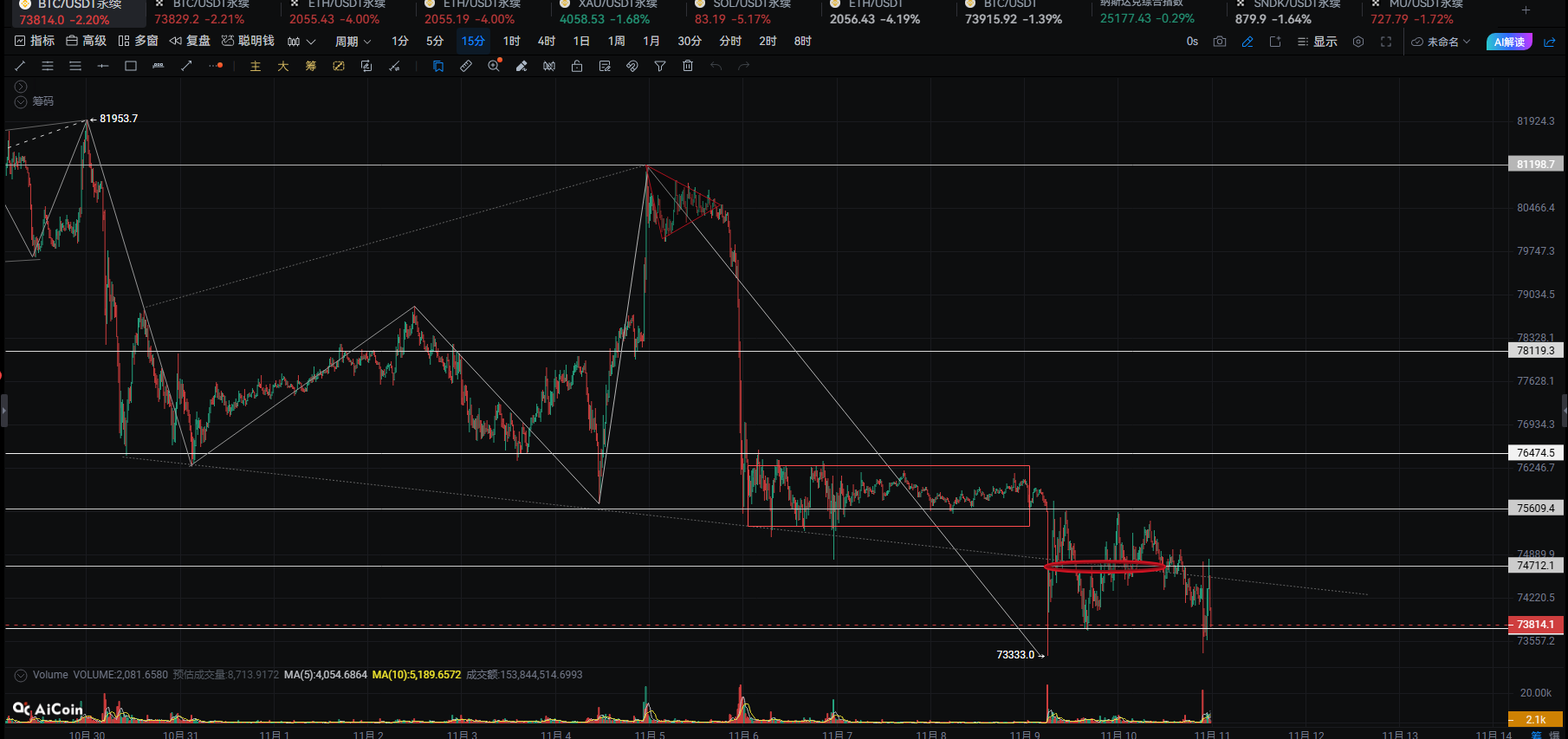
The latest hawkish message from Washington has rendered the script for December unprecedentedly clear and harsh. Federal Reserve Board member Christopher Waller bluntly stated that U.S. inflation is “too high,” the September data “performed poorly,” and price increases have begun to show widespread persistence. Even if there is slight improvement in October's CPI, he personally still tends to support a 25 basis point rate hike in December; if October's core CPI month-on-month is around 0.3% or higher, it could support a more aggressive move of 50 basis points—this is not an official decision of the FOMC, but it is akin to an advance conditional pricing list: 25 or 50, depending on how sticky inflation proves to be. In tandem, Utkarsh Ahuja from Moon Pursuit Capital reminds investors that high inflation is constraining the Federal Reserve's future “rescue” policy space; even if technology stocks weaken, the Fed may not be able to pivot to easing as quickly as in the past. The so-called “Federal Reserve put option” is becoming unreliable. Under the expectation of “higher rates for a longer duration,” the discount rate for global assets is being lifted overall, and the crypto market must also rewrite its pricing model accordingly: BTC is once again treated as a high-beta asset extremely sensitive to the risk-free rate, while ETH is similarly viewed as an extension of interest rate trading within the PoS and cash flow discounting framework. The reassessment of risk appetite and liquidity premium will permeate through every upcoming macro data point and interest rate decision node.
Inflation Persists: Waller's Choice Between 25 and 50 Points
This time, Waller did not speak in abstract terms about “watching and waiting,” but rather presented a choice with thresholds: even if October's overall CPI improves slightly from September, he would still vote to support a 25 basis point rate hike in December; only if the month-on-month core CPI in October is around 0.3% or above would he consider switching to the more aggressive 50 basis points option. This conditional guidance directly tying the rate hike to single-month core inflation is tantamount to laying cards on the table for the market—in his view, the question is not “should we hike,” but “how much should we hike before inflation shows clear signs of surrender.” The September inflation data, which he previously described as “performing poorly,” along with the widespread persistence of price increases, has rendered some optimistic expectations that “inflation will take care of itself” ineffective and has turned the narrative that “inflation is not far from target” into a false proposition.
Within such a data-dependent framework, the market is forced to rewrite its storyline: the terminal rate's peak must be moved higher, the timeline for high rates must be pushed back, and bets on “a couple more hikes followed by an immediate pivot” need recalibration. On the surface, Waller merely provided the numbers 25 and 50, but in essence, he locked the discussion range of the Federal Reserve firmly into a hawkish track of “how much rather than whether to hike,” pushing back expectations for rate cuts or pauses even further. For funds that have already viewed BTC, ETH, and other high-beta assets as amplifiers of “Federal Reserve pivot expectations,” this is not a technical detail to be ignored; rather, it forms a macro constraint that directly permeates valuations, positions, and leverage structures.
Policy Space Locked: The “Federal Reserve Put Option” Fades
After Waller pinned the discussion framework down to “how much,” Utkarsh Ahuja explicitly pointed out another layer of meaning on this track: against the backdrop of stubbornly high inflation, despite technology stocks beginning to weaken, it is difficult for the Federal Reserve to quickly pivot back to easing to support the market as in the past. He put it more straightforwardly—persistently high prices have locked in the central bank's “rescue” policy space. For more than a decade, Wall Street has summarized each policy pivot following significant sell-offs with a simple term—“Federal Reserve put option”: as long as the drop is severe enough, the Federal Reserve will eventually step in to support, and this invisible safety net has elevated the U.S. stock market while simultaneously pushing the valuation elasticity of high-beta assets like BTC and ETH to the extreme.
Ahuja noted that San Francisco Federal Reserve President Mary Daly recently maintained an open attitude toward “potential further rate hikes,” essentially in a communicative effort to actively dilute the market belief in the “inevitability of a market rescue”: even if asset prices retract, as long as inflation remains above target, the decision-makers have reason to prioritize price stability over stock market levels. For the crypto market, this means two things happening simultaneously: on one hand, higher and more persistent rate expectations elevate the risk-free rate, compressing valuations for long-duration risk assets like BTC and ETH; on the other hand, the perception that “after a deep drop the Federal Reserve will step in” has been weakened, and on-chain capital is more likely to retreat to USDT, USDC, and other “on-chain dollars” with lower leverage structures during volatile times, rather than instinctively doubling down during sharp declines. The entire market's risk appetite curve is forced to shift downward.
Higher Rates for Longer: From Treasury Yields to BTC and ETH Discount Rates
As Waller and others continue to push signals that “further tightening is necessary,” the market is not only repricing the federal funds rate but is also raising both nominal and real rates along the entire U.S. Treasury yield curve. A steeper and higher interest rate curve, combined with the consensus that inflation remains relatively high, has turned dollar assets back into “yielding hard currency” in the eyes of global investors: holding long-term U.S. Treasuries and cash in dollars provides not only nominal coupon rates but also real returns against inflation, and the liquidity that once roamed the global market in search of stories and elasticity has been siphoned away by this thicker “risk-free straw.”
In this environment, all long-duration assets reliant on future growth expectations—from growth stocks to mainstream on-chain assets—must rewrite their valuations at a higher discount rate. Historical experience shows that rising real rates exert pressure on non-yielding assets like gold, while BTC is marketed as “digital gold” on one hand and has fluctuated in sync with high-beta tech stocks through multiple cycles on the other: the reality is that when real rates rise and global liquidity tightens, the market is more inclined to treat it as a high-beta risk asset for liquidation first, and only in extreme pressure scenarios will the narrative of “safe-haven positions” be briefly activated. After transitioning to PoS, ETH has had some capital priced using a method involving “discounting future cash flows”: with each step up in the risk-free rate, the relative attractiveness of staking returns must be compared again with bank interest and Treasury rates. DeFi activity is shrinking under more expensive funding costs, and the imagined space for protocol fees and on-chain cash flows is compressed. These three combined effects push ETH’s sensitivity to interest rates and macro liquidity higher than in any previous cycle.
Capital Migration: ETF Subscriptions, Leverage Cooling, and On-Chain Dollars
After Waller placed “a rate hike in December, even by 50 basis points” on the table, the traditional capital asset allocation question is no longer “do you like Bitcoin,” but rather “how much weight should be given to high-beta assets at higher risk-free rates.” In the past, whenever tightening expectations surged, capital would retract from high-volatility targets like tech stocks back to Treasuries and dollar cash; now, BTC-related ETFs have been folded into the same risk budget: the investment committee of the same multi-asset fund will be torn between U.S. stocks, Treasuries, money market funds, and BTC ETFs. Any upward revision of the terminal rate path will compel them to pull some “macro trading chips” back from BTC ETFs and growth stocks into shorter-duration, lower-volatility cash and short-duration bond positions. Ahuja from Moon Pursuit Capital warns against “presuming a Fed market rescue,” effectively telling these institutions: they can no longer expect the Fed to pivot immediately when the stock market declines; portfolios that treat BTC as a liquidity trading target will also have to tighten positions, making BTC's weight as “macro beta” prone to phase compression.
On the other hand, leverage within the crypto sphere will be rapidly repriced under such expectations. Perpetual contracts and on-chain lending protocols carry most of the leverage, with most collateral being BTC, ETH, and tokens pegged to the dollar. When the risk-free rate is constantly “raised” by hawkish statements, the opportunity cost of capital rises, risk aversion sentiments gain traction, proactively deleveraging combined with passive liquidations will amplify what was originally a mild price correction into more severe intraday volatility: futures longs are liquidated, spot is sold to top up margin calls, ETH collateral gets liquidated, and the scale of on-chain lending shrinks simultaneously. In this environment, assets pegged to the dollar, like USDT and USDC, will be treated as “cash substitutes” on-chain, with some funds that originally chased coin-based returns and high leverage instead sheltering in these “on-chain dollars” to increase the risk-free weighting in their portfolios. Going forward, tracking the net subscriptions of BTC-related ETFs, perpetual funding rates, and the proportion of on-chain dollars will provide insight into how much this round of the “25 or 50 basis points” dispute has rewritten the capital structure of the crypto market.
Inflation Data as an Anchor: How the Crypto Circle Trades Policy Reaction Functions
When looking at the statements from Waller and Ahuja together, the story is already quite clear: the Federal Reserve's reaction function is firmly anchored to inflation, rather than technology stock pullbacks or a large drop in BTC. Waller directly ties whether to add 25 or 50 basis points in December to the month-on-month core CPI data for October, effectively stating “the decision is based on the numbers”; Ahuja reminds that under high inflation conditions, even if technology stocks come under pressure, the Federal Reserve may not have the space to immediately restart “market support mode.” For the crypto market, at this point, the most crucial question is no longer betting on how much will be added in December, but rather accepting a more unfavorable tone: as long as inflation remains sticky, the framework of “higher rates, maintained longer” is unlikely to be broken. In terms of trading, a simple but practical three-line framework can be used to read the market: first, observe the inflation trend itself—whether core CPI sticks above Waller's “red line” of 0.3% or shows continuous decline, which determines whether the Fed's discourse is “more hawkish” or “softly hawkish”; second, observe the linkage between technology stocks and BTC—multiple cycles have proven that the two often rise and fall together around turning points in risk appetite, and the compression of technology stock valuations is a reflection of BTC's global liquidity premium being discounted; third, observe changes in on-chain leverage and the percentage of “on-chain dollars”—a contraction in leverage and an increase in dollar-pegged assets indicate that the market is making room for higher risk-free rates, rather than pre-buying risk positions for the next bull market. By tracking data and prices along these three lines, there is an opportunity to understand whether BTC and ETH are digesting “higher rates maintained longer” or are pricing in some yet-to-appear pivot at each inflation release and each round of Fed communication.
Join our community to discuss together and become stronger!
AiCoin exclusive Hyperliquid benefits: https://app.hyperliquid.xyz/join/AICOIN88
AiCoin exclusive Aster benefits: https://www.asterdex.com/zh-CN/referral/9C50e2
On-chain Telegram community: https://t.me/AiCoinWhaleData
On-chain community: https://www.aicoin.com/link/chat?cid=N6OVMor5g
AiCoin on-chain Twitter: https://x.com/aicoinwhaledata
免责声明:本文章仅代表作者个人观点,不代表本平台的立场和观点。本文章仅供信息分享,不构成对任何人的任何投资建议。用户与作者之间的任何争议,与本平台无关。如网页中刊载的文章或图片涉及侵权,请提供相关的权利证明和身份证明发送邮件到[email protected],本平台相关工作人员将会进行核查。