Over the past year, the changes in Binance Wallet have gone beyond just adding a few trading entrances.
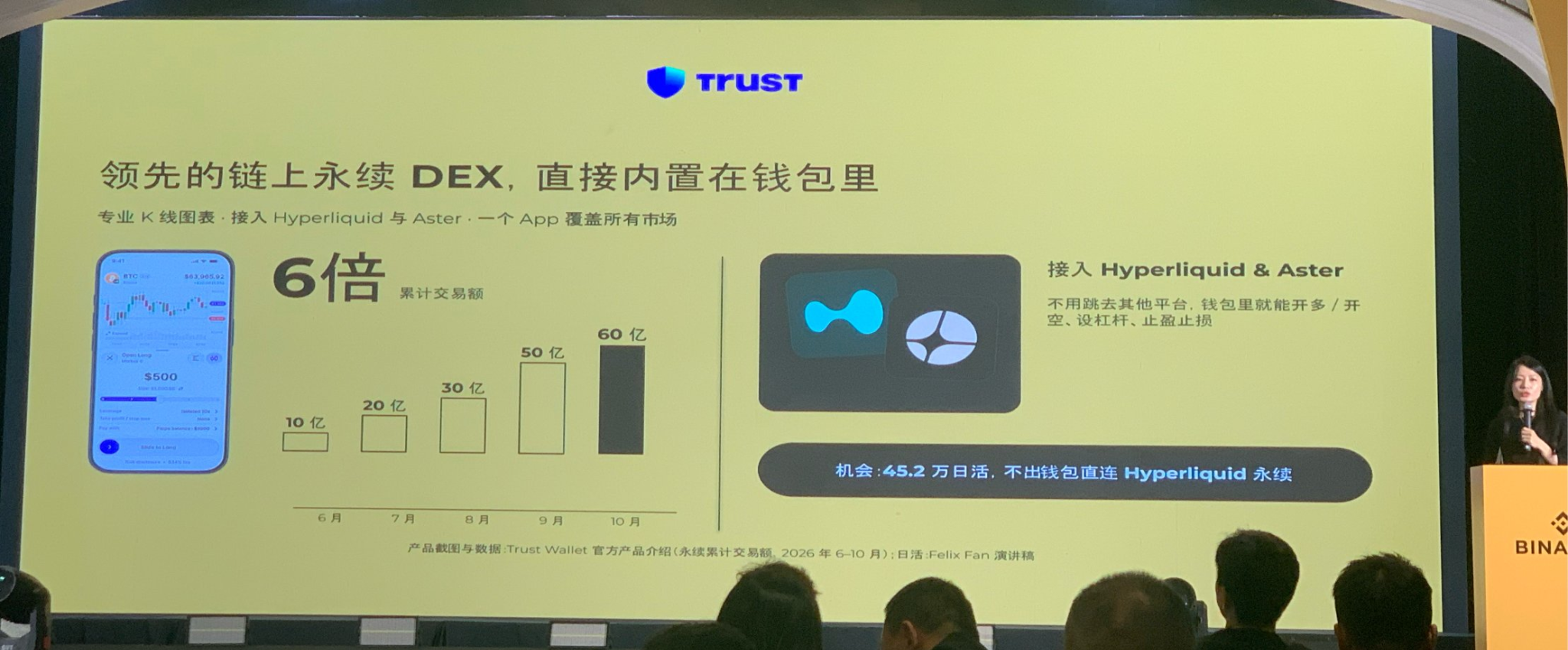
Since Binance Alpha was recognized by the market, Binance Wallet has gradually expanded into Meme trading, smart money tools, prediction markets, on-chain wealth management, RWA, and AI Agent. Binance Wallet is evolving from a singular wallet tool into a set of on-chain infrastructure covering "discovering opportunities—trading execution—participating in predictions—asset yields—AI automation."
The noteworthy aspect of this product roadmap is that it does not confine the wallet to the singular scenario of "asset storage" but attempts to centralize the main user behaviors on-chain.
Users can discover popular assets and views on real positions within the wallet, participate in prediction markets, configure stablecoin yields, and can allow AI to execute transfers, swaps, limit orders, wealth management deposits and withdrawals, and order placements in prediction markets through Agent ID and Agent Wallet.
1. Product Roadmap of Binance Wallet: From Entrance to Closed Loop
Currently, the on-chain products of Binance Wallet can be categorized into four layers:
First Layer: Meme Trading and Opportunity Discovery
Users discover popular assets and on-chain trading opportunities through the Meme model, Binance Alpha, Binance Square, and smart money tools.
Second Layer: Prediction Markets and New Trading Scenarios
Users participate in prediction markets around sports events, market incidents, and short-term price trends, with trading logic expanding from "buying and selling tokens" to "judging event outcomes."
Third Layer: On-chain Wealth Management and RWA
Users can utilize stablecoin yields and future RWA products to let wallet assets participate in returns related to traditional financial assets without directly entering complex agreements.
Fourth Layer: AI Agent and Automated Execution
Through Agent ID and Agent Wallet, users can express intentions in natural language, with AI assisting in executing multi-chain transfers, swaps, limit orders, wealth management deposits and withdrawals, and order placements in prediction markets.
These four layers together form a relatively complete on-chain path:
Discover opportunities → Obtain information → Make judgments → Execute trades → Manage assets → Automate through AI.
2. Meme Trading: From Watching Trends to Watching Real Positions
The hardest part of Meme trading often isn’t finding a hot token, but judging whether the information is genuine, whether liquidity is sufficient, and whether traders are genuinely participating with funds.
The Meme mode on the Binance Wallet web interface provides tracking and smart money tools, while combining real position views, messages, and leaderboards from Binance Square to help users discover traders worth paying attention to.
This is equivalent to consolidating three information dimensions:
- What assets the market is focusing on;
- Which addresses or traders are holding positions;
- How these traders have performed and what their views are.
Compared to text shoutouts on regular social media, real position information can add a layer of data verification. Users not only see what someone says but can further observe:
- Whether the relevant asset was held when the view was published;
- What the position size and asset ratio are;
- Whether they continue to increase or decrease positions afterwards;
- Whether the trading results align with the view;
- Whether the trader is consistently stable or only occasionally hits the mark.
For data analysis platforms, this means that "views" can be transformed into trackable data events: recording the publication time, asset price, position changes, and subsequent gains, ultimately forming a trader profile.
Of course, real holdings do not equal trading advice. Traders may change strategies at any time, and positions may only represent a small proportion of the portfolio. Users still need to independently assess liquidity, contract addresses, trading depth, and risk.
3. Prediction Markets: The Growth Logic Behind Transaction Volumes
Prediction markets are a rapidly growing part of the Binance Wallet product matrix.
Binance Wallet officially announced the integration of prediction markets on October 9, with a cumulative transaction volume reaching 949M and a user base of 446,000.
Events are an important growth engine for prediction markets, with a focus on high-attention scenarios like the World Cup, League of Legends, and the NBA.
Prediction markets easily attract user attention because they convert complex financial transactions into more intuitive questions:
- Can a certain team win the match;
- What is the ultimate outcome of a certain event;
- Will BTC rise or fall within 5 minutes;
- Will a certain event occur within a specified time.
Users can observe market prices to gauge the collective probabilistic judgments of the results. Market prices are not the final answer but are the collective result of participant funds and views.
4. BTC 5-Minute Product: The Efficiency and Risk of Short-Term Forecasting
The BTC 5-Minute product has led Polymarket for two consecutive weeks, with a transaction volume of 40.15M in the past month.
The characteristics of short-term forecasting products are:
- Short result confirmation time;
- High participation frequency;
- Easy for users to understand;
- Faster feedback between trades and results.
However, short cycles also imply higher noise and uncertainty. The 5-minute price changes may be influenced by liquidity, sudden orders, market fluctuations, and brief market reversals, making it unreliable to rely solely on trend judgments.
From a data analysis standpoint, the metrics worth observing for short-term products include:
- Transaction volume for each time period;
- Capital ratio for long and short positions;
- Deviation of settlement results from market implied probabilities;
- Activity levels across different events and time segments;
- User participation frequency and average holding time;
- Profit and loss distribution among users who participate continuously.
Growth in transaction volumes in prediction markets does not necessarily mean all participants are profitable. Assessing product quality also requires attention to liquidity, settlement transparency, odds fluctuations, and user retention.
5. Free "Divine Calculator" Activity: Reducing Barriers to Prediction Market Experiences
There is a free "Divine Calculator" activity in the prediction market.
The purpose of the free activity is to allow new users to familiarize themselves with the operation of prediction markets, event types, result settlements, and probability fluctuations without bearing or with minimal financial risk.
For the platform, this is a product design that reduces educational costs. Users learn the gameplay first and then decide whether to participate in real funds markets.
For users, free activities are more suitable for observing:
- How prediction questions are set;
- What criteria confirm outcomes;
- How market prices fluctuate;
- Whether their judgments are stable;
- What differences exist between the prediction process and actual results.
6. On-chain Wealth Management: Manage Returns Without Directly Entering Protocols
On-chain wealth management is another important direction for Binance Wallet.
Binance Wallet is currently providing a no-deposit interest path: users do not need to directly enter complex protocols; assets can remain in their own wallets, holding stablecoins with one-time activation, no lock-up, and weekly yield collection, with an APR of about 1.5%—5%.
If this mechanism is officially opened as presented, its main value lies in lowering the operational threshold for on-chain wealth management.
Traditional DeFi wealth management typically requires users to complete multiple steps:
- Connect to the protocol;
- Select the network;
- Approve token authorizations;
- Deposit assets;
- Monitor yield fluctuations;
- Handle redemptions and cross-chain transfers.
The experience of no-deposit interest products attempts to hide these complex steps within the wallet, making the user experience closer to that of traditional wealth management products.
7. RWA Wealth Management: Bringing Traditional Financial Returns On-chain
Binance Wallet will also launch RWA wealth management products. The first batch is expected to comprise about 9 products, with an expected APY range of about 2.9%—12.2%, covering directions including gold, money market funds, and US Treasury-related returns.
The core logic of RWA is to expose on-chain users to yield sources related to real-world assets. Compared to pure crypto asset yields, RWA products may be more influenced by:
- The US interest rate environment;
- The yields of US Treasuries and money market funds;
- The issuers and custodians of the products;
- The asset tokenization structure;
- The subscription and redemption mechanisms;
- Regional and investor qualification requirements.
Therefore, RWA wealth management cannot simply compare APY levels. Users need to further check:
- What the underlying assets are;
- Whether returns are fixed or variable;
- Whether there are lock-up periods;
- How long redemptions take;
- Whether the product is supported in their region;
- What asset the returns are distributed in;
- Whether there are counterparty and liquidity risks.
8. Agent ID and Agent Wallet: AI Begins to Enter the On-chain Execution Layer
Agent ID and Agent Wallet represent the most futuristic parts of this product set.
Agent ID provides AI with a dedicated .ai domain name linked to Binance AI accounts and is non-transferable. Agent Wallet allows users to express intentions, with AI assisting in executing multi-chain transfers, swaps, limit orders, wealth management deposits and withdrawals, and order placements in prediction markets.
This indicates that the interaction method of the wallet may change.
In the past, users had to complete each operation themselves:
- Select the network;
- Input the address;
- Select the token;
- Input the amount;
- Set the slippage;
- Confirm the transaction;
- Wait for the on-chain result.
In the future, users may first articulate their goals:
"Allocate this portion of USDC into yield products."
"Buy when BTC drops to a certain price."
"Transfer assets from Chain A to Chain B while minimizing fees."
AI Agent will then generate an execution plan based on user permissions, risk rules, and asset status.
This will make on-chain operations easier but will also increase the importance of permissions management. Users must clarify:
- Which assets the Agent can control;
- What the maximum limit for a single transaction is;
- Whether automatic signing is permitted;
- Which transactions require manual confirmation;
- The validity period of limit orders and wealth management operations;
- How to pause or revoke Agent permissions.
AI is responsible for execution, which does not equate to AI bearing losses. A truly mature Agent Wallet needs to prioritize permissions isolation, risk control, transaction simulation, and revocation mechanisms.
9. What Kind of Product Closed Loop is Binance Wallet Forming?
Putting all the above functions together, one can see a complete user path:
1. Discover
Users discover assets and traders through Binance Alpha, Meme mode, smart money tools, and real position views.
2. Judge
Users form their own judgments through market movements, on-chain data, messages, leaderboards, and prediction market probabilities.
3. Execute
Users complete Meme trades, swaps, limit orders, or participate in prediction markets within the wallet.
4. Configure
Users allocate idle stablecoins to no-deposit interest or RWA wealth management products.
5. Automate
Users use Agent ID and Agent Wallet to have AI assist in executing multi-chain transfers, trades, and asset management.
These five steps expand the wallet from an "asset entrance" to an "information, trading, yield, and automated execution platform."
Conclusion
Starting from Binance Alpha, Binance Wallet has now extended to Meme trading, prediction markets, on-chain wealth management, RWA, and AI Agent.
The core of this path is not to create a single explosive feature but to connect the main behaviors of users on-chain: discovering opportunities, validating views, participating in markets, and configuring yields, with AI assisting in execution.
From a data perspective, what is most worth observing in the future is not the download volume of a single product but whether the entire closed loop can be sustainably enhanced:
- Whether Meme users convert to prediction market users;
- Whether trading users utilize on-chain wealth management;
- Whether RWA users further use Agents;
- Whether Agent execution genuinely reduces on-chain operational costs;
- Whether users complete more asset management actions within the wallet.
When the wallet simultaneously has information entrances, trading entrances, yield entrances, and AI execution entrances, it is no longer just a wallet but is evolving into a full-stack on-chain infrastructure.
AiCoin Exclusive Benefits for Users
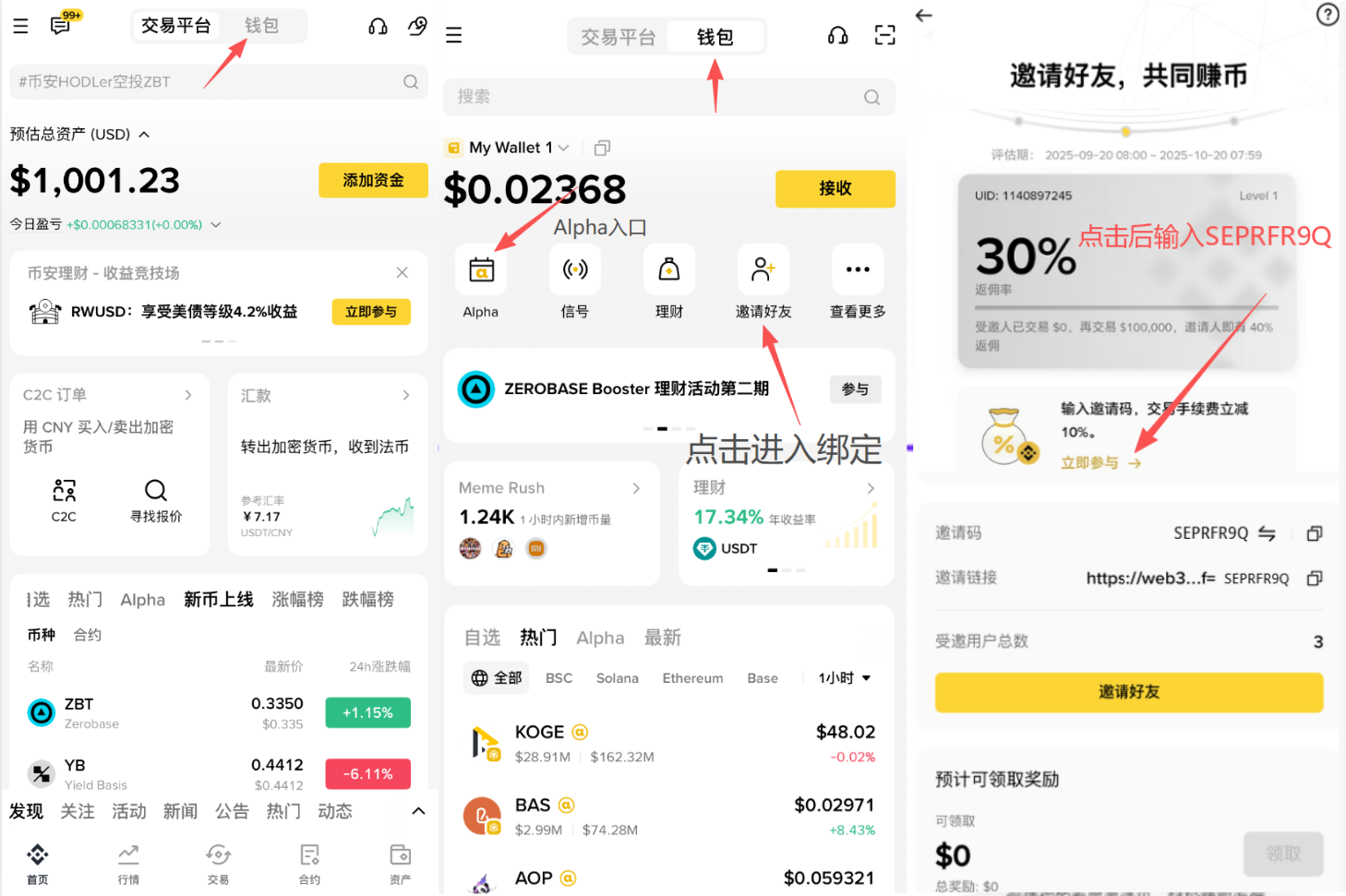
👉 Enter the invitation code SEPRFR9Q when using Binance Wallet to enjoy a 10% rebate on transaction fees, making Meme trading cheaper and more profitable
🔗 Exclusive Link:
https://web3.binance.com/referral?ref=SEPRFR9Q
免责声明:本文章仅代表作者个人观点,不代表本平台的立场和观点。本文章仅供信息分享,不构成对任何人的任何投资建议。用户与作者之间的任何争议,与本平台无关。如网页中刊载的文章或图片涉及侵权,请提供相关的权利证明和身份证明发送邮件到[email protected],本平台相关工作人员将会进行核查。