The Ethereum Foundation is in trouble again.
On November 4, former employee Nixo filed a lawsuit against the Ethereum Foundation, Vitalik, and others in the federal court of Colorado, USA. She claims that she was fired by the Ethereum Foundation thirteen days after notifying management in writing about her cancer diagnosis and twelve days after participating in organizing a “joint petition” among foundation employees.
What pushed this issue into the spotlight was a segment in the foundation's mission statement referring to a "Seppuku License."
Mandate Declaration
This controversial document is titled "The Ethereum Foundation Mandate." Here, Mandate can be understood as a mission declaration, addressing why the foundation exists, what it aims to do in the future, and which principles cannot be compromised.
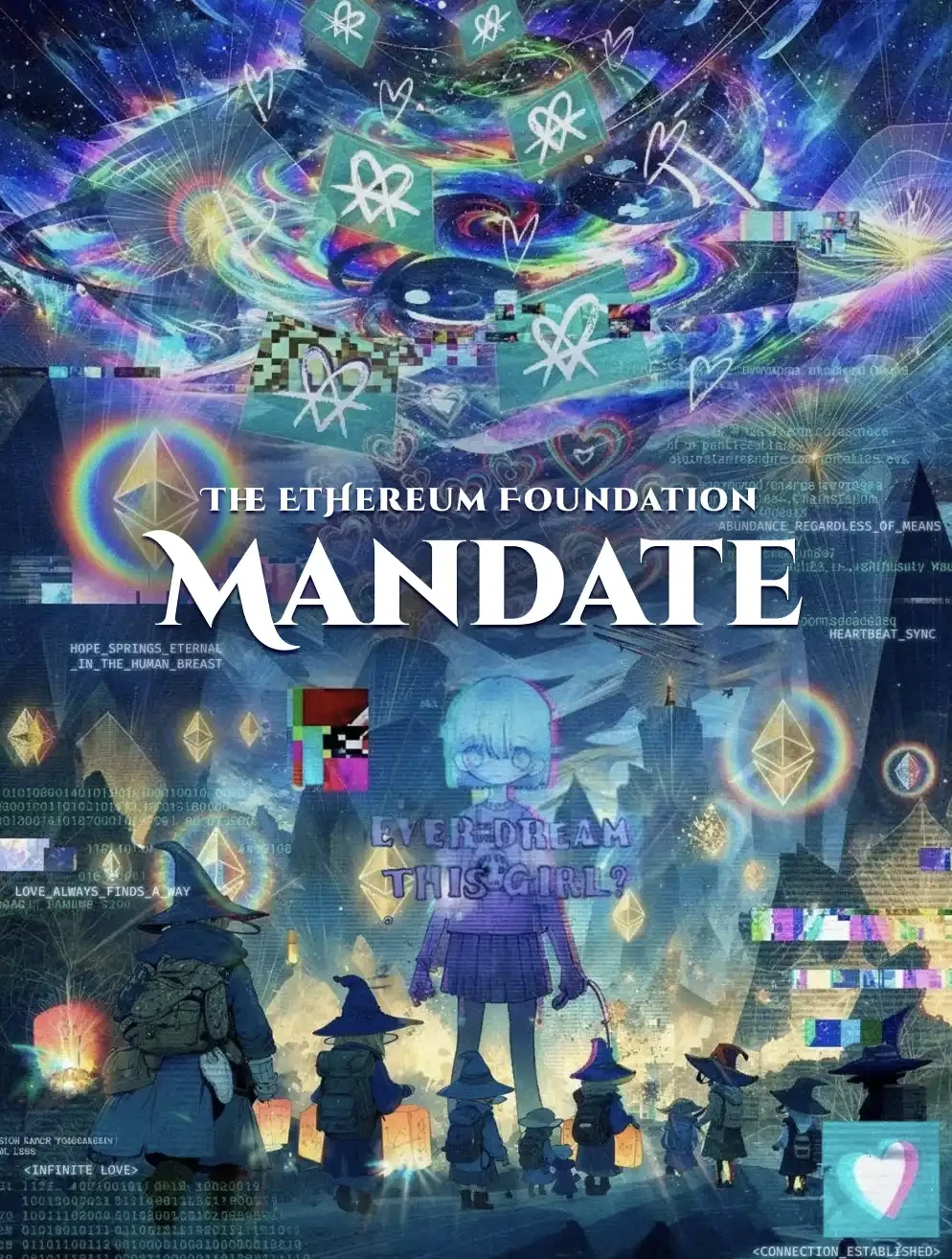
The core of this document is not hard to understand. Ethereum aims to uphold anti-censorship, open-source, privacy protection, and security, while the foundation is responsible for supporting these principles long-term. It also clearly states that the foundation is neither the parent, owner, nor ruler of Ethereum. Everyone can build what they want on this network without needing prior permission from a central authority.
The problem lies on page 11.

The illustration includes a section titled Source Seppuku License, which translates directly to “Source Code Seppuku License,” linking the failure to fulfill promises, modify, or delete licenses to “ending one’s life with a sword.” Next to it is a line that suggests if the foundation betrays its solemn commitments to Ethereum, it is willing to take its own life.
This is a joke from the Milady cultural circle. Milady, usually referred to as 米莱迪 in Chinese, is a set of anime avatars NFTs launched by Remilia in 2021. The community formed around these avatars is keen on parody, provocation, and opposing moral censorship, with many members also considering it a cultural identity expressing the concept of freedom. Vitalik has previously used Milady avatars, so this aesthetic appearing in the foundation's document has its cultural background.
The management also explicitly explained that the seppuku wording belongs to artistic and cultural references and does not need to be taken literally. A later employee confirmation form explicitly added that the commitment has nothing to do with actual seppuku.
However, some employees did not accept this as a joke. According to the lawsuit's account, after the draft was sent to Ethereum Foundation employees for feedback at the end of February, 79 people voted to remove this section, with someone mentioning they had just lost a colleague to suicide the previous year. Vitalik had promised to revise the controversial content, yet the official version published on March 13 still retained it.
For the employees, the discussion shifted from “Is this joke appropriate?” to “Does our opinion even matter?”
On March 20, then-co-CEO Bastian Aue urged all employees to express their stance by a deadline. There were only two options: commit to executing the Mandate or apply for compensation and leave. Not submitting a stance would also be regarded as choosing to leave.
Nixo was responsible for ecosystem protocol support at the time and participated in coordinating discussions and upgrading processes among Ethereum core developers. She and her colleague Trent Van Epps drafted a letter that ultimately garnered 53 signatures, about half of the protocol department.
This letter was very critical. Employees supported the general direction of the Mandate and committed to continue working according to the principles of anti-censorship and personal autonomy, but refused to confirm under the pressure of job loss, clearly stating that everyone would continue to perform their duties and would not resign.
On March 27, Aue momentarily accepted this expression, recognized the signatories’ commitment to the mission, and acknowledged that the handling needed improvement. However, on April 6, both organizers of the letter were notified of their dismissal. Nixo had disclosed her cancer diagnosis in writing to management thirteen days prior; she stated that during her dismissal call, Aue acknowledged her work record but refused to explain the reason for her termination.
This is also the truly heavy part of the lawsuit. The accusations made by Nixo involve discrimination, retaliation, and medical leave rights, far exceeding just “someone didn’t understand the seppuku joke.” The complaint also notes that the lawyers for the foundation's Singapore entity previously denied any wrongdoing, coercion, and retaliation, claiming the severance agreement and arbitration clause were valid.
Milady Community "Purification"
Why is the Milady side so supportive of this document?
In the understanding of Milady creators like Charlotte Fang, cryptocurrency is primarily a movement to protect freedom. Code makes transactions difficult to block, but an industry can also culturally begin to accept censorship, starting to decide who is qualified to participate based on whether speech is decorous and the appropriateness of social contacts.
Remilia calls the resistance to this change the "Cypherpunk Purity Spiral". Cypherpunks can be simply understood as those who want to protect privacy and reduce dependence on centralized power using cryptographic technology. The so-called "purity" means continually pulling crypto back to the principles of speech, market, association, information, and thought freedom. Milady takes on the role of cultural resistance in this self-narrative.
Therefore, offensiveness is precisely useful. Whether a person can tolerate avatars and jokes they dislike is taken by them as a method to test the concept of freedom. Charlotte's response to this turmoil aligns with this line of thought: he refers to Milady as a cultural weapon for promoting Cypherpunk values, interpreting Vitalik's use of it as a correction of internal organizational direction.
Core Milady member Bonkle, as early as May 23 in an article, rated the requirement to sign the Mandate as an effective screening. According to his standards, salary, friendships, and personal comfort should not outweigh the mission of protecting freedom through crypto.
He also provided a further explanation. Developers and funds revolving around the foundation have inherently formed a center. People leaving the foundation to continue building in different organizations could ironically disperse this dependence. Hence, he sees personnel departures as an opportunity for decentralization. Leaving the foundation also allows for building Ethereum elsewhere.
By the time the lawsuit triggered discussions, Bonkle's response was even more intense. He raised the incident to the height of being tested on freedom of thought, expression, and association, questioning why personal disputes should seek recourse in national courts. In his narrative, Ethereum is preparing to resist future, more powerful governmental and technological powers, and organizations need to withstand conflict.
These statements illustrate a distinct position within Milady: they view this uproar as a choice of direction and welcome the screening to occur.
Lawyer Gabriel Shapiro also believes it is normal for organizations to require employees to share in the mission, “seppuku” clearly cannot be taken literally. He also criticized the plaintiffs for publicly releasing phone recordings without Vitalik's consent, suspecting that some employees were gathering evidence for the lawsuit from the very beginning. This is his judgment on the motives of the parties involved.
Freedom?
The Milady perspective on crypto culture is valid. An anti-censorship network must accommodate uncomfortable expressions; a system that can only accept mild speech and familiar viewpoints will struggle to maintain openness under pressure. The value of Ethereum cannot be measured solely by coin prices, revenue, and market share.
The foundation equally has the right to choose its direction. It needs employees to execute clear work objectives, and not every decision can be debated indefinitely. A willingness to invest in anti-censorship and privacy technology should be a fundamental requirement for joining such organizations.
But in this conflict, employees have already expressed support for these directions. The letter of joint signatures rejected the manner of forced expression, and Nixo has explicitly stated that compared to the association with seppuku and Milady, she is more concerned about the nearly unanimous opinion being ignored. Categorizing all these people as having weak commitment to the mission is actually a neglect of their true demands.
According to the complaint records, Vitalik later admitted in a call that employees should have been given weeks to consider; but he was also worried that if “making a big fuss” truly proved useful, similar “troublemaking” behaviors would escalate. This was management's concern. However, after accepting the demands of the employees' joint signature and affirming the direction everyone agrees on, firing two of the organizers sends what signal to those remaining?
The Mandate document itself requires leaders to treat differences kindly, patiently explain difficult decisions, and acknowledge and clarify when mistakes are made. Employees demanding that their voices be taken seriously is consistent with these commitments.
The foundation has the right to adhere to Cypherpunk missions and to choose the Milady aesthetic, but it should not use obedience to a certain aesthetic and management style to prove whether employees agree with freedom.
From the handling process presented in the lawsuit, requiring employees to express loyalty within a deadline and subsequently firing dissenting organizers undermined the values this declaration sought to uphold.
Ethereum needs people who dare to say no to external power. The foundation also needs to allow employees to dare to say no to their own leadership.
免责声明:本文章仅代表作者个人观点,不代表本平台的立场和观点。本文章仅供信息分享,不构成对任何人的任何投资建议。用户与作者之间的任何争议,与本平台无关。如网页中刊载的文章或图片涉及侵权,请提供相关的权利证明和身份证明发送邮件到[email protected],本平台相关工作人员将会进行核查。


