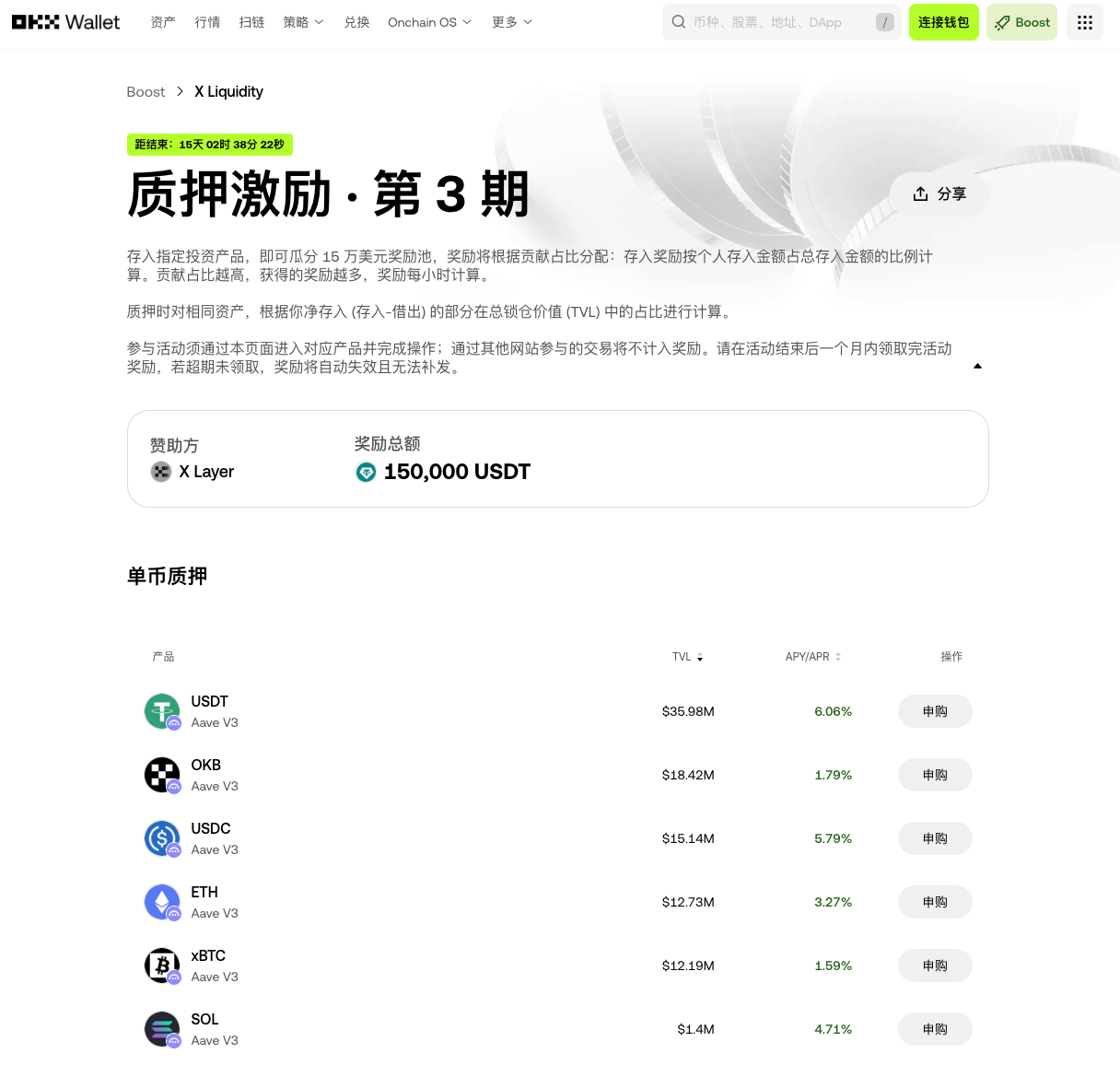
OKX Wallet Boost's X Liquidity staking incentives continue to update. The latest launched Staking Incentive · Phase 3, sponsored by X Layer, allows users to deposit specified assets into Aave V3 on X Layer through the event page to share a 150,000 USDT reward pool.
This phase covers a richer array of assets than just a single stablecoin activity, including:
- USDT
- OKB
- USDC
- ETH
- xBTC
- SOL
The deadline for the activity is November 25, 2026, 15:00 (UTC+8). The official event page simultaneously shows that rewards are calculated based on user contribution proportions and are calculated hourly.
The core of this event is not "depositing to receive a fixed APY," but rather the overlap of two sets of income sources:
- The deposit yield rates displayed by the Aave V3 product itself;
- The additional staking incentive rewards provided by X Layer.
Therefore, users need to consider the base APY, event reward proportion, asset price risk, and cost of funds, and cannot only look at the absolute amount of the activity reward pool.
Latest Activity Data: Total Reward Pool 150,000 USDT, Current TVL of Six Product Categories Approximately 95.86M USD
According to the current data displayed on the official event page, the TVL and APY/APR of each single-coin staking product are as follows:
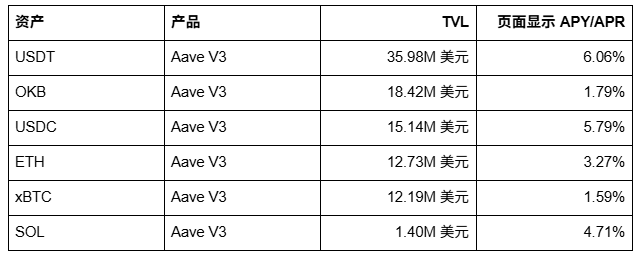
By simply adding the numbers displayed on the page, the total TVL of the six products is approximately 95.86M USD. Among them:
- USDT TVL accounts for approximately 37.5% of the total six assets;
- OKB accounts for approximately 19.2%;
- USDC accounts for approximately 15.8%;
- ETH accounts for approximately 13.3%;
- xBTC accounts for approximately 12.7%;
- SOL accounts for approximately 1.5%.
This indicates that current funds are mainly concentrated in USDT, OKB, and USDC, which collectively account for more than 70% of the TVL of the six product categories on the page. The TVL of SOL is relatively small, but the page displays an APY of 4.71%, indicating that APY and TVL cannot simply be equated: the yield level will also be affected by borrowing demand, asset utilization, reward mechanisms, and market supply and demand.
TVL and APY will change dynamically, and the above numbers only represent the data at the time of page capture, not fixed data for the entire event cycle.
How are Rewards Calculated? It's Not "150,000 USDT Divided by Number of Participants"
The explanation of the rewards mechanism on the event page is very crucial:
Deposit rewards are calculated based on the individual's deposited amount as a proportion of the total deposited amount; the higher the contribution percentage, the more rewards received, and rewards are calculated hourly.
To illustrate with a simplified model: if the effective net deposits of all participants in the activity pool during a certain period total 10,000,000 USD, and a certain user’s effective net deposit is 10,000 USD, then that user's contribution percentage during that period is approximately 0.1%.
If rewards are simply averaged in that period, the user's obtainable activity rewards will also be influenced by the following factors:
- Remaining time of the activity;
- Net deposit amounts of other users;
- Product pool corresponding to the asset;
- Whether the user borrows or reduces their position;
- Whether the account participates through the event page;
- Specific accounting and disbursement rules for activity rewards.
Therefore, the 150,000 USDT is the total reward pool for the activity, and does not mean that every user can obtain fixed earnings, nor does it mean that depositing 1,000 USD corresponds to a fixed amount of rewards.
Most Important Rule This Time: Calculate Based on "Net Deposit" Rather Than Simply Deposit Amount
The official page clearly states that for the same asset when staking, the rewards will be calculated based on the user’s net deposit amount, which is:
Net Deposit = Deposit Amount − Borrowed Amount
At the same time, rewards are calculated based on the net deposit portion's proportion in the total locked value (TVL).
This rule will affect users' judgment of yield. For example:
- The user deposits 10,000 USDT but subsequently borrows 4,000 USDT;
- The effective net deposit calculated for the activity may be understood as 6,000 USDT;
- The user cannot simply use the initial deposited amount of 10,000 USDT to estimate the activity rewards.
This also means that using borrowing to increase nominal funding scales does not equate to increasing activity rewards. Borrowing will introduce interest costs, changes in health factors, liquidation risks, and market volatility risks, and one should not blindly conduct circular operations to increase reward proportions.
What Type of Participants Are Each of the Six Assets Suitable For?
1. USDT: The Basic Choice for Stablecoin Positions
USDT is the product with the largest TVL this phase, with the page showing a TVL of approximately 35.98M USD and an APY/APR of approximately 6.06%.
For users who already hold USDT and wish to obtain on-chain yields without directly bearing the price volatility of BTC, ETH, or SOL, USDT staking is a relatively straightforward direction to understand.
However, stablecoins are not without risk, and users still need to pay attention to:
- The stablecoin's peg to the US dollar;
- Aave V3 smart contract and protocol risks;
- X Layer network and cross-chain asset risks;
- Whether the activity rewards are stable and how to withdraw them;
- Network fees and liquidity during purchase and withdrawal.
The 6.06% displayed on the page is the current APY/APR data for the product and should not be understood as a fixed annualized return throughout the event period.
2. USDC: Another Entry Point for Stablecoin Returns
USDC has a page showing a TVL of approximately 15.14M USD and an APY/APR of approximately 5.79%.
The yield rate of USDC is close to that of USDT, and users can compare based on their existing assets, conversion costs, preferences for stablecoins, and risk tolerance.
If frequent conversions of stablecoins are undertaken to pursue a few basis points of APY, then conversion fees, slippage, and network costs may offset the interest margin. A more reasonable approach is to prioritize existing assets and then compare base income with activity rewards.
3. OKB: Also Bearing Asset Price Volatility
OKB's page shows a TVL of approximately 18.42M USD and an APY/APR of approximately 1.79%.
The staking yield rate of OKB is lower than that of USDT and USDC, but participants may value the ecological attributes, holding demand, and related developments of OKB itself.
Unlike stablecoins, the dollar-denominated yield of OKB may be affected by token price changes. Even if the page APY is positive, if the price of OKB drops, the user’s total dollar assets may still decrease.
Therefore, OKB staking is more suitable for users who originally planned to hold OKB and are willing to bear token price fluctuations, rather than for those who enter solely to chase a perceived high APY.
4. ETH: Basic Returns Alongside Price Exposure
ETH's page shows a TVL of approximately 12.73M USD and an APY/APR of approximately 3.27%.
Apart from ETH staking or lending yields, users will also continue to be exposed to ETH price fluctuations. If ETH rises, gains may receive a dual boost from asset price appreciation and basic yields; if ETH drops, basic yields may not cover price losses.
ETH is suitable for users who are long-term bullish on the Ethereum ecosystem, originally plan to hold ETH, and wish to enhance the efficiency of capital utilization. Short-term users should pay special attention to costs and slippage during deposits, withdrawals, conversions, and cross-chain processes.
5. xBTC: On-Chain Yield Opportunities Related to Bitcoin
xBTC's page shows a TVL of approximately 12.19M USD and an APY/APR of approximately 1.59%.
The key focus with xBTC is not just the yield displayed on the page, but also the asset mapping mechanism, price tracking, liquidity, redemption paths, and cross-chain risks. Users should confirm the specific product description of xBTC before participating and understand its differences from native BTC.
For those wishing to maintain exposure to BTC prices while exploring on-chain yields, xBTC may provide a means of on-chain usage; however, it should not be simply equated with native BTC, nor can the risks associated with wrapped assets, bridging, and protocols be ignored.
6. SOL: Current TVL is Small, but APY Shows High
SOL's page shows a TVL of approximately 1.40M USD and an APY/APR of approximately 4.71%.
SOL has the lowest TVL among the six asset categories, but the page indicates that the APY is higher than that of ETH, OKB, and xBTC. For data analysis users, this "low TVL + high APY" combination is worth observing, but should not be directly interpreted as a higher risk-free return.
Factors that may influence the APY of the SOL product include:
- Borrowing demand;
- Capital utilization;
- Changes in product supply and demand;
- Activity rewards or incentive structure;
- SOL price fluctuations;
- Asset liquidity on X Layer.
High APY needs to be assessed alongside higher volatility and smaller liquidity pools.
The Real Highlight of Phase 3 Activity: Rewards and Basic Returns Can Be Observed Simultaneously
The most noteworthy aspect of this activity is placing mainstream coins, stablecoins, and OKB within the same X Liquidity incentive framework.
Users can break down the yields into two parts:
First Part: Aave V3 Basic Yields
The APY/APR shown on the page comes from the current state of the corresponding product. It will change with market borrowing demand and protocol parameters, not a fixed deposit interest rate.
Second Part: X Layer Activity Rewards
The 150,000 USDT reward pool is calculated based on the user’s effective net deposits and their contribution to the total TVL, with hourly statistics.
These two parts cannot simply be added together to determine a fixed annual yield, as the activity rewards depend on:
- Remaining time of the activity;
- Funding scale of other participants;
- Changes in individual net deposit ratios;
- Activity accounting methods for assets and products;
- Timing and eligibility for reward collection.
A more prudent expression would be:
Current product APY provides a reference for basic yield, while activity rewards offer additional incentives, but the final result depends on dynamic fund proportions and activity rules.
Participation Steps: Must Enter Corresponding Products from the Event Page
The official rules clearly state that to participate in the activity, one must enter the corresponding products through this event page and complete the operations; transactions made through other sites will not count towards rewards.
The recommended operational steps are as follows:
- Open the official page for X Liquidity Staking Incentive · Phase 3;
- Connect OKX Wallet;
- Choose USDT, OKB, USDC, ETH, xBTC, or SOL from the event page;
- Enter the corresponding Aave V3 product page;
- Verify assets, networks, APY/APR, TVL, and transaction fees;
- Confirm deposit amount and complete on-chain operations;
- Regularly check net deposits, activity status, and expected rewards;
- After the activity ends, manually claim rewards within the specified timeframe.
The page indicates that after the activity ends, rewards need to be claimed within one month; overdue claims will be automatically voided and cannot be reissued.
Four Types of Costs That Must Be Calculated Before Participation
1. Price Volatility Costs
The price volatility of USDT and USDC is relatively small, but OKB, ETH, xBTC, and SOL will bear their own price risks. APY returns may be offset by price declines.
2. Network and Conversion Costs
If users need to cross-chain, convert, or purchase specified assets first, transaction fees, slippage, and gas costs will affect actual yields.
3. Withdrawal and Liquidity Costs
The TVL displayed on the activity page reflects the scale of funds, but does not equal the amount users can exit without loss at any time. Conditions for withdrawal, conversion, and network operations should be confirmed before participation.
4. Borrowing Costs and Liquidation Risks
Since the activity is calculated based on net deposits, borrowing will reduce effective net deposits; if using borrowing or circular strategies, one also needs to bear borrowing rates, changes in collateral ratios, and liquidation risks.
How to Determine Which Pool is More Worth Investigating?
A simple comparison model can be established:
Expected Total Return ≈ Basic Yield + Activity Rewards − Price Loss − Transaction Costs − Borrowing Costs
Each of these items is not a fixed value.
Data analysis users can focus on tracking:
- Whether TVL is increasing rapidly;
- Whether APY/APR is continually declining;
- Whether other participants' deposit scales are expanding;
- Whether personal net deposit proportions are being diluted;
- Whether asset prices are experiencing significant volatility;
- Whether the activity reward balance and collection rules are changing;
- Whether the product is experiencing suspended deposits, borrowing, or withdrawal restrictions.
If a pool has a high APY but TVL is growing rapidly and individual reward shares continue to decrease, actual activity rewards may be lower than static page intuition. Conversely, a smaller TVL pool may display a higher APY, but it may correspond to lower liquidity and higher execution risks.
Conclusion
X Layer Staking Incentive · Phase 3 provides a 150,000 USDT reward pool, supporting users to deposit USDT, OKB, USDC, ETH, xBTC, or SOL into Aave V3 on X Layer through OKX Wallet.
Current product data displayed on the page shows that USDT has a TVL of approximately 35.98M USD, APY/APR of approximately 6.06%; USDC approximately 15.14M USD, 5.79%; ETH approximately 12.73M USD, 3.27%; xBTC approximately 12.19M USD, 1.59%; SOL approximately 1.40M USD, 4.71%; OKB approximately 18.42M USD, 1.79%.
The deadline for the activity is November 25, 2026, 15:00 (UTC+8).
What deserves the most attention in this phase is not simply comparing which APY is the highest, but understanding the dynamic reward mechanism:
Rewards are calculated based on net deposits and contribution proportions to total TVL, updated hourly; base APY, activity rewards, asset prices, and transaction costs must be assessed together.
Exclusive Benefits for AiCoin Users
Use OKX Web3 Wallet to "Invest in Global Assets"!
Bind invitation code 【AICOIN88】 to enjoy a 20% discount on transaction costs (Gas optimization and other benefits)!
Download/upgrade the OKX Web3 Wallet now to catch the trend:
https://jump.do/xlink?checkProxy=true&proxyId=24
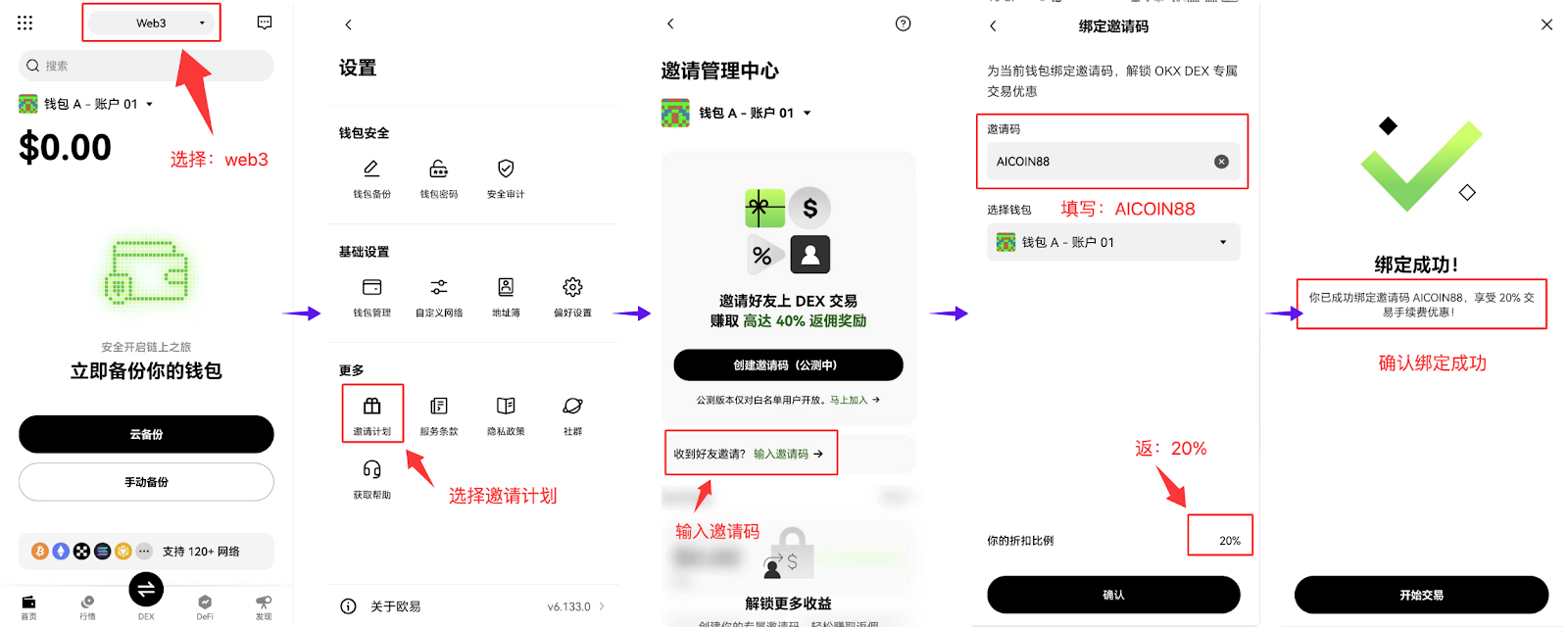
Bind OKX Wallet using exclusive invitation code 【AICOIN88】, web operations are also convenient!
https://web3.okx.com/ul/joindex?ref=AICOIN88
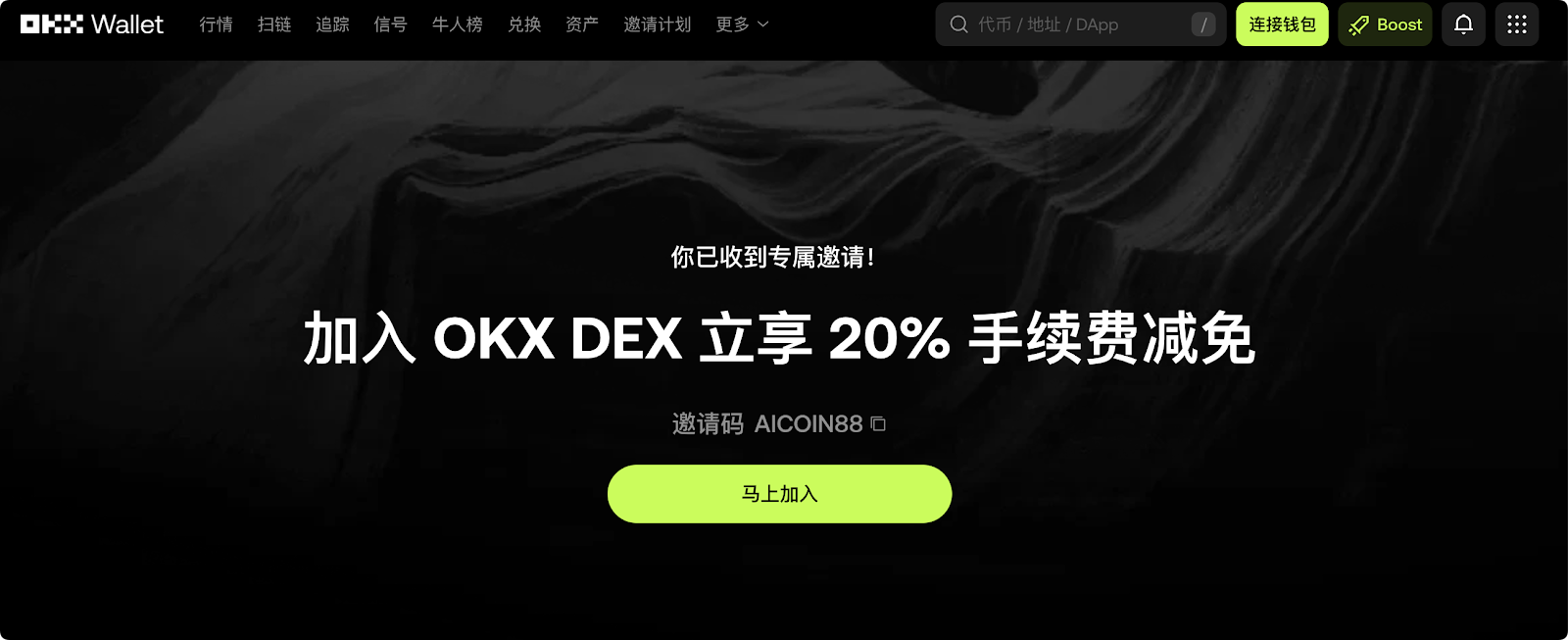
Don't wait, get the OKX Wallet, bind the benefits, and earn new wealth!
免责声明:本文章仅代表作者个人观点,不代表本平台的立场和观点。本文章仅供信息分享,不构成对任何人的任何投资建议。用户与作者之间的任何争议,与本平台无关。如网页中刊载的文章或图片涉及侵权,请提供相关的权利证明和身份证明发送邮件到[email protected],本平台相关工作人员将会进行核查。