Original author: Long Yue
Original source: Wall Street Journal
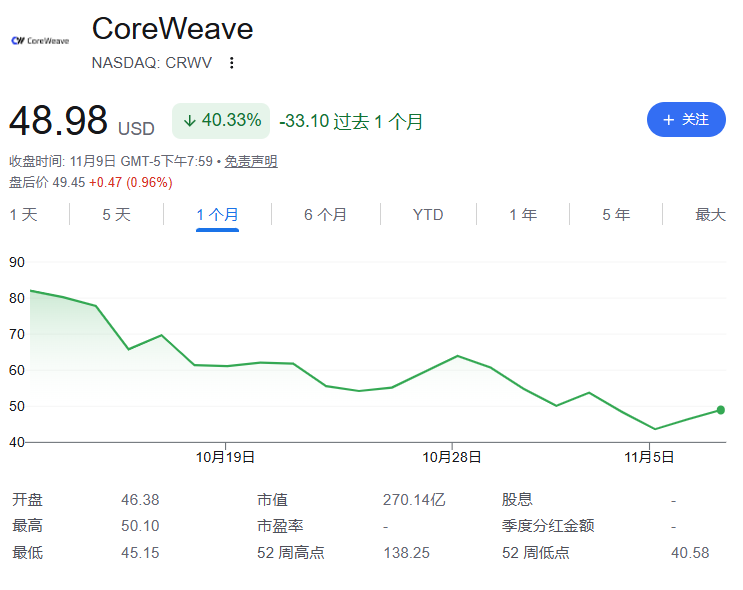
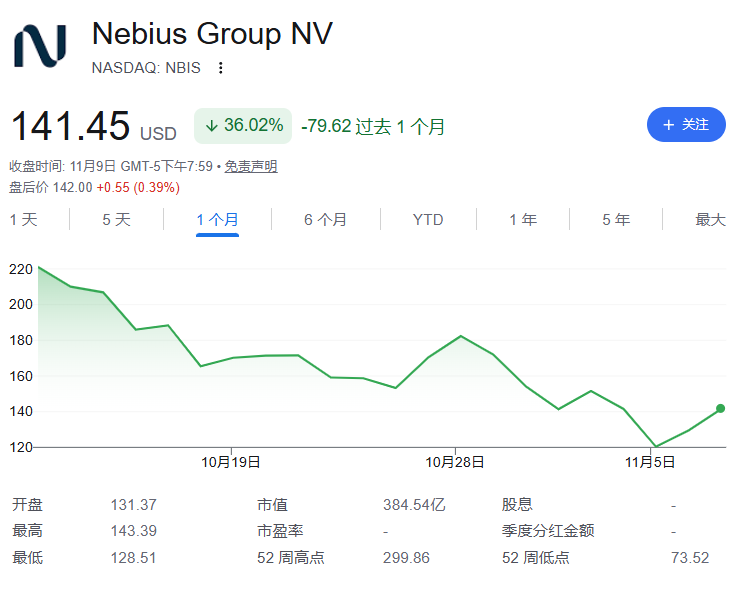
Under the double pressure of rising debt costs amidst a boom in AI infrastructure investment, the stock prices of two emerging cloud computing companies, CoreWeave and Nebius, have both nearly halved in just one month.
This week, the two companies will successively release their Q3 financial reports on November 10 and November 12. This timing is quite delicate—the market is waiting for an answer: is this sell-off an overreaction or a reasonable pricing?
From a fundamental data perspective, both companies' revenue growth trajectories remain strong, with analysts expecting CoreWeave's revenue to double by 2027 and Nebius's revenue to grow more than twofold. However, the core issue lies not in revenue but in the massive debt that supports this growth.
Why did the stock prices nearly halve in a month?
According to Chris Beauchamp, Chief Market Analyst at IG, the credit default swap (CDS) spread for Meta hit a record high in late October—prior to which Meta had raised its capital expenditure expectations again, leading investors to sell off at the highest-leverage end of the AI infrastructure chain, namely "new cloud" companies. The capital expenditure of such companies often amounts to multiple times their annual revenue.
CoreWeave was hit hardest. The company carries about $50 billion in debt, and in mid-October, the yield on its bonds maturing in 2031 approached 16%, while the CDS spread widened to around 1200 basis points—this is the level typically reserved for borrowers whose ability to repay is in doubt.
Although Nebius's debt scale is relatively small and it recently signed a $3.5 billion financing deal, its stock price drop was nearly equivalent to that of CoreWeave. This indicates that investors did not differentiate much in this round of sell-off.
In the past month, CoreWeave and Nebius's stock prices plummeted by 44% and 36%, respectively.
Financial report expectations: Revenue growth remains strong, but losses continue
For CoreWeave, the market consensus expects Q3 revenue to be $3.55 billion, with StarMine's smart estimate at $3.54 billion, nearly the same, implying an unexpected increase of only about 0.06%. In contrast, the first quarter's unexpected increase was 5.73%, and the second quarter narrowed to 0.59%, showing that analyst predictions have gradually caught up with its growth pace. EBITDA is expected to be $2.05 billion, corresponding to a profit margin of about 58%, but the company expects to record a loss of $1.16 per share, narrowing to $0.55 in the fourth quarter.
For Nebius, the revenue expectation is $908 million, slightly higher at $916 million per SmartEstimate, with an expected positive surprise of about 0.96%. The unexpected increases for the first and second quarters were 7.43% and 1.67%, also showing a narrowing trend. EBITDA is expected to be $353 million, corresponding to a profit margin of about 39%, with an estimated loss of $0.69 per share, potentially expanding to $0.95 in the fourth quarter, before gradually improving.
Bullish logic: Has the decline excessively reflected pessimistic expectations?
From a purely numerical perspective, both companies' growth stories remain noteworthy.
According to consensus data cited by IG, CoreWeave's revenue is expected to be $12.86 billion this year and is projected to rise to $26.47 billion by 2027, an increase of about 106%; Nebius's revenue is expected to be $3.37 billion this year, projected to soar to $11.98 billion by 2027, an increase of about 255%. Supporting these forecasts are CoreWeave's over $129 billion in backlog orders and Nebius's more than $40 billion in long-term contracts.
On the valuation front, CoreWeave's current EV/EBITDA is 14.6 times (based on the past twelve months), and Nebius's forward EV/EBITDA has been drastically compressed from 191.4 times over the past twelve months to 6.4 times. Analysts have an average target price of $131.41 for CoreWeave and $286.53 for Nebius, implying potential upsides of about 183% and 121% relative to current stock prices.
There are also positive developments in the business sector. Palantir has listed Nebius as a preferred partner for sovereign AI infrastructure, which is expected to open government revenue; Nebius completed its acquisition of Inferize in October, strengthening its reasoning business capabilities. CoreWeave is expanding in Denmark and plans to build a global AI network backbone covering the UAE, India, Indonesia, Singapore, Australia, South Korea, and Japan starting in the fourth quarter.
Bearish logic: Debt issues may be more important than revenue
However, growth driven by debt is attractive only if the debt can be renewed on reasonable terms.
CoreWeave raised its capital expenditure expectations to between $35 billion and $39 billion this August, roughly three times its expected revenue in 2026. Against a backdrop of bond yields approaching distress levels, the core issue for the market is no longer whether customers need computing power, but whether lenders are still willing to foot the bill. If there are signs of a passive narrowing in the capital expenditure range, the market may interpret it as financing difficulties rather than proactive adjustments.
Nebius's financing situation is relatively healthy but not without flaws. The $3.5 billion senior secured financing arrangement with Citibank has a maturity of only 364 days, with an interest rate of SOFR plus 275 to 350 basis points—which means financing long-term assets with short-term funds, while management plans to advance asset-backed financing based on contract orders, which needs to be executed in an already significantly tightened market.
Moreover, CoreWeave's customer concentration risk cannot be ignored, with major clients including Microsoft, OpenAI, and Meta. CEO Michael Intrator has cumulatively reduced his holdings by nearly $1 billion through pre-arranged trading plans since the IPO, which may raise governance questions at this time. Nebius may also face inquiries regarding its former parent company Yandex, which retracted its 2026 performance expectations after its Russian data center was attacked, although the two companies are now independent entities.
The earnings call is the real key
In a typical quarter, a slight positive surprise along with stable performance guidance may suffice. But this is not a typical quarter.
Since the revenue expectations for both companies are close to consensus, the importance of the numbers themselves may be overshadowed by the management's statements during the earnings call. What investors are most concerned about is the latest developments in financing conditions, the timeline for achieving free cash flow, and the degree of diversification of the customer base. The market particularly anticipates CoreWeave to provide a free cash flow path planning extending to 2030.
The performance of profit margins is equally crucial. CoreWeave's approximate 58% EBITDA profit margin is a core pillar of its solvency argument, while Nebius's approximately 39% profit margin has quickly risen from a lower base, but any decline in profit margins from either company could reinforce the judgment that "the economics of GPU leasing are not as attractive as the growth rate suggests."
According to IG analysis, the following signals may mark a turnaround in market sentiment: CoreWeave clearly specifies the capital expenditure range of $35 billion to $39 billion and explains the sources of funds; provides a credible timeline for free cash flow to turn positive, ideally covering until 2030; new orders show that the customer base surpasses existing major cloud vendors and AI laboratories; Nebius provides specific details on asset-backed financing arrangements for $40 billion in contract orders, along with the refinancing plans for the 364-day financing arrangement; evidence of growth in reasoning business after the acquisition of Inferize; and a narrowing of CoreWeave's bond yields and CDS spread after the earnings report—this may indicate issues more than stock price reactions.
Chris Beauchamp wrote in the article: "If both companies can demonstrate that funds are in place and profit margins remain stable, the market may determine that the more than 40% decline has reflected excessive pessimism. If, on the other hand, the earnings call is dominated by refinancing issues and vague answers, then a stock price halving may represent reasonable pricing rather than an overreaction."
免责声明:本文章仅代表作者个人观点,不代表本平台的立场和观点。本文章仅供信息分享,不构成对任何人的任何投资建议。用户与作者之间的任何争议,与本平台无关。如网页中刊载的文章或图片涉及侵权,请提供相关的权利证明和身份证明发送邮件到[email protected],本平台相关工作人员将会进行核查。


