Source: Jin Ten Data
On Tuesday evening at 21:30, the U.S. Bureau of Labor Statistics will release the Consumer Price Index (CPI) for October. Investors will focus on whether the prices that have risen significantly for two consecutive months will start to cool down, and whether the latest data will change the market's judgment on further interest rate increases by the Federal Reserve.
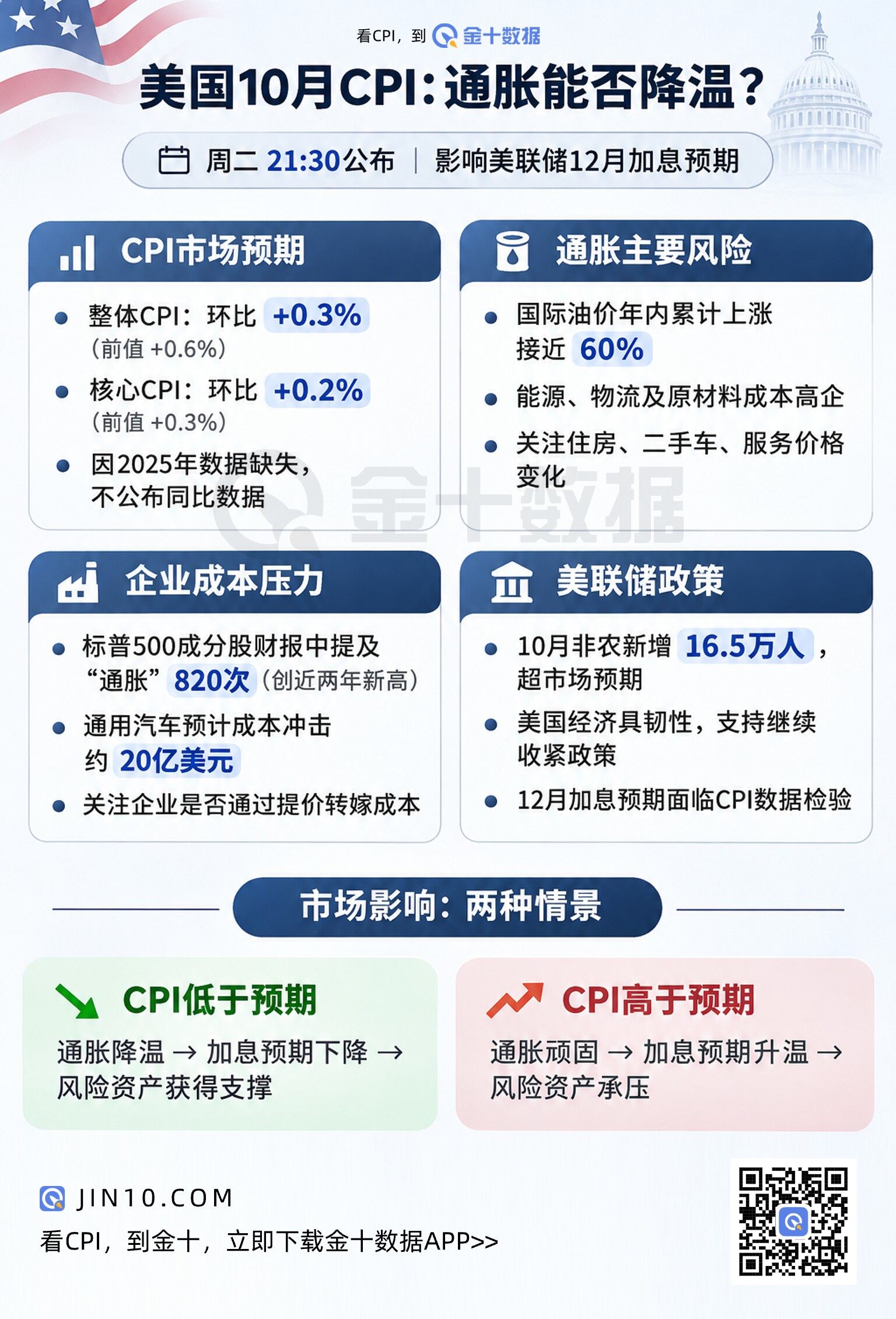
A Reuters survey shows that economists expect the overall CPI in October to rise 0.3% month-on-month, lower than September's 0.6%; the core CPI, excluding food and energy prices, is expected to rise 0.2% month-on-month, likely marking the smallest increase in three months.
This CPI report has a special consideration. Due to the U.S. federal government shutdown in October 2025, which led to the lack of that month's CPI report, the U.S. Bureau of Labor Statistics will be unable to publish year-on-year inflation data. The month-on-month rate will be released normally. Therefore, the market will rely more on the month-on-month changes in overall and core CPI, as well as specific price components, to judge the inflation trend.
Additionally, this report will be the last CPI data before the Federal Reserve's interest rate meeting in December (the next CPI will be released later on the same day as the Federal Reserve's interest rate decision). The previously released October non-farm payroll report was stronger than market expectations, further reinforcing the view that the U.S. economy remains resilient. For Wall Street, which is reassessing interest rate prospects, whether inflation can fall as expected becomes an important variable determining the trend of asset prices in the next phase.
Inflation Expected to Cool, But Price Pressures Remain
Previously, the U.S. CPI rose 0.6% month-on-month in September, the largest single-month increase since April of this year, deepening market concerns about the persistence of inflation after two consecutive months of significant increases.
Latest forecasts from economists suggest that the overall price increase in the U.S. may slow significantly in October. The core CPI is expected to rise 0.2% month-on-month, a decrease from September's 0.3%. If the forecast holds, it will provide some buffer to the previous streak of strong inflation data.
Citi Group economists predict that the transmission of high energy costs to other goods prices may be relatively limited, and price increases in the services sector will also remain moderate.
The Bloomberg economic research team estimates that the actual month-on-month increase in the overall CPI for October may be around 0.25%, with the core CPI at about 0.24%. The research team believes that the price increases of goods and services may both slow down, with changes in used car, consumer electronics, and housing-related service prices warranting attention.
However, the drop in energy prices does not mean that inflation pressures have been alleviated. Although international oil prices fell significantly last week, dropping below $100 per barrel, the cumulative increase since the beginning of the year is still nearly 60%, and natural gas prices are also far above early-year levels.
Persistently high energy prices are driving up costs in transportation, manufacturing, agriculture, and household spending. Whether businesses can continue to absorb these costs and whether they pass on the pressures by raising the prices of goods and services will influence the inflation trend in the coming months.
Concerns About Corporate Inflation Rise, Market Must Also Monitor Price Transmission
Recent corporate earnings reports reflect that inflation pressures in the U.S. have widely affected different industries.
Statistics from Bloomberg show that during October earnings calls of S&P 500 companies, the term "inflation" and related vocabulary were mentioned 820 times, the highest level since February 2024. Among these, industrial companies accounted for about one-quarter of the mentions, reflecting the pressures brought by rising energy and logistics costs.
General Motors expects that rising commodity, logistics, and storage chip prices will lead to an adverse impact of about $2 billion this year. Coating manufacturer PPG Industries stated that it is considering raising product prices to alleviate raw material cost pressures.
Consumer goods companies are facing similar issues. Spice manufacturer McCormick warned that high shipping costs and weak consumer spending are simultaneously impacting operations, and the company still needs to assess the inflation and cost outlook for 2027.
The statements from these companies make the specific components of October's CPI more valuable for reference. If energy price shocks remain mainly concentrated in a few categories like gasoline, while core goods and services prices start to slow down, the market may perceive the risk of further inflation diffusion as having eased. If housing, transportation, and other service prices continue to grow rapidly, the persistence of inflation will remain a major issue for the Federal Reserve.
This Friday, the U.S. will also release the Producer Price Index (PPI) for October. Economists expect the year-on-year increase in PPI to accelerate to 6.6%, reaching the highest level in nearly four years. This data will further reflect price pressures in the production stage for enterprises and provide additional evidence for judging whether costs continue to be transmitted to consumers.
Whether the Federal Reserve Will Raise Rates in December, CPI Will Provide Key Basis
The October CPI is receiving heightened attention, as the direct reason is that the Federal Reserve's monetary policy stance is being tested by persistent inflation.
The Federal Reserve maintained its benchmark interest rate at the end of October's meeting, but some officials have advocated for further tightening of monetary policy. The market currently expects the Federal Reserve might raise rates in December and continue to increase rates in March next year.
Last Thursday, Cleveland Fed President Mester stated that to bring inflation back to the 2% target in a timely manner, the Federal Reserve needs to adopt a restrictive monetary policy stance. She leans towards making more frequent, smaller rate adjustments to reduce the risk of monetary policy lagging behind economic conditions.
Mester previously voted against last month's Federal Reserve interest rate decision. She believes that ongoing supply shocks could lead businesses and consumers to gradually form stronger inflation expectations, complicating the central bank's efforts to stabilize prices.
New employment data also puts the Federal Reserve in a more direct policy choice. The U.S. reported an increase of 165,000 non-farm jobs in October last Friday, surpassing all market forecasts. The resilient job growth indicates that the economy can still bear higher borrowing costs, giving the Federal Reserve space to continue focusing its policy on controlling inflation.
If the core CPI for October is significantly below market expectations, investors may lower their judgments on the future magnitude or frequency of rate hikes. Conversely, if inflation exceeds expectations again, the market may reassess how long rates will remain high and even raise expectations for a tighter policy path.
免责声明:本文章仅代表作者个人观点,不代表本平台的立场和观点。本文章仅供信息分享,不构成对任何人的任何投资建议。用户与作者之间的任何争议,与本平台无关。如网页中刊载的文章或图片涉及侵权,请提供相关的权利证明和身份证明发送邮件到[email protected],本平台相关工作人员将会进行核查。


