A dazzling highlight in a sea of blood
As I write these words, the S&P 500 (SPX) and the Nasdaq 100 ETF (QQQM) have just completed their trading for the day, down 4.36% and 6.36%, respectively. This round of sell-offs is mainly focused on AI-related stocks, including Oracle Corporation (ORCL), Micron Technology (MU), Sandisk Corporation (SNDK), CoreWeave (CRWV), and Nebius Group N.V. (NBIS). I specifically point out these five companies because I have rated them all as "Strong Sell" in the past few days and even months. The decline in share prices and the rapid widening of credit spreads are suddenly making it much more expensive for these companies to obtain capital.
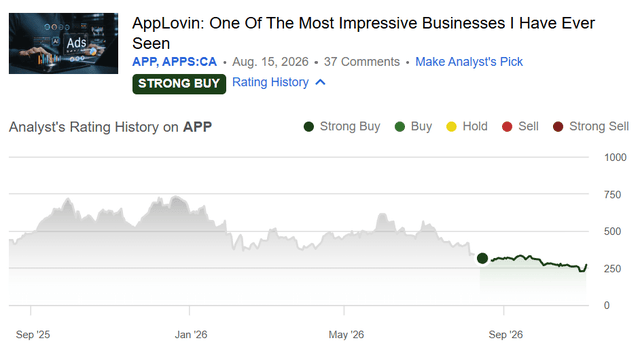
Compared to the overall market, my long-only portfolio has clearly outperformed today, closing down only 0.66%. Firstly, I have no long exposure to any AI infrastructure-related stocks; secondly, one of my core holdings surged over 30% today after announcing explosive earnings last night. I am, of course, referring to AppLovin (APP), a stock I first covered last August and rated as "Strong Buy."
AppLovin is one of the most impressive companies I have seen in over 15 years of stock research. Management believes that given the enormous development space in the e-commerce and CTV markets, the company can sustainably maintain revenue growth of 20%-30% in the long term. This sustained high double-digit revenue growth is also accompanied by what can be described as record profit margins.
[Image Location: AppLovin Historical Coverage (David Desjardins, Seeking Alpha)]
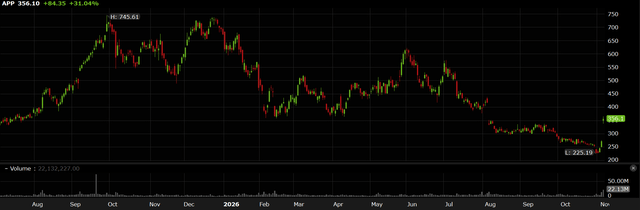
I have always believed that regardless of market conditions, opportunities will always exist, and I maintain this attitude every day I participate in the financial markets. This is essentially the core idea that Benjamin Graham wanted to express through the metaphor of "Mr. Market": in the face of the market's rapid and extreme emotional fluctuations, we should take advantage of it rather than fear it. The public market allows us to buy a small piece of ownership in world-class companies at prices that would not be possible in a private negotiated deal. From this perspective, the fact that AppLovin's stock price has surged nearly 60% from last Friday's low of $225.19 is indeed unbelievable. As a disclosure, AppLovin has now become one of the largest positions in my personal portfolio, with an average cost of $301.05 per share. Of course, in hindsight, I should have been buying much more aggressively during this sell-off. As stated in Chapter Eight of "The Intelligent Investor":
If an investor allows himself to panic or excessively worry because of an unfounded market decline in the stocks he owns, he is actually turning his fundamental advantage into a fundamental disadvantage.
[Image Location: AppLovin Historical Share Price (David Desjardins, Questrade)]
A third quarter that significantly exceeded expectations
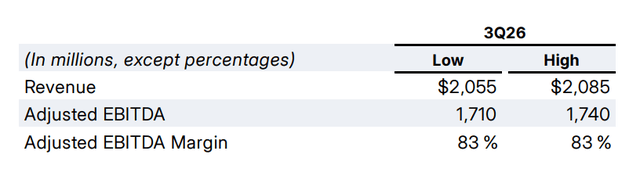
Back in early August 2026, when AppLovin announced its Q2 2026 performance, management expected third-quarter revenue to be between $2.055 billion and $2.085 billion. Fast forward to last night, AppLovin announced a record third-quarter revenue of $2.185 billion, exceeding the upper guidance by a full $100 million. During the sell-off of APP in recent months, I saw many people comparing AppLovin to The Trade Desk (TTD), which is very interesting. And APP's explosive Q3 2026 earnings report reminds us once again that in the short term, stock prices and market sentiment are entirely likely to diverge from a company's true fundamentals.
[Image Location: AppLovin Q3 2026 Guidance (Q2 2026 Press Release)]
In fact, as CEO Adam Foroughi stated during the Q3 2026 earnings call, AppLovin has exceeded its own guidance in 14 out of the last 16 quarters. Speaking of which, we only need to recall the last quarter: at that time, the company's performance was only slightly above the lower limit of the guidance range, and the stock price subsequently plummeted by about 20%. This triggered a lot of anxiety at the time, although management had explained to the market that the main reason was simply the timing impact of a new model release. The financial results announced last night confirm that this was indeed the case and not just an excuse from management to support the rapidly falling stock price. In my view, this has greatly enhanced the credibility of AppLovin's management.
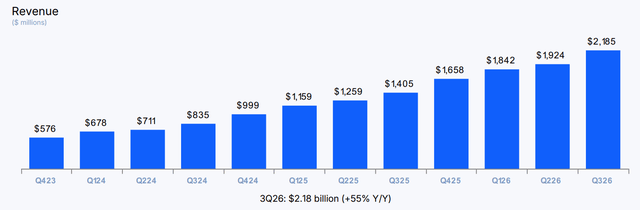
As shown in the chart below, AppLovin's third-quarter revenue grew approximately 14% quarter-over-quarter, which is one of the highest sequential growth rates for the company in recent years. Looking ahead to the fourth quarter, management expects revenue to be between $2.365 billion and $2.395 billion, which, based on the median of the range, implies a quarter-over-quarter growth of about 9%. Year-over-year, this corresponds to a growth rate of about 43.5%, slightly slowing compared to the 55% year-over-year growth in the third quarter.
[Image Location: AppLovin Historical Quarterly Revenue (Q3 2026 Presentation)]
In my view, the real million-dollar question when analyzing AppLovin is how long this astonishing growth can continue. A comparison can be made with Micron, which I previously studied: Micron is currently trading at less than 4 times the 2028 forward PE, which essentially tells us that the market believes the company’s current record profit levels are only temporary. However, I expect AppLovin's long-term revenue growth sustainability to be significantly stronger. During the most recent conference call, Adam Foroughi reiterated that the company's long-term revenue growth expectation is about 30% annually.
We believe that this business can compound at about 30% annually over the long term. And as this year has already proven, as long as conditions allow, we will strive to significantly exceed this growth rate.
So, how confident am I in this long-term sustainable growth forecast of 30%? As mentioned earlier, AppLovin achieved a year-over-year revenue growth of 55% in Q3 2026, while the median year-over-year growth for management’s fourth-quarter guidance is still at 43.5%. In other words, even if future growth "slows" to 30%, it would still represent a very noticeable slowdown from current levels, allowing for some margin of error. Moreover, management has a long-standing record of exceeding their own expectations, so I have no reason to believe the company's long-term growth outlook is significantly exaggerated.
I also want to emphasize that the company can convert revenue growth into profits at extremely impressive margins. Over the past few quarters, the company's adjusted EBITDA margin has consistently been in the 80% mid-range. What I want to convey is that the vast majority of the new revenue in the future is likely to directly translate into net profit, ultimately converting to free cash flow.
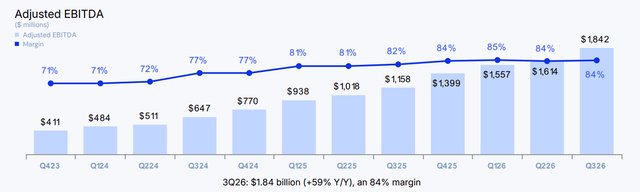
[Image Location: AppLovin Historical Adjusted EBITDA and Margin (Q3 2026 Presentation)]
A valuation severely disconnected from reality
So, for a company that is expected to grow 30% annually in the long term and requires almost no substantial reinvestment of capital into the business, how high of a valuation multiple would you be willing to give? As shown in the chart below, AppLovin required only $7.5 million in capital expenditure in the third quarter to achieve about 55% revenue growth. This means that approximately 99% of operating cash flow can be directly converted into free cash flow. This is almost the standard definition of a "light asset business model."
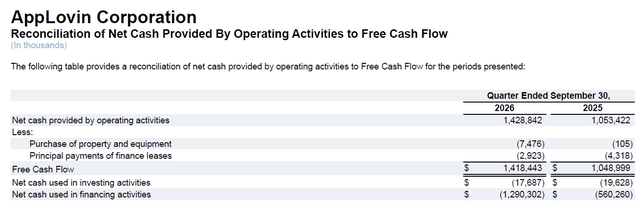
[Image Location: AppLovin Non-GAAP Free Cash Flow (Q3 2026 Press Release)]
From a capital allocation perspective, the company is returning a significant portion of that free cash flow to shareholders through share buybacks. In the third quarter alone, AppLovin repurchased $1.4 billion worth of stock at an average price of about $340 per share. Another strong signal showing management's confidence is that the company's board has authorized an additional $3.2 billion for stock buybacks this quarter, bringing the remaining buyback capacity to $3.6 billion as of the end of October.
Since the initiation of the stock repurchase authorization, AppLovin has repurchased a total of 104 million shares for a total expenditure of $9.4 billion, corresponding to an average repurchase price of about $90 per share. At today's closing price of $356.10, these 104 million shares are now valued at about $37 billion. To put it bluntly, Adam Foroughi and his team have created about $27.6 billion in value for shareholders just through share buybacks. Given such an amazing track record, it is no surprise that the company was actively buying back stock even when its share price dropped below $250 last week. We will have to wait until the Q4 2026 earnings report is released to know the answer, but I don't believe the company's increase of the buyback authorization by $3.2 billion this quarter was just a coincidence.
How many companies can achieve a 55% revenue growth within a year while continuously reducing the number of outstanding shares? If management's long-term forecast of 30% annual revenue growth can be sustained, and the number of outstanding shares continues to decline, I believe that this stock will ultimately receive a significantly higher valuation re-rating. From this perspective, today's approximately 31% increase in stock price may just be the beginning of a larger market repricing process.
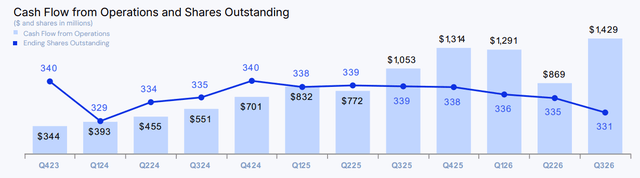
[Image Location: AppLovin Historical Operating Cash Flow and Outstanding Shares (Q3 2026 Presentation)]
In the third quarter alone, AppLovin generated $1.4 billion in free cash flow, which annualizes to about $5.6 billion. Relative to the company's market capitalization of $119.2 billion at today's close, this translates to a free cash flow yield of about 4.7% based on the most recent quarter annualized. Again, this mid-single-digit free cash flow yield comes accompanied by a long-term expectation of 30% annual revenue growth. Even after today's significant increase, I still find AppLovin's valuation remarkably cheap.
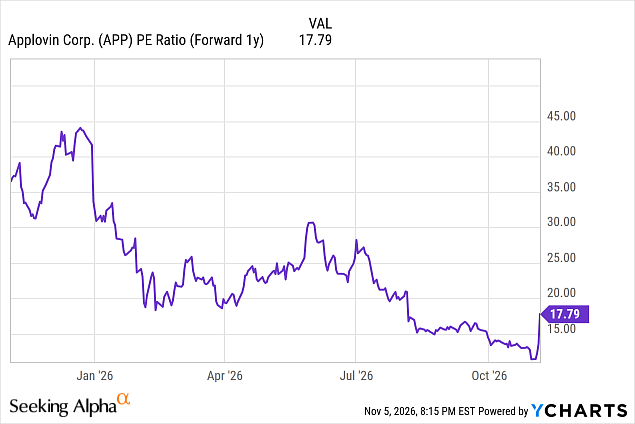
Now, let's look at Wall Street's consensus expectations. The market expects AppLovin's EPS to reach $19.57 in 2027, corresponding to a forward PE of about 18 times. To put this number into perspective, the current S&P 500 is computed at a forward EPS of about $415 per share, with an overall forward PE also landing at approximately 18 times. The biggest difference between the two is that AppLovin is expected to have a significantly faster growth rate, and achieving this growth will require almost no substantial capital investment.
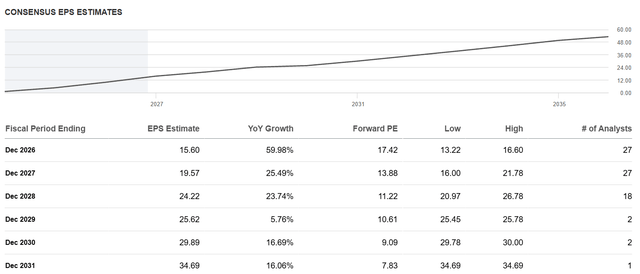
[Image Location: AppLovin EPS Market Consensus Expectations (David Desjardins, Seeking Alpha)]
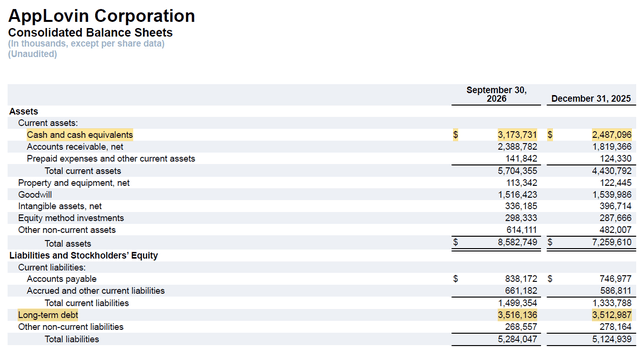
Another very important risk mitigation factor is that AppLovin's capital structure is almost entirely equity-based. As shown in the chart below, the company had $3.2 billion in cash and cash equivalents at the end of the third quarter, with long-term debt at $3.5 billion. Given the current stock price level and the company's extremely strong free cash flow generation capability, I even think it would be very reasonable to moderately increase some debt on the balance sheet to accelerate stock buybacks. Just a reminder, as of the end of October, APP still had $3.6 billion in available stock buyback capacity. Even if an additional several billion dollars in debt was added, it would not pose a problem for the company; if management wanted, they could even pay it all off in less than a year using current cash flows.
[Image Location: AppLovin Q3 2026 Balance Sheet (Q3 2026 Report)]
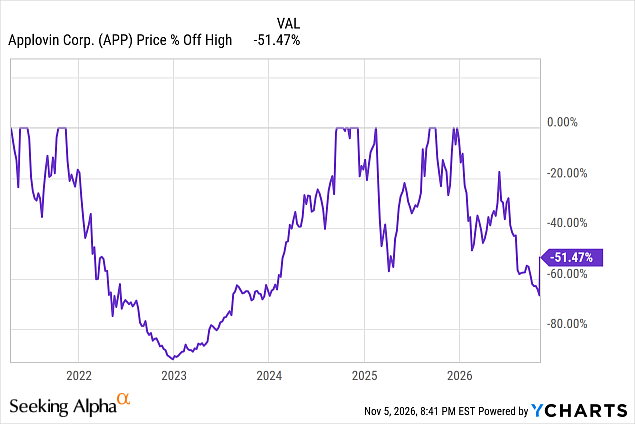
An almost entirely equity-based capital structure can significantly reduce the downside risks faced by common shareholders. After all, if you have almost no debt, how could you go bankrupt? Furthermore, in an all-equity capital structure, the impact of a significant stock price retracement differs entirely from that of a highly leveraged company. Once large amounts of debt are involved, stock price fluctuations usually amplify significantly. Relative to the historical peak of $745.61 per share set in September 2025, APP's stock price remains over 50% retraced. Considering the company's limited debt pressure on the balance sheet and consecutive quarterly financial performances breaking records, this retracement seems even more worthy of attention.
Could The Trade Desk become a potential acquisition target?
When I first covered AppLovin back in August last year, I posed a question: Could AppLovin be interested in acquiring The Trade Desk? In the comments section of that article, many readers indicated that the strategic possibility of such a deal seemed unlikely. However, after listening to the third-quarter earnings call, I want to raise the topic again, as AppLovin CEO Adam Foroughi explicitly expressed a desire to acquire more data to accelerate model development. In addition, AppLovin has already begun entering the Connected TV market, which is precisely one of The Trade Desk's most important markets.
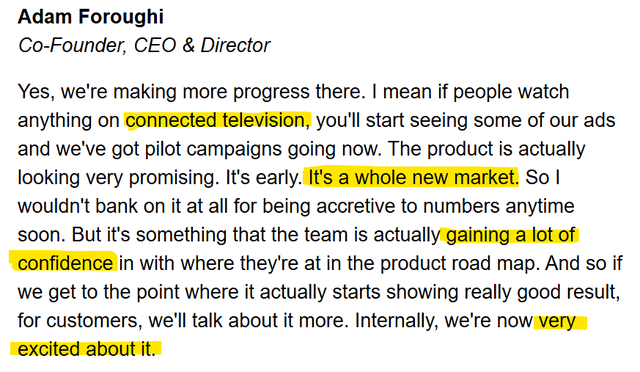
[Image Location: Adam Foroughi Discussing Connected TV (Q3 2026 Earnings Conference Call)]
Adam Foroughi also shared some interesting details about the $1.05 billion MoPub acquisition deal announced in October 2021. AppLovin did this transaction not to operate MoPub as a continuing business but to acquire its data and clients; thus, about 90 days after completing the transaction, MoPub was proactively shut down. Could AppLovin use a similar strategy for The Trade Desk? First and foremost, this would directly remove a significant competitor from the Connected TV market; secondly, it could significantly accelerate AppLovin's model development.
The Trade Desk currently has a market cap of about $6.3 billion, with approximately $1.5 billion in net cash on the balance sheet. Given that AppLovin generated $1.4 billion in free cash flow just in the third quarter, acquiring a company valued at only about $4.8 billion would not pose any financial pressure at all. Of course, this scenario is purely my speculation, but I will keep this possibility in mind when TTD announces its third-quarter results next week.
Conclusion
As the financial performance breaks record after record each quarter and the number of outstanding shares continues to decrease, I believe that AppLovin's stock price will break through the historical high of $745.61 per share set in September 2025; it's just a matter of time. Based on today's closing price of $356.10 per share, this means a potential upside of about 110%. For this scenario to materialize, the only thing AppLovin needs to do is to continue delivering on its long-term revenue growth target of 30% annually.
I want to emphasize again: in my 15 years of studying numerous stocks, AppLovin has shown me the most impressive set of fundamentals I have ever encountered. The most important question remains how long this growth rate and profitability can be sustained, and on this point, investors need to grant a certain degree of trust in management's long-term forecasts.
However, even if future revenue growth slows more rapidly than expected, I still believe that the current forward PE of about 18 times for 2027 offers sufficient margin of safety. Even after today's stock price increase of about 31%, I still find the current risk-reward structure clearly asymmetric to the upside, so I reiterate a "Strong Buy" rating for APP.
Would you rather buy Micron at a forward PE of about 3.7 times for 2027 or AppLovin at a forward PE of about 18 times? Which stock is truly cheaper? Of course, I may be wrong in my judgment, but I have made this 18 times PE stock one of the largest positions in my personal portfolio. Perhaps this is what they call "putting one's money where one's mouth is," or in other words—eating the food you cook yourself.
免责声明:本文章仅代表作者个人观点,不代表本平台的立场和观点。本文章仅供信息分享,不构成对任何人的任何投资建议。用户与作者之间的任何争议,与本平台无关。如网页中刊载的文章或图片涉及侵权,请提供相关的权利证明和身份证明发送邮件到[email protected],本平台相关工作人员将会进行核查。