
Text|Huang Xiaoyi(WeChat H997Hbiu)
Dialogue|Wang Zhaoyang(WeChat Geisterspiele)、Huang Xiaoyi
“Frontier data, made in China.”
This is the slogan displayed on the official website of Intelligent Knowledge. It points to a crucial aspect that must be filled in the next stage of competition for AI in China: the ability to continuously supply high-quality data needed for cutting-edge models.
Today, across the ocean, Silicon Valley is fervently discussing how to distill human experiences. Companies like Anthropic are actively building data teams internally while collaborating with external vendors; Scale AI, Surge AI, and Mercor are growing within this tight collaboration, resulting in several companies with valuations in the hundreds of billions. The competition for model capabilities has extended into a competition for data supply capabilities.
This is also an opportunity that Intelligent Knowledge identified a year and a half ahead of time, or even earlier.
In April 2025, Intelligent Knowledge was established, later receiving seed investment from Wuyuan Capital and Qiji Chuangtan, as well as angel investment co-led by Jinqiu Fund and Yaotu Capital.
Many core technical members of this company had previously participated in model data work within Byte, and there are also members from companies like Scale AI.
In the founding team, the founder and CEO Wang Sheyang was in charge of model data engineering for Byte Seed, and the CTO Li Kuanye’s work at Byte covered areas from pre-training data pipelines to reinforcement learning data synthesis and environment building for inference and tool invocation. Co-founder and president Zeng Ziwen hails from the Byte commercialization platform and traffic strategy team.
In the latter half of 2024, they collectively noticed inside large companies that the production of knowledge required by models was rapidly transcending organizational boundaries.
“Post-training is gradually becoming a focus, with the distribution of human experiences required becoming broader and more specialized, and the direction of data needs constantly changing with tasks. It is very difficult for a single company to organize all these people internally and produce all the data needed for models.”
The opportunity for independent data companies has arrived.
However, as one of the earliest entrepreneurial companies in the country to engage in post-training data, for at least the first six months after its establishment, the Intelligent Knowledge team found it difficult to gain understanding and recognition for its business model from investors.
“In just half a year, no one understood, and then newcomers had no opportunity.” Zeng Ziwen said.
In the first half of 2025, the DeepSeek-R1 model further validated the potential of reinforcement learning to enhance reasoning abilities, accelerating domestic model teams’ exploration of post-training and agent capabilities. In the latter half of the year, these underlying commercial opportunities began to be recognized by more people, and a wave of individuals who, like the Intelligent Knowledge team, had previously been responsible for data and training within model companies began to start their own ventures.
By 2026, as mentioned in our previous publications “AI Data Fury”“The Future of AI and Hot Money at This Moment is Hidden in China's Alexandr Wang”, model factories, entrepreneurs, applications, transit stations, and investors will pour in in batches. High orders, high profits, high valuations alongside gray areas will create the liveliest aspect of this new market.
In the face of chaos, Li Kuanye, who is both a post-00s and an “industry veteran,” feels that there is always one main line: “Data doesn’t require genius ideas, just needs to be taken seriously and carefully in every judgment.”
Li Kuanye breaks down the data required for reinforcement learning into three elements: the environment, which determines what the model can see and manipulate; the task, which determines what the model needs to accomplish; and the validator, which assesses how well it performs.
As model capabilities grow and enter real production, the challenges associated with the three elements are also changing.
Just last year, when they were running model evaluations, they were often held back by underlying infrastructure: if concurrency was high, the entire environment would even crash. This year, such issues have significantly decreased, the infrastructure supporting model operations has gradually matured, and the industry has begun to focus more on replicating real business environments.
However, in his view, the environment is still the Easy Part, because after establishing the environment, there are still two pressing issues to address: What tasks are worth having the model tackle before training begins? After the model completes a task, what criteria should be used to judge whether it did well or provide feedback?
For example, having the model enter several invoices into the reimbursement system is a clear task. It’s enough to check if the amounts and dates are correct. But if the requirement changes to “next week go to Shanghai to meet clients, make some arrangements,” the model then needs to check emails, chats, and calendars, first clarifying what needs to be arranged, and then coordinating various affairs.
Tasks become more ambiguous, environments more complex, and validation has to assess if the itinerary is reasonable, whether the budget was well spent, and the quality of experience.
Especially when the business is moved into a frozen, retrainable virtual environment, real feedback is also absent. A truly good task that can improve the model is the starting point, while the scoring criteria represent the ending, both ends relying increasingly on expert judgment.
In short, Human Data is all you need.
This is different from the approach of many data companies in the industry. For some time, because the model factories prioritized quantity and deadlines over quality, many companies used synthetic data as “expert data,” and many practitioners believed that the capabilities of strong models are already better than those of humans, asserting that their trajectories would outperform human operations.
However, Intelligent Knowledge believes that while expert experience indeed becomes increasingly scarce, it remains the most important factor.
To some extent, thinking “expert experience is no longer important” arises from not finding the experts that models need, or from failing to convert human experiences into training signals.
Their viewpoint has also been validated by the industry's attention.
“The market's focus has undergone several shifts, initially emphasizing data engineering pipelines and efficiency; later, it began to over-rely on the scale of expert networks, paying attention to quantity; now it is once again re-evaluating expert experience, focusing on how to continuously produce high-quality data.” Li Kuanye said.
“This is a signal of improvement in the data industry.”
We chatted with Li Kuanye about their experiences after leaving the model factory and the continuously updating judgments over the past year.
Listening to his sharing, one can feel a seriousness and rigor that belongs to a technician. This young man with slightly longer hair, who enjoys playing rock, often prefixes his viewpoints with “in my view,” distinguishing changes he perceives from unverified inferences, while also demonstrating a willingness to deduce the longer-term essence of data from the perspectives of models and intelligence.
For instance, “RSI optimally utilizes existing capabilities but does not equate to generating new intelligence.”
Furthermore, “many everyday tasks do not require such high levels of intelligence, but need to repeatedly extract information in cross-system complex environments while making trade-offs without standard answers. Intelligence and experience are relatively independent parts.”
His way of thinking mirrors the work of data, as both must find reliable signals amidst a chaotic world and abstract human experiences.
In an industry driven by business and constantly changing winds that divert attention, this dialogue also resembles a rare moment of calm reflection from a frontline practitioner, offering an alternate perspective to comprehend today's intelligence bottlenecks.
As Intelligent Knowledge mentions in its self-statement on the official website, “Machines may go faster, stronger, and remember better. But their humanity comes from our choices of what to teach them, what to ignore, and what kind of taste to endow them with. Our mission is to cultivate truly soulful AGI.”
No matter how model capabilities change, one point they consistently uphold:
“Without human participation, AGI cannot be achieved.”
Here is the transcript of the dialogue, edited and organized:
“In half a year, from no understanding to newcomers having no opportunity”
Silicon Star: Why did you choose to leave Byte to start a data company? At that time, the industry was still in its infancy; what did you see within the model company?
Li Kuanye:When I first joined Byte in 2022, I was working on big data engineering in the commercialization advertising team. Later, as everyone began to pay attention to GPT and scaling law, I seized this opportunity to shift towards large models.
At that time, the team gathered a vast amount of data from the Internet. Algorithm researchers focused more on model architecture, and the engineering aspect needed individuals with big data experience to solve another category of problems: how to scale the entire data processing pipeline, designing distributed cleaning and processing strategies for extraordinarily massive data. My primary involvement was in building the pre-training data processing system.
After about six months, anxiety began to surface: the internet data had been used up, what else could be done next? Post-training discussions were becoming more frequent. Before this, the pre-training team had received significantly more attention.
In the latter half of 2024, particularly after the launch of the ‘o’ series, reinforcement learning became an important topic of discussion. I participated in a GUI Agent team for environment and data construction, also beginning to engage with complex environments and long-term agents.
During this phase, reinforcement learning no longer merely involved providing the model with an input and having it produce an answer for comparison with a standard answer; the model was now required to continuously execute tasks within the environment, and we needed to build corresponding training environments and scalable evaluation systems. For example, enabling thousands of tasks to simultaneously roll out in complex virtual environments and complete follow-up evaluations.
This part took nearly another six months. Around April of last year, we decided to start this company.
Before this, we had already discussed a judgment: data should not be a task confined within a single company.
It requires a massive workforce and needs to be flexibly organized based on tasks; the knowledge and experience that need to be covered are widely distributed. It is challenging for any single company to produce all the data required for models internally in a closed manner. This creates opportunities for external companies.
As for how to conduct this business specifically, in February of last year, Mercor inspired us. At that time, it was just starting to gain attention and was initially introducing interview services, but the blog showcased Human Data. This left a strong impression on us, and we later discovered that interviews served as an entry point to establish expert networks: selecting suitable candidates and then organizing them to produce expert data for companies like OpenAI.
Inspired by this, we quickly made the decision: we should start our own company.
Silicon Star: Many people's impressions of data are still stuck on labeling. But today, the data required by models is becoming increasingly complex, and high-valuation companies are appearing in this industry. From the past to now, what are the evolutions and distinctions in data?
Li Kuanye:The data needed for every generation of models differs.
Initially, before the rise of large models, data labeling focused more on basic common-sense tasks such as classification and tagging. For example, given an image, determining whether it contains a cat or a dog.
At that time, this was labor-intensive work that did not involve particularly strong specialized knowledge. Companies would ensure quality by establishing strong offline management capabilities: organizing and training a large number of people to complete annotations.
With the emergence of large models, data increasingly relied on knowledge. For example, during the pre-training stage, a significant amount of checking was necessary to ensure whether a segment of text contained harmful content or factual inaccuracies; this part of the work could be undertaken by individuals with a certain level of education.
Subsequently, there were preference data: the model would give two or three answers, and humans would judge whether A was better than B, which is RLHF. Compared to previous stages, this aspect relies more on individuals who are trained and have a certain understanding of AI. Scale AI also seized the opportunity to transition from traditional labeling to this type of work.
Now we have entered a third stage where data is increasingly driven by evaluation. This is fundamentally because we need to answer: What is intelligence, and how do we determine that a model has achieved the desired capabilities?
For example, everyone says a model has strong programming capabilities, but exactly where is its strength? It may require a ten-year engineer to dissect the work of a programmer into front-end, back-end, operations, and further break it down to evaluate the performance of specific tasks.
A profession encompasses many types of work, and the model's performance in each task will affect its economic value in that field, thus increasingly depending on experienced individuals for judgment.
Knowledge and experience bring added value, making data gradually become a high-value-added work area, which I believe represents the greatest change.
Participants need to engage deeply with models, identify problems, and transform subjective feelings like “I think it did well or poorly” into standards that can be verified and evaluated. This is a consideration for both data companies and experts producing data.
Silicon Star: After starting your company, how has your understanding of the data industry changed?
Li Kuanye:Since April of last year, the market's focus has actually gone through several changes.
Initially, everyone was mainly concerned with how to build labeling production lines and control data quality. At that time, RLHF was still the mainstream approach, and the production paradigm was not as complex as it is now. A good set of labeling specifications could maintain quality at a relatively high and controllable level.
By the latter half of last year, attention began to shift from production systems to expert networks.
Previously, when making right/wrong judgments and preference judgments, people could be concentrated in offline environments to produce in relatively stable conditions. However, as the demand for professional capabilities increased, this method became challenging. Experts come from diverse backgrounds; some might have their full-time jobs, making it impossible to concentrate them in a single location.
Thus, the on-line expert network received more attention. It was also around this stage that we began to receive tailored requests for experts.
In the first half of this year, people began to believe in the scale effects of expert networks, thinking they could scale. But soon, it became clear that transforming a knowledgeable person into someone who can produce data entails a high cost in itself. Just because many individuals already exist in the expert network doesn’t mean adding another person’s cost will noticeably decrease.
Meanwhile, models are progressing rapidly, and individuals who once helped models may gradually become unhelpful; as models enter new fields, a new group of individuals will be needed. For example, CAD and mechanical drawing began to be discussed more frequently in the latter half of this year.
Thus, the scaling effect of expert networks was not as robust as previously imagined. It is not feasible to fully apply past internet industry thinking and prioritize scaling.
We are now paying simultaneous attention to both the quality and efficiency of expert networks, not just the number of individuals, which has made the experience accumulated in data production pipelines last year important again.
The threshold for experts is rising, and the requirements for production systems are also increasing. In the past, there was perhaps excessive focus on one end; now both ends must perform well.
Spending money to hire experts is the simplest part
Silicon Star: But the difficulty you face in organizing experts is also present: experts are scattered across various industries, demands change rapidly, quality requirements are increasingly high, and delivery times are tight. Data companies are basically spending money to hire people and increase incentives; where does the differentiation and competitiveness lie?
Li Kuanye:Finding experts is inherently a high-barrier, costly endeavor.
First, there is a value problem: how much should we spend to find individuals who can help the model improve? This amount is increasing, which aligns with objective规律, and how to find these individuals is itself one of the core competencies of the company.
However, there is also another part of the competitive edge: how to organize them and make them aware of what the model currently needs. Not every expert knows what they should do to assist the model. They need to be trained and guided, which represents another core value.
This competitive edge comes from evaluating the capacity boundaries of models, and internally we will continue researching to identify the points and directions where the model struggles, then search for corresponding individuals and train them to conduct tasks that can elevate model capabilities.
The entire process is not so easily scalable; it is relatively complex, which also constitutes the barrier. In contrast, spending a lot of money to hire people is the easier part.
Silicon Star: Can I understand that data companies need researchers or experienced experts to research specific fields together, and once they clarify the details, form training and task processes so that more experts can provide professional judgments more efficiently?
Li Kuanye:Exactly.
Previously, the model company would identify where the model's flaws lay, as everyone was seeking common problems. For example, how to improve the accuracy of function calling, or how to ensure the model better adheres to instructions. These foundational capabilities associated with models relied heavily on researchers.
Now the demand has shifted to: how to make the model closer to a real expert, how to integrate expert work scenarios, and how to judge the model's performance.
Consequently, in our research team, we not only have PhDs with backgrounds in computer science but also those in biology, finance, law, and other fields. They need to collaborate with industry experts to judge which problems the model is underperforming on and which ones are worth investing in.

The difficulty of this work isn’t solely in research itself. Organizing people from different fields to discover problems together and produce data also requires investment. Sometimes, the workload of operation and management can even exceed that of research.
In what I see in the American market, discovering the boundaries of model capabilities across different industries has already begun to become the work of data companies. This is because data companies are closer to experts, enabling them to quickly organize them to discover problems with models, then transform these findings into specific data requirements: what tasks should be generated, what data sets should be constructed, to help models fill gaps.
In the future, domestic markets may also evolve to a corresponding stage, but it is still a bit early.
Silicon Star: As a data company spanning multiple industries, how do you judge the judgments of these experts? Is it solely reliant on the expert network, or is there a quantifiable and universal method?
Li Kuanye:Both parts exist.
For instance, there may be 40 or even 100 criteria for scoring a task, some of which entail deep professional judgment, while others are relatively superficial.
The deeper parts often involve truly challenging, ambiguous issues that rely heavily on the consensus formed by experts on the matter. We will consult multiple experts to judge the same question, similar to voting, where the prevailing opinion generally approaches the industry’s optimal solution.
The superficial portions can already be aided by models or engineering means. For example, having different models perform the same task to see which aspects they all get right and where there is divergence, then assessing whether a strong model truly performs better or whether the scoring criteria is flawed.
This approach can also reveal some systematic errors: unclear task descriptions or cases where it clearly requires A, yet acceptance checks B. These issues can be identified through engineering approaches.
From this perspective, the data industry might be one of the areas most significantly benefiting from model dividends.
The purpose of combining both approaches is to improve data production efficiency. Expert resources are limited; we hope their efforts are as efficient as possible, so any portions that can be managed in advance through engineering and models are addressed before involving experts.
This creates a cycle: as models get stronger and cover more simple tasks, we seek out experts who can address more difficult issues, thus propelling model improvements further.
Silicon Star: A startup cannot simultaneously enter ten industries; it must choose to focus on legal, financial, or other fields first. For you, why choose A over B?
Li Kuanye:The judgment of the broader direction is not complicated.
For example, OpenAI and Anthropic continuously demonstrate what they are focusing on. In my assessment, actions in the domestic market may be about six months to a year slower than those abroad, but the overall direction won’t deviate too much.
However, Anthropic is a large company, and the choices we make are certainly just a subset of their focus while also needing to consider national circumstances.
We continually ask several questions.
Firstly, where is the economic value of this industry? Its contribution to GDP can serve as a reference point.
Secondly, does this endeavor hold validity domestically, and in what different form might it manifest? We have researched the differences in industrial structures between China and the US. In our observations, the economic proportion of legal and professional white-collar work in the US is comparatively high; domestic e-commerce and logistics sectors may warrant greater attention.
Thirdly, where is the attention of model factories, particularly in what domestic model factories are focusing on? Data has supply chain attributes; whether clients are investing in one direction directly influences commercialization and monetization efficiency.
The division of labor between model factories and data companies lies in their ability to create compound returns
Silicon Star: The data industry is close to models and directly enjoys the dividends of model improvements. But does this mean it is also the most vulnerable to being overtaken by model companies themselves? Will the answers differ between the present and the long term?
Li Kuanye:Currently, both model factories and data companies are undertaking this work, domestically and abroad.
However, from the perspective of intelligence, we explore the boundaries and limits of knowledge work within human society as a whole. This issue is too broad to be accomplished by one or a few companies.
On the one hand, model companies recruit excellent professionals internally to help analyze the boundaries of model capabilities. In key areas such as science, they seek PhDs and professors for participation. With so many fields, it is challenging to cover them all, which is one of the anchor points for data companies.
On the other hand, as research deepens, the market is actually expanding. Last year, some expressed concerns that the model's coding ability was so strong that there would be little left to pursue in coding data. But once we reach new capability boundaries, people hope that models are further integrated into workflows, leading to the emergence of increasingly complex issues.
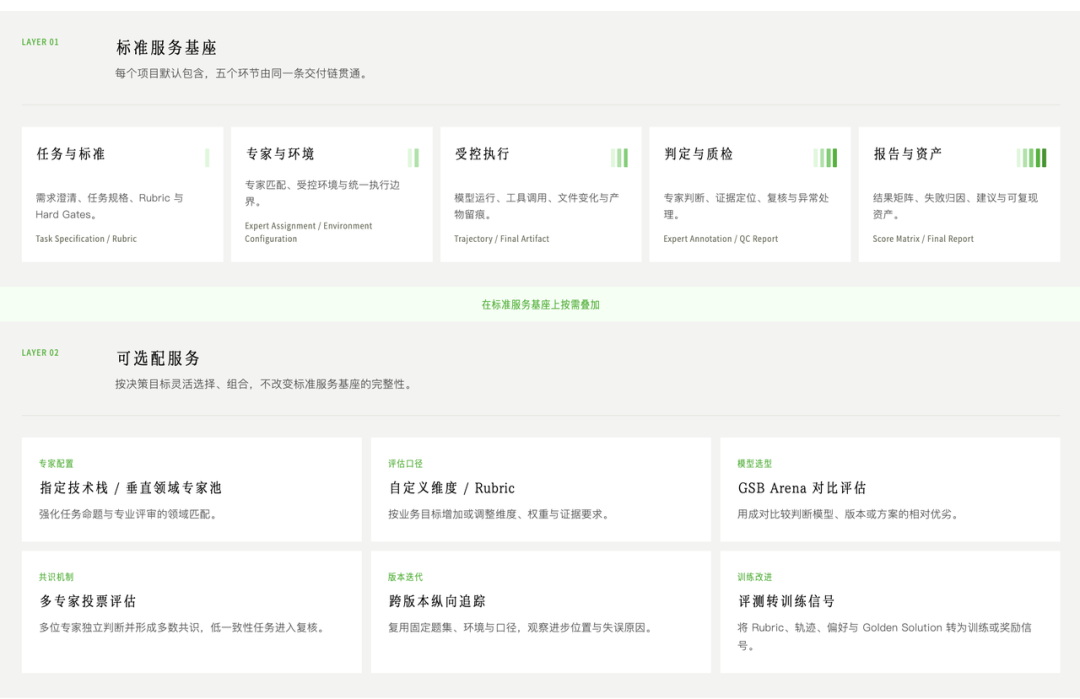
As a data company, we will start from the evaluations, first clarifying a given industry's knowledge system, then identifying where models struggle at various nodes and solving them one by one. Understanding quality standards and operating expert networks will all be accumulated in this process.
In the long term, the industry is likely to see a proliferation of various data companies, each delving deep into specific fields, then expanding outward based on existing accumulations.
Silicon Star: What is the current logic of data division of labor both inside and outside model factories?
Li Kuanye:Model factories do not resist external procurement; in fact, they are quite dependent on it. As I see it, at this stage, the market remains in short supply.
In terms of division of labor, model factories are gradually establishing quality systems and when outsourcing, focus their energy on preventing poor data from flowing into training.
Because internal production always limits the diversity of data, connecting with different companies allows engagement across various industries and diverse sources; simultaneously, directions change quickly; last year, people were still discussing code, this year it's RSI. It is challenging for model factories to rapidly assemble large internal teams for each new direction and subsequently adjust course.
For model factories, establishing a data control system forms the greatest returns.
Silicon Star: Since you can access human experiences more closely and identify what the models lack, even examining various models horizontally, why not become a model company directly?
Li Kuanye:I believe this ultimately comes down to the issue of division of labor. Although people say data brings intelligence, I do not want to downplay the role of computational infrastructure and algorithms; they are equally important. Large-scale reinforcement learning training relies on substantial algorithmic and engineering work: optimizing clusters, adjusting training algorithms, and parameters. These require continuous accumulation and investment.
For startups, focus is also crucial. Easily changing missions or consistently adding new tasks may result in inadequate performance.
Given that we recognize data as an important link, it should have an independent position: we uncover the weaknesses of models, pose good questions, and subsequently deliver these questions to companies capable of excelling in computation and algorithms, enabling models to further advance.
Data quality has become more important than quantity and diversity
Silicon Star: Should quality judgment be left to model factories, or is it significant for suppliers to provide high-quality data at the source, becoming a critical part of competition? Now, which is more important, diversity or quality?
Li Kuanye:I believe we have reached a stage where quality is more critical than diversity.
Internally, models must have teams to ensure quality control; otherwise, various attempts to exploit rules and acceptance loopholes will emerge externally. If there isn’t even a final checkpoint internally, it is difficult to trust that good data can be provided from the outside.
For data companies, quality is equally vital for competitiveness. Quality, diversity, and quantity are the three most important competitive dimensions for suppliers.
Silicon Star: Ultimately, judging data quality comes down to whether it can elevate the models after entering training. But this requires genuine training and involves time delays. The term “data quality” is quite abstract; what capabilities does it actually reflect? Moreover, if different model factories receive similar data, where would the differences arise?
Li Kuanye:The most direct assessment is whether the model’s performance improves after the data enters training, and if it sees improvement in other evaluations.
This task is currently challenging for data companies to execute comprehensively. Companies like Mercor also utilize their data for training and ablation experiments, however, the scale of their experiments still differs from those within model factories. While results can convey some aspects of quality, the strength of the causal relationship regarding whether it can be extrapolated to a client's large model is tricky to assess.
Returning to the data itself, we have several types of work we can undertake.
One type involves model factories placing increasing emphasis on the insights provided by experts during their thinking record, including how many experts contributed judgments, what discussions transpired, and how consensus was ultimately reached.
Some suppliers overly rely on AI during the production process with little of their own judgment, making it impossible to provide this segment.

Silicon Star:It resembles the evolution of models; initially giving answers, and later also providing the thought processes behind them.
Li Kuanye:Exactly. Another area worth investing in is observing the behaviors models exhibit while executing tasks, and subsequently analyzing the reasons behind failures. This may correspond to failure patterns that repeatedly emerge within certain tasks. I believe data companies should assume greater responsibilities over this aspect in the long term.
For example, if the same task is assigned to a model and it fails half of its checks, we examine what was lacking in those failures, summarize missing methods or experiences into prompts to feed back into the task, letting it retry. If it performs better armed with prompts, we can further assess if that prompt reveals a capability gap for the model.
However, situations where necessary information is deliberately withheld must be ruled out. If I conceal the password from the model, it obviously cannot complete the task; but once I disclose it to the model, it can succeed. That does not represent the capability gaps we wish to identify.
If the prompts provided are methodological or experiential, this validation bears more significance. It also presents a form of work data companies can undertake that clients easily comprehend.
Intelligence and experience are relatively independent matters
Silicon Star: Coding data not only improves programming capabilities but also enhances the general capabilities of models. Will similar situations emerge for mathematics, science, or other industries? Have you seen any signs?
Li Kuanye:I believe so.
Code and mathematics advance relatively quickly because they correspond to more fundamental capabilities behind them. Mathematics emphasizes reasoning, while code involves skillsets related to tool invocation. Some model companies also structured their teams in early stages according to these capabilities: you focus on enhancing reasoning while I handle function calls, rather than completely dividing by industry.
I prefer to understand model training through an educational lens. Previous foundational capability training seemed akin to undergraduate education or lower. Coding tasks notably rely on these foundational capabilities, yielding standout performances. This area of foundational abilities and general intelligence enhancement won’t be halting; it is advancing rapidly.
However, returning to economic value and practical work, many daily tasks do not require such high levels of intelligence. Why can models manage difficult problems yet not resolve tasks that seem less challenging?
Because they might lack experience from working within relevant real-world settings.
I view experience and intelligence as relatively independent components; mathematics often operates within closed realms, pursuing questions with distinctly correct answers, yet many situations in reality do not afford black-and-white answers.
Why is such a decision made in this scenario, while under different conditions, a different approach is chosen? There are numerous trade-offs involved. This collection of decision-making experiences is, in my understanding, another form of intelligence.
Silicon Star: Data companies are relatively proximate to the training of the next generation of models. What directions are worth observing in the near and long term?
Li Kuanye:The long-term direction is more stable. The short-term is influenced by capital movements and trending factors, thus it is harder to predict.
In the long run, models should assist a sufficient number of individuals in completing tasks that originally required extensive time for contemplation. This necessitates delving into various industries, understanding how different professionals consider problems, make decisions, and which decisions yield better outcomes. This will continue to be the direction of model evolution.
For individuals, regularly utilizing models and identifying deficiencies is also valuable. To begin with, your operational efficiency using models will be higher. We have encountered industries relatively distant from AI and seen that overall usage levels are not yet high. However, the efficiency gap between those who employ models effectively and those who do not is already quite apparent.
Additionally, individuals who make good use of AI usually have deeper insights into data; they understand why a model may not perform well in specific areas, reflect on improvement strategies, and may even yield benefits by contributing data. We would very much like to find such individuals.
When assessing data, we often inquire: If the model performed this task well, how much would you be willing to pay for it? If someone cannot respond, the value of that data may not be sufficiently solid.
The short-term research hotspots are AI for Science and RSI. Demand driven by products tends to focus on working scenarios, especially for white-collar knowledge work. For example, helping a model produce a PPT not only requires good aesthetics but also logical content, structure, and expression sequence, warranting payment from users.
Silicon Star: RSI is currently very popular, and it even has a niche direction called Data RSI. What are your thoughts on this?
Li Kuanye:RSI has different definitions and dimensions, including self-improvement in data, algorithms, and model operation systems. Overall, I think it is more about maximizing existing capabilities. Model improvements need to continuously gather external signals, whereas RSI focuses more on internal loops, studying how to better digest existing signals.
For instance, enabling models to design experiments and optimize parameters by themselves. This is vital, as human researchers may no longer be able to keep pace with the speed at which models can conduct experiments. When goals are clear, models can persistently try, improving experimental efficiency, which is an advantage brought by RSI.
However, I believe that continuously pushing the boundaries of intelligence cannot be achieved strictly through RSI alone.
I still contend that without human involvement, AGI cannot be achieved.



免责声明:本文章仅代表作者个人观点,不代表本平台的立场和观点。本文章仅供信息分享,不构成对任何人的任何投资建议。用户与作者之间的任何争议,与本平台无关。如网页中刊载的文章或图片涉及侵权,请提供相关的权利证明和身份证明发送邮件到[email protected],本平台相关工作人员将会进行核查。