On November 8, a draft email sent by NVIDIA internally to employees obtained by multiple media outlets like Axios shows that Jensen Huang admitted to having an extramarital affair in the letter.
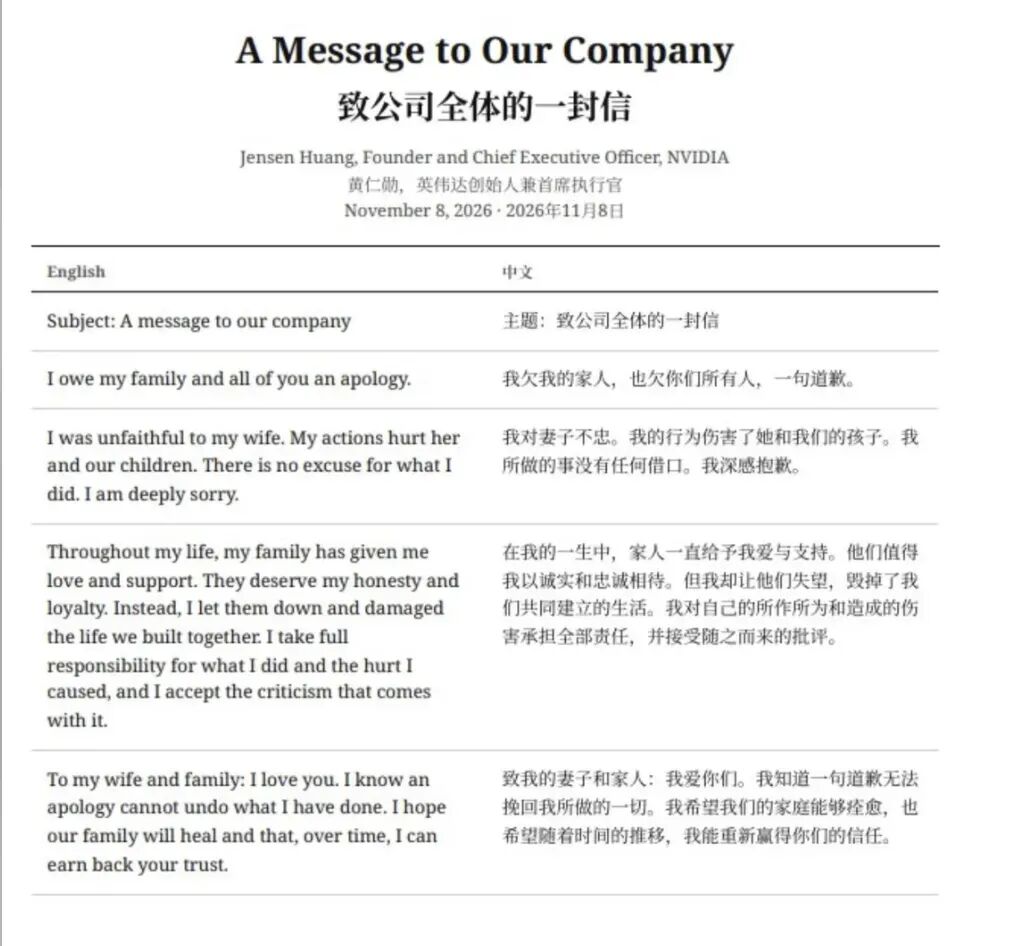
The first sentence of the letter is: "I owe my family, and I owe all of you an apology."
Then he admits: infidelity to his wife.
Many people close the page at this point, thinking it is just a scandal of a wealthy individual. But if you read to the third to last paragraph, you will find he suddenly changes the topic —
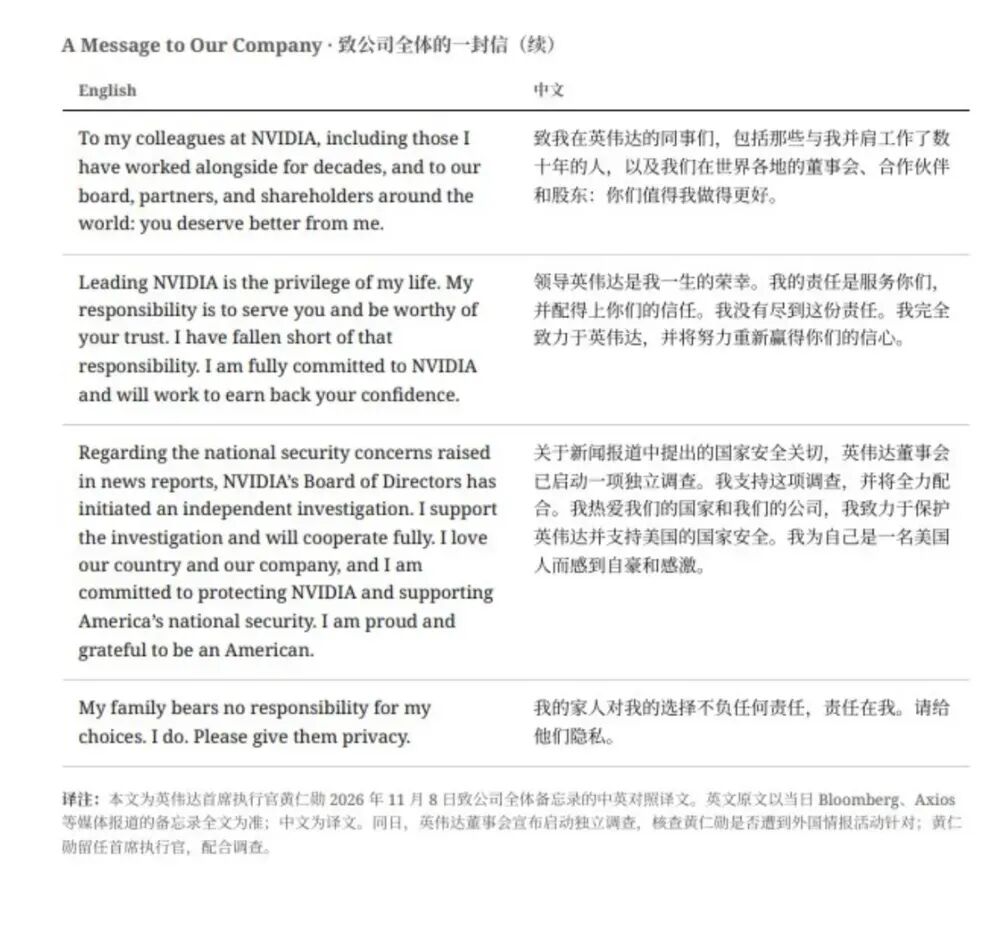
Regarding the national security concerns raised in the news reports, the NVIDIA board has initiated an independent investigation. I support this investigation and will fully cooperate.
Why does a CEO apologize for personal ethics and make a point to discuss national security?
This is the most significant part of the letter.
A letter actually fighting two battles
The letter superficially addresses two matters.
One is family matters: apologizing to his wife and children, with "no excuse," pleading for privacy for the family from the outside world.
The other is business matters: apologizing to employees, the board, partners, and global shareholders, stating, "You deserve a better version of me," and promising to continue fully dedicating himself to NVIDIA.
But the reason this letter had to be published on the company’s official website and not on a personal social account is the third matter.
Let’s clarify the timeline.
First, media outlets like The New York Times reported that Jensen Huang had a close relationship with a businesswoman named Alice Huang (also known as Huang Le, who has no familial relation to Jensen Huang). She was a senior executive at Megaspeed International, a data center company based in Singapore—this company is a client of NVIDIA.

Then, Megaspeed was investigated for allegedly helping entities evade U.S. export restrictions and smuggling NVIDIA AI chips.
Subsequently, reports surfaced that U.S. intelligence agencies suspected this relationship could involve foreign intelligence activities. This needs to be clarified: currently, there are only media reports, no public evidence, nor any judicial conclusions.
But Washington's reaction speed is quicker than any conclusion.
The chairs of three House committees jointly sent a letter to Jensen Huang, requesting him to attend a closed-door briefing on November 18. Republican lawmakers wrote directly in the letter: recent reports have raised "significant national security concerns regarding the acquisition of U.S. sensitive technology and information."
The acting chair of the Senate Foreign Relations Committee, Democratic Senator Chris Coons, publicly criticized him harshly on X. Earlier this spring, Rubio led the drafting of a warning memo against NVIDIA.
Bipartisan. In today’s Washington, these three words indicate the seriousness of the situation more than any piece of legislation.
The real question is not about personal life
It is important to clarify one thing: Congress is not regulating a CEO's marriage.
What they want to clarify are two questions:
First: Have NVIDIA's high-end chips been leaked through improper channels?
Second: What role does the CEO's personal relationship play in this?
This is why "personal relationships" suddenly become less personal in this matter.
AI chip export controls are the toughest technological red line in the U.S. over the past three years. But lines drawn on paper need products to move through roads. The most challenging part of enforcement is not legislation but finding a means to take action.
A CEO's social relations happen to be the kind of thing that can be easily questioned yet is also the hardest to prove. It does not require proof of chip sales; it only needs to establish that you have a "close relationship" with someone in that chain to initiate an independent investigation.
In simple terms: personal ethics is the entry point; export controls are the main topic.
And for NVIDIA, the trouble lies in its current unique position—it is both a target of this regulation and the sole supplier of global AI computing power. Investigating it is equivalent to probing the bloodstream of the entire industry.
The board's statement of "full confidence" is both a shield and a risk warning
NVIDIA's board reacted quickly and standardly: initiating an independent investigation, forming a committee composed of independent directors to oversee it, and hiring external independent legal counsel for assistance.
Then they added: expressing full confidence in Jensen Huang and his leadership team.
This statement is worth pondering.
On one hand, it is necessary. In a company valued in the trillions, if the CEO encounters such an issue and the board wavers in its initial statement, the market will vote with its feet that very day.
On the other hand, it is also a statement of "this is all we can say for now." Because NVIDIA's current predicament is—there are no alternatives.
Jensen Huang founded NVIDIA in 1993 and has been CEO for 33 years. The company's technical direction, customer relationships, supply chain negotiations, and even its external communication all revolve around him. This is not a company that can transition smoothly to someone else.
Thus, you will see a very interesting division of labor:
The board is responsible for the investigation, while the CEO is responsible for work.
The spokesperson for NVIDIA stated: the investigation will not slow down NVIDIA; Jensen Huang has pledged to continue serving as CEO without interruption.
Investigate as needed, work as usual. The coexistence of these two matters itself is an answer.
However, there is a hidden danger that cannot be ignored: the irreplaceability of the founding CEO, while usually a protective moat, becomes a risk exposure when something goes wrong. Because all trust is concentrated on one person's judgment, once that judgment is questioned, the company has no second pillar to rely on.
Conclusion
This incident offers three directly applicable lessons for the domestic AI industry.
First, export compliance is not just a legal issue; it is the CEO's responsibility.
The most glaring aspect of this round of turmoil is that a senior executive's personal relationship could become a breakthrough for an export control investigation. For businesses engaged in cross-border computing, models, and data, the compliance boundary has extended to "who you know and who you have dined with." This is not an exaggeration; it is happening.
Second, tying a company's fate to one person is the most expensive governance cost.
NVIDIA can withstand this pressure today because its technology barriers are sufficiently robust. But switching to another industry or scale, the same impact could be fatal. Many domestic AI companies also operate under a founder-dominated decision-making structure. It is advisable to establish decision-making, compliance, and succession mechanisms while the company is still small, as doing so incurs the lowest cost and faces the least resistance.
Third, in crisis management, admitting is cheaper than defending.
Although Jensen Huang's letter was not particularly well-written, he did one thing right: he did not make excuses, he did not say "this is a personal matter unrelated to the company," and he did not shift the blame to the media. He admitted, took responsibility, and made his stance clear to keep working.
In the realm of public opinion, the fastest way to minimize losses is never through explanation but through acknowledgment.
As for NVIDIA, in the short term, this incident is unlikely to shake its fundamentals—the chips remain the same, the customers are still the same, and the earnings call on November 17 will proceed as scheduled.
But in the medium term, the closed-door briefing on November 18 will be the watershed moment. Because what Congress will ask that day is not whether he has wronged his wife.
But rather, where those chips actually went.
免责声明:本文章仅代表作者个人观点,不代表本平台的立场和观点。本文章仅供信息分享,不构成对任何人的任何投资建议。用户与作者之间的任何争议,与本平台无关。如网页中刊载的文章或图片涉及侵权,请提供相关的权利证明和身份证明发送邮件到[email protected],本平台相关工作人员将会进行核查。


