Original author: Huang Renxun
Original editor: Xu Qingyang
Original source: Tencent Technology
On November 9, after Nvidia CEO Huang Renxun publicly revealed his “extramarital affair”, the subsequent question was: Can he continue to lead this company with a market value of about 4.5 trillion dollars? If not, who will continue to lead Nvidia?
While countless netizens watched, Trump publicly stated his support for Huang Renxun to continue serving as Nvidia's CEO. “Huang Renxun is an ‘upright person’ who has made outstanding contributions to the development of the United States.”
Almost at the same time, Nvidia's board of directors established a committee composed of independent directors and hired an external independent legal advisor to review the relevant situation.
Nvidia's board stated that they still trust Huang Renxun and his management team. Huang Renxun himself also supports this investigation and has committed to continue fulfilling his CEO responsibilities to ensure the normal operation of the company.
If this incident leads to Huang Renxun being unable to fulfill his duties, who will take over Nvidia? Can the existing board and management team maintain the normal operation of the company?
The 11 Most “Powerful” Individuals
Since the founding of Nvidia in 1993, Huang Renxun has served as the company’s CEO, presiding over this tech company for more than 33 years.
From the perspective of outsiders, Huang Renxun is Nvidia, and Nvidia is Huang Renxun.
Nvidia uses a one-share, one-vote common stock system and does not set up a dual-class share structure, allowing shareholders to have corresponding voting rights according to the number of shares they hold.
According to Nvidia's proxy statement released in May 2026, as of March 23 of that year, Huang Renxun beneficially owned about 870.6 million shares of the company’s common stock, accounting for approximately 3.58% of the total equity. Subsequent insider trading filing documents (Form 4) indicate that the number of shares Huang Renxun holds has been adjusted due to charitable donations, tax withholdings upon the vesting of restricted stock, and other reasons.
Based on the closing price of $186.64 on November 6, the market value of Nvidia shares held by Huang Renxun is approximately $16.249 billion.
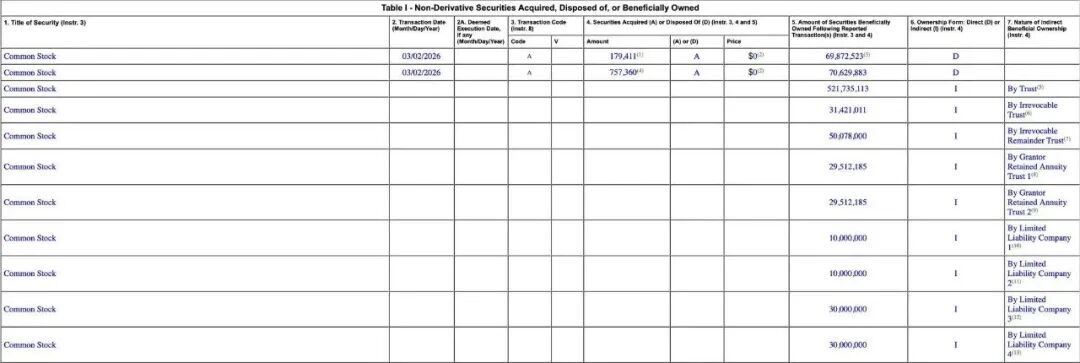
Nvidia's Form 4 change detail submitted to the SEC in March 2026 shows an increase of approximately 937,000 shares of common stock, increasing Huang Renxun's direct ownership to about 70.63 million shares.
This means that the long-standing phenomenon of “dual identity” seen from the outside is not unbreakable - Huang Renxun, while being the founder and long-term helmsman, has not gained absolute control over the company through special voting rights.
From a governance perspective, the board of directors of Nvidia, elected by the shareholders' meeting, is the absolute core of company governance.
On May 7, the Nvidia board expanded its membership from 10 to 11 members, with former Goldman's vice chairman Suzanne Nora Johnson filling the newly added seat, and this appointment took effect on July 13.
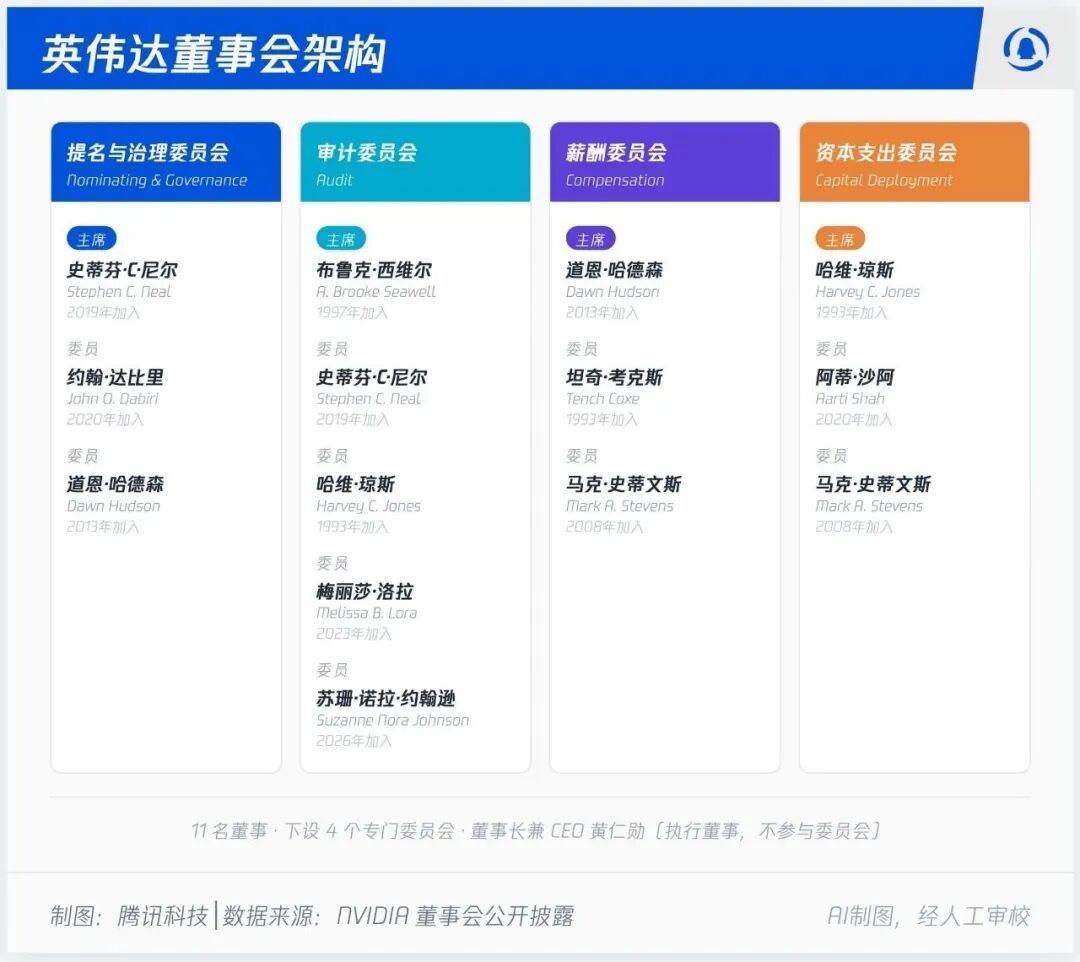
List of current Nvidia board members
Currently, among Nvidia's 11 board members, Huang Renxun is the only non-independent director, while the other 10 are independent directors. The board has established professional committees including the audit committee, the nomination and corporate governance committee, and the compensation committee, each responsible for financial oversight, director nominations, corporate governance, and executive compensation.
The majority of independent directors means that significant governance matters are not decided solely by Huang Renxun, and this independent investigation is a case in point.
According to the arrangements published by the company, the investigation is handled by a committee composed of independent directors, and external legal advisors have been engaged to participate. Since the investigation involves the CEO himself, leading the review by independent directors helps to avoid direct interference by Huang Renxun in the decision-making of the investigation, thus maintaining the independence of the probe.
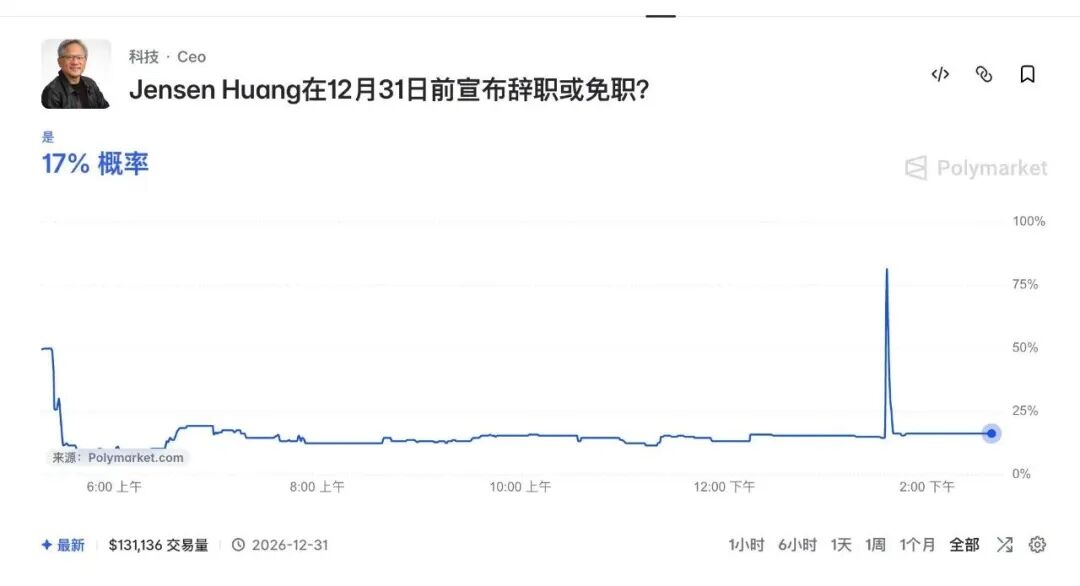
Prediction platform Polymarket predicts the likelihood of Huang Renxun announcing his resignation before December 31
Data from the prediction platform Polymarket shows that the probability of “Huang Renxun announcing resignation or dismissal before December 31” has fluctuated sharply, at one point exceeding 75%, and currently remains around 17%.
While the prediction market focuses on the end of the year, Nvidia's board has not disclosed a specific timeline for the investigation and resolution.
For outsiders and investors, more crucial than the prediction nodes are the two upcoming information disclosure windows: one is the Nvidia earnings conference scheduled for November 17, Eastern Time, where management will inevitably face intense questioning from analysts and the market; the other is a closed briefing on November 18, where three important committees of the U.S. House of Representatives have requested the presence of Huang Renxun himself.
These two timelines may become critical moments revealing the follow-up direction.
Huang Renxun Has No Successor

List of executives reporting directly to Huang Renxun
If the board oversees and makes significant decisions, then the core of Nvidia's daily operations is a large executive team directly managed by Huang Renxun.
Nvidia's management structure has a very distinct characteristic: it is highly flat.
According to a report by Bloomberg in January of this year, Huang Renxun has not established a multi-layer management system in the traditional manner of large enterprises. Media such as Business Insider previously reported that the number of executives reporting directly to Huang Renxun once reached around 55, but later this number decreased to about 36.
These executives are distributed across strategic, hardware, software, AI, public relations, and network fields, including CFO Colette Kress, Global Field Operations Executive Vice President Jay Puri, Operations Executive Vice President Debora Shoquist, and General Counsel Tim Teter, among others.
This means that Nvidia has not set up too many intermediate management levels, allowing many key business leaders to report directly to Huang Renxun, reducing the levels of information transmission, and enabling the CEO to directly grasp the progress of each business line.
Huang Renxun himself has explained this management structure design multiple times.
In his view, traditional enterprises divide organizations according to divisions or business units, which easily leads to independently operating management systems and even creates information barriers. He prefers Nvidia to operate like a complete “Computing Stack,” allowing different departments to collaborate around common goals.
Huang Renxun also does not agree with traditional methods of nurturing successors. In his view, companies should continuously pass knowledge, experience, and decision-making capabilities in daily work, rather than designating someone in advance to complete succession arrangements. In March of this year, Huang Renxun publicly expressed on the well-known American podcast Lex Fridman Podcast that he does not believe in formal succession plans and expressed a desire to lead Nvidia long-term.
“If you are worried about succession plans, and are troubled by this anxiety every day, what should you do? Break everything down. If you truly care about the company's future after you leave, the most important thing is to pass knowledge, information, insights, skills, and experience to the team as frequently and continuously as possible,” Huang Renxun stated at that time.
This management approach indeed allows more executives to be directly involved in company decisions, but it also brings another problem: having 36 executives report to the CEO does not mean that one of those 36 is already capable of succeeding the CEO.
Additionally, Huang Renxun’s family members also hold positions at Nvidia, adding a layer of special color to the company's management structure.

Huang Renxun's daughter Huang Minshan
According to reports from The Information and other media, Huang Renxun's daughter Huang Minshan joined Nvidia as an intern in 2020 and gradually rose through the ranks.
In March 2026, she was appointed as Senior Director of Physical AI Products and Technology Marketing, responsible for marketing related to Omniverse, robotics, and physical AI products. Company data discloses that her total compensation in the 2026 fiscal year was approximately $1.23 million.
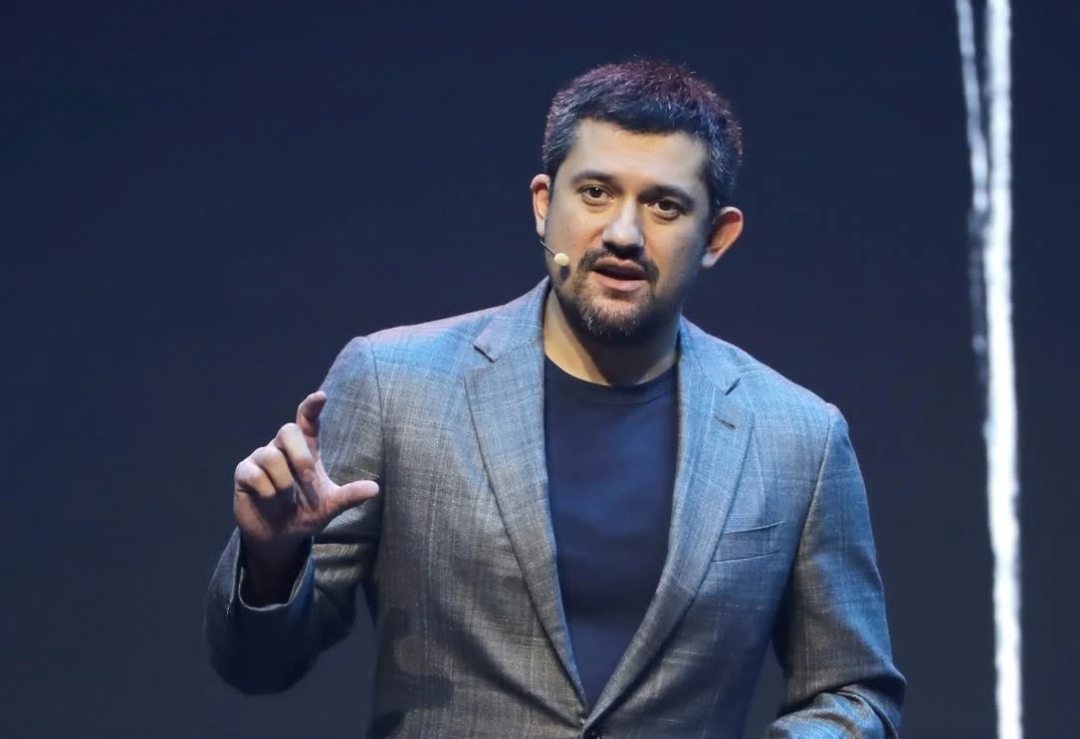
Huang Renxun's son Huang Shengbin
Huang Renxun's son Huang Shengbin (Spencer Huang) joined Nvidia in 2022 and currently serves as Director of Robotics Product Management, responsible for the robotics-related product line, with compensation in the 2026 fiscal year of approximately $1.32 million.

Huang Renxun's son-in-law Nico Caprez
In addition, Huang Renxun's son-in-law Nico Caprez joined Nvidia in early 2024, initially serving as Manager of Corporate Development. In January 2026, he was promoted to Vice President of Global AI Infrastructure Growth, responsible for business related to Neocloud, data center financing, and large cloud customer relations.
Compared to Huang Renxun’s two children, the promotion of son-in-law Nico has attracted more attention.
According to Business Insider, he has participated in several large financing and cooperation arrangements, and some employees and partners even refer to him as Huang Renxun’s “consigliere.”
According to The Information, some Nvidia employees believe the company is showing increasingly obvious family business characteristics, and there are speculations that Huang Minshan and Nico may be nurtured as candidates for future management.
Currently, none of the above three have been listed as executives of Nvidia, nor is there public evidence to indicate they have been identified as successors to Huang Renxun. From the perspective of their positions and business divisions, they are currently not qualified to be considered potential candidates to take over Nvidia comprehensively.
Therefore, while Nvidia's management structure is sufficiently flat, it has not resolved the issue of CEO succession.
If Huang Renxun Leaves
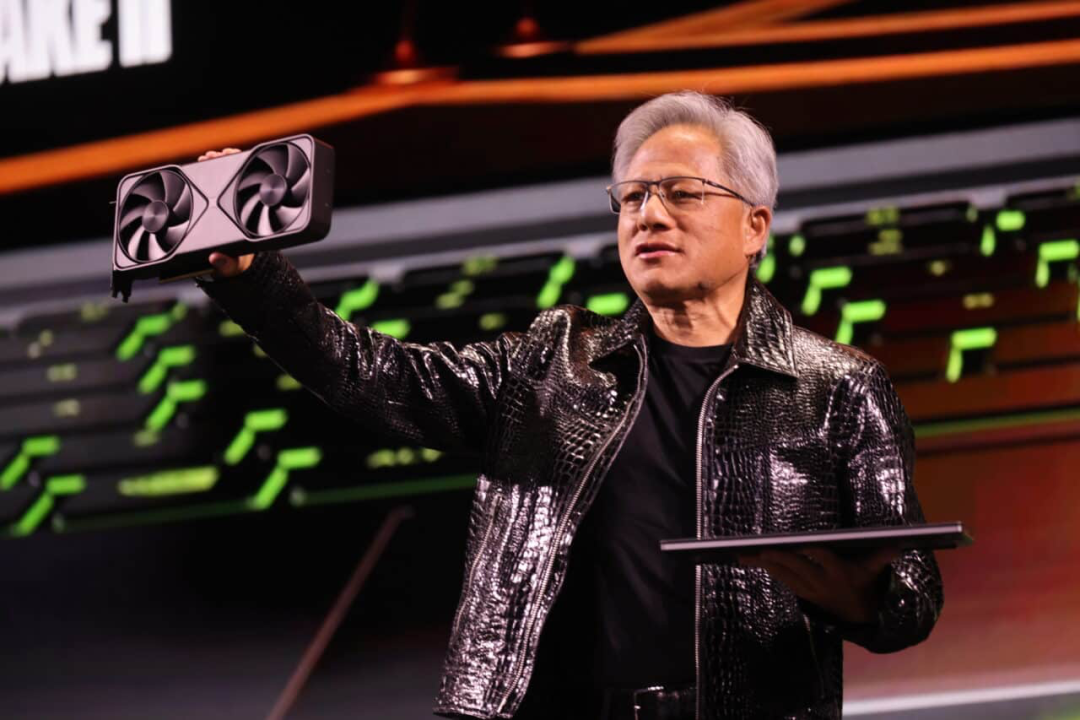
Although Nvidia has a mature governance structure, it has not publicly disclosed clear CEO succession arrangements to date.
In terms of succession planning, there are plenty of references from other large companies.
Apple (which announced the transition plan between Tim Cook and John Ternus in advance) and Berkshire Hathaway (which confirmed Greg Abel as successor early on) both indicate that clearly defining candidates in advance and setting a transition period can effectively reduce the fluctuations caused by core leadership changes.
Even if Huang Renxun suddenly cannot fulfill his CEO responsibilities, Nvidia's daily operations are unlikely to be halted. The company’s existing management team can handle their respective business management tasks. The board can also arrange interim leaders and explore subsequent personnel options according to corporate governance procedures.
However, maintaining business operations does not equate to smoothly completing the transition of the highest management level. Huang Renxun's role at Nvidia has long exceeded routine operational management; he has long directed the company's technological strategy and business direction and is also an important figure connecting chip research and development, software ecology, and global customers.
From GPUs to CUDA, and then to AI infrastructure, Nvidia's several key business transformations have been closely related to Huang Renxun’s judgment. He also frequently represents the company in communications with global tech enterprises, governments, and industry partners. Thus, the successor needs to face not only managing a large tech company but also how to continue the existing technological lines, maintain industry partnerships, and explain the company's next strategic steps to the market.
This issue has also attracted media attention. A Bloomberg report in January 2026 discussed Nvidia’s CEO succession issue, and Business Insider previously pointed out that the company has not yet identified a clear and widely recognized potential successor. Wedbush analyst Dan Ives has also spoken about the importance of Huang Renxun to Nvidia's strategy and market perception.
These discussions point to the same issue: Nvidia has a management team capable of supporting daily operations, but currently, there is no publicly acknowledged candidate who can be seen as a comprehensive successor to Huang Renxun.
Huang Renxun is still at the helm, and the board has clearly expressed confidence in him. However, as Nvidia's position in the global AI industry continues to rise, CEO succession is no longer just an internal personnel arrangement for the company, but also relates to the market's judgment on its long-term strategic continuity.
For Nvidia, how to make the company’s development no longer overly reliant on a core leader will be a governance issue that needs to be addressed sooner or later.
免责声明:本文章仅代表作者个人观点,不代表本平台的立场和观点。本文章仅供信息分享,不构成对任何人的任何投资建议。用户与作者之间的任何争议,与本平台无关。如网页中刊载的文章或图片涉及侵权,请提供相关的权利证明和身份证明发送邮件到[email protected],本平台相关工作人员将会进行核查。


