The focus is on the collateral effects of personal turmoil. Jensen Huang's private relationship incident has brought two existing risks in Nvidia's China business—U.S. export controls and Chinese import approvals—into the spotlight, coinciding perfectly with the earnings report on November 17. The questions to be addressed thus fall on the income side, and whether this turmoil will alter Nvidia's revenue trajectory in China over the next few quarters.
1. The personal turmoil has become corporate, but the real danger isn't the CEO's moral issue
The investigation targets national security risks, with the authority now handed over to the board.
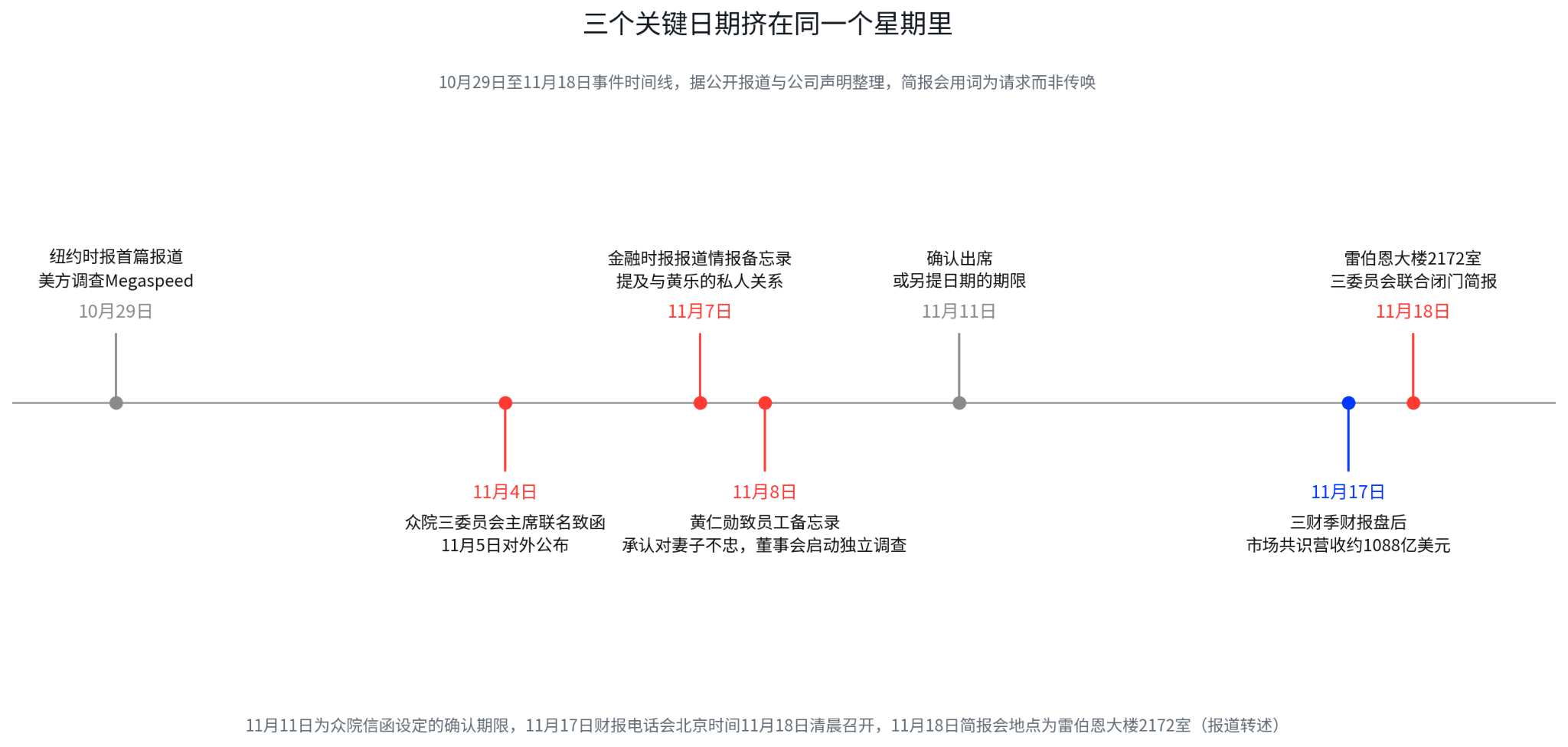
On November 8, Jensen Huang admitted infidelity to employees and apologized (full text published by Bloomberg). On the same day, Nvidia's board announced the initiation of an independent investigation, aimed at foreign intelligence actions involved in recent media reports, to be handled by an independent director committee, with assistance from external independent legal counsel. The board also stated that there is currently no reason to believe that U.S. national security or Nvidia's confidential information has been compromised, and Jensen Huang himself has committed to cooperating with the investigation (company statement, reported by media).
This distinction is important. Public information does not indicate that Jensen Huang is accused of any crime, nor does it imply his involvement in any intelligence activities. What the market should genuinely focus on is whether the independent investigation will change the corporate governance judgment on this matter, and whether the investigation results will further engage the U.S. Congress and the export control system.
Congress has already taken action. On November 4, House Foreign Affairs Committee Chairman Mike McCaul, China Task Force Chairman Mike Turner, and Permanent Intelligence Committee Chairman Michael Crawford jointly sent a letter, publicly announced on November 5, requesting that Jensen Huang participate in a closed-door briefing on November 18, focusing on his interactions with Megaspeed executive Alice Huang, and on the security measures Nvidia has implemented regarding foreign competitors acquiring sensitive technology and information. They required confirmation of attendance or alternative dates by November 11 (House Foreign Affairs Committee statement and various media reports).
Words matter. This letter is not strictly a subpoena; it is a request for a closed-door briefing jointly issued by the three committees. The policy risk will be evident in the next steps—if formal hearings, subpoenas, or amendments to export controls occur after November 18, or if the Commerce Department imposes new approval restrictions on Nvidia's China operations, this matter will transition from a corporate governance issue to an income-related event. November 18 is closer to the starting point of the policy chain, and risk validation will come afterward.
On the Democratic side, ammunition is also being prepared. Senator Chris Coons, expected to chair the Senate Foreign Relations Committee, has stated on X that he will investigate the related reports. Senator Elizabeth Warren, likely to chair the Senate Banking Committee, has long demanded Jensen Huang to testify publicly regarding sales in China, a request that was previously denied. Trump's statement on October 31 was, "I always thought Jensen Huang was very straightforward," followed closely by, "This is a very complex issue" (as reported by various media).
2. $4.8 billion procurement and "each one has been counted," the real controversy lies in the compliance chain
The cases in Congress have names, amounts, and procurement records, with the controversy centered on whether the compliance chain can be independently verified.
Megaspeed is a company constructing data centers in Southeast Asia, including providing computing power services to Chinese customers, and is one of Nvidia's important clients (as reported by the AP). Customs records from the trade data platform ImportGenius indicate that Megaspeed's affiliated entity in Malaysia procured AI devices worth at least $4.8 billion, which include Nvidia chips and related technology, between June 2024 and February 2026 (as reported by the New York Times).
The $4.8 billion is the procurement amount, and public information does not yet prove that this batch of equipment has entered mainland China illegally. The intelligence clues reported by the media have not reached judicial determination, and neither Huang Le nor anyone from Megaspeed has been formally charged. Jensen Huang's private relationships with related parties also do not infer that Nvidia participated in illegal activities.
Nvidia has previously denied that Megaspeed shipped Nvidia AI chips to China, and Jensen Huang stated that the company has verified the deployment status of the related GPUs, saying, "We have studied the deployment situation of all their GPUs, and every single one has been counted" (as reported by Hong Kong Economic Journal). Initiating an independent investigation means that the explanations previously provided by the management will be reviewed by independent directors and external legal advisors.
This statement thus becomes sensitive. Whether the counting results can withstand independent verification by the U.S. government, Congress, and subsequent investigations is more critical than simply confirming that the counting occurred. If the final conclusion is that the equipment did not enter China illegally, the impact of this matter will likely remain confined to political noise and compliance costs. If the investigation finds loopholes in the export control system, or if Congress determines that the existing approval and tracking mechanisms are insufficient, Nvidia will face stricter customer reviews, GPU flow monitoring, and sales restrictions in China.
Nvidia's recent actions connect with this backdrop. The company is requiring some Southeast Asian cloud clients to join its Fleet Intelligence monitoring system, disclosing the deployment locations and operational information of accelerators as a condition to gain Nvidia cloud partner status (as reported by Bloomberg on November 6). Thus, the future costs of doing business in China go beyond whether sales can occur, but also include who products can be sold to, where they can be deployed, and whether it can be continuously proven that no transshipment has occurred.
3. The real revenue risk lies with H200: Washington allows it, but Beijing has not granted large-scale release
If we compress this week's political news into one market variable, it would be four words: revenue from China.
Nvidia's last quarterly performance announcement makes it clear that the revenue guidance of $108 billion for the third quarter does not include revenue from the data center computing sales in China. CFO Colette Kress also revealed that data center product revenue shipped to the Chinese market in the second quarter accounted for less than 1% of the total data center revenue (company earnings announcement, as reported by Yicai and others on August 27). This determines that even if the Chinese market resumes some H200 sales, unless it is large-scale and stable commercial shipments, it cannot be interpreted as an upside surprise beyond the company's guidance.
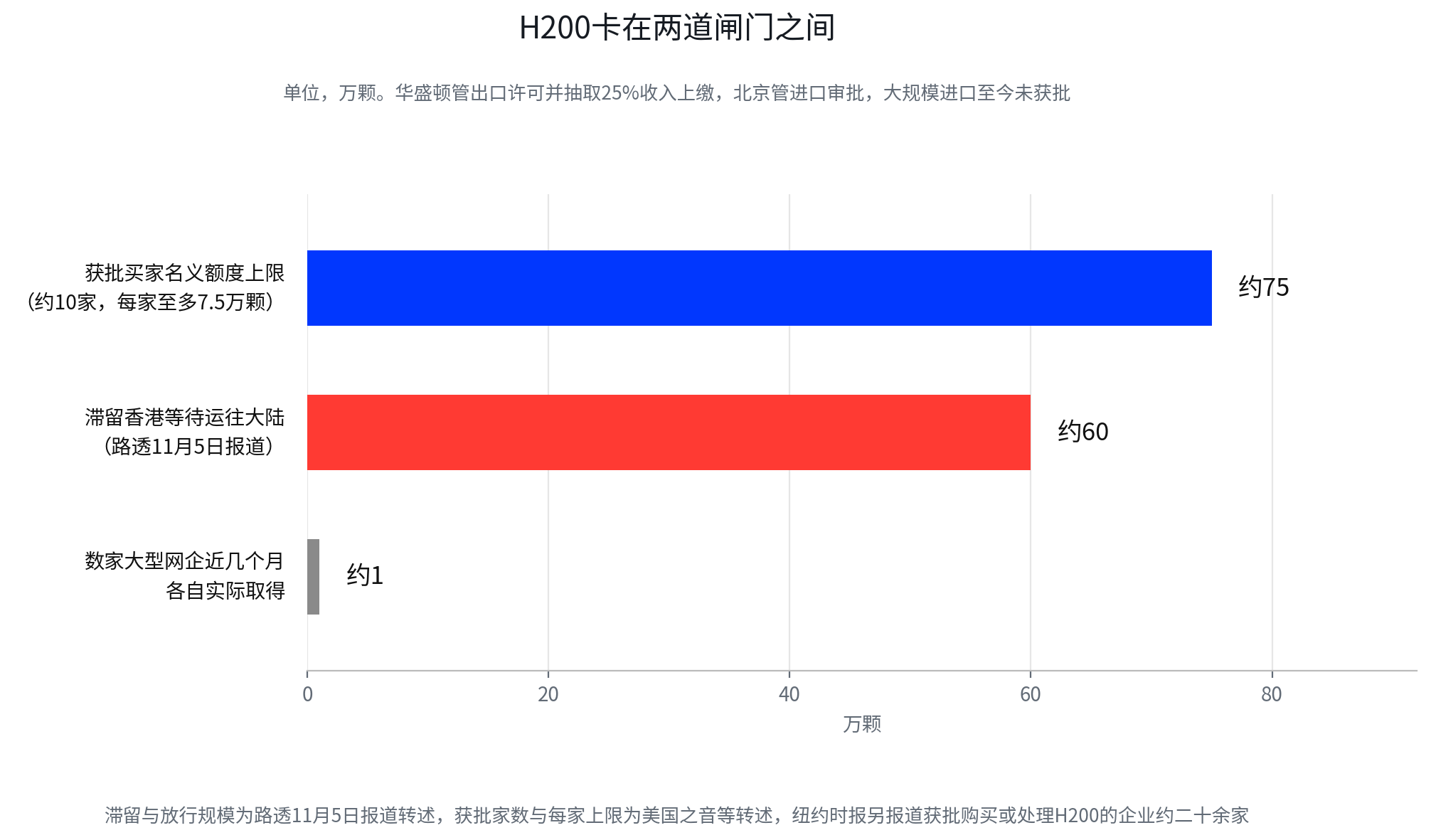
The H200 is currently caught between two regulatory frameworks. On the U.S. side, the Biden administration previously banned the export of H200 to China, which was overturned by Trump on December 8, 2025. The Commerce Department subsequently approved about 10 Chinese companies to purchase, with each allowed to buy up to 75,000 units, although these transactions are still subject to the licensing system (as reported by Voice of America and others). No approval has been granted by China for the large-scale entry of H200 onto the mainland, and on November 5, Reuters reported that about 600,000 H200 units are stranded in Hong Kong, with several large Chinese internet companies each obtaining about 10,000 units in recent months, along with a small amount smuggled in through intermediaries (as reported by Reuters). The New York Times investigation also found that around twenty Chinese companies have been approved for purchasing or processing H200, among which New Matrix's registered address in Beijing is an empty office location (as reported by the New York Times).
Nvidia is facing a unique inventory situation, where goods have arrived in Asia, but revenue has yet to be realized. This differs entirely from general demand issues; Chinese customers have a need, products have been produced, but approvals have not been completed, preventing normal large-scale sales confirmation from occurring. The longer the inventory remains, the higher the policy uncertainty, making it increasingly difficult to assess customer purchasing rhythms.
Prices are reflecting the scarcity. A server equipped with eight H200s in the Chinese market is quoted at over 6 million yuan, nearly three times the price from a year ago (as reported by World News citing Reuters). Demand exists, but the policy bottlenecks the conversion from demand to actual sales, accurately describing the current state of the H200. Therefore, the market should not read this situation as Nvidia losing the Chinese market; it is more accurate to say that the potential demand in the Chinese market still exists, and the ratio that can be converted into Nvidia's reported revenue increasingly depends on the regulatory policies of both countries.
Jensen Huang's congressional briefing should be closely monitored for this reason. It may not immediately reduce any quarter's revenue, but it could change the policy probabilities for the coming quarters.
4. Earnings report, Congress, and stock prices collide in the same week; a real trading window has formed
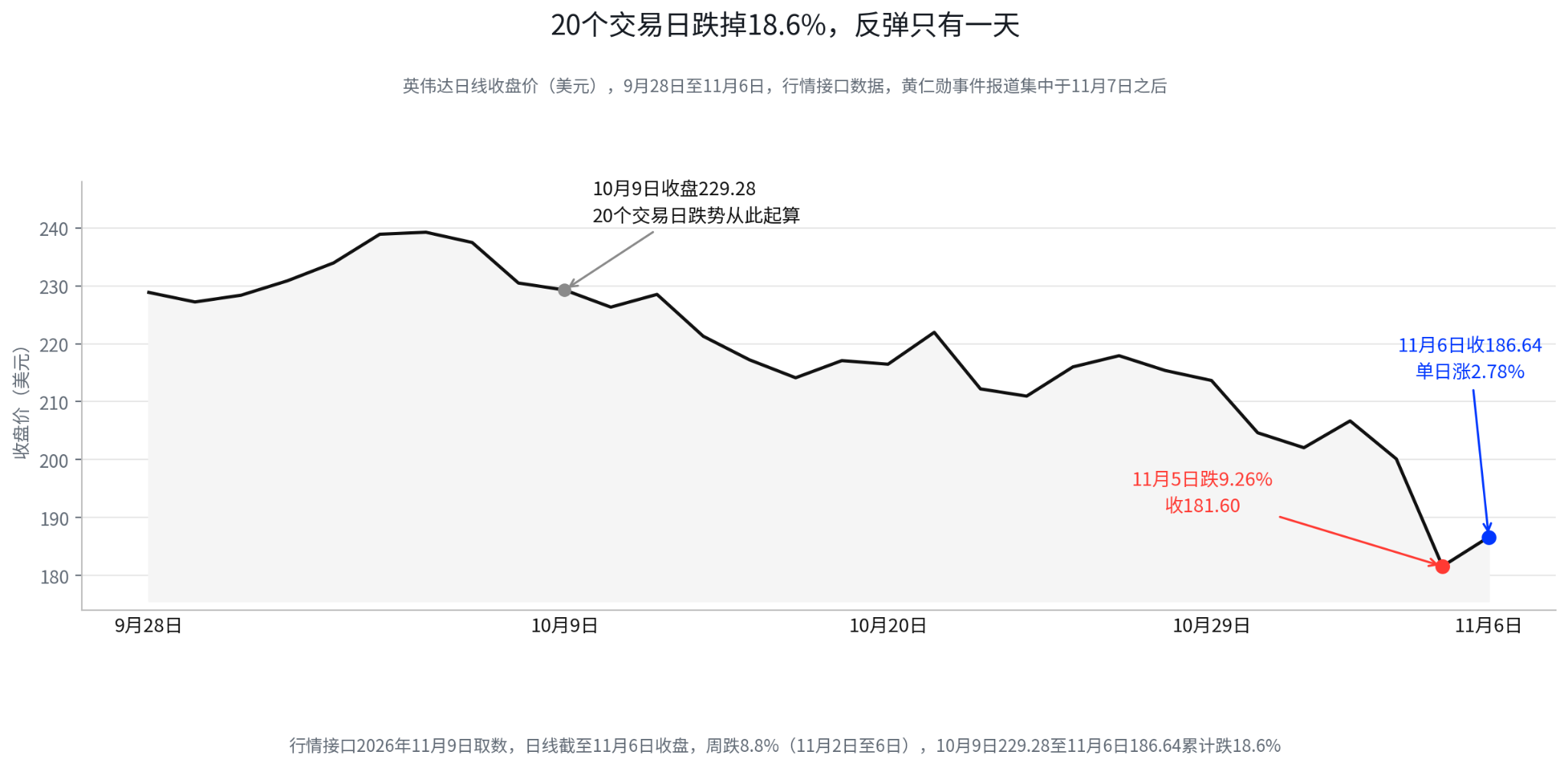
This round of adjustments occurred before the investigation results, with the market already pre-trading on the double risks of policy and earnings reports.
On November 5, Nvidia's stock fell 9.26% in one day, closing at $181.60, with a trading volume of 306 million shares. On November 6, it rebounded 2.78%, closing at $186.64. From the closing peak of $239.24 on October 6, the current price has receded about 22%, and accumulated a decline of 18.6% over the past 20 trading days (data from market interfaces). It is still unclear whether this drop reflects a risk reassessment or emotional deleveraging ahead of the earnings report.
The following week will be information-rich.
On November 11, the deadline for Jensen Huang's confirmation to the congressional closed-door briefing request.
On November 17, Nvidia will release its Q3 FY2027 earnings report, and the company has confirmed its release and conference call schedule (company calendar).
On November 18, Jensen Huang will participate in the congressional closed-door briefing, provided it goes as planned.
The checklist for earnings night is clear: whether the data center revenue can continue to significantly exceed guidance, whether orders and supplies for Blackwell and subsequent platforms remain strong, and whether there have been any changes in the management's latest statements on the China business. The company guidance is $108 billion with a 2% margin of fluctuation, and a gross margin of 74% with a 50 basis points margin of fluctuation, with the market consensus around $108.8 billion (MarketBeat summary, reported). FactSet records indicate that out of the past 20 quarters, data center revenue has only fallen short of expectations three times, averaging 5.1% above expectations (as reported by Economic Daily).
If the data center revenue continues to significantly exceed guidance and management does not further lower expectations for the China business, and if no new regulatory actions arise following the briefing on November 18, this round of decline is closer to being characterized as a combination of policy noise amplified by overvaluation deleveraging. If there are no issues in the earnings report itself, but export control amendments, tighter approval from the Commerce Department, or a proactive reduction in expectations for the China business arise after the briefing, the market would need to recalibrate not just one quarter's revenue, but how much revenue Nvidia can obtain from the Chinese market in the coming quarters, and whether this portion can still be counted towards growth expectations. The implications for valuation from these two scenarios are entirely different.
5. In conclusion: The probability of Chinese policy landing, not Chinese revenue
Jensen Huang's admission of infidelity does not have direct significance in terms of financial modeling, and the independent investigation by the board does not equate to Nvidia already violating national security. What matters on the trading table is whether this turmoil will change the U.S. regulatory attitude toward Nvidia's China business.
The current state of the Chinese channel is tightening on both ends: the U.S. controls export licenses, and China controls import approvals. Approximately 600,000 H200 units are stranded in Hong Kong, with Chinese customer demand evident; what is bottlenecking is the transition from demand to actual sales.
In the next steps, signals worth monitoring are ordered by time: the gap between data center revenue and guidance in the earnings report on November 17, whether there will be legislative text, subpoena procedures, or restrictions from the Commerce Department after the briefing on November 18, and when the H200 units in Hong Kong will convert into actual shipments. Look at the earnings report on November 17, examine the policies on November 18, and then see if the Chinese revenue can be realized, with the pricing chain unfolding in this order.
Disclaimer: The contents of this article are for general information and market commentary only, organized based on publicly available information as of the time stated in the text. Relevant market data, expectations, and probabilities may change with market conditions. The views and investment strategies cited from third-party institutions, analysts, or other individuals only represent the respective third parties’ opinions at a specific time and do not represent BIT's views or recommendations. This article does not constitute investment advice, investment research, an invitation, solicitation, or a recommendation of any security, investment product, or trading strategy, nor should it be the basis for any investment decision. Financial markets carry risks, and securities prices and market performance may fluctuate, with past performance and historical market trends not indicating or guaranteeing future results. Investors should independently assess the relevant risks based on their own situation and seek professional advice when necessary.
免责声明:本文章仅代表作者个人观点,不代表本平台的立场和观点。本文章仅供信息分享,不构成对任何人的任何投资建议。用户与作者之间的任何争议,与本平台无关。如网页中刊载的文章或图片涉及侵权,请提供相关的权利证明和身份证明发送邮件到[email protected],本平台相关工作人员将会进行核查。


