What is the IPO valuation of Anthropic? The answer has not yet been determined: as of November 5, 2026, neither the S-1 nor Amendment No. 1 listed a price range. The last confirmed valuation by the company was a post-money valuation of $965 billion from the H round in May 2026, while market rumors regarding Anthropic's 2026 IPO plan place the valuation at about $1.5 trillion, down from the rumored $1.8 trillion to $2 trillion in October.
Key Takeaways
- The only confirmed valuation by Anthropic is the post-money valuation of $965 billion corresponding to the $65 billion H round financing announced on May 28, 2026.
- The IPO valuation is another number and has not yet been determined: the Amendment No. 1 submitted on November 2, 2026, still did not list a price range, and the rumored valuation dropped from $1.8 trillion to $2 trillion in October to about $1.5 trillion after the amendment submission.
- From $61.5 billion in March 2025 to $183 billion, $380 billion, and then to $965 billion, Anthropic's valuation soared in about 14 months, with each step announced formally by the company.
- The S-1 filing submitted on October 26, 2026, shows that Anthropic raised a total of $141.1 billion since its inception, its credit line was expanded to $15 billion in September 2026, and the Anthropic Public Benefit Fund holds a 5% stake.
- Amazon invested about $18 billion, and Google about $20 billion; both will hold over 5% of shares post-IPO but will not have voting rights; the IPO offering size has also not been determined.
What is Anthropic's current valuation?
Based on the last valuation published by the company, Anthropic is worth $965 billion, a figure determined when the H round financing was completed on May 28, 2026.
This round raised $65 billion, led by Altimeter, Dragoneer, Greenoaks, and Sequoia; the company also reported an annual revenue exceeding $47 billion.
Neither the S-1 nor the Amendment No. 1 submitted on November 2, 2026, proposed a new valuation since the registration statement records how much investors have already paid, rather than how much the next buyer is willing to pay.
The S-1 fills in the scale behind this number, revealing first-half 2026 revenue of $16.29 billion, second-quarter operating profits of $974 million, and $131.7 billion in cash and short-term investments as of June 30, 2026.
Amendment No. 1 then provided third-quarter data: revenue of $16.96 billion, a shift to a GAAP operating loss of $567 million following profitability in the second quarter, with cash and short-term investments of $131.8 billion as of September 30, 2026; detailed breakdowns can be referenced in the Anthropic Q3 2026 financial report.
During the roadshow, IPO investors will be pricing these numbers, not the headline valuation.
2026 Anthropic IPO Valuation: How $965 Billion Became Rumored to be $1.5 Trillion
The valuation of Anthropic moved from $965 billion to a rumored IPO number of about $1.5 trillion through three steps: the private round set the floor, the filing disclosed the balance sheet, and finally pricing determined the public market number.
The private floor is the $965 billion of the H round, a price negotiated for new issued preferred shares on a day in May.
The balance sheet backing this number includes: according to the S-1, a cumulative fundraising of $141.1 billion since inception; according to Amendment No. 1, cash and short-term investments of $131.8 billion as of September 30, 2026; there is also a revolving credit line that was expanded to $15 billion in September 2026, maturing on September 4, 2031.
What is still lacking is the public market number: Yahoo Finance noted when reporting the S-1 submission that the discussed valuation range was $1.5 trillion to $2 trillion.
The Motley Fool reported on October 29 that newer estimates were gradually aligning towards the lower end of that range.
Reportedly, potential investors in October believed that $1.8 trillion to $2 trillion was a reasonable valuation.
After the S-1 submission, Bloomberg reported on October 28 that investor-stated valuations were $1.4 trillion to $1.5 trillion, potentially reaching $1.75 trillion; Reuters reported a similar figure, about $1.5 trillion.
The Amendment No. 1 on November 2 did not include a price range, so the approximately $1.5 trillion remains only a market rumor, not a number in the filing.
All of the above are media reports, not company statements; the IPO valuation will ultimately equal the final offer price multiplied by the number of shares outstanding after the issuance.
The IPO issue size (which is the number of shares sold and the funds raised) has also not been determined: the number of shares in both the S-1 and Amendment No. 1 is still blank, and the $1 billion in the S-1 fee table is just a placeholder for calculating registration fees, not the actual offering size.
Reuters reported in September that Anthropic is negotiating with NVIDIA for NVIDIA to act as a cornerstone investor in this offering, investing up to $10 billion (reprinted by The Star), but no cornerstone investors are listed in the S-1 summary, so this remains just a report.
Traders have already begun pricing for the public market number: on November 5, 2026, in Polymarket's “Anthropic IPO Closing Market Cap (Middle Brackets)” market, the probability that the closing market cap exceeds $1.8 trillion on the first day was 53%, $1.5 trillion to $1.8 trillion was 27%, and $1.2 trillion to $1.5 trillion was 18%; this is the market expectation with real money bets, not information disclosed by the company.
How these ranges settle and the probabilities of the listing date can be referenced in the Polymarket first-day closing market guidelines.
How does the price range translate into the IPO valuation?
The IPO valuation is actually a calculation of two numbers, both of which will wait for the later S-1 amendments to provide: the price range and the number of shares outstanding after the issuance.
Multiplying the midpoint of the price range by the number of shares outstanding gives the implied valuation that will be quoted in the media headlines during the roadshow.
During the roadshow, the price range may be adjusted up or down based on demand; the underwriters will finalize the final issuance price the night before the listing, determining the IPO valuation.
The first day's closing market cap is the third number: the closing price multiplied by the same number of shares, which is exactly what the market bets on across various ranges.
These numbers may deviate from the rumored $1.5 trillion, and as of November 5, 2026, none has existed yet.
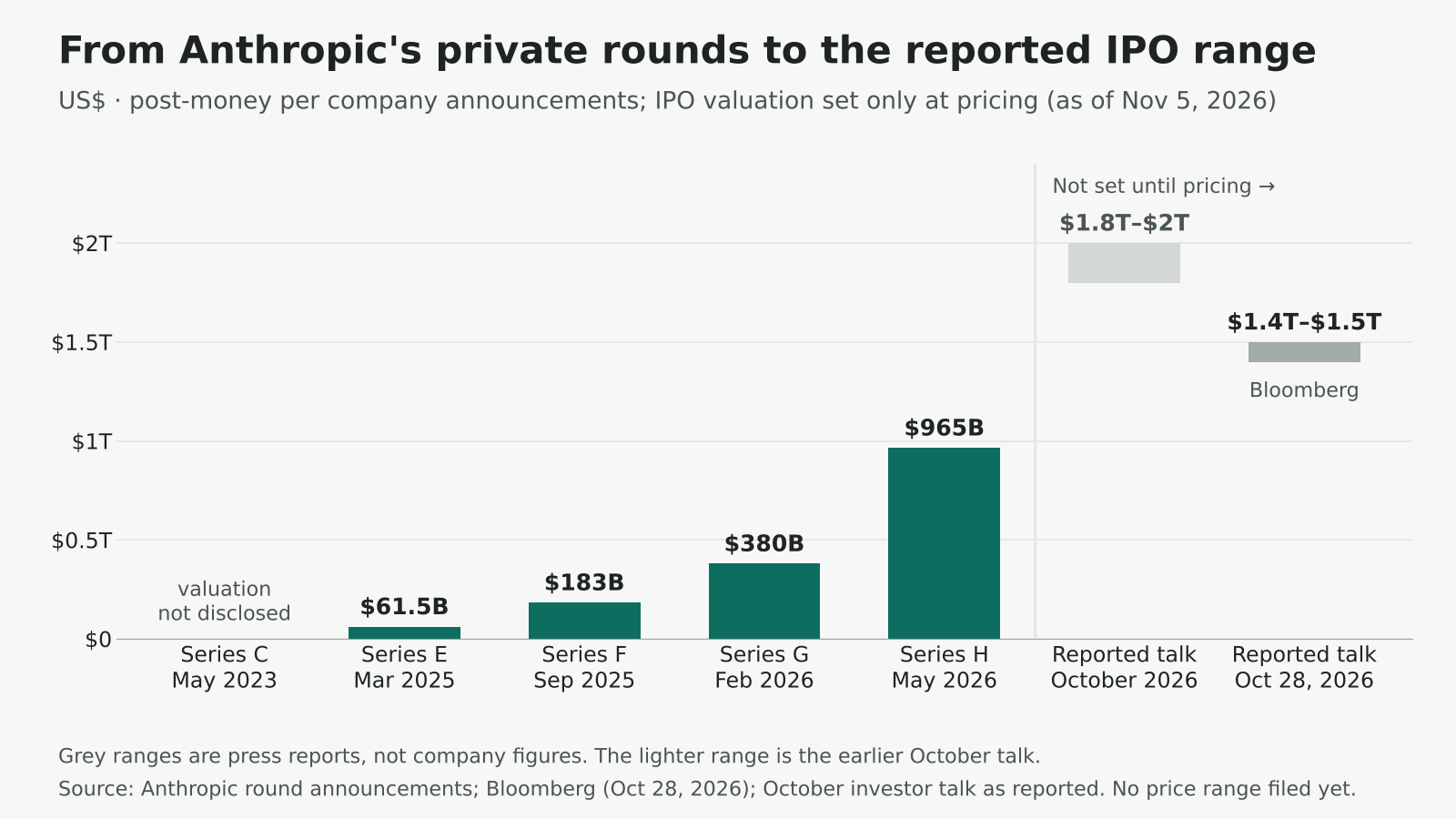
From Anthropic's private financing round to the rumored IPO valuation range; the final step will only be determined at pricing.
How did Anthropic's valuation rise step by step?
Anthropic's valuation has gone through five rounds of publicly announced financing, rising from undisclosed figures in 2023 to $965 billion in 2026, with each of the last three rounds at least double that of the previous round.
- C Round, May 2023: Raised $450 million, undisclosed valuation, led by Spark Capital.
- E Round, March 2025: Raised $3.5 billion, post-money valuation of $61.5 billion, led by Lightspeed Venture Partners.
- F Round, September 2, 2025: Raised $13 billion, valuation of $183 billion, led by ICONIQ, see details in the F round financing announcement.
- G Round, February 12, 2026: Raised $30 billion, valuation of $380 billion, led by GIC and Coatue, see details in the G round financing announcement.
- H Round, May 28, 2026: Raised $65 billion, valuation of $965 billion, led by Altimeter, Dragoneer, Greenoaks, and Sequoia.
The above list only covers the financing rounds for which Anthropic has publicly disclosed valuations; Amazon and Google's convertible notes and preferred share subscriptions are not included, which will be explained in the equity structure section below.
During the same period, the company's reported annual revenue grew from about $1 billion to over $47 billion, reflecting the growth represented by each jump in valuation.
All preferred shares will convert into common stock at the time of the IPO, so on the day ANT is listed, the structure of these financing rounds will disappear.
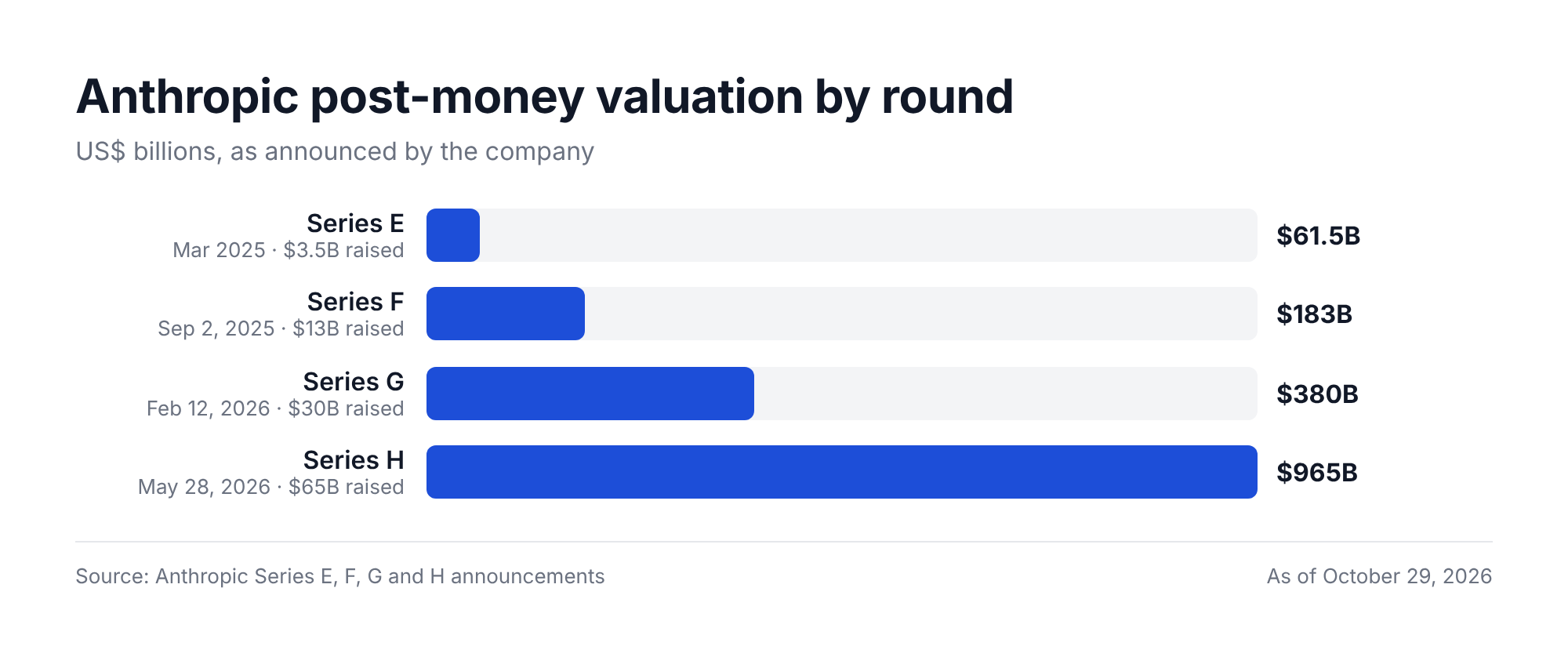
The post-money valuation of each round of Anthropic's financing, organized according to the company's announcements.
How much is one share of Anthropic stock?
Anthropic currently does not have an official stock price: Neither the S-1 nor the Amendment No. 1 submitted on November 2, 2026, provided this, and the price range will only appear in a future amendment.
However, the S-1 did set a benchmark for the number of shares: Anthropic completed a 1-for-10 stock split for Class A and Class N shares on September 17, 2026, so any per-share numbers prior to this (including the quoted price per share in the H round) are currently ten times the corresponding numbers.
The H round priced the preferred shares, and the price paid for this round does not equal the public market stock price, as the rights attached to preferred shares are not accessible with the A-class common stock issued in the IPO.
The secondary market quote for "Anthropic stock" may refer to common shares, preferred shares, or neither, and the company's investor announcements have stated that any unapproved transfers of equity are invalid.
The circulated figure of “$71.43 per share” after the amendment is a calculation by Protos: estimated based on a footnote about the implied fair value of common shares as of September 30, 2026, is not the IPO issuance price, nor is it the price range.
As of November 5, 2026, the most honest answer regarding the per-share price is: there are no numbers before the next S-1 amendment presents a price range.
Why is the value of employee-held shares lower than the headline price?
Preferred shares enjoy rights that ordinary shares do not, such as liquidation priority, so in the private market, the pricing of common shares has historically been lower than the price of preferred shares in the same round.
This difference will disappear at the IPO, as all preferred shares will convert to common shares.
Before that, any quoted "Anthropic stock price" needs to specify: which class of shares, the price on which date, and whether the transfer was approved.
Why is post-money valuation not equal to market value?
Post-money valuation is the price negotiated for the new issued preferred shares on a specific day, while market value is the trading price of common shares multiplied by the number of shares outstanding.
Both can deviate in either direction: the protective terms for preferred shares imply that the public market price per share should be lower while the scarcity and demand on the first day could push prices up.
SpaceX's closing price exceeded its issue price by 19% on its first day, forecasting that the market is betting Anthropic will behave similarly, but betting is ultimately not actual data.
Anthropic will only have a market value once ANT starts trading; before then, any figure for "Anthropic market value" or Anthropic stock valuation, if not the $965 billion post-private valuation, is just market expectation.
Who owns Anthropic stock?
Before the IPO, Anthropic's shareholders include Amazon, Google, Microsoft, seven co-founders, employees, preferred investment owners from rounds A to H, and the Anthropic Public Benefit Fund; the S-1 lists the holding conditions of each party.
- Amazon: has invested about $18 billion since 2023, including $8 billion in convertible notes and $10 billion in preferred stock; notes will convert at IPO, and post-conversion Amazon's holding limit is 12%.
- Google: purchased about $20 billion in preferred shares in 2026, approximately $10 billion in March and $10 billion in May; has the right to additionally purchase up to $10 billion at the IPO issuance price; new shares obtained have a holding limit of 14.99%, and related regulations are found in the note purchase agreement attached to the S-1.
- Post-IPO Amazon and Google: are expected to hold over 5% of the company each and will not have voting rights.
- Microsoft: is also an investor and one of the three cloud service providers with long-term computing power commitments with Anthropic.
- Co-founders: There are seven in total, each holding about 232 million to 245 million Class A shares, five of whom will sell part of their holdings at the IPO.
- Anthropic Public Benefit Fund: holds 5% of fully diluted shares, held by a wholly-owned subsidiary.
- Investors from rounds A to H: hold preferred shares that will convert to common shares at the IPO.
Control does not follow shareholding numbers: each public offering Class A share has one vote; one T class share held by the Long-Term Benefit Trust can select a majority of board seats; and one F class share held by the founders' LLC controls 50.1% of the voting power, refer to where Anthropic's S-1 is and what its contents are for further organization.
Amazon's own Q2 2026 10-Q quarterly report also confirms the $8 billion notes and the preferred stock subscription for 2026 from its accounting perspective.
Why the influence of strategic investors is not just in shareholding
Amazon, Google, and Microsoft are shareholders and also Anthropic's largest suppliers; Amazon and Google are its biggest customers.
The S-1 discloses computing power commitments including: at least $110 billion to Amazon from May 2026 to April 2036, at least about $114.5 billion to Google from April 2026 to July 2033, and at least $44.9 billion to Microsoft from November 2026 to May 2033.
Additionally, there is a commitment of up to $120.5 billion with SpaceXAI for a term until 2029, which either party can notify to terminate 90 days in advance starting in early 2027; and a five-year lease agreement with Broadcom for about $161.2 billion.
As the two major customers are also two significant strategic shareholders, the S-1 lists customer concentration as one of the risks; any change in either relationship will impact both revenue and costs.
For valuation, this means equity tables and commitment expenditure tables must be viewed together: holdings are indeed a smaller number.
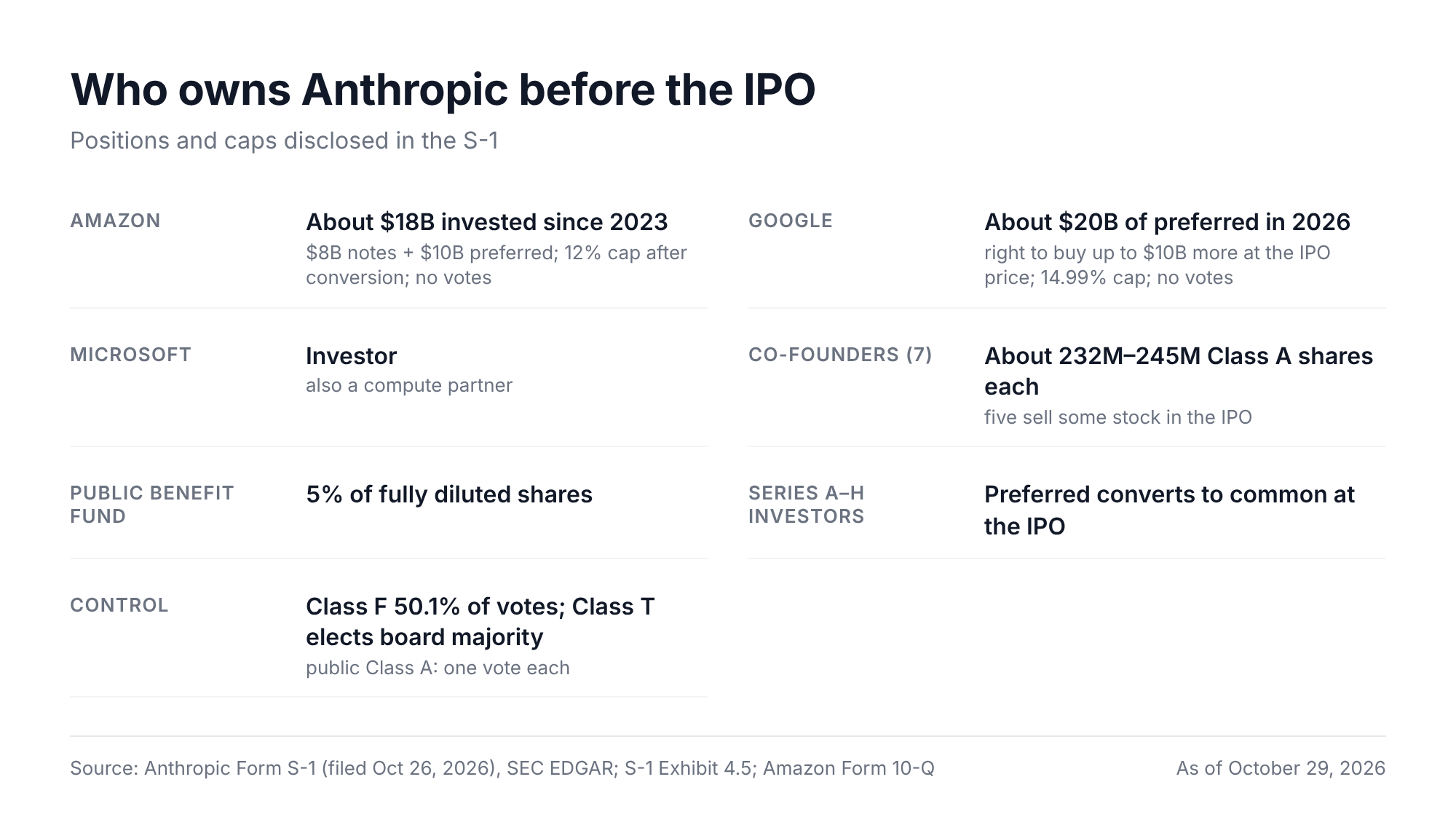
Major shareholders of Anthropic and the holding limits of the two major shareholders, organized according to the S-1.
What should be the expected IPO valuation for Anthropic?
As of November 5, 2026, Anthropic's IPO valuation has not yet been determined, with the price range in the subsequent S-1 amendment being the first company number that can anchor the valuation.
Multiplying that range by the number of shares outstanding after issuance will yield the implied valuation; and the final price set the night before listing will determine the actual valuation.
The rumored figure of around $1.5 trillion (down from $1.8 trillion to $2 trillion in October) is the starting point of the market, not the company; the roadshow, which can start as early as November 10, 2026, is when demand will truly be tested.
Here’s a simple calculation, which is neither a prediction nor company numbers: annualizing the third-quarter revenue of 2026 ($16.96 billion × 4 ≈ $67.8 billion), a $1.5 trillion valuation is about 22 times this annual revenue.
For the steps confirmed between filing and pricing and those still expected, refer to the IPO timeline.
What factors might raise or lower the valuation?
Currently, four visible factors will influence where the price range falls and the stock's performance post-listing.
- Demand structure: Bloomberg reported on October 27 that Anthropic has selected JPMorgan to lead the retail sales in the US and is considering allocating 15% to 20% of shares to retail investors; this proportion may still be adjusted and can change the buyer composition on the first day. The S-1 did not specify any ratio.
- Index inclusion: Nasdaq added SpaceX to the Nasdaq 100 index within a month after its listing, and given Anthropic's expected issuance scale, it may meet similar conditions, leading to index buying and subsequent selling pressure linked to the index.
- Release of lock-up shares: The S-1 outlines a phased release schedule for the lock-up period: some insiders can sell up to 10% of their holdings from the first day of listing, while other shareholders will have freed shares in phases on days 27, 48, 62, and 76, with the largest shareholder not fully released until the Q3 2027 financial report or the 365th day.
- Governance discount: A class share buyers have only one vote per share, but the founder shares hold 50.1% of the voting rights, and there is also a trust that can select a majority of board seats; the S-1 itself lists this structure as a risk.
These factors will not change the $965 billion valuation that has already become history but will affect the number that replaces it.
A recent large public offering reveals valuation insights
SpaceX serves as a precedent in 2026: it priced its IPO at $135.00 per share on June 11, 2026, selling a total of 638,888,888 shares, with net proceeds of approximately $85.7 billion, and its first-day closing price exceeded the issue price by 19%.
According to The Motley Fool, SpaceX had a first-day valuation of approximately $1.77 trillion, which is the record that the rumored range for Anthropic's valuation may challenge.
For Anthropic, the lesson from this precedent is the process: SpaceX's price range was only published a few days before pricing through an amendment, and its first public market valuation also only appeared after trading began.
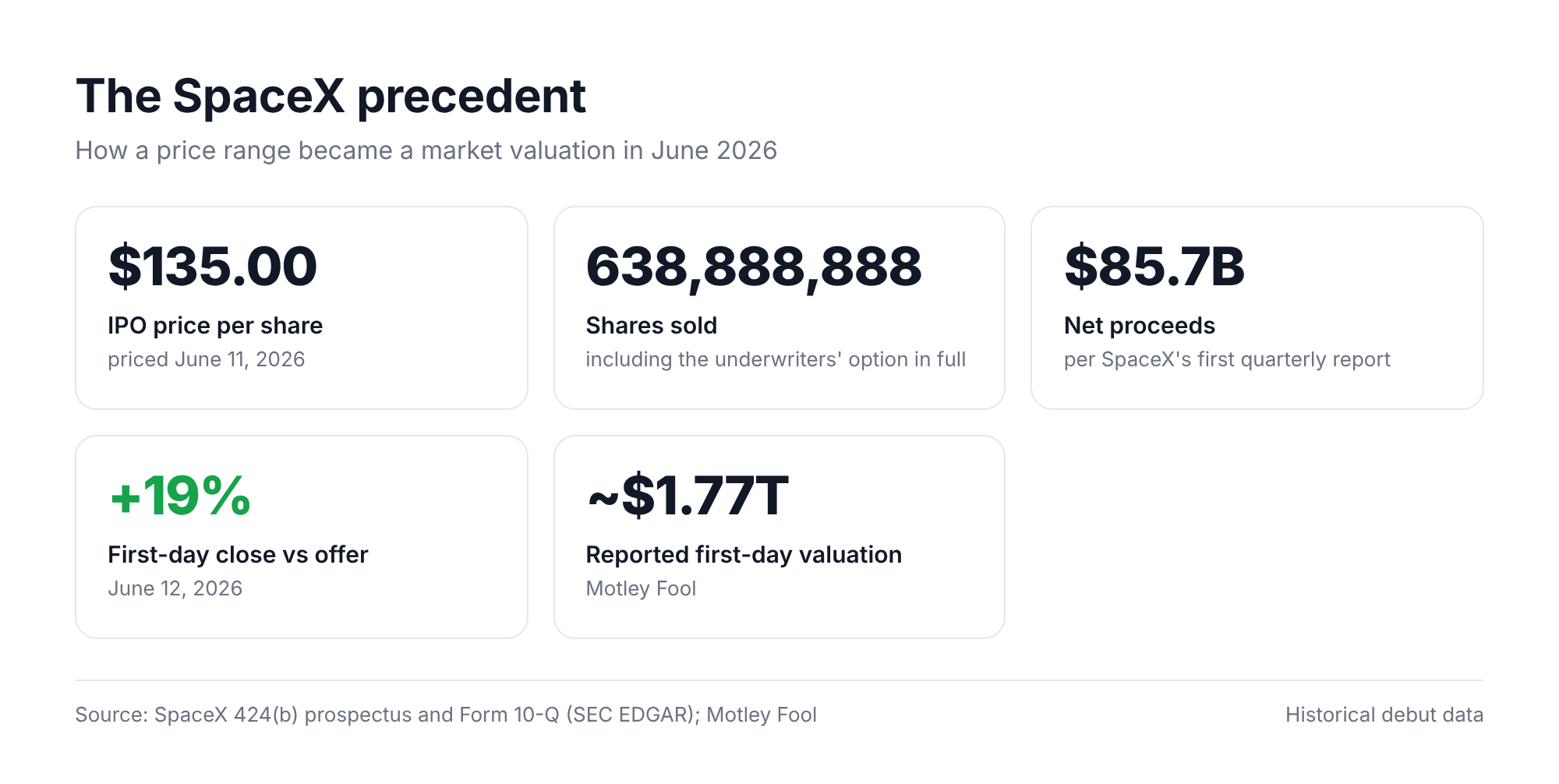
The largest IPO of 2026 illustrates the process of how the price range transforms into market valuation.
Anthropic Pre-IPO Valuation: What are traders really pricing?
Pre-IPO products and prediction market pricing represent Anthropic’s expected valuation, not its stock price; what should be compared to the $965 billion private valuation is this figure.
Pre-IPO valuation contracts are quoted at $1,500, representing a whole company valuation of $1.5 trillion; the range of $1.5 trillion to $1.8 trillion in prediction markets also refers to similar figures for the entire company post-listing.
Neither represents shares, voting rights, or dividends, and both may fluctuate due to unverified reports from the company.
On MEXC, Anthropic Pre-IPO countdown pages will track various milestones to see how these expectations first transform into the price range in the filing, then into actual trading prices.
Frequently Asked Questions
How much is Anthropic worth?
The post-money valuation of $965 billion comes from the H round financing announced on May 28, 2026; this is the last confirmed valuation by the company.
What is Anthropic's IPO valuation?
As of November 5, 2026, this has not been determined since neither the S-1 nor the Amendment No. 1 provided a price range; the market rumor is about $1.5 trillion, whereas the last confirmed valuation is $965 billion from May 2026.
What is the issuance size of the Anthropic IPO?
This remains undetermined; the issuance size fields in both S-1 and Amendment No. 1 are empty, and the $1 billion in the fee table is just a placeholder for calculating registration fees, not an actual raised amount.
Who owns Anthropic?
Amazon, Google, Microsoft, seven co-founders, employees, investors from rounds A to H, and the public benefit fund; post-IPO, public market Class A shareholders will also be added.
How much of Anthropic does Amazon own?
Amazon has invested about $18 billion; the notes it holds will convert at the IPO, with a post-conversion ownership limit of 12%, expected to hold over 5% after listing, but without voting rights.
Does Google own shares of Anthropic?
Yes, Google bought about $20 billion in preferred shares in 2026 and can buy up to $10 billion more at the IPO issuance price; the holding limit for newly acquired shares is 14.99%.
What is Anthropic's market value?
There is no market value before ANT starts trading; $965 billion is the post-private valuation, and the first-day market value will be the closing price multiplied by the number of shares outstanding.
How much is one share of Anthropic?
There is currently no official stock price; the first meaningful number will be the price range to be provided in future S-1 amendments, based on the number of shares after the 1-for-10 split on September 17, 2026.
What is the stock ticker for Anthropic?
ANT, listed on the Nasdaq Global Select Market, according to the application disclosed in the S-1.
Can you buy Anthropic stock before the IPO?
No, but you can gain indirect exposure through holding funds that own Anthropic, listed shareholders such as Amazon, and Pre-IPO products that track expected valuations but do not deliver stock.
Conclusion
$965 billion is a real, dated number confirmed by the company; the rumored IPO valuation of around $1.5 trillion has been revised down from $1.8 trillion to $2 trillion in October and is still not finalized.
The S-1 has already disclosed the details behind this number: cumulative funding of $141.1 billion, cash of $131.7 billion, a 5% equity held by the public benefit fund, and holding limits for two strategic investors at 12% and 14.99% respectively, as well as shares held by the founders controlling 50.1% of voting rights.
What is currently missing is the price range; before assessing how much Anthropic is truly worth, the next S-1 amendment containing the price range is a must-read document, and after listing, reference can also be made to the guide on how to purchase Anthropic stock.
免责声明:本文章仅代表作者个人观点,不代表本平台的立场和观点。本文章仅供信息分享,不构成对任何人的任何投资建议。用户与作者之间的任何争议,与本平台无关。如网页中刊载的文章或图片涉及侵权,请提供相关的权利证明和身份证明发送邮件到[email protected],本平台相关工作人员将会进行核查。


