Abstract: On November 8 (U.S. time), Nvidia officially released Huang Renxun's apology letter and announced that the board of directors would initiate an independent investigation regarding the risks related to foreign intelligence activities reported by the media. The company stated that there is currently no reason to believe that national security or Nvidia’s secrets have been compromised, and Huang Renxun will cooperate with the investigation. In the two trading days prior, AI chip stocks had just experienced significant volatility: on November 5, NVDA and AMD fell by 9.26% and 17.26%, respectively; on November 6, they rebounded by 2.78% and 11.04%, respectively. These fluctuations occurred before the official announcement on November 8 and cannot be directly attributed to this incident. When major information is released outside of regular U.S. trading hours, how do overnight stocks and stock-related perpetual contracts form different price expectations? This article discusses trading methods and risks using BBX DEX's NVDAUSDT, AMDUSDT and contract grids as examples.
On November 8, a letter from Nvidia founder and CEO Huang Renxun quickly shifted the market’s focus from AI chip orders, computing power, and valuations to the corporate governance and information security of this tech giant.
The more directly related issue to shareholder interests than personal matters is this: what conclusions will the independent investigation reach? Will it affect the market's judgment of management, technical security, and future operations? And how can investors express these yet-to-be-formed expectations while the regular trading sessions on major U.S. exchanges have not resumed?
1. What happened at Nvidia on November 8? Confirmed facts and questions for investigation should be separated
On November 8 (U.S. time), Nvidia published a letter from Huang Renxun to employees on its official website. Huang Renxun admitted to being unfaithful to his wife, apologized to his family and company colleagues, and stated that he would take responsibility.
On the same day, the Nvidia board issued a statement: in light of media reports regarding Huang Renxun potentially being a target of foreign intelligence activities, the board has initiated an independent investigation, with a committee of independent directors conducting the review with the assistance of external legal counsel. Huang Renxun expressed his support and will cooperate with the investigation.
Importantly, the board also clearly stated: there is currently no reason to believe that national security or Nvidia's trade secrets have been compromised. Regarding specific allegations of intelligence activities from the outside, media reports or investigation matters at this stage should not be construed as confirmed facts. The company also expressed confidence in Huang Renxun and his management team.
For the capital market, what may need to be repriced is not the private relationship itself, but the corporate governance, key personnel risks, business continuity, and potential regulatory implications stemming from it. Whether the aforementioned risks ultimately constitute a substantial impact still depends on the investigation results and subsequent disclosures.
2. NVDA and AMD had already fallen and then rebounded, but the order of events must not be confused
Just before this sudden event, AI chip stocks had just experienced two trading days in opposite directions.
U.S. stock target | Closing on November 5 | Change on November 5 | Closing on November 6 | Change on November 6 |
Nvidia (NVDA) | $181.60 | -9.26% | $186.64 | +2.78% |
AMD (AMD) | $404.40 | -17.26% | $449.04 | +11.04% |
The data corresponds to the closing of the Nasdaq regular trading session, with all dates being in Eastern Time (ET). According to AMD's investor relations website, on November 6 after the U.S. stock market closed until 19:59 (ET), AMD was quoted at $448.14, down 0.20% from the day's close.
This sequence of events is crucial: the rebound on November 6 occurred before Nvidia issued its official statement on November 8. Therefore, "AMD's 11.04% increase" cannot be described as a stock price performance resulting from the Huang Renxun incident, nor can it be concluded that the market has begun to transfer Nvidia's orders or competitive advantages to AMD based solely on the differing increases in AMD and NVDA.
However, the sharp declines and rebounds also reveal a reality: as AI investment returns, capital expenditures, and market risk appetite are reassessed, chip stocks may experience significant two-way fluctuations in a very short period. New corporate governance events further increase uncertainty in the next trading sessions.
3. How does weekend news enter prices? U.S. overnight stocks and perpetual contracts are not the same market
The regular stock trading on major U.S. exchanges typically occurs from 9:30 AM to 4:00 PM (ET) on weekdays. Information released over the weekend often takes until the next trading session to be more fully reflected in mainstream stock market transactions, quotes, and liquidity.
However, "U.S. regular trading hours closed" does not mean that all stock trading completely stops. The U.S. already has alternative trading systems (ATS) that provide overnight stock trading. For instance, Blue Ocean ATS has a night trading session from Sunday to Thursday 8:00 PM to 4:00 AM (ET), allowing eligible investors to trade real U.S. stocks through related brokerage channels outside of certain regular hours.
Another trading mechanism is stock-related perpetual contracts. These do not directly settle stocks but allow traders to establish long or short risk exposures to related reference assets on margin. Using BBX DEX as an example, the platform states that its stock and multi-asset perpetual contracts can be traded around the clock during their operating periods, with funding primarily coming in stablecoins like USDT.
These two markets fundamentally differ in asset nature: stock overnight trading involves securities, while stock perpetual contracts involve derivative positions. The latter's quotes do not necessarily equal the latest stock closing price and do not guarantee continuous accurate tracking of reference prices during the underlying stock's market closure.
This type of difference can become more apparent after major breaking news: participants, order book depth, marking prices, reference indices, funding rates, and liquidity conditions can all affect trading outcomes. When the reference spot market resumes trading, quotes across different markets may also quickly readjust.
4. From BBX's AMDUSDT quotes, understanding the difference between “contract rising” and “U.S. stocks rising”
According to the trading page data from BBX DEX on November 9, as of 11:50 Beijing time, the latest price quote for the AMDUSDT perpetual contract was 457.57 USDT, with a 24-hour increase of 2.45%; the index price displayed during the same period was 457.65, and the marking price was 457.66. This is a specific screenshot at a timestamp showing perpetual contract data, not the real-time stock price or post-market trading price of AMD, and thus, cannot be used to conclude that AMD stocks rose due to the Huang Renxun incident.
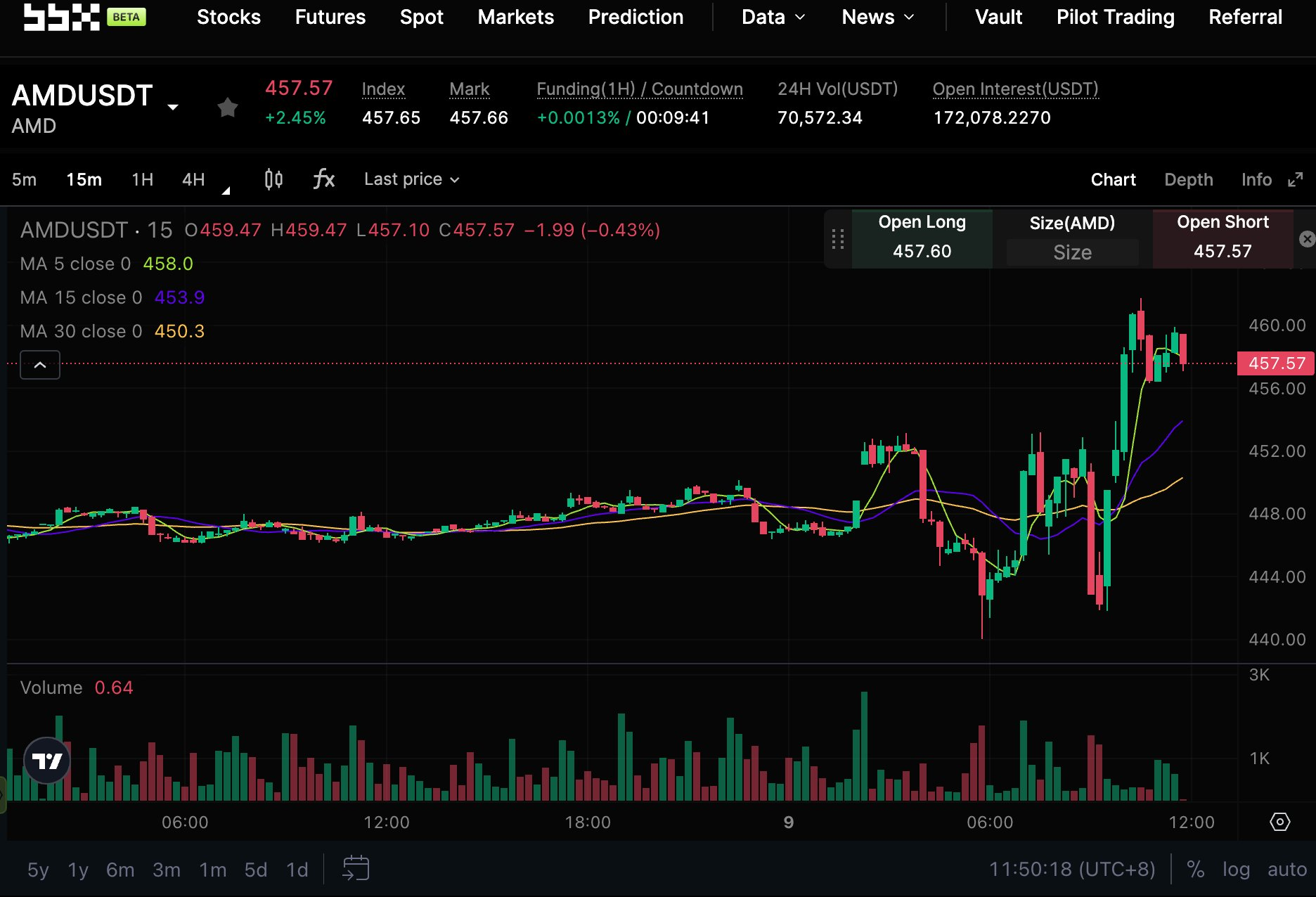
Figure: BBX DEX AMDUSDT perpetual contract trading interface, November 9, 2026, 11:50 (UTC+8).
From a trading mechanism perspective, even using AMD as a reference asset, perpetual contracts and U.S.-listed stocks may show different prices. For traders, three questions need to be confirmed first: is the latest price seen the transaction price or the marking price? How is the contract reference index calculated? Is the price deviation related to transaction depth, spreads, or funding rates?
If these conditions have not been verified, simply subtracting the contract quote from the stock closing price does not directly yield a conclusion of "risk-free arbitrage opportunities."
As for NVDA, the progress of the investigation may lead investors to form sharply opposing judgments: one side worries about additional governance and regulatory risks, while the other believes the company's operational fundamentals have not shown verifiable changes. Disagreements between bulls and bears do not equate to either side being necessarily correct.
5. Two directions for trading NVDA or AMD: how BBX stock perpetual contracts operate?
For crypto asset traders accustomed to using stablecoins, BBX DEX offers another entry point for price exposure related to stocks. Taking Nvidia and AMD as examples, the platform's related trading pages include:
NVDAUSDT (Nvidia stock-related perpetual contract): Traders can choose to go long or short based on their own judgment.
AMDUSDT (AMD stock-related perpetual contract): Similarly provides directional exposure to price movements related to AMD.
Assuming a contract position has a notional value of 1,000 USDT, and the relevant contract price moves in favor of the position by 5%, not considering factors such as fees, funding rates, slippage, and liquidation, the floating profit and loss would change by around 50 USDT; if the direction is reversed, it could result in a loss of about 50 USDT. Here, the 1,000 USDT represents the notional position, not the actual margin put in. With leverage used, both yield and loss rates on margin can be amplified, even leading to forced liquidation.
Stock-related perpetual contracts do not confer ownership, dividends, or voting rights of Nvidia or AMD stocks to holders. Investors should also verify before placing orders whether the current contract is tradable, local access restrictions, leverage limits, marking prices, funding rates, and forced liquidation rules.
For event-driven trading, one of the greatest risks is a sharp reverse volatility occurring before news is fully digested. Being able to go long or short does not guarantee profit from news.
6. If NVDA and AMD fluctuate repeatedly, what can contract grids do?
In addition to single-direction trades, automated strategies are also tools that some traders consider when observing volatile markets. The **contract grid (Futures Grid)** offered by BBX DEX allows traders to choose long, short, or neutral strategies and execute orders based on preset price ranges and grid parameters.
The essence of grid strategies is not to predict event outcomes but to respond to price fluctuations within the defined range according to rules. If a particular stock-related contract continues to fluctuate up and down around a certain range for a period, some grid orders may match; if prices quickly break through the range unilaterally, the strategy could instead accumulate adverse positions or result in significant floating losses.
Thus, trading NVDA and AMD around the occurrence of sudden investigative events cannot simply conclude that "the greater the volatility, the more profit from the grid." Realized single grid profits do not equal overall strategy profitability, and unrecognized profits and losses, trading fees, funding rates, slippage, and liquidation risks from leverage must also be calculated. Specific tradable assets and parameters are subject to BBX platform's real-time interface.
7. What is most worth observing next are not rumors, but three verifiable variables
Firstly, is the further disclosure of the Nvidia board's independent investigation. The market needs to see verifiable investigative progress instead of treating unconfirmed allegations as established facts.
Secondly, the NVDA and AMD quotes and transaction volumes resumed trading on November 9. They will help the market determine whether this sudden news truly changes investors' pricing of the two companies. It is important to note that the quotes and liquidity of regular stock trading, overnight stock trading, and perpetual contracts cannot be confused.
Finally, Nvidia's own operational data. According to the company's previous announcement, Nvidia plans to hold a conference call for its third-quarter financial results on November 17 at 5:00 PM (ET). AI chip orders, data center businesses, profit margins, and capital expenditure outlook remain important information for assessing the company's long-term value.
The Huang Renxun event has brought Nvidia's corporate governance into a new phase of public examination, also drawing more attention to the market expectations of NVDA and AMD. For traders, the truly important questions are not "who will rise because of this," but whether they can distinguish between verified facts, unverified assumptions, and the real risks of the financial products being traded.
About BBX
BBX is a multi-asset trading platform with stablecoins as funding. Through the BBX stock account, eligible users can trade real U.S. and Hong Kong stocks; the execution, clearing, and custody of related securities are completed through collaborating securities infrastructure. BBX DEX offers tokenized stock trading, multi-asset perpetual contracts collateralized by USDT, and automated trading tools like contract grids. Different products do not share the same rights, trading times, risk mechanisms, and applicable regions.
One Account. Global Markets.
Disclaimer and Risk Warning
This article is for information exchange and reference only and does not constitute any investment advice, profit guarantee, or buy/sell recommendation. Financial markets involve risks, and leveraged and derivative trading may lead to significant losses. All market data and product information may change; specific trading rules, fees, and applicable conditions are subject to the latest information publicly announced by the relevant platform.
References
NVIDIA Official: A Message to Our Company (November 8, 2026)
NVIDIA Official: Statement from NVIDIA Board of Directors (November 8, 2026)
Reuters: Nvidia probes whether CEO Huang was target of foreign spying (November 8, 2026)
AMD Investor Relations: AMD Historical Stock Prices, November 6 Closing and After-Hour Quotes
StockAnalysis: NVDA Historical Stock Prices, November 5-6 Changes
Blue Ocean ATS Official: U.S. Overnight Trading Hours and Mechanism
NVIDIA Official: November 17 Third Quarter Financial Results Conference Call Announcement
BBX Official X Update: AMDUSDT Contract Screenshot Source (November 9, 2026)
免责声明:本文章仅代表作者个人观点,不代表本平台的立场和观点。本文章仅供信息分享,不构成对任何人的任何投资建议。用户与作者之间的任何争议,与本平台无关。如网页中刊载的文章或图片涉及侵权,请提供相关的权利证明和身份证明发送邮件到[email protected],本平台相关工作人员将会进行核查。