
Behind the new rich, ultimately, is old money.

Author Wei Xianghui
Editor Liu Yanqiu
The word count of this article is 4168
Handmade ratio丨85% AI content丨15%
In the 1990s Guangdong, factories were hiring, and businesses were emerging. As long as young people were willing to take risks, they could earn their first pot of gold. The private economy flourished, and many believed that wealth could change one’s fate more than diplomas.
However, a primary school teacher in Wuchuan, Zhanjiang, Guangdong, had his own insistence. Despite frequent visits from parents who told him "studying is useless," he still valued education and insisted that his son study hard. His son also lived up to his expectations, gaining admission to Zhejiang University at the age of 17.
Over the next twenty years, the boy completed his undergraduate and master's studies in Hangzhou, researched machine vision, and experimented with using machine learning in financial trading with classmates, ultimately co-founding a quantitative investment firm with Zhejiang University alumni. In 2015, Huanfang Technology was established in Hangzhou. In 2023, DeepSeek was also born in Hangzhou. That boy from Guangdong gained fame.
Similar to Liang Wenfeng's hometown of Guangdong, Zhejiang, where DeepSeek is located, has an active private economy with a longstanding tradition of commerce.
As early as the Ming and Qing Dynasties, the Longyou, Ningbo, and Shaoxing merchant groups were already active in various regions. By modern times, Ningbo merchants entered Shanghai via waterways, engaging in banking, shipping, and trade. There was once a saying on the Bund that "no Ningbo, no market." After the reform and opening-up, Wenzhou merchants explored north and south, small commodities from Yiwu sold globally, and Hangzhou gradually became a major hub for internet and technology startups.
Doing business ultimately relies on people. Seniors mentor juniors, and as juniors thrive, they cannot forget their old friendships. Through business dealings, relationships and trust slowly accumulate, allowing room for negotiation in many matters.
In 2026, Liang Wenfeng opened his doors to external capital for the first time. A group of Zhejiang investors soon gathered behind him. A company with a strong technical idealism was backed by a group of individuals with a solid local business background. At first glance, it somewhat resembled a "hometown gathering" of Zhejiang capital.
I roughly sorted this out, and the identifiable capital from Zhejiang currently amounts to about 3.55 billion yuan. If calculated based on DeepSeek's two rounds of financing totaling approximately 150 billion yuan, it would account for about 2.3%. However, this figure mixes different levels of fund subscription amounts and project investment quotas, serving only as a preliminary reference for the scale of capital participation and cannot be seen as the actual share of Zhejiang capital investment.
2.3% might not seem high, but, combined with DeepSeek's financing threshold, it's actually significant. For instance, in the first round of financing, Liang Wenfeng and the founding team firmly maintained control over the company, with Hangzhou Chengli acting as an important external holding platform, holding approximately 8.52% of DeepSeek's equity. Although this cannot be viewed as the full ratio of external investors' holdings, in a financing round where investment qualifications were scarce, Zhejiang capital being able to secure a place is noteworthy.
Taking a closer look at the players in this capital landscape, there are local state-owned assets, private enterprises organized by the Hengdian Group, and Zhejiang tycoons like Zhong Shanshan. They each had their own businesses and capital paths but ultimately intersected at DeepSeek.
How much ancient camaraderie lies behind this capital and how many new mutual interests are there remains unclear to the outside world. The only certainty is that in such a sought-after investment project, being able to join the table is itself not an easy task.
"The martial world is not about fighting and killing; it's about human feelings and world affairs." Even with cutting-edge technologies like large models, when it comes to sharing the pie, behind it lies a web of relationships that ordinary people cannot discern.
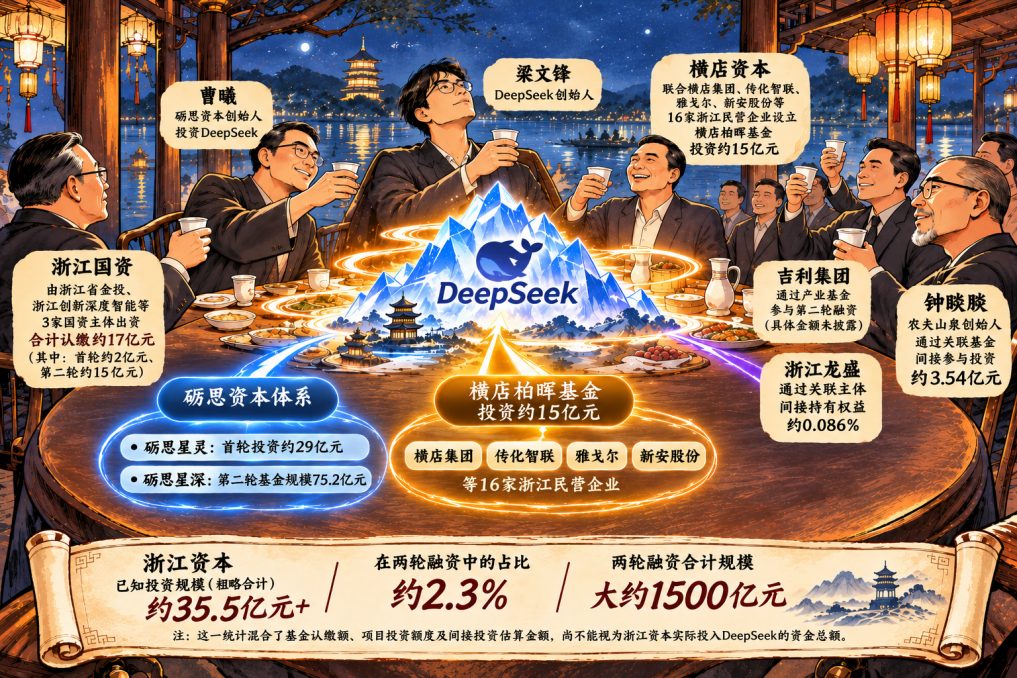
AI generated image
Cao Xi makes a bridge, state capital enters the game
Let’s talk about the background first.
In his early years, Liang Wenfeng sought funding but gave up when he found that his focus on frontier exploration clashed with VCs’ profit-driven demands. However, this did not hinder a wave of investors lining up to check in at DeepSeek. I remember one "big-eyed" investment institution told me to go line up first and get a number, just in case there might be financing in the future.
It was wise to be prepared; this institution finally appeared on DeepSeek's investor list. However, the one making the biggest waves was Cao Xi's Lisi Capital. Not only did it appear in DeepSeek’s financing network for two consecutive rounds, but it also seamlessly became the largest "channel" for DeepSeek's shares.
Interestingly, Lisi’s founding time is not long, but it has already laid out plans in several of China's most exciting AI startup tracks, including The Dark Side of the Moon, Wumeng Chipology, and Muxi… all backed by Lisi. Around DeepSeek, in May of this year, DeepSeek's first round of financing entered a critical phase, and the Tianjin Lisi Starling Fund under Lisi was established. Subsequently, this fund, approximately 2.9 billion yuan in scale, indirectly participated in DeepSeek's financing through Hangzhou Chengli.
The first round of investors was mainly selected by Liang Wenfeng himself, and how he and Cao Xi established their connection or when they first discussed investment is unknown to us. However, the entry ticket that Lisi obtained for DeepSeek is a testament to Mr. Cao's social skills.
This ticket quickly demonstrated its value.
In the LP list of the Lisi Starling Fund, the Zhejiang Provincial Jin Investment Science and Technology Innovation Mother Fund III has appeared, holding approximately 6.9% of the fund's shares, which roughly translates to around 200 million yuan in contributions based on the fund size.
Thus, Zhejiang state-owned assets entered the indirect investment network of DeepSeek. Some media reported that the participation of state capital in the first round was not high, with only the National Artificial Intelligence Industry Investment Fund directly investing in DeepSeek, contributing approximately 980 million yuan, and was not subject to a lock-up period and enjoyed voting rights in the company.
By the second round, the collaboration between Zhejiang state capital and Mr. Cao expanded further.
In early November, another fund under Lisi, Tianjin Lisi Star Deep, completed a fundraising of 7.52 billion yuan, with 40 LPs participating, and Lisi continued to acquire investment shares in DeepSeek.
Among them, Zhejiang Innovation Depth Intelligent Venture Capital Partnership contributed 1.4 billion yuan, becoming the second largest contributor to the fund, whereas the two funds, Zhejiang Provincial Science and Technology Innovation New Era and Science and Technology Innovation Future, each contributed 50 million yuan. Three Zhejiang state-owned assets cumulatively contributed 1.5 billion yuan.
From approximately 200 million yuan in the first round to 1.5 billion yuan in the second round, the subscription scale of Zhejiang state capital to Lisi-related funds has significantly increased. However, Xingshen is a blind pool fund, and public information has yet to prove that this 1.5 billion yuan was all invested in DeepSeek; Lisi has also not made any public statements.
In the capital circle, finding money is a skill; finding good projects is another skill. Cao Xi happens to possess both these skills. But to me, securing the project is even more crucial, as many people want to invest in DeepSeek but cannot find a way; Mr. Cao can do it effortlessly.
Hengdian organizes, Zhejiang merchants gather
Unlike the official involvement, when characters from the martial world enter the fray, there usually needs to be a leading figure.
XU Wenrong, the boss of Hengdian Group, acts as that leading figure among Zhejiang's private capital.
Many people know Hengdian because it has one of China's largest film shooting bases. The palaces, markets, and conflicts of the ancient costume dramas are often staged here. However, Hengdian's real business story began much earlier than the film city.
In 1975, Xu Wenrong led local farmers to establish a silk-reeling factory, which later gradually developed into industries such as magnetic materials, medical chemicals, and electronics. By the 1990s, Hengdian Group had become a significant local enterprise. In 1996, the construction of Hengdian Film City began, which later became renowned nationwide for its film industry.
Xu Wenrong is a representative of the first generation of township entrepreneurs in Zhejiang. His entrepreneurial experience nearly encapsulates a segment of development history of Zhejiang's private economy post-reform and opening-up: starting from township factories, relying on manufacturing to accumulate capital, and then extending into different industries.
However, Xu Wenrong has his own understanding of wealth. In 2000, the Hurun Report listed Xu Wenrong as one of China's richest entrepreneurs. Xu later approached Hurun, explaining that Hengdian Group's assets could not simply be counted as his personal wealth. Hengdian Group has a unique collective economic background and is not a family-owned business of the Xu family.
Since then, Xu Wenrong and his family have rarely appeared on wealth lists.
In China's business society, measuring an entrepreneur's influence by wealth figures is one method; it is another matter altogether how many industrial resources they can organize. Decades later, Hengdian Group has grown into a large enterprise group with annual revenues exceeding 95 billion yuan and several listed companies under its umbrella. Xu Wenrong has gradually retreated to the background, yet Hengdian’s industrial and capital networks continue.
In 2026, this network may extend to DeepSeek.
On June 8, Hengdian Baihui Venture Capital (Hangzhou) Partnership was established. On September 18, the fund completed its filing. Starting in late September, a number of listed companies in Zhejiang gradually disclosed investment announcements.
Transfar Zhilian came, YOUNGOR came, Xin'an Co. came, Hengdian Dongci, Debang Lighting, Yingluohua, Jiansheng Group, and Nanhua Futures also appeared on the funding list.
The founders and actual controllers of these companies are all prominent figures in Zhejiang's business community. They represent a group of private enterprises that have共同经验 manufacturing expansion, capital market development, and industry transformation. Having traversed industrial cycles for decades, they have also accumulated capital in various fields.
For these veterans who have operated in Zhejiang’s business community for many years, the young man from Guangdong who came to Hangzhou to study at 17 over twenty years ago has now become a person to be sought after and befriended.
According to announcements from listed companies, the Hengdian Baihui Fund plans to raise 1.65 billion yuan, aiming to invest in high-growth technology companies. Hengdian Capital serves as the fund manager, with Xu Jiawei representing Hengdian Capital.
From public documents, it appears that these companies did not complete their funding contributions on the same day but joined successively as the fund expanded. In the announcement that Transfar Zhilian disclosed in September, there was already an indication of the Hengdian Baihui's expansion to 1.65 billion yuan. After that, companies such as YOUNGOR continued to disclose related investments.
According to people close to Hengdian Capital, Hengdian Capital obtained approximately 1.5 billion yuan of investment shares in DeepSeek in the second round. If this information is ultimately confirmed by delivery documents, then the 1.65 billion yuan fund size of Hengdian Baihui would be very close to the DeepSeek investment shares obtained.
The richest man takes action, big shots make bets
Compared to the collective investment organized by Hengdian Capital, the way Zhejiang's richest man Zhong Shanshan entered DeepSeek is much stealthier.
I checked public equity materials, and Zhong Shanshan, through his affiliated investment entities, entered Hangzhou Chengli via Guan Zi Equity Investment (Lishui), Tianjin Huixing, Tianjin Huizhi, and other multi-layered partnerships, indirectly participating in the first round of DeepSeek’s financing. The investment scale is estimated by the media at about 350 million yuan.
This entrepreneur, who accumulated massive wealth through Nongfu Spring and Wantai Biological, appearing in the investment network of a foundational model company is somewhat unexpected.
Externally, Zhong Shanshan is referred to as a "lone wolf" in the business world, conducting his affairs independently. He was born in Zhejiang, previously worked as a journalist and salesperson, and later entered the drinking water industry, founding Nongfu Spring. His primary wealth has long been concentrated in consumer goods and biopharmaceuticals, rarely appearing in public as a technology investor.
However, being low-key does not mean he is inactive. According to the listing application documents for Xizhi Technology on the Hong Kong Stock Exchange, Guan Zi Venture Capital has appeared in the pre-listing shareholder list of this AI optical computing chip company. Now, by participating in DeepSeek through associated funds, Zhong Shanshan's investment portfolio has extended into the fields of AI computing power and foundational models.
Another surprising investor is Zhejiang Longsheng. In the equity chain of DeepSeek's first round of financing, Zhejiang Longsheng entered Hangzhou Chengli through associated entities such as Hangzhou Longshan Chemical, Shanghai Lejin, and Shanghai Tanying, resulting in approximately 0.086% indirect equity in DeepSeek according to public equity relationship penetration calculations.
Zhejiang Longsheng is known for its dyes and chemical businesses. Dyes, chemical intermediates, and other traditional manufacturing businesses have long comprised its industrial base. Today, this veteran listed company has also established a capital relationship with an AI foundational model company through its investment platform.
Geely represents a different case.
The Geely Automotive Industry Fund participated in the second round of DeepSeek's financing. Compared to the indirect investments made by Zhong Shanshan and Zhejiang Longsheng through associated funds, Geely has a more direct application scenario for artificial intelligence.
From intelligent cockpits and assisted driving to automotive R&D, manufacturing, and supply chain management, AI technology is entering multiple segments of the automotive industry. In recent years, Geely has also continuously laid out intelligent businesses. For this automotive group, investing in foundational model companies not only provides potential financialreturns but also leaves room for future technological collaboration.
In fact, in DeepSeek's first round of financing, several traditional industrial capital players have already appeared. Besides the reported investment of about 5 billion yuan from the CATL system, listed companies like Jiuzan Medical and Tanchun Beijian have also indirectly participated through funds.
Overall, the selection of investors in DeepSeek's second round of financing reveals a stronger industrial orientation. It is said that DeepSeek requires prospective investors to explain the data support and business collaboration resources they can provide. Companies like Geely, Zhaoyi Innovation's Shixi Capital, and Lenovo's Legend Capital, which have industrial backgrounds, have become new faces in this round of financing.
Behind the new rich, ultimately lies old money. The arrival of old money adds a heavier tone to this tech newcomer. In this gathering, some value the potential wealth returns from technological transformation, some hope to find new growth opportunities for existing industries, and some simply wish to secure a seat in the next round of technological competition, buying a ticket to the future.
Whether they are fellow townsfolk or new acquaintances, once seated at the same table, they are all friends. Come, let's down this drink first.
Original content from 投中网
免责声明:本文章仅代表作者个人观点,不代表本平台的立场和观点。本文章仅供信息分享,不构成对任何人的任何投资建议。用户与作者之间的任何争议,与本平台无关。如网页中刊载的文章或图片涉及侵权,请提供相关的权利证明和身份证明发送邮件到[email protected],本平台相关工作人员将会进行核查。


