Fan Yating|FFF111f__
Sun Rui|lombredeau
“If it’s delicious, ask the chef; for good products and good companies, you should ask entrepreneurs.”
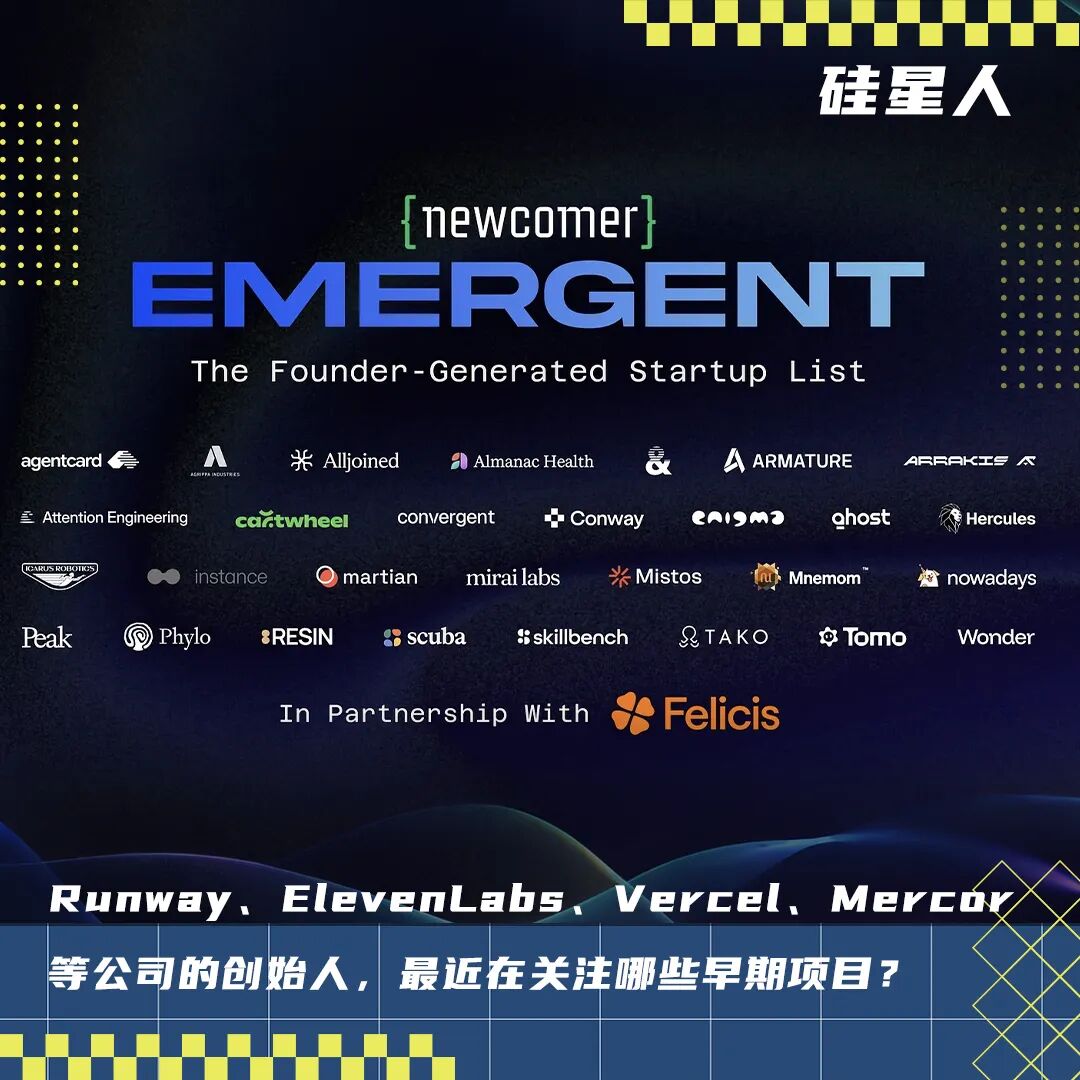
Recently, Newcomer in collaboration with top venture capital Felicis launched the Emergent list, which enumerates 29 currently noteworthy startups. Felicis was founded in 2006 by Google’s early product manager Aydin Senkut, who previously invested in projects like Shopify and Canva, and also backs Runway, Tines, and Mercor.
This list appeals to us because, unlike most lists, the AI startups featured here have been personally nominated and recommended by the founders of various unicorns and cutting-edge tech companies, such as Runway, ElevenLabs, Glean, Fireworks AI, Tines, and Crosby.
Founders often have more frontline insights. For example, Vercel's Rauch recommended Armature because users are starting to use software through ChatGPT, Claude, and programming Agents, and software companies need to understand how these Agents choose tools and where they get stuck. Runway recommended Cartwheel, which can integrate into animators' existing workflows and has also participated in its financing.
This list spans eight tracks: software development and delivery, AI infrastructure, Personal Agent, enterprise automation, AI4S, AIGC, embodiment, and industrial services. To some extent, this also represents the hottest and most in-demand areas of AI entrepreneurship. As these are early-stage projects, they focus on breakthroughs in single-point scenarios rather than building large, comprehensive companies.
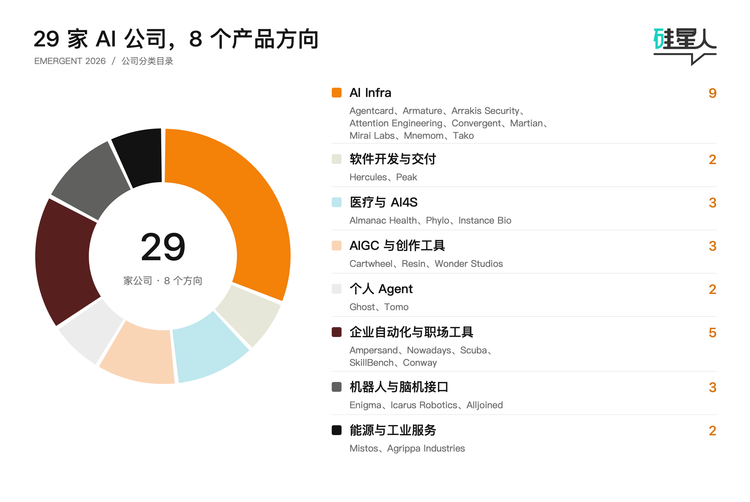
We have compiled this list and provided introductions based on founder recommendations, hoping that the cutting-edge engineering practices and entrepreneurial trend highlighted by this list can inspire new insights for investors and entrepreneurs in the domestic market.
1
Software Development and Delivery
AI can write a piece of code faster; however, companies must turn code into usable systems or finish testing before going live. Hercules and Peak are doing these two things.
1. Hercules|https://hercules.app/
Product Overview
Hercules is a fully managed AI application development platform designed for enterprise users. A small business wanting to create an inventory management system can directly tell Hercules what to input, who to approve it, and who to view the inventory. It generates a usable web application, with the platform providing the database, account permissions, payment, hosting, and backup. Besides inventory, clients can also use it for CRM, employee back-office, and customer portals.
Why It’s Worth Noticing
Founded by Brendan Falk and Grant, both of whom were part of the popular terminal tool Fig (acquired by AWS). It addresses the real pain points of traditional no-code platforms, which suffer from front-end and back-end separation and cumbersome configuration. The project is recommended by Lin Qiao, co-founder of Fireworks AI and founder of Rogo, emphasizing its use of open weight models for application generation, making calculations easier.
2. Peak|https://peak.inc/
Product Overview
Peak is a cloud-based automation testing and build (CI) acceleration platform for R&D teams. Peak can directly undertake tasks from GitHub Actions, provide a cloud-based runtime environment, and automatically retain dependency packages and build caches, significantly reducing the time spent preparing environments repeatedly. It is also testing AI-based code auto-fix capabilities currently.
Why It’s Worth Noticing
The founding time and funding amount have not been disclosed. The project is recommended by Gabriel Stengel, founder of Rogo. For supported Ubuntu tasks, the team typically only needs to modify a single line of configuration for seamless integration; the unique “Shadow Mode” allows the same batch of tests to be compared in terms of time and accuracy on both the original platform and Peak, enabling zero-risk validation of efficiency improvements using the enterprise’s actual projects. The selling points of Peak are easily verifiable.
1
Agent Infra
In the agent era, there is substantial demand for infrastructure surrounding various aspects of agents. Many crowded directions have emerged, such as creating agents' visas and agent risk control, with these startups still needing to demonstrate their distinctiveness and irreplaceability.
1. Agent card|https://agentcard.com
Product Overview
Providing Agents with bank cards so that Agents can spend online independently. Agent card addresses the traditional issue where Agents can help users search for products and fill in orders, but payment usually requires human involvement.
Why It’s Worth Noticing
Karen Serfaty serves as CEO and previously founded the corporate expense management company Atlas, which was later acquired by Remote, where he became the head of the cards business. Vercel co-founder and CEO Guillermo Rauch believes that Agents should possess complete autonomous online payment capabilities, and Agentcard is providing payment infrastructure for Agent startups, consumer applications, and B2B enterprises. This space is undoubtedly crowded, with giants like Stripe and Visa involved, along with more startups directly competing with them.
2. Armature|https://agentcard.com
Product Overview
Focusing on Agent Experience (AX), creating observability, testing, and optimization for Agents. Armature is dedicated to studying how Agents use products, primarily conducting analysis of Agent behavior, Agent automation testing, and Agent discoverability (focusing on optimization of customer acquisition and distribution aimed at Agents).
Why It’s Worth Noticing
It extends the logic of GEO to Agent tool selection. Vercel co-founder and CEO Guillermo Rauch mentioned that users accessing products via Claude, ChatGPT, and Coding Agents is becoming the new normal; Armature is able to record the interactions between Agents and products, allowing enterprises to understand what questions users posed to Agents and how Agents utilized their products. Perhaps, in the future, software companies will purchase Agent analysis and testing tools just as they do with user analysis tools today. The founder previously served as a Forward Deployed Engineer at Palantir and later joined Tsuga, spun off from Datadog, where he was responsible for building observability infrastructure from scratch. Another member, Louis, was in charge of AI automation at the consumer application Joko.
3. Arrakis Security|https://arrakis.security/
Product Overview
Providing security monitoring and permission management for enterprise Agents, preventing overreach, access to sensitive data, or triggering security risks. Arrakis Security mainly possesses three capabilities: scanning deployed Agents to identify permission configurations and potential security risks; real-time monitoring of Agent behavior to detect abnormal operations and block them promptly; establishing a baseline of Agent behavior to assess whether operations deviate from normal task ranges.
Why It’s Worth Noticing
ElevenLabs co-founder and CEO Mati Staniszewski recommended Arrakis Security. He believes that past security tools were primarily designed around humans using machines, while Agents are now beginning to operate CRMs and financial systems autonomously, and Arrakis is addressing the new security issues arising from Agents’ autonomous actions. Consequently, Agent Security could become a necessary infrastructure for enterprises to scale up Agent deployment. It can manage Agents' access permissions and extend to monitoring and constraining these practical behaviors. Currently, they have completed a $8 million seed round of financing.
4. Convergent|https://convergent.dev
Product Overview
Helps enterprises discover issues from real Agent usage records, automatically generates testing environments, and employs Coding Agents to fix problems. Convergent focuses on Agent reliability, addressing the issues that arise when Agents make errors in real production environments but are difficult for development teams to reproduce and fix.
Why It’s Worth Noticing
The team has personnel who have worked at DeepMind, Meta, Mercor, Perplexity, Glean, and other companies. Currently, the product mainly targets Agent firms in vertical fields such as legal, finance, human resources, and SRE.
Crosby founder and CEO Ryan Daniels recommended Convergent. He believes that Convergent can mine failure cases from production environment Agent execution records, build high-fidelity testing environments, and directly call in Coding Agents to fix issues. This takes Agent tools further into automation and self-improvement.
5. Mnemom|https://www.mnemom.ai
Product Overview
Establishing trusted infrastructure for Agents. It builds a reliable identity, behavior verification, and security governance system for Agents, allowing enterprises to verify their behavior before Agents execute tasks and to leave traceable encrypted credentials.
Why It’s Worth Noticing
LinkedIn co-founder Reid Hoffman recommended Mnemom, which advances Agent safety from post-monitoring to pre-constraint, further establishing a cross-Agent credit evaluation system. When many Agents need to trust each other with task delegation, transactions, and collaboration, an independent, verifiable trust mechanism could become important infrastructure. Founder Alex Garden previously founded the food tech company Zume, and CTO Wassim Wehbi worked at Microsoft for over 14 years, responsible for enterprise Agent automation-related projects.
6. Martian|https://withmartian.com/
Product Overview
Providing model routing for AI applications. Martian evaluates the capabilities, costs, and response speed of different models based on task requirements, dynamically selecting models during runtime and also supporting task assignment to multiple models for collaborative processing. Developers can connect to different models through a unified interface without maintaining separate model selection logic for each application.
Why It’s Worth Noticing
Mercor co-founder and CEO Brendan Foody recommended Martian, believing that as the number of models continues to grow, selecting the appropriate model for each task will become a core piece of infrastructure,
Martian has already achieved leading progress in this direction. Founded in 2022, it secured $9 million in seed round financing led by NEA and Prosus Ventures. Model routing is also a crowded space. Martian primarily targets AI application developers and development teams, studying the performance of models across different Prompts to predict quality and costs.
7. Mirai Labs|https://trymirai.com/
Product Overview
Providing an edge-side AI inference engine for phones and computers. Primarily focused on edge models, optimizing the local running efficiency of models on devices like Apple Silicon, and reducing memory usage and inference costs through model and hardware co-optimization.
Why It’s Worth Noticing
If personal agents need to continuously perceive user demands, understand contexts, and execute tasks in real-time, edge inference might become an important foundational capability. ElevenLabs co-founder and CEO Mati Staniszewski specifically noted that the team previously founded Reface and Prisma, and already has experience bringing edge AI products to hundreds of millions of users. Reface is an AI face-swapping and video generation application with several hundred million total users. Prisma is an AI image application that once reached around 100 million monthly active users.
8. Tako|https://tako.com/
Product Overview
Providing structured data and real-time search APIs for Agents, enabling them to access reliable and up-to-date information without solely relying on the knowledge of the models themselves.
Tako mainly offers four types of APIs:
Search API: Searching information from organized data sources and the web.
Answer API: Providing referenced answers to natural language questions.
Contents API: Accessing web content and its underlying structured data.
Agent API: Supporting asynchronous deep research and data supplementation.
Why It’s Worth Noticing
CEO Alex Rosenberg previously worked at Amazon, and CTO Bobby Abbott previously worked at cryptocurrency investment firm Paradigm.
Imbue co-founder and CEO Kanjun Qiu recommended Tako; she is also a user of this product. Tako aggregates and cleans a large amount of data from various sources, allowing large models to read and analyze information in a more reasonable manner. She found that Tako could answer complex data analysis questions and provide high-quality data. We believe this can also lower the cost for Agents to acquire and process information.
9. Attention Engineering|https://attention.inc/
Product Overview
Recording users’ operations and working contexts on computers to provide Agents with persistent, retrievable personal memory. The product currently launched by the company is Coast, focusing on context capture, memory retrieval, and context support for Agents.
Why It’s Worth Noticing
Agents need to know what users have done, what they've seen, and what decisions they have made in order to continuously assist users in their work. Snorkel AI co-founder and CEO Alex Ratner recommended Attention Engineering, as he focuses on the context generated during users' computer operations, also known as "analyst exhaust". This data can provide AI with richer background information and training signals, making models more professional and personalized.
1
Personal Agent
Ghost aims to obtain the computing power and data required for a personal Agent to continuously operate with a dedicated computer. Tomo, on the other hand, leverages a messaging app that users utilize daily.
1. Ghost (Core)|https://ghost.ai/
Product Overview
Ghost's first product Core is a $3,499 personal AI hardware device that emphasizes no subscription. It runs models locally, connects with users' applications, files, wearable devices, and smart homes, allowing the Agent to work continuously in the background. Users can delegate tasks such as reminders, schedules, and device operations to it.
Why It’s Worth Noticing
Crosby's Ryan Daniels nominated Ghost. The project is founded by 19-year-old serial entrepreneur Zain Javaid, who secured $11 million in seed round funding led by a16z. The product highlights a “one-time purchase, no subscription" model. However, for home hardware without a screen, users expect stable “certain delivery” akin to appliances when they spend a substantial amount. Therefore, the AI Agent's error tolerance is very low during operation; a single misoperation could damage user trust, indicating a possible experiential gap between demonstration and real daily use.
2. Tomo|https://www.tomo.ai/
Product Overview
Tomo is a chat-based life assistant aimed at ordinary consumers. Users can simply send messages to have it assist in arranging daily plans, supervising habit formation, remembering details from weeks ago (such as interview preparations), and joining group chats to help organize activities.
Why It’s Worth Noticing
The Tomo team includes engineers from renowned companies like Retool and Harvey. In June 2026, the company announced the completion of a $5 million seed round, led by Bain Capital Ventures, with participation from Accel, Conviction, Pear VC, and others.
Apart from conceptual narratives, the core challenges for this type of Personal Agent lie in three fundamental problems: the gap between reasoning costs and consumer willingness to pay, the engineering design of long-term and short-term memory architecture, and the delicate balance between proactive interaction and interruption levels.
1
Enterprise Automation and Workplace Tools
As agents enter organizations, how can they better integrate? Moreover, how significant can their enhancement of work truly be? This remains something that needs to be recorded and quantified. This has also given rise to many scenarios and businesses. Among them, SkillBench is particularly recommended; it focuses on the changes in human employee skills following the widespread adoption of AI, tracking work processes and analyzing human-machine contributions.
1. Ampersand
Product Overview
Establishing a dynamic operational model for enterprises to help AI understand how business operates and optimize processes, evaluate Agents, and build automation.
Why It’s Worth Noticing
Founded by Jai Kondapalli, Joey Wang, and Josh Dresner, the team comes from Palantir, OpenAI, and Google. It can convert a company's business processes and actual operations into continuously updated operational models.
When enterprises deploy Agents, the challenge isn't just getting the models to use tools, but also helping them understand complex business processes and actual operation modes within the enterprise. Ampersand enables AI to obtain a continually updated map of enterprise operations. Crosby founder and CEO Ryan Daniels mentioned that leading AI-native service companies can use Ampersand to understand corporate operations, redesign business processes, evaluate Agents, and accelerate engineering development.
2. Conway|https://conway.ai
Product Overview
Training prediction models based on enterprises' real-time event streams to assist corporations in making pricing, recommendations, and credit assessments. Conway's core idea is to turn a company's dispersed data into event sequences that models can learn from, then leverage these models to predict future outcomes.
Why It’s Worth Noticing
Many critical decisions in enterprises rely on predictions of future outcomes. For example, whether a user will make a purchase, whether a transaction carries risk, or whether a price will facilitate deals. These questions require models to learn from a vast array of real business events, and Conway can transform real-time business data into sustainable predictive capabilities, enabling companies to adjust decisions based on the changing business environment. Mercor co-founder and CEO Brendan Foody recommended this project. The founder has worked as a journalist, led a nonprofit startup accelerator Prod, and has experience in investments with Andreessen Horowitz's cryptocurrency team.
3. Nowadays|https://www.nowadays.ai
Product Overview
Using Agents to undertake corporate event planning, automatically completing event preparations from venue selection, vendor communication, to price negotiations. Nowadays mainly serves scenarios such as team building, corporate annual meetings, industry conferences, and business events—venue and vendor searches, automated communication and negotiation, comparing proposals, and event management.
Why It’s Worth Noticing
Nowadays appears to have found a practical AI application scenario. Much of event planning work involves repetitive information collection, email communication, quote comparisons, and vendor coordination. These tasks have clear objectives and execution steps, making them inherently suitable for Agents to undertake. ElevenLabs co-founder and CEO Mati Staniszewski noted that Nowadays has already planned events for companies such as Google, Amazon, and Notion.
The founder Anna Sun previously held product manager and software engineering roles at Datadog, DoorDash, and Amazon, while COO Amy Yan worked in strategy and operations at Google, Meta, and McKinsey.
4. Scuba|https://scuba.app
Product Overview
Establishing shared memory for teams and Agents to ensure that working contexts dispersed among different members and tools can be continuously recorded, retrieved, and reused. Scuba is positioned as a Shared Context Engine for teams and Agents. It mainly addresses the issues of fragmented team information and difficulty in retaining experience.
Why It’s Worth Noticing
Founded by former Slack product leaders Noah Desai Weiss and Dolapo Falola. Scuba fills in the memory capability at the team level, allowing different members and Agents to share experiences and contexts. As enterprises increasingly use different Agents, teams may not only need more automation tools but also a layer that connects people and Agents within a shared knowledge system. Abridge co-founder and CEO Shiv Rao sees great potential in founder Noah Desai Weiss, believing that in the competitive AI-native office arena, the founding team's judgment and aesthetics regarding the product will be key to standing out.
5. SkillBench|https://skillbench.com
Product Overview
Analyzing how employees use AI coding tools, measuring the impact of AI on work efficiency and employee skills to help enterprises optimize human-machine collaboration. SkillBench focuses on how employees' skills change following the widespread adoption of AI automation. It primarily establishes an analysis system based on developers’ usage of AI coding assistants: work process tracking, human-machine contribution analysis, and skills change analysis.
Why It’s Worth Noticing
The founder is a professor at the University of California, Santa Barbara, researching the collaborative dynamics between humans and robots or AI, and authored "The Skill Code". LinkedIn co-founder Reid Hoffman believes the greatest return from AI automation will belong to those enterprises that can simultaneously elevate individual employee potential. SkillBench aims to help enterprises automate more tasks while gradually allowing employees to take on jobs that necessitate judgment, expertise, and interpersonal relationships. For instance, AI can help developers complete coding tasks faster, but if employees gradually have fewer opportunities for independent thinking, debugging, and problem-solving, short-term efficiency gains may come with long-term skill degradation.
1
AI4S: Medical and Biological Research
The application of AI in the life sciences is advancing toward deeper waters: clinical settings require "hallucination-free trust," biological research calls for "callable agents," and hands-on experiments urgently need "real feedback from the physical world."
1. Almanac Health|https://almanac-health.com/
Product Overview
Almanac Health provides clinicians with the clinical AI assistant Almanac Chat. Doctors can ask questions via text or voice, consult guidelines and papers, perform clinical calculations, or draft documents based on consultation notes. When connected to electronic medical records, the system can enter conversations based on relevant patient histories.
Why It’s Worth Noticing
Founder Cyril Zakka studied retrieval-augmented generation suitable for clinical use at Stanford, and later led health AI work at Hugging Face. Founded in 2025, it disclosed a $10 million seed round in April 2026, led by F-Prime, with participation from General Catalyst and Lightspeed.
Almanac Health can quickly trace back to sources while reviewing medical records. Glean founder Arvind Jain values its ability to bring credible evidence into clinical practice.
2. Phylo (Biomni Lab)|https://phylo.bio/
Product Overview
Phylo's Biomni Lab is an AI workstation for biological researchers. Researchers can submit experimental data to Biomni Lab, asking it to retrieve literature, call upon biological databases and computational tools to analyze data or view protein structures, and then bring the process and results back to the same project. It can also assist in planning the next experiments.
Why It’s Worth Noticing
Phylo originated from the Biomni open-source project launched at Stanford in 2024. In February 2026, it disclosed a $13.5 million seed round, co-led by a16z and Menlo Ventures’ Anthology Fund. Lin Qiao from Fireworks AI is interested in how the team can customize open-weight models for biological tasks. For researchers, the product's utility also lies in reducing the need to switch back and forth between databases, command line tools, and literature. The reproducibility of analysis processes and the alignment of citations with original texts determine how much work it can undertake for researchers.
3. Instance Bio|https://instance.bio/
Product Overview
Instance Bio is a company that conducts experiments and delivers data for biological model developers. After customers submit target antigens and candidate sequences, Instance runs actual experiments and sequencing in an automated wet lab, delivering structured data that facilitates molecular screening or the next round of model training.
Why It’s Worth Noticing
Co-founder and CEO David Scott previously worked at gene editing/synthetic biology unicorn Arbor Biotechnologies. Adept co-founder David Luan values that the experiments themselves can be redesigned. Although AI can design millions of candidate molecules on a computer, it lacks real physical feedback.
1
AIGC and Creative Tools
The following three projects consistently opt for "embedding in and integrating with the existing workflows of professional creators," no longer pursuing idiot-proof creativity and one-click generation.
1. Cartwheel|https://getcartwheel.com/
Product Overview
Cartwheel is a 3D character motion generation plugin designed for animation, gaming, and film teams. Users can generate character motions based on reference videos or texts, and it supports motion redirection and API export, seamlessly integrating with mainstream 3D engines like Unreal Engine and MetaHuman.
Why It’s Worth Noticing
Co-founded by former OpenAI scientist Andrew Carr and former Google creative director Jonathan Jarvis, it has raised a total of $15.6 million. It has moved away from the "one-click generation of full films" toy route and is focused on professional animation production pipelines. Runway's Cristóbal Valenzuela appreciates how it integrates into existing production workflows.
2. Resin|https://resin.co/
Product Overview
Resin is a local track section generator designed for music producers. Musicians can start with a drumbeat or melody, allowing Resin to generate suitable bass or other instrumentation, which can then be brought back into the Digital Audio Workstation (DAW) for further editing.
Why It’s Worth Noticing
Runway's Valenzuela values its involvement in the creative processes already initiated by musicians. Founder Pedro Tsividis possesses a dual background as both a jazz musician/drummer and a cognitive science researcher at MIT. The product retains the creators’ absolute control over their work and avoids “one-click full automation,” instead focusing on music theory context perception and collaborative assistance.
3. Wonder Studios|https://wonderstudios.com/
Product Overview
Wonder Studios is a full-service provider that integrates AI and traditional film production. Their business covers brand advertising, music videos, and original film projects, directly responsible for the final visual effects and quality of completed films.
Why It’s Worth Noticing
The founding team of Wonder Studios includes executives from ElevenLabs, Turo, Lumiere Ventures, among others. The company has raised over $15 million in total. ElevenLabs' Staniszewski bets that production companies can improve efficiency using AI and gain returns through their works and IP.
1
Robotics and Brain-Computer Interfaces
AI is moving from screens into the physical world of gravity, nerves, and complexity.
1. Enigma|https://www.enigma.inc/
Product Overview
Enigma is committed to providing shareable intelligence and operational software for robots from different manufacturers. Users can instruct robots via voice or a simple interface on what to do, and Enigma's models and software convert the commands into actions that devices like robotic arms can execute.
Why It’s Worth Noticing
Founded in 2025, it completed a $71 million seed round in July 2026, led by Index Ventures and Ribbit Capital, with participation from Conviction. Karan Goel of Cartesia appreciates its effort to be compatible with different robots.
Enigma addresses the fragmented pain point in the robotics industry that necessitates rewriting control codes whenever hardware changes. It has collected valuable high-quality physical interaction data by allowing hundreds of real robots to be tested remotely online.
2. Icarus Robotics (Joy)|https://icarusrobotics.com/
Icarus Robotics is developing specialized robots for the microgravity environment of space stations, named Joy. The robot utilizes a free-flying body and dual mechanical arms, designed specifically for moving items, maintenance checks, and research support within the space station, with plans to deploy it to the International Space Station in 2027.
Why It’s Worth Noticing
Tines' Eoin Hinchy particularly emphasized the scarcity and high cost of human resources at space stations, along with the repetitive nature of many tasks. Co-founder and CEO Ethan Barajas has participated in NASA's HUNCH space technology projects, and CTO Jamie Palmer is a seasoned robotics hardware expert. The project secured $6.1 million in seed round funding in September 2025.
Enigma avoids entering the excessively competitive humanoid robotics arena on the ground, directly targeting the pressing demands of expensive astronaut labor and restricted spaces, adopting a high-safety approach of “initial human remote operation for data accumulation, with gradual, incremental autonomy later.” However, it currently resembles a research project exploring general control paradigms.
3. Alljoined|https://www.alljoined.com/
Product Overview
Alljoined focuses on developing non-invasive brain-computer interfaces and decoding models that can be worn on the head. When individuals view different images on screens, the device collects EEG signals, and the model attempts to recover visual information from the signals. The team has collected EEG data from 20 participants using consumer-grade equipment and released a dataset containing over 1.6 million visual stimulus trials.
Why It’s Worth Noticing
The project was launched in 2024, and the amount of financing has not been disclosed. Runway's Valenzuela is concerned whether expanding data scale can improve the decoding effects of low-cost EEG devices.
Consumer-grade EEG is easier to collect but yields weaker signals. Alljoined currently showcases progress from controlled visual experiments, but further solutions will be needed to achieve stable use in everyday environments that spans across individuals and devices.
1
Energy and Industrial Services
The following two companies directly confront engineering projects. One provides design services for electricity and energy infrastructure, while the other develops shipping and logistics solutions for maritime transport.
1. Mistos|https://mistos.com/
Product Overview
Mistos is an engineering service company that applies AI to electrical projects. To complete design calculations, solution comparisons, and engineering documentation for newly established power plants or energy facilities, Mistos attempts to accelerate these steps using AI, delivering engineering results to project owners.
Why It’s Worth Noticing
Naveen Rao from Unconventional AI focuses on the engineering cycles behind the new power supply at data centers. For power project owners, the company's value can be measured by how long it takes to complete a set of engineering designs and the cost reductions achieved. The business model is steady and pragmatic.
2. Agrippa Industries|https://www.agrippaindustries.com/
Agrippa Industries is a hardcore technology company focused on maritime logistics and specialized vessel development. Based on existing commercial vessel designs, it develops low-cost maritime logistics solutions covering vessel design adjustments, laying down recovery, and cargo handling.
Why It’s Worth Noticing
The project originated from the renowned Stanford "Hacking for Defense" research incubation project, nominated by Snorkel AI's Alex Ratner. The team possesses deep expertise in maritime engineering and specialized machinery. In August 2026, it secured approximately $19 million in related research and development contracts (planned for completion in 2029), making it an entity deeply tied to national-level specialized logistics infrastructure.
1
Conclusion
In fact, comparing the AI markets domestically and internationally, everyone exhibits strong similarities in foundational understanding and scenario pain points: the industry is no longer paying for pure technological narratives; capital and entrepreneurial teams are also shifting towards more certain engineering implementations.
This explains why the current focus of venture capital has quickly tilted towards infrastructure, embodied hardware, and edge open-source, accounting for nearly 50%. Whether establishing safety and trust governance mechanisms for Agents, exploring physical connections through personal devices and robots, or compressing inference costs through open-source models and edge computing, all point to the same core — focusing on landing scenarios and rebuilding users' certainty in AI delivery.
We can also observe the hard questions faced by teams on both sides: the long-term retention of personal assistants, the specialization of content tools, the reliability of enterprise applications, and the verification cycles in scientific and industrial scenarios...
Ultimately, as model capabilities become increasingly homogenized, relying solely on technical architecture is no longer sufficient to form absolute barriers. The future determining factors will belong to those who can deeply embed into business workflows, organize complex full-case deliveries, and continuously accumulate data feedback loops from genuine usage. "Staying away" from red ocean concepts and diving into the depths of the industry is the hardcore moat that will enable crossing cycles.



Click a“heart” and move on.
免责声明:本文章仅代表作者个人观点,不代表本平台的立场和观点。本文章仅供信息分享,不构成对任何人的任何投资建议。用户与作者之间的任何争议,与本平台无关。如网页中刊载的文章或图片涉及侵权,请提供相关的权利证明和身份证明发送邮件到[email protected],本平台相关工作人员将会进行核查。


