
In the classic American drama House of Cards, there is a scene at the beginning that crosses the Potomac River, looking towards America's political center.

The name of the show is House of Cards. Just yesterday, I was joking with my friends that even this TV show cannot imagine many scenes in today’s American politics. The title of this TV series carries many layers of metaphor, one of which is that every politician holds cards; some have more, some have less, with different strategies for those with many cards and for those with few cards.
In political analysis, methods are as numerous as the stars. Political economy focuses more on the costs and benefits of policies, identity politics, and constructivism are intricately linked, while historians often prefer institutional analyses and historical analyses. Macro investors usually prefer to observe forces beyond the control of politicians.
It’s like economic analysis; you can also pull out many things
- Historical analysis tells you that stocks often rise after midterm elections, just as if you look at the last seven interest rate cutting cycles in 2024, copper has always fallen.
- Economic cycle theory can always tell you what cycle you are currently in, but often misses structural issues.
In investment, I have given up reliance solely on historical experience or economic cycle theory. I prefer to discuss market groups' competitive strategies, and in political analysis, I also prefer to discuss group compositions and the future outlooks of different groups.
I remember when Trump was elected, I shared that within Trump's government, he held four groups: the MAGA from the Midwest, friends he met when he was still a Democrat in New York, the tech elites from California, and the Republican establishment he encountered in Florida. These people have conflicts and contradictions among them but are united together; turning friends into more is an ability of an excellent politician. Musk and MAGA have conflicts over immigration issues and also conflicts with Beshear; Rubio and Vance also have significant ideological differences.
No organization ever exists in perfect unity; people can unite under a big banner while still having their own thoughts. Thus, our discussion today consists of three parts:
1. The main groups within the Democratic Party after the midterm elections, their demands, and potential actions.
2. The main groups within the Republican Party after the midterm elections, their demands, and potential actions.
3. The game of both sides.
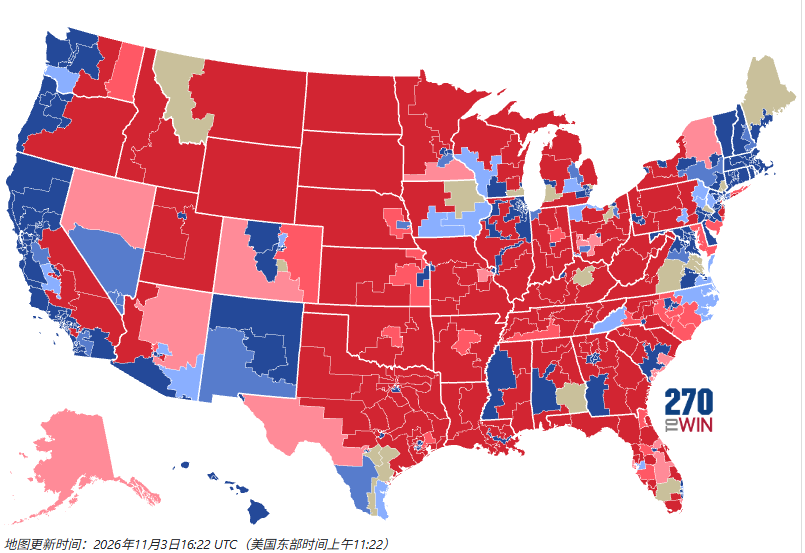
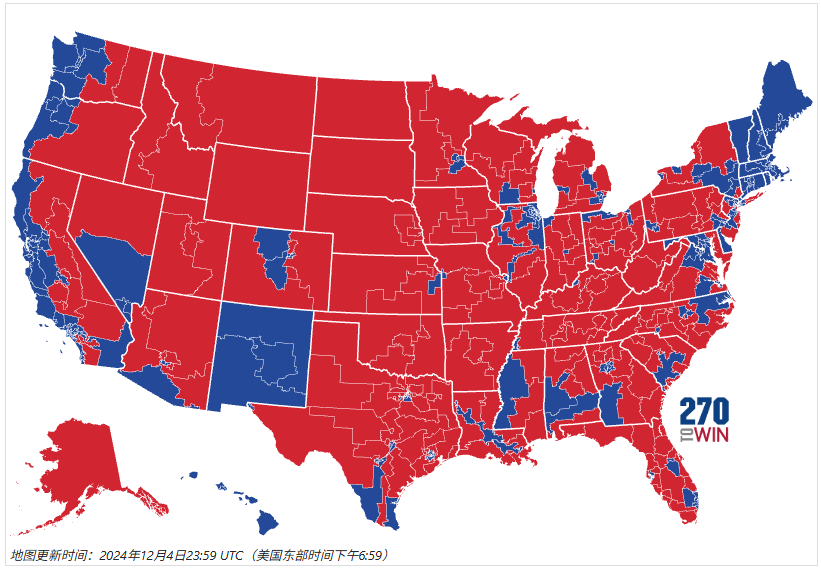
The above figure shows the election situation for the House of Representatives in 2026, while the lower figure shows the election situation for 2024. The House elections do not completely represent the Democratic Party’s influence, but it's a good indicator for simulation. We can see that the influence of the Democratic Party has expanded, mainly in traditional Republican states, represented by the Midwest.
This corresponds with the data we see. Within the Democratic Party, there are two major groups: one is called the New Democratic Coalition (NDC), and the other is the Congressional Progressive Caucus (CPC). The CPC, particularly, has more radical demands, with many of its members coming from New York and Chicago, traditional large cities. In the NDC, there are several members from the Midwest; within this group of over 140 people, 20 come from the Midwest, making it a significant part of the composition.
The current number of members in the NDC should be around 140, while the CPC has around 100 members, making these the two largest components of the Democratic Party. The most significant characteristic of the NDC is that because many members are not in big cities, they do not automatically have overwhelming competitors against Republicans in their districts, so many of their policies must consider conservative thoughts.
While it’s wildly unreasonable to represent an organization by one topic, if I had to say, I believe Abundance Economics Abundance Economics - perhaps it's the next narrative to focus on is a relatively representative narrative of this organization.
The CPC is the Democratic Party that many Chinese readers are familiar with; they are more radical on many social issues, which makes sense because many of their districts are deep blue, so if they are not radical, it is difficult to stand out in the party primaries.
On economic issues, the CPC is sometimes very radical, even extremely so, especially regarding expanding public healthcare, strengthening labor rights, and enforcing antitrust laws.
On economic issues, the CPC often criticizes the NDC's Abundance Economics, viewing it as a form of appeasement that trusts future wisdom and the power of time. It relies on growth to resolve conflicts. The NDC is also left speechless; in their districts, since they are not located in big cities, the wealth gap is not necessarily so wide, and the average income level is much lower than that of large cities. Therefore, using heavily radical discussions on the wealth gap cannot attract voters.
At this moment, the common ground that can unite the CPC and NDC is the high current price level and public spending level regardless of how the economy develops. While there are differences over how big the resistance should be, there are not many disagreements about lowering prices and reducing spending by the "Republican" government. On the issue of Iran, both sides broadly agree that ending the war is a core demand, but on foreign affairs, the CPC sometimes prefers to abandon American overseas influence and return to domestic concerns, while the NDC is often more moderate on this issue.
After the above introduction, let's assume you are the leader of the Democratic Party, either Jeffries or Schumer, and you are facing the situation: there is a comparatively centrist and moderate group expanding rapidly, which helped the Democratic Party win the midterm elections, while a traditional and more radical Democratic Party group has held its ground and is currently the second largest group in the party. The combination of these two has already contributed a significant number of votes, and the big victory has stripped more radical DSA members of their leverage and voice.
There are two imminent matters:
- What to do in 2027
- More importantly, how to plan for the 2028 elections
Due to time constraints, I will skip some processes; I believe the Democratic Party will tend to take a centrist route in 2027 and 2028 rather than a radical one because
1. The Republican Party has taken too radical a route, causing centrist voters to lean towards the Democratic Party.
2. A moderately left-leaning route should be the common ground of both factions. The executive power in the U.S. is significant, so Congress has limited capabilities. If Congress is too radical, it may provoke voter dissatisfaction. If Congress merely leans to the left and can claim that if prices drop it is a Democratic achievement, while failing to reduce prices can be blamed on the president, it can satisfy both sides. A highly radical route will lead Trump to veto it and consolidate the Republican Party while a moderately left proposal is more likely to gain the president's approval, even if Trump vetoes it, the political cost will be greater.
3. In this midterm election, many Democratic stars have received support by using more neutral language (Texas is purple), so why change a winning formula.
Specifically, I think the Democratic Congress will expect to collaborate with President Trump on healthcare, tariffs, and housing to accomplish some work, as this is also a part of reducing costs, and Trump also hopes that prices can drop. They will be more cautious on immigration and war issues because, first, these inherently fall under presidential authority, and Congress can do little about them; second, these issues can be too radical and may have counterproductive effects. Regarding appropriations, I believe the Democratic Party will seize the topic of the debt ceiling in 2027 to try and make some trade-offs, but I believe that ultimately the debt ceiling will still be resolved because, as mentioned above, I feel the Democratic Party is prepared to use a more centrist approach to approach the 2028 elections.
Moreover, outside of economic issues, corruption is also a significant concern for Americans, and the Democratic Party is highly likely to initiate inquiries against some individuals.
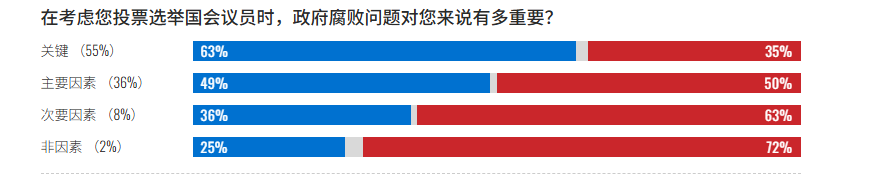

When compared with the immigration issue, you will find that corruption is rarely a key issue for Republican supporters as well.
To add a comment, the Democratic Party currently lacks a clear political star, so this relatively neutral-left approach rather than extreme left may be more beneficial for preparations for 2028.
The Democratic Party’s greatest advantage is that in 2028, Trump will most likely not run, so whether they perform well or poorly over these two years, the Democratic Party will have something to say. Schumer and Jeffries may need to persuade the CPC to be more patient and not rush to push too many changes in the 2026-2028 cycle. I believe they can accomplish this; between 2026 and 2028, many demands from the NDC will probably become practices of the Democratic Party.
In contrast, the Republican Party will emerge more united in thought after losing the midterm elections.
In these two years, White House Chief of Staff Susie will resign, and Miller will become the new Chief of Staff. In this election, although the Republicans lost the midterm elections, most of the previous members who were estranged from Trump have instead left, and Trump now has a more loyal internal environment.
However, the biggest divergence among them lies in foreign affairs. This is also the core purpose of JD Vance’s statement regarding whether to support Israel, which has large divides among Trump’s supporters. On economic issues, their core stance is tough on immigration, protective on tariffs, and on cultural issues, there isn't much disagreement.
The biggest discussion here is about whether Trump's priorities in the next two years will focus on leaving a cultural diplomatic political legacy similar to Clinton or post-2006 Bush or if he wants to find ways to help the Republican Party win in 2028. I think it's hard to draw a conclusion on this matter, but today's situation leans more towards the former.
I believe there isn’t much need to explain the demands of Trump and his supporters. Many policies from the past two years have validated this. The core point is, in their eyes, what is changeable and what is unchangeable?
Returning to the four main supporting groups of Trump in 2025:
- MAGA
- Tech Right
- Businessmen
- Establishment
As MAGA becomes the core group of the Republican Party, the remaining three groups need to rethink their policy positions.
With Musk representing the tech right advocating for deregulation, I estimate that this group will face many counterattacks from the Democratic Party in the future, and that this part sometimes overlaps with the demands of MAGA. Technology companies, in the eyes of MAGA, are not necessarily perfect; especially their viewpoints on immigration issues are very different from theirs.
The Republican establishment and businessmen advocate for free markets and tax cuts, oppose tariffs and increased debt. This part actually resonates with the demands of the Democratic Party’s NDC; the core question is whether Trump and MAGA will retaliate against this. Personally, I believe Trump will only impose limited constraints on this, for instance, he definitely does not want to eliminate all tariffs, but some exemptions are completely possible. He had done this at the peak of inflation, so it can now be readily accepted. Free markets are supported by the Republican establishment, business representatives, and Democrats' NDC. This group is now numerous, aligning with Trump's thoughts. Thus, we also see that after the Democrats took office, some regions have stated that while regulation on AI must occur, projects that have been approved can continue under "reasonable" conditions.
MAGA will remain steadfast on immigration issues, and for the sake of 2028, I doubt the Democratic Party will oppose this too vehemently.
In summary, I believe in the next two years:
- The key for the Democratic Party is to pursue a moderately left rather than an extreme left agenda.
- On healthcare, certain tariffs, cost of living, and real estate issues, as long as the approaches are not too radical, Trump may be willing to cooperate with the Democratic Party.
- On immigration and war issues, or if the Democratic Party proposes overly radical claims, Trump will be very willing to use his veto power.
- Regarding appropriations and the debt ceiling, it's basically certain that by 2027, or at the latest by 2028, there will be some wrangling, but I think both sides will still reach an agreement, and it won't necessarily take an exceptionally long time.
In 2028, the Democratic Party will likely run with a moderately left stance, while Trump in these two years will have to decide whether to focus more on his political legacy or on the Republican Party's next election, which may be a core issue.
免责声明:本文章仅代表作者个人观点,不代表本平台的立场和观点。本文章仅供信息分享,不构成对任何人的任何投资建议。用户与作者之间的任何争议,与本平台无关。如网页中刊载的文章或图片涉及侵权,请提供相关的权利证明和身份证明发送邮件到[email protected],本平台相关工作人员将会进行核查。