Will this "blue tsunami" really crush the AI boom?
Since the "blue tsunami" swept through the U.S. Congress, coinciding with the ongoing corrections in the AI sector that have persisted for several weeks, the market has been almost entirely flooded with related reports over the past day.
Now, tech giants may face a prolonged game of strategy. The political winds on Capitol Hill have fundamentally changed, and several state legislatures and local communities have also shifted, which could force hyperscalers to rethink their AI capital expenditure plans — originally expected to exceed $1 trillion by FY2027.
Meanwhile, the risk of a broader ban on data center construction can no longer be ignored, even in Texas. This blue wave not only swept through Texas but also produced unexpected results in several traditional Republican stronghold states. In this traditionally deep red state, about 30% of the new data center capacity expected to come online by 2028 in the U.S. is projected to come from Texas.
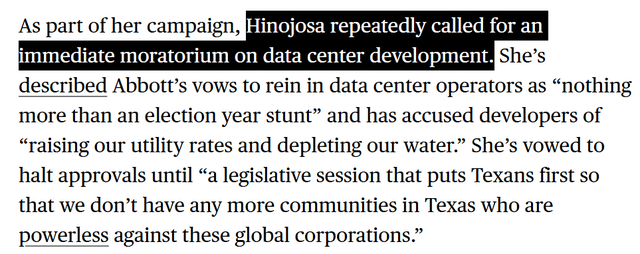
[Original image location: Texas's newly elected Democratic governor has taken a hard stance on a moratorium on data centers (Bloomberg)]
The incoming Texas Democratic governor, Gina Hinojosa, has made it very clear that once she officially takes office next year, a tough and "immediate" moratorium on data center construction will be a core part of her political agenda.
We will see at the beginning of 2027 how she will fulfill this promise made to Texas voters.
Against this backdrop, a harsh reality is that the American public seems not only to dislike having data centers built near their homes but has also expressed a very strong opposition attitude.
The data center moratorium policy in Texas appears quite severe.
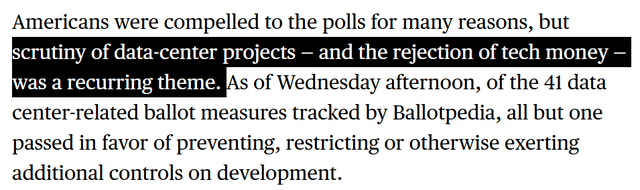
[Original image location: The American public is strongly dissatisfied with current data center construction (Bloomberg)]
The public's aversion to data centers has developed to a surprisingly high degree. According to a recent statistic from Ballotpedia, of 41 voting propositions related to data centers, only 1 ultimately favored not obstructing further data center construction or related development.
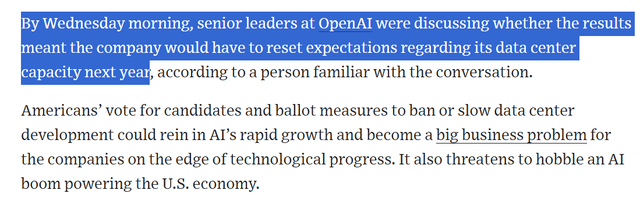
[Original image location: Tech giants are rethinking the pace of data center construction (The Wall Street Journal)]
Reportedly, this has caused some unrest within the tech industry as companies are reassessing how this shock might ultimately evolve after the Democrat-controlled Congress officially takes over in January 2027.
The market has actually begun to readjust positions, or you could say, the market has been preparing for this pullback in advance, as data center and AI-related stocks have continued to be sold off after the election.
However, this may also catch some AI bears by surprise, as the market ultimately rebounded successfully from the extreme volatility low point following the election. The Nasdaq (QQQ) (NDX) closed up over 0.9% on Wednesday.
However, I must point out that this volatility is likely to persist, as there remains much uncertainty about how this political upheaval will unfold in the coming months, and we may not get clearer answers until then.
The market's focus has now shifted to: is this change a boon or a bane for the largest tech companies that are currently making substantial CapEx investments or are expected to continue accumulating large-scale capital expenditures in the coming years?
Facing Reality: The Market Already Expected the Democrats to Control Congress
I think many people are not so surprised to see the blue wave finally lead to the Democrats controlling Congress.
Before the final election results were announced, the prediction market itself had been leaning towards this outcome.
However, even the most ardent AI bull investors might not have anticipated the scale of this "blue tsunami" would be so large.
As the market begins to factor in a more contentious and polarized legislative environment, and Congress may further tilt towards unfavorable conditions for the tech industry, 2027 increasingly looks like a decisive year for AI capital expenditures and the pace of data center construction — regardless of whether the outcome is ultimately good or bad.
A Democrat-controlled Congress could impose restrictions on the AI boom from almost every angle, including regulatory frameworks, data center construction moratorium policies, tighter requirements on grid infrastructure and electricity prices, and related tax and subsidy policies, among others.
Even if these policies ultimately require repeated negotiations between the White House and Congress, this will certainly result in a future business environment that is more uncertain than before.
Given that the AI boom has already permeated so many areas of the economy, this change could also have widespread impacts across the entire market.
Savvy investors surely remember that AI is actually a "five-layer cake." Which industries will benefit from it?
Energy pipeline companies.
Gas turbine manufacturers.
Utility companies.
Renewable energy firms.
Fuel cell manufacturers like Bloom Energy.
Energy storage companies.
And employment and enterprises related to the construction industry like Caterpillar and its peers.
Therefore, the beneficiaries are certainly not limited to chip designers like Nvidia (NVDA), AMD (AMD), or Broadcom (AVGO). In my view, if the U.S. genuinely wants to "stop AI," it must be very cautious, as the economic benefits brought by the AI boom are not solely concentrated in tech giants or data center companies.
Things are much more complicated than that. If we suddenly reverse this infrastructure expansion, which amounts to trillions of dollars and is unprecedented in U.S. history in terms of construction speed and growth momentum, then the chain reactions and consequences for the entire economy could be difficult to estimate.
AI Slowdown Does Not Mean AI Collapse

[Original image location: SpaceX could become the largest AI cloud service provider by the end of 2027 (SemiAnalysis)]
At least for now, this does not seem to pose a catastrophic shock to the existing backlog, as much of the investment commitments for 2027 are likely already largely settled. Elon Musk may still proceed along the original path, enabling SpaceX (SPCX) to become the world's largest AI cloud platform by the end of next year.
However, 2028 has now become a mystery. The ultimate outcome will depend on new legislation, data center construction moratorium policies, and other related resistance, and how these will develop after the Democrats officially take control of the U.S. Congress and/or seize various political positions in early 2027.
For the entire tech sector, especially hyperscalers, I still view constructive pullbacks as opportunities for further accumulation.
If these changes truly force tech companies to rethink AI spending, then from another perspective, it could even improve the free cash flow margins of hyperscalers in the coming years, allowing them to return to or accelerate their path toward a positive free cash flow inflection point while merely slowing the overall AI investment cycle.
So this is a very nuanced environment, and I actually see the slowdown in data center investment pace as a net positive rather than a net negative.
As the workflows of AI agents and enterprises' adoption of AI agents continue to expand over the next few years, the underlying demand for computing power will also continue to increase, helping to sustain the entire investment cycle.
Of course, this does not mean the market won't experience a longer-lasting pullback, as significant back-and-forth volatility around these concerns may still continue in the coming months.
Unless I see a truly negative structural trend reversing the AI boom — and that has not happened yet, nor do I see signs of it happening soon — I believe this phase may provide us with a very good buying opportunity, perhaps even one of the best opportunities before the next round of market improvement.
免责声明:本文章仅代表作者个人观点,不代表本平台的立场和观点。本文章仅供信息分享,不构成对任何人的任何投资建议。用户与作者之间的任何争议,与本平台无关。如网页中刊载的文章或图片涉及侵权,请提供相关的权利证明和身份证明发送邮件到[email protected],本平台相关工作人员将会进行核查。