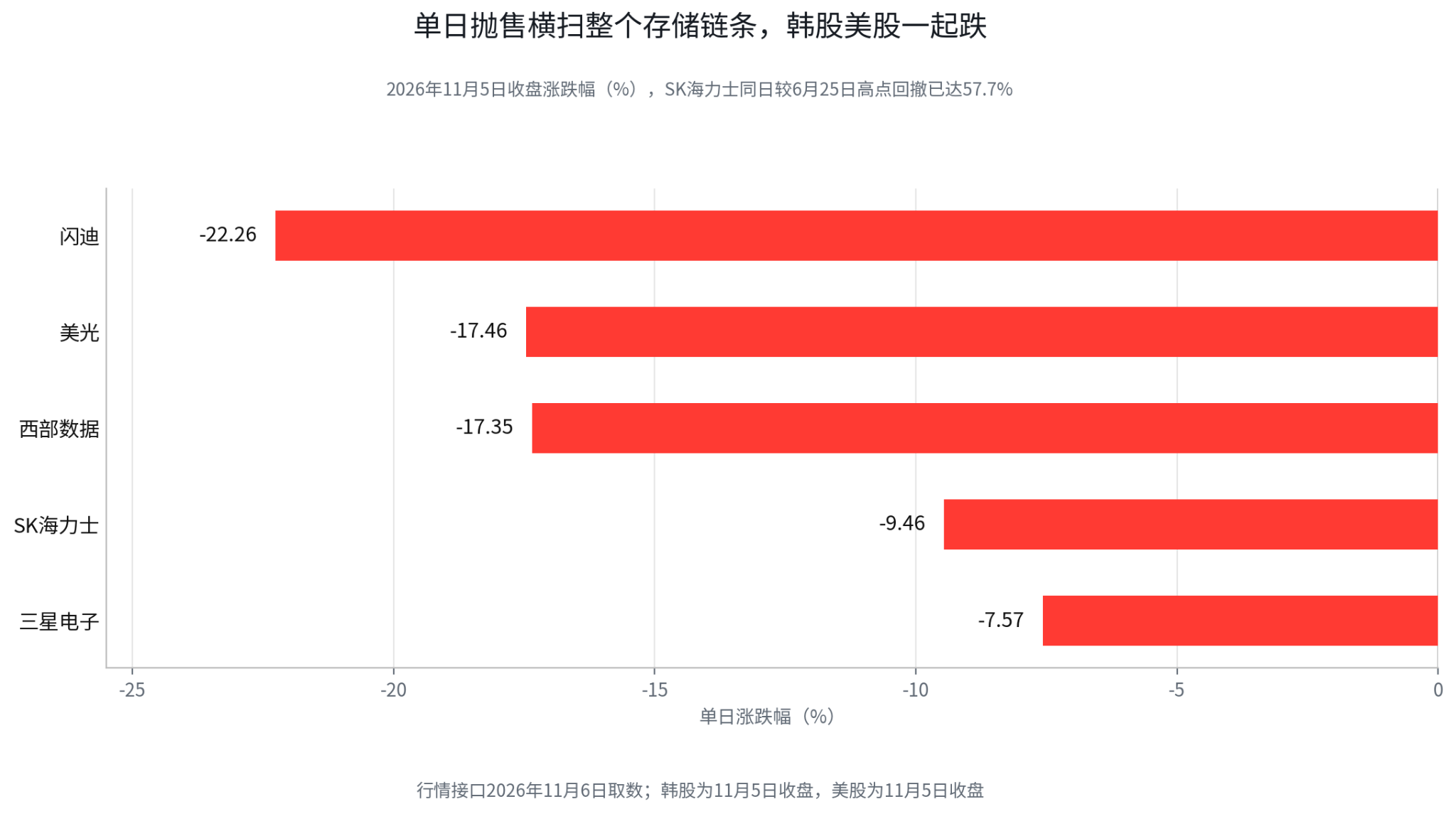
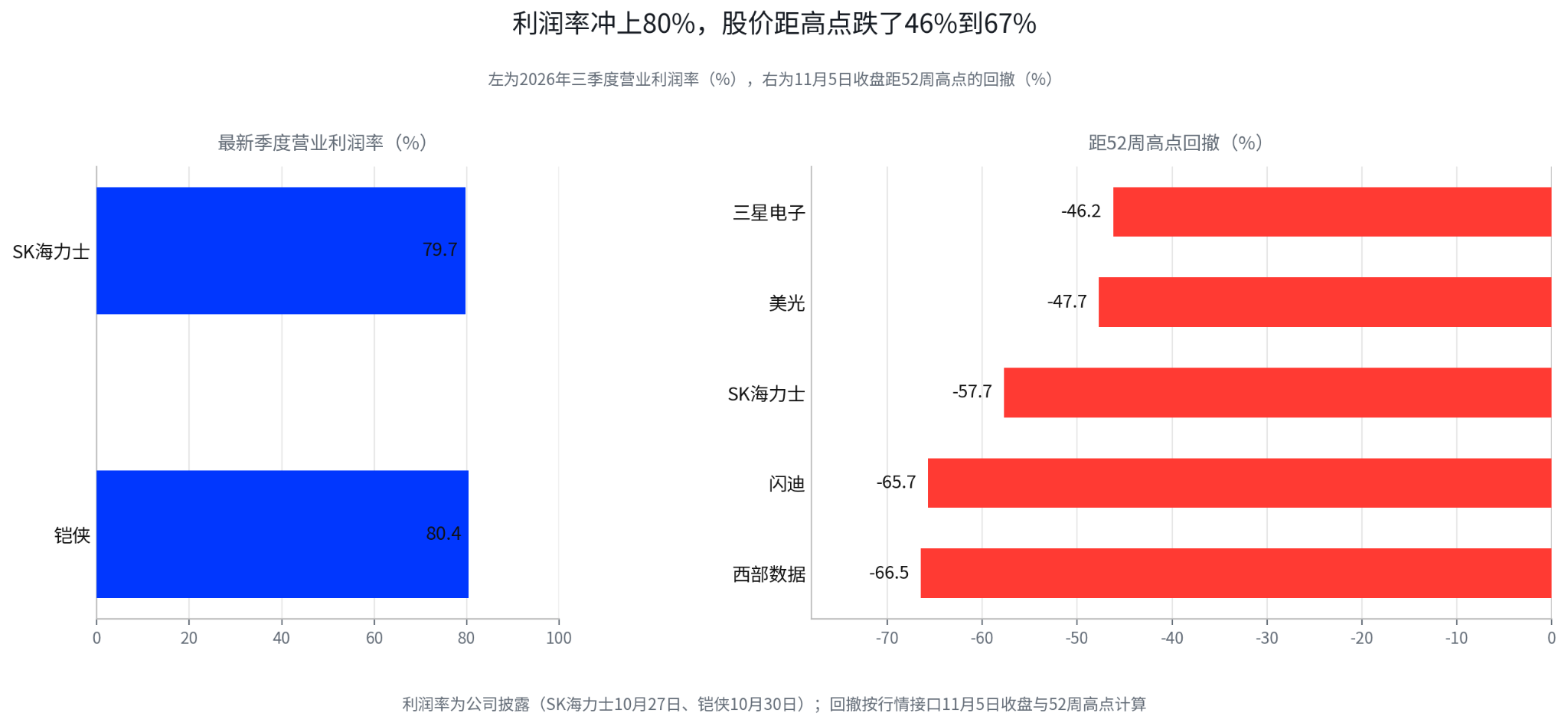
On November 5, the storage sector presented a striking contrast that was hard to ignore. SK Hynix reported an operating profit of 83.33 trillion won for the third quarter, with an operating profit margin close to 80%. Samsung Electronics' quarterly operating profit exceeded 107 trillion won, with its semiconductor business contributing the vast majority. Both companies' profits are at record highs, yet their stock prices are moving in the opposite direction to their financial performance; SK Hynix dropped 9.46% in a single day, while Samsung Electronics fell by 7.57%, and U.S. storage stocks also faced concentrated sell-offs.
SK Hynix closed at 1.264 million won, having retreated 57.7% from its peak of 2.987 million won on June 25. The market can see the profits, but what they are skeptical about is whether these profits are the starting point for a new round of long-term growth, or merely a bright moment left behind at the peak of the cycle.
The challenges facing storage stocks have shifted; the question of whether profits are high enough is merely the first half, while how quickly those profits can grow is the second half. The market is no longer concerned with profit levels, but rather with the profit growth rate as the main line of inquiry.
The core debate of this market cycle has shifted from whether demand will exist in the future to whether locked-in orders can maintain current prices, and how much additional unconfirmed demand can grow.
1. Prices are still rising, but the market is beginning to worry that they may not be able to rise much further
The profitability flexibility of the storage industry stems from price; while prices are still rising, the rate of increase has begun to slow down.
DRAM and NAND are typical cyclic products; once supply and demand are out of balance, price increases will quickly translate into profit statements. When the rate of price increases starts to narrow, even if quotes continue to rise, stock prices may preemptively reflect that profit growth has peaked.
TrendForce's data has already shown this change trajectory: the contract price for conventional DRAM rose by 90% to 98% quarter-on-quarter in the first quarter, dropped to 58% to 63% in the second quarter, and further narrowed to 13% to 18% in the third quarter (according to reports). From nearly doubling in a single quarter to growing by just a few percentage points, the speed of price increases has clearly slowed.
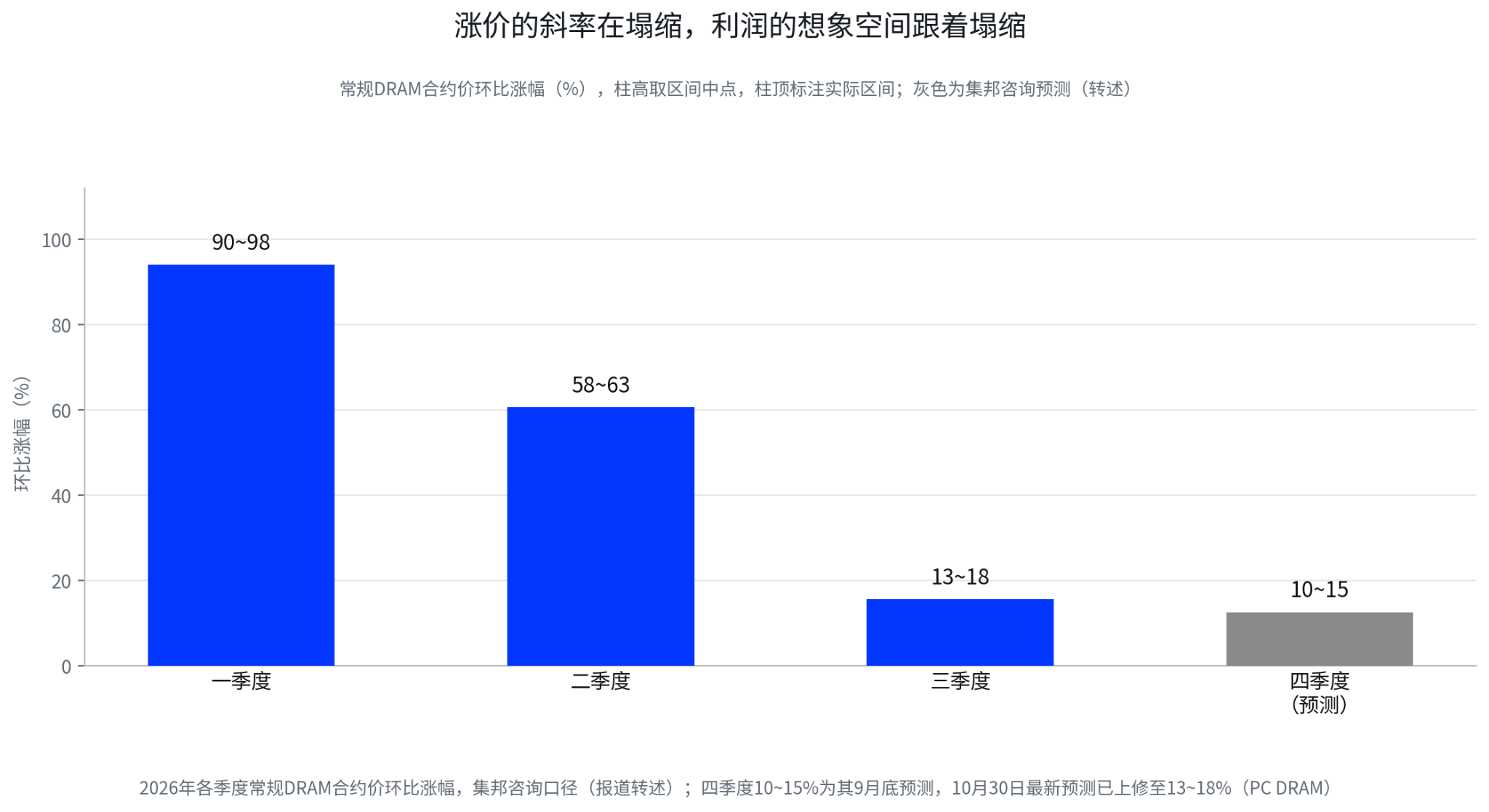
However, one cannot conclude that the cycle has turned just based on this set of numbers. On October 30, TrendForce raised its forecast for fourth-quarter PC DRAM price increases to 13% to 18%, up from a previous estimate of 10% to 15%, indicating that suppliers are continuing to tilt capacity toward server memory, which could further tighten the supply of ordinary PC DRAM. The industry judgment circulating in the market is that manufacturers like Samsung and SK Hynix may reduce PC DRAM supply by over 40% next year. The trend of price increases remains, but the support has shifted sources, relying on capacity allocation and structural shortages; the phase of synchronized expansion of terminal demand across all categories has passed.
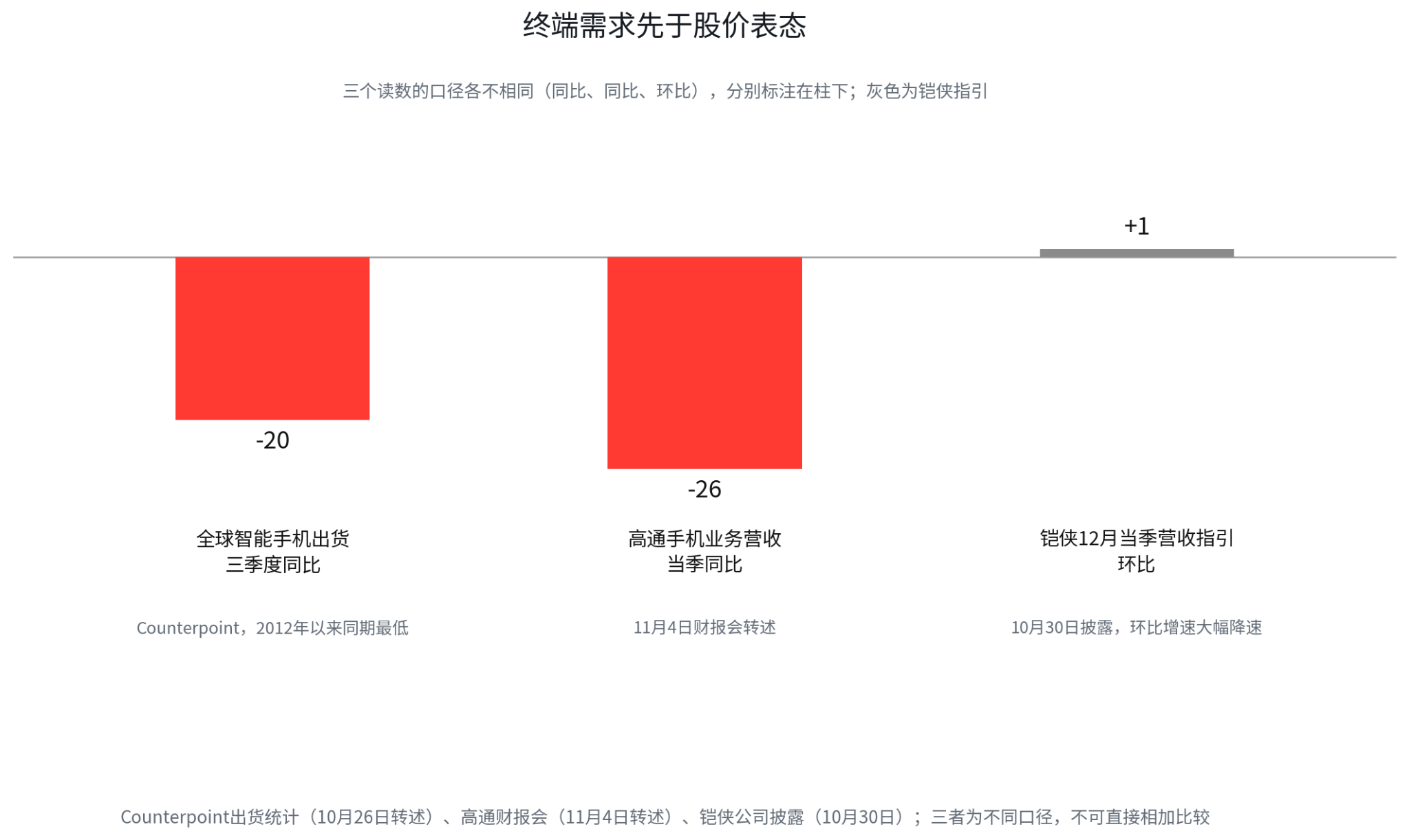
Kioxia's financial report revealed another side of demand for the market. The company reported revenues of approximately 2.48 trillion yen and operating profits of about 1.99 trillion yen for the July to September quarter, with an operating profit margin exceeding 80%, showcasing very strong profit performance (the company disclosed this on October 30). However, the revenue guidance for the December quarter was only about 1% growth quarter-on-quarter, with management mentioning weak demand from mobile and PC sectors and limited capacity of terminal customers to bear higher memory costs. On the day of release, Kioxia's stock price closed down.
This is where the market's real tension lies: upstream manufacturers can continue to drive price increases through production cuts and adjustments to product structures, but downstream customers may not be able to absorb the costs indefinitely. The higher the storage prices, the greater the cost pressure on terminal manufacturers of phones and PCs; if the heightened costs are ultimately passed on to consumers, demand could be further suppressed, but if manufacturers choose to absorb the costs themselves, profit margins will be compressed.
The storage industry has entered a more complex phase: supply for the server side remains tight, while the consumption side is starting to feel the burden of high prices. Suppliers' profits continue to expand, but the response of terminal demand to prices is becoming more important than ever.
2. The midterm elections added a new variable to AI server demand
The pressure in consumer electronics has already reflected in data and company statements; even the AI server, the most solid leg of support, has been affected by policy variables.
Counterpoint data shows that global smartphone shipments fell 20% year-on-year in the third quarter, marking the lowest level for the same period since 2012 (according to a report on October 26). Qualcomm noted at its November 4 earnings call that memory pricing is compressing the smartphone industry's scale, with the company's mobile business revenue declining by 26% year-on-year in the quarter (as referred during the earnings call).
Apple's statements are more representative. Shortly after taking over as CEO, John Ternus stated at the earnings call on November 2, "What we're seeing with memory pricing right now is unprecedented." The company provided a gross margin guidance for the December quarter of 45% to 46%, noting that rising memory costs are a significant reason for the pressure on gross margin (the original transcript from the earnings call). If Apple needs to raise product prices to cope with rising costs, the pressure on small and medium-sized phone and PC manufacturers will only increase.
The elasticity of demand on the consumer side is decreasing, making the storage industry's growth focus increasingly dependent on AI servers. Initially, this was the strongest support in this super cycle, but after the midterm elections in November, this demand line has encountered new policy variables.
The Democratic Party's victory in both the House and the Senate means that the legislative agenda for the last two years of the Trump administration will face stronger constraints, and congressional investigations and oversight may increase. More importantly for the storage industry is the local political backlash surrounding data center construction during the election. As of November 4, Ballotpedia statistics show that among 47 local votes related to data centers that have been determined, 46 had results leaning toward restricting data center construction, with varying methods of restriction, including bans on new constructions, imposed construction moratoriums, additional public voting processes, and stricter conditions for enjoying tax benefits. Other organizations have also reported that among 44 related votes on the same day, 38 passed restrictions, although the scope and timing of these statistics vary.
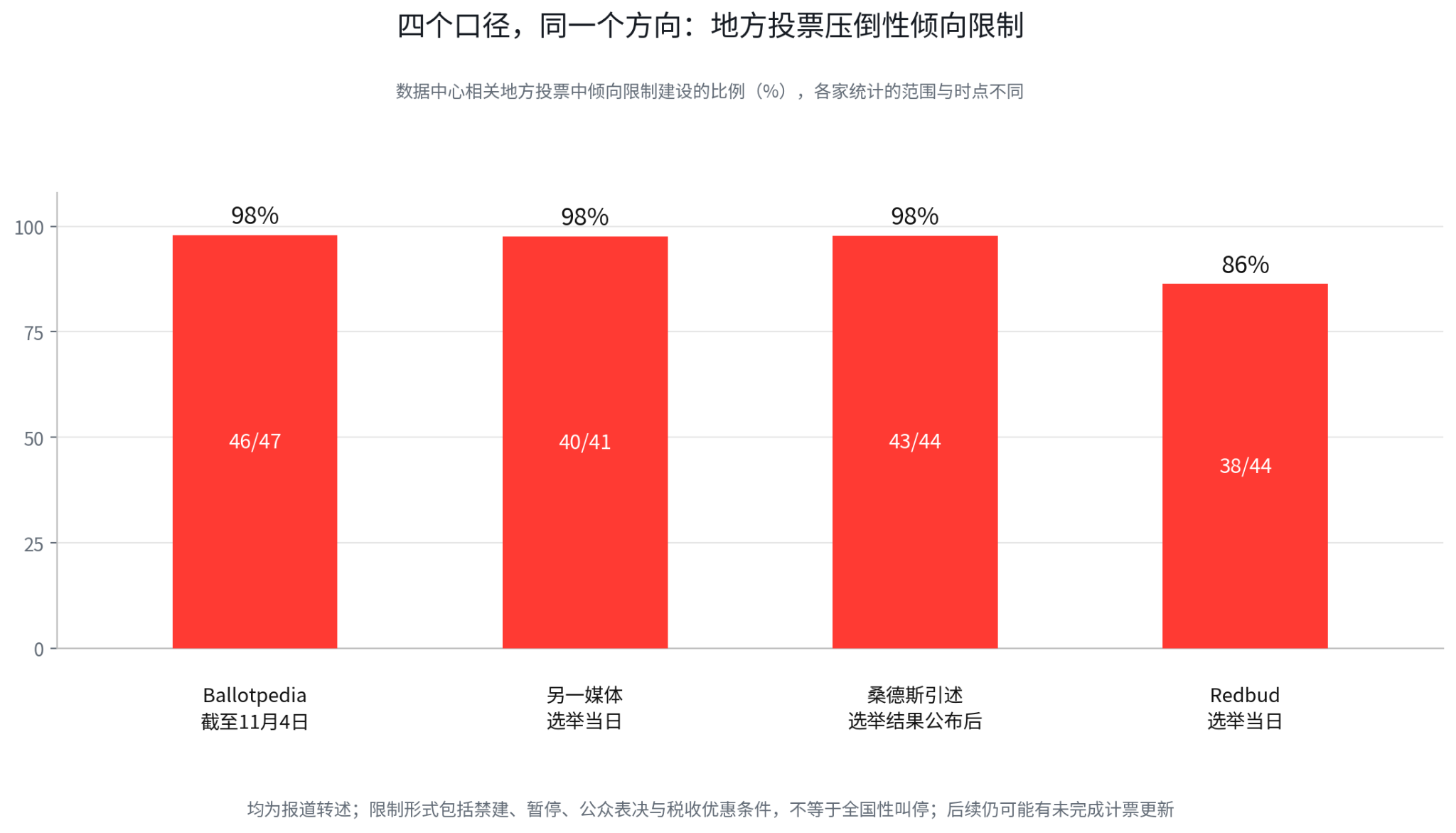
Sanders also called for a national pause on data center construction after the election results were announced, citing that 43 out of 44 communities support local restrictions. However, this is still a political initiative and has not entered the congressional deliberation process. The Democratic Party controlling Congress does not equate to an immediate halt of data center projects across the country, as Trump still possesses veto power and local planning and project approvals are decentralized among states, cities, and relevant regulatory agencies.
For the storage industry, the real concern has shifted to whether the costs and timelines for newly initiated projects have changed beyond already signed orders. If local governments raise approval thresholds, requiring developers to bear more power, water, and community support costs or tighten tax benefits, the financing and construction periods for projects may be extended. If data center projects are delayed, the procurement of servers, deployment of network equipment, and associated DRAM and SSD orders could subsequently be postponed.
This has a clear time lag effect on the storage market. Long-term supply agreements that have already been signed will not automatically disappear due to an election outcome; however, new data center projects expected in 2027 and beyond may need to reassess investment returns and construction timelines. Orders secured at the moment will not suddenly drop to zero because of an election; the concern for the market is that incremental demand in upcoming quarters may not be as certain as previously anticipated.
This also explains why long-term demand remains strong even as stock prices start to decline. Goldman Sachs' industry meeting notes remain optimistic about HBM demand, considering that the supply gap may extend until 2028 (as referenced on October 28). The capital market starts to break down AI infrastructure investments into two issues: whether the already confirmed orders can be fulfilled and whether the next round of new capital expenditure can be realized as planned. The former sustains current profits while the latter determines whether valuations can continue to expand.
3. A 3.5 times PE looks cheap but could actually be the most expensive time for cyclical stocks
The valuation method itself is not wrong; the error lies in using the profits at the cycle peak as the denominator.
J.P. Morgan's report on November 4 brought the valuation contradiction of storage stocks to light. According to the report, major storage stocks have retraced around 45% from the peak in 2026, while the Philadelphia Semiconductor Index has retraced about 29%. The expected price-to-earnings ratio for 2027 is approximately 3.5 times, whereas another media's reference states around 3.6 times, with both figures being discussed. Meanwhile, market expectations for EPS compounded growth from 2026 to 2028 remain as high as 98% (according to reports).
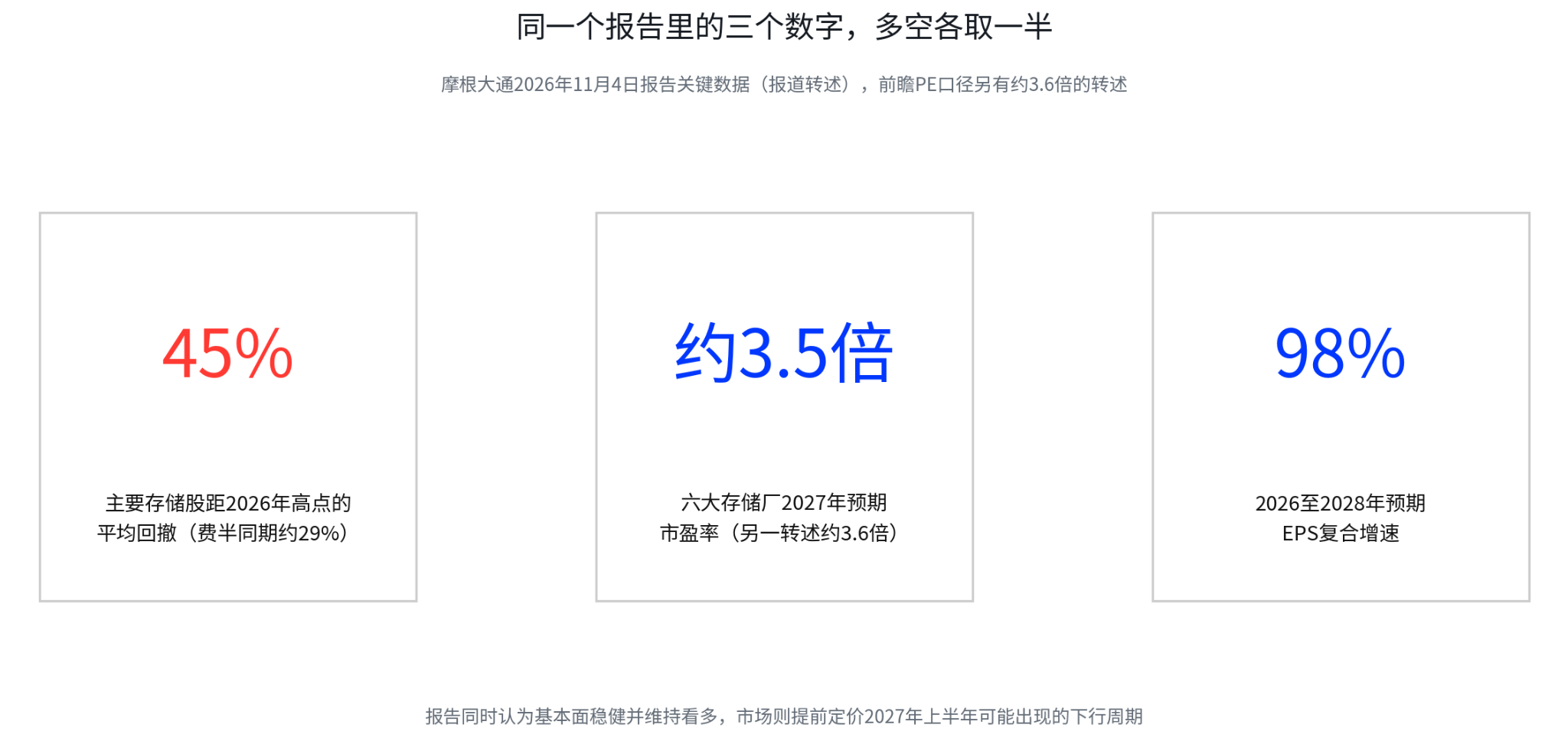
A price-to-earnings ratio of 3.5 times, along with nearly doubling profit growth, might seem extremely cheap at first glance. The denominator of the price-to-earnings ratio is profit; when storage prices are rising rapidly and capacity utilization is high while product structure continues to shift towards HBM and server memory, a company's profits will swiftly increase. At this point, even if stock prices have risen significantly, as long as profit growth is faster, the price-to-earnings ratio may remain very low. This reflects another aspect: the market is willing to believe that current profits can be sustained for many years in order to be considered cheap.
If storage prices plateau or if consumer demand contracts further due to rising costs, profit growth rates may change before revenue does. If profits decline from the cycle's peak, a price-to-earnings ratio that initially seemed merely 3.5 times would quickly become no longer cheap as the denominator shrinks. The market’s real assessment is whether these companies can maintain levels of profitability close to today’s in two years; this year's performance is merely a ticket for entry.
This is also why stock prices may decline before record earnings are reported. Stock prices discount the future, while already announced quarterly results merely reflect the past. The compression of valuations for storage stocks essentially reflects capital's discount of profit sustainability.
However, bears should not overlook supply-side constraints. SK Hynix officially disclosed that over 50% of its capacity from 2027 to 2028 has already been booked through long-term supply agreements, and the company anticipates that the memory shortage will last until 2030 (the company disclosed on October 27). The company emphasized that these agreements will reflect market conditions and help stabilize future profits. Samsung is also continuously expanding its supply of HBM4, server DRAM, and enterprise SSDs. AI server demand remains strong, and the expansion of advanced processing, packaging, and testing capabilities requires time, making it impossible for supply to keep pace in the short term.
Both sides of the market agree on the existence of AI demand, but the contention lies in how long high profits can be sustained. Bulls bet that the structural shortage of HBM and server memory will extend to 2028, believing that long-term agreements and capacity constraints can protect profits. Bears worry that the phase of rapid price increases may have already passed, with pressures from terminal costs, data center project approvals, and electricity constraints gradually transmitting over the next few quarters. Micron's forward price-to-earnings ratio is also less than 5 times, with CEO Mehrotra stating that supply will only slowly improve until 2028 (as referenced on November 3).
The current market's 3.5 times price-to-earnings ratio reflects another point: capital is unwilling to use today's level of profits to pay for the high valuations expected in the coming years.
4. Capacity has been booked for years, but what’s not locked in is profit margin
Capacity locking solves the issue of who to sell to, while long-term agreements resolve how much to sell; the actual valuation is still determined by selling prices and profit margins.
If customer demand for capacity over the next few years has already been locked in, what is the market really worried about? Here, three concepts must be differentiated:
SK Hynix officially disclosed that over half of its capacity from 2027 to 2028 has signed long-term agreements, which is a strong fundamental signal. Some media have summarized management's statements as a practical sell-out of supply for the next three years, which belongs to a paraphrase; however, the hard numbers in the announcement indicate that more than half of the capacity has been signed under long-term agreements. The specific restrictions of long-term agreements depend on contract terms, including minimum purchase amounts, price adjustment methods, whether customers can postpone or cancel, existence of prepayments, and the high cost of breach. Secured shipment volumes do not necessarily mean that every chip can maintain the current selling prices and profit margins.
This is also a point where the policy risks of the midterm election need to be reconsidered. When local governments in the U.S. increase data center approval thresholds and add power and water配套、短期内不会自动取消云厂商已经签订的存储长协。真正受到影响的,是尚未落地的数据中心项目,以及下一轮新增服务器采购。如果项目延期,云厂商可能先调整新增资本开支,再影响未来长协的续签和扩张。政策冲击更可能作用于增量需求,直接摧毁已经锁定订单的场景反而少见。
The supply side also has a time lag. SK Hynix, Samsung, and Micron are still expanding their HBM and server storage supplies, but the release of capacity for advanced products takes time. Meanwhile, the ordinary DRAM and NAND markets may also be influenced by domestic manufacturers' capacity expansions. Changxin Memory's fifth-generation DRAM process has already gone into mass production, with capacity expected to potentially double by 2028 (TechInsights reports, referenced on October 5 and 19), while Yangtze Memory continues to promote NAND product upgrades. Different products do not operate on fully synchronized supply and demand cycles, and one cannot infer that because HBM is still tight, the entire storage industry can continue to maintain current profit levels.
5. The next indicators to determine whether the storage cycle has truly peaked are three signals that are more important:
First, watch whether contract prices transition from narrowing increases to actual declines. The upward revision of fourth-quarter PC DRAM price forecasts indicates that supply tightness still exists. However, it is essential to distinguish between server DRAM, PC DRAM, HBM, and NAND, and not equate the pricing of one category directly with the entire storage market. What truly needs vigilance is a shift from slowing price increases to declines, along with increasing channel inventory and weakened customer purchasing willingness.
Second, observe whether capital expenditures for AI data centers are influenced by policy and electricity constraints. After the midterm elections, the local restrictions on data center projects have shifted from campaign slogans to actual cases of bans, pauses, public votes, and tax benefits conditions. The next step is to watch if large cloud providers adjust their capital expenditure guidance, whether project approvals and electricity access timelines are extended, and if construction plans for new data centers are delayed. Only when these changes transmit to server procurement will they genuinely affect storage manufacturers' orders.
Third, look at whether the coverage of long-term agreements and actual profit margins can be maintained simultaneously. Long-term agreements can enhance capacity utilization and shipment certainty; if the price adjustment range of contracts declines or if the supply of high-profit products gradually increases, profit margins may still fall. SK Hynix and Samsung's upcoming financial reports need to simultaneously observe the product structure, average selling price, gross margin, and capital expenditures of HBM, server DRAM, and enterprise SSDs; merely looking at whether revenue and operating profits are reaching new highs is not sufficient.
The storage industry is still situated within the structural opportunities brought about by the expansion of AI infrastructure; demand for HBM and server memory has not disappeared due to an election cycle. The market is no longer willing to factor all growth expectations into stock prices in advance; questions about whether the consumer side can bear high prices, whether data center projects can be completed on schedule, and whether suppliers can maintain current profit margins are becoming more important than the next record-breaking financial report.
An 80% operating profit margin is a result that this super cycle has already delivered. A projected price-to-earnings ratio of 3.5 times reflects the market's doubts about the sustainability of future profits. The wall that storage stocks have collided with is built of pricing; its height is not determined by the absolute level of profits but by how much the market is willing to pay for unfulfilled future years.
Disclaimer:
This content is for general informational and market commentary purposes only, based on publicly available information as of the time mentioned, relevant market data, expectations, and probabilities may change with market conditions. The views and investment strategies of third-party institutions, analysts, or individuals cited herein represent their opinions at a specific time and do not represent BIT’s views or recommendations. This document does not constitute investment advice, investment research, an invitation, solicitation, or recommendation for any securities, investment products, or trading strategies, nor should it be the basis for any investment decision. Financial markets present risks, and securities prices and market performance may fluctuate; past performance and historical market trends do not represent or guarantee future results. Investors should assess the relevant risks independently based on their circumstances and seek professional advice as needed. BIT's Hong Kong stock trading services are not available to residents of Hong Kong or users in other restricted jurisdictions.
免责声明:本文章仅代表作者个人观点,不代表本平台的立场和观点。本文章仅供信息分享,不构成对任何人的任何投资建议。用户与作者之间的任何争议,与本平台无关。如网页中刊载的文章或图片涉及侵权,请提供相关的权利证明和身份证明发送邮件到[email protected],本平台相关工作人员将会进行核查。


