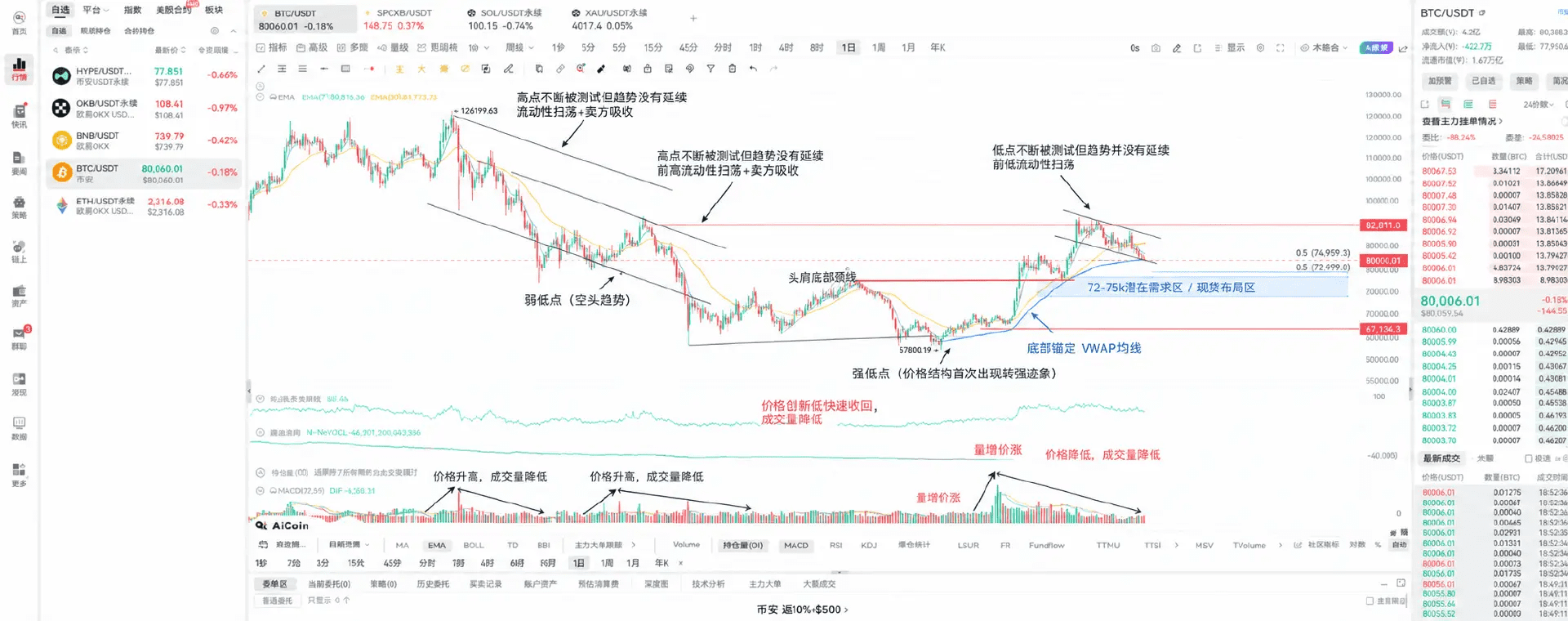
When the market experiences a rapid decline, traders are most easily swayed by two emotions: one is the fear of missing out on the trend, leading them to chase short positions after the sharp drop; the other is seeing a short-term rebound and mistaking it for a trend reversal. Both impulses can worsen the entry position. The truly valuable shorting opportunity is not when “the price has already dropped a lot,” but rather when the downward structure is still in place, the rebound is weak, and the risk boundary is clear, allowing the market to present conditions for entry that align with the plan.
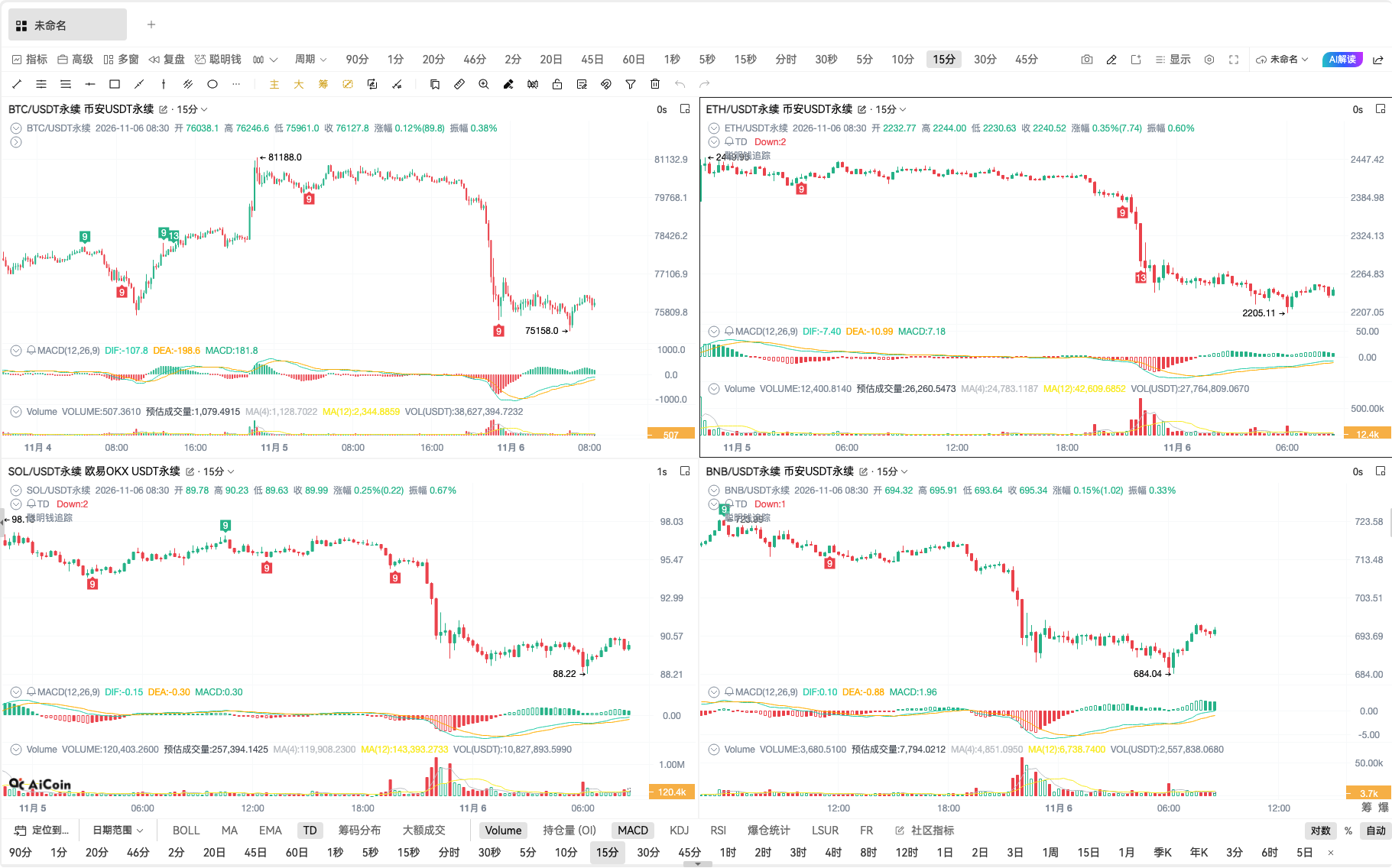
BTC/USDT dropped approximately 5.75%, ETH/USDT dropped approximately 5.69%, SOL/USDT dropped approximately 5.16%, and BNB/USDT dropped approximately 5.21%. AiCoin's multiple chart displays show BTC, ETH, SOL, and BNB synchronously declining over a 15-minute period: multiple trading pairs experienced a rapid drop, followed by consolidation or attempts to rebound near the lows. The most important information here is not how much a single coin has dropped, but that multiple mainstream trading pairs are under pressure together in a short period, indicating a clear weakening of risk appetite during the time of the screenshot. The data above are point readings from user-provided screenshots and do not represent real-time market conditions.
What does synchronized decline indicate: spreading selling pressure, but it doesn't mean you can directly chase shorts
When BTC, ETH, SOL, and BNB decline in sync, the explanatory power of random fluctuations in individual coins weakens, increasing the likelihood of overall market selling pressure spreading. In the chart, BTC quickly fell from a local high, with ETH, SOL, and BNB also showing step-wise declines or long bearish candles; subsequently, multiple charts consolidated in a low-range area. This resonant decline provides a background for short-term bears but does not automatically constitute a signal to enter.
The reason is that a rapid drop itself quickly consumes the selling momentum and may also trigger short covering and bottom-fishing buying. If traders directly chase shorts after consecutive long bearish candles, they may end up selling at the most extreme short-term sentiment position; even if the medium-term remains weak, the price may first rebound, resulting in unfavorable entries and unrealized losses. Multiple assets dropping at the same time also implies increased correlation risk: shorting BTC, ETH, SOL, and BNB simultaneously does not necessarily mean four independent trades, but rather the risk of the same market direction is compounded.
Therefore, the correct question is not “after dropping 5%, should I still short?” but rather “is the downward structure still valid, is the rebound encountering resistance, and if I judge incorrectly, where to exit?”
Prioritize observing three types of shorting conditions
First, does the rebound form a lower high? If the price rises after a sharp drop but the rebound high is lower than the previous high, and then weakens again, it indicates that buyers have temporarily failed to reclaim the downward structure. Compared to chasing shorts at the end of a long bearish candle, waiting for a failed rebound or key support to be tested is usually easier to clarify the risk boundary. After a sharp drop, if each trading pair experiences low-range consolidation or slight pullbacks, we should observe whether these rebounds can sustain, rather than assuming a continued decline solely based on low-range consolidation.
Second, can a break of key support be confirmed? A sudden breach might be due to liquidity sweeps or quick fluctuations; if the price stays below a key area and the retest cannot reclaim, the break signal will be more valuable for reference.
Third, does the volume and momentum support continued downward movement? If trading activity is high during the drop, but participation decreases during the rebound, and the short-term momentum turns back to bearish, there will be more complete evidence of continuation of weakness; if the price continuously makes new lows but selling volume contracts, or quickly regains the break position, we should be cautious of a weakening downward momentum. MACD and transaction volume can help observe momentum changes, but both should serve as auxiliary evidence to price structure, rather than independent entry buttons.
Bearish counterattack or downward continuation: articulate judgments into two scenarios
Bearish scenario: multiple trading pairs show limited rebound, and the rebound high gradually moves lower; the price re-breaks below the consolidation low, and there is volume accompanying the downward move. At this point, it can be viewed as a candidate scenario for continued weakness, and then assess whether to participate according to individual plans, rather than defaulting to shorting simply because “the market has fallen.”
Rebound scenario: the price recovers key areas following the sharp drop, and lower lows appear consecutively, with BTC and other mainstream coins stabilizing first, followed by a convergence of downward movement of ETH, SOL, and BNB. If these changes occur, the original bearish logic needs to be downgraded or invalidated, and traders should avoid adding more to prove their judgment is correct.
Clearly writing the scenarios and invalidation conditions can reduce the risk of being stimulated by large bearish candles and continuously chasing orders during trading. Shorting plans should at least clarify in advance: what the triggering conditions are, what each maximum allowable loss amount is, what kind of price behavior signals judgment invalidation, and what the total risk exposure limit for multiple accounts is. Leveraged contracts can amplify gains and losses, while rapid fluctuations may also lead to slippage, forced liquidation, and orders not executing as expected.
The value of placing orders with multiple accounts: less switching and repeating, executing proportionally when opportunities arise
When traders have confirmed a short strategy and need to execute it across multiple accounts, the speed and consistency of operations become practical issues. Logging in or switching accounts individually, selecting trading pairs separately, and repeating inputs for direction and quantity not only consume time but also easily result in selecting the wrong account, inconsistent amounts, or missing orders. During rapid market fluctuations, the more operational steps there are, the harder it is to complete executions as per the same plan.

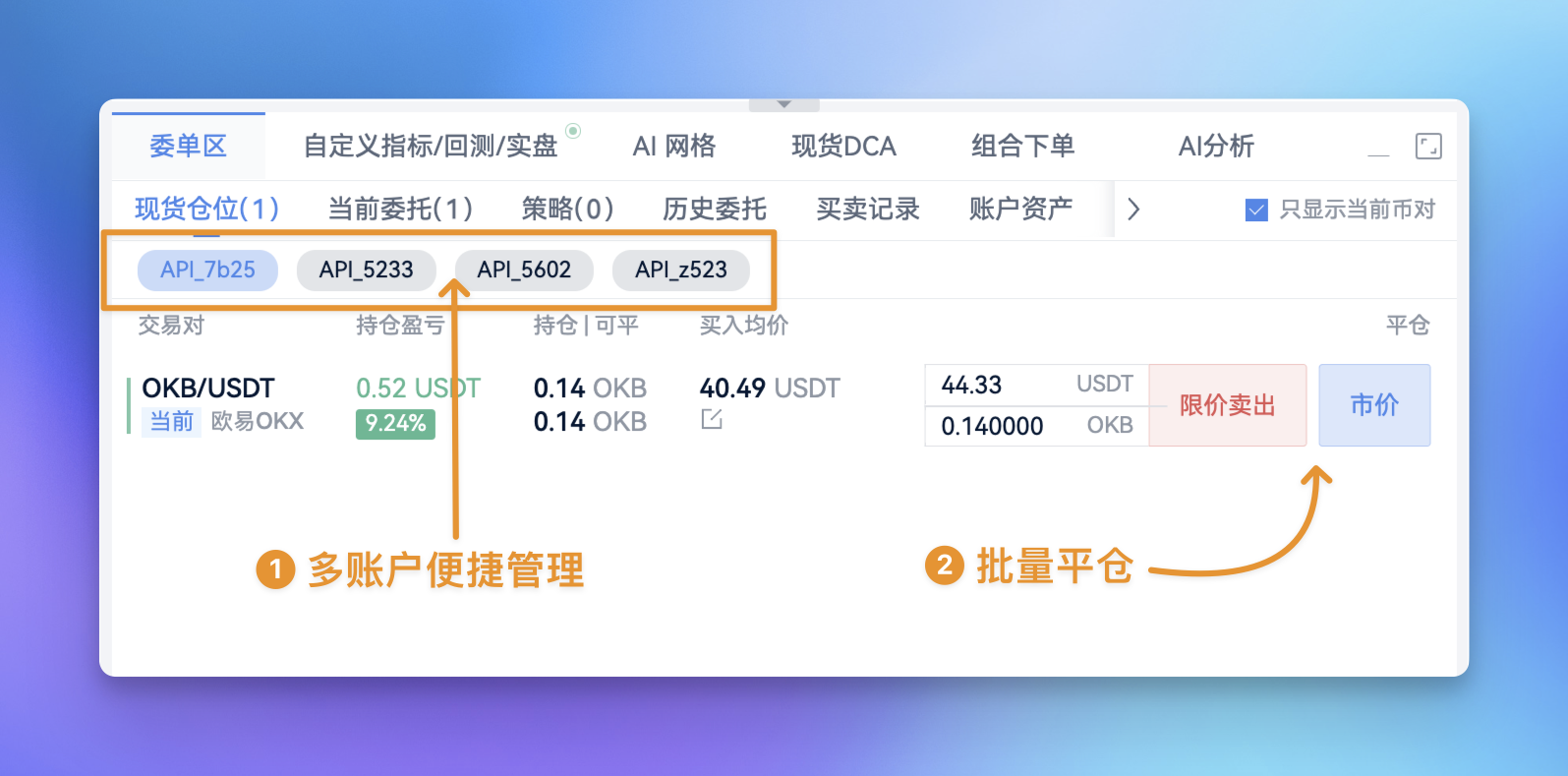
The role of AiCoin’s multi-account order placing is to consolidate multiple API accounts into a unified ordering process, reducing repeated switching and inputting, allowing traders to execute according to pre-set proportions. It is suitable for personal traders, teams, or scenarios involving following trades that need to manage multiple accounts simultaneously. The product documentation introduces synchronized ordering across multiple accounts, following trades, and split accounts, as well as daily operations like batch order cancellation.
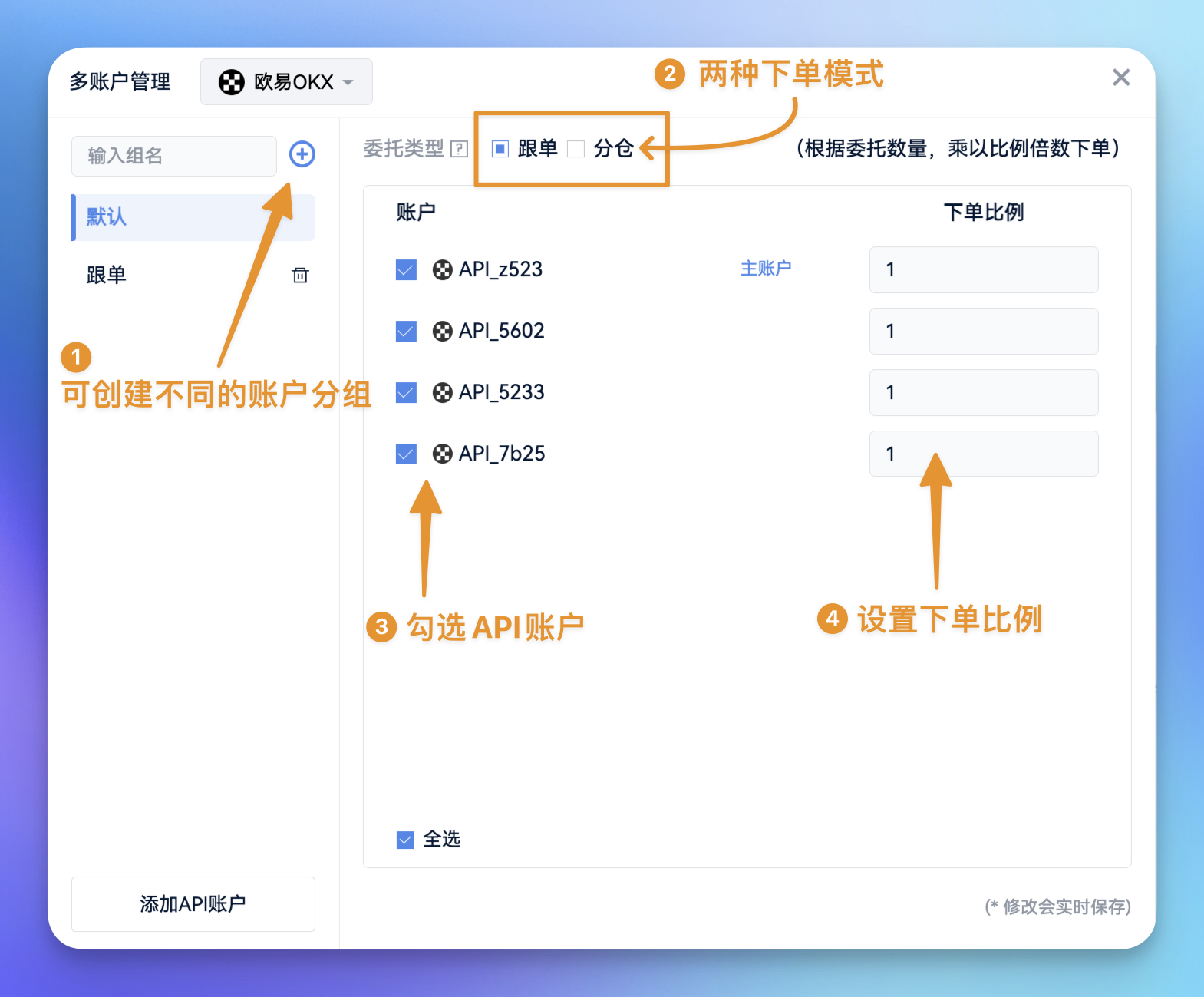
The following trade mode is suitable for first setting a base order quantity and then allowing other accounts to follow based on their respective proportions or multiples. If several accounts execute the same shorting plan, but the scale of each account's plan differs, ratios can be set in advance to reduce on-the-spot calculations.
The split account mode is suitable for first determining the total delegated order volume across multiple accounts and then splitting it proportionally among the accounts. If a team wants to first limit the total scale and then clarify the share each account will bear, the split account mode is more intuitive. In simple terms, following trades means accounts follow a base quantity executed in proportion; splitting accounts means distributing a predetermined total quantity proportionally.
Operational process: converting short plans into multi-account orders
1. First, determine the trading logic and risk boundaries. Clarify triggering conditions, invalidation conditions, single trade risks, and total risks across multiple accounts based on your analysis and do not chase trades due to a sudden drop on the charts.
2. On the AiCoin order panel, activate multi-account ordering, select the API accounts involved this time, and check the exchange affiliation and authorization status of each account.
3. Choose between following trades or split accounts according to the plan. Following trades are used for quantities entered in proportion to accounts; split accounts are used to allocate pre-determined total order volumes proportionally. The order ratio should be set based on account balance, existing positions, and risk limits; do not assume all account conditions are the same.
4. Check each account's trading pairs, short direction, order types, and quantities, then submit the synchronized orders. You can first confirm a small range of accounts or simulate the process to avoid the impact of operational setting errors affecting multiple accounts simultaneously.
5. After placing orders, check the order status, actual成交, average成交价格, and position changes one by one. If the market reverses or conditions invalidate, handle stop-losses, cancel orders, or reduce positions according to the preset plan; synchronous execution does not mean all accounts will obtain completely identical成交 results.
Multi-account ordering is best suited to solve the problem of “the plan is clear, but account execution is cumbersome.” It can help traders complete multi-account collaboration faster, but it will not replace users' judgment on shorting timing, nor will it reduce market risks. Establishing positions in the same direction across multiple accounts can make the total exposure more concentrated; thus before using following trades or split accounts, first review the total risk, rather than just looking at individual account order amounts.
Conclusion: Do not chase drops, wait for signals; have plans, then execute synchronously
The current market environment shows several trading pairs, including BTC, ETH, SOL, and BNB, fluctuating low after a synchronous drop. Such markets may present short-term shorting opportunities, but meaningful entries usually require structural confirmation: weak rebounds, failure to reclaim key levels after breakdowns, and volume and momentum continuing to support downward movements. If the price quickly regains key areas, the bearish judgment should be reevaluated.
Once the trading plan is formed, AiCoin's multi-account ordering can help traders execute established plans more quickly and uniformly through following trades or split accounts, reducing the need for individual account switching and repeated inputs. Analyze first, then set risk boundaries, and finally execute with tools — this is more important than treating multiple accounts as a “short-accelerator.”
AiCoin exclusive user's “Multi-Account Ordering” super tool
One-click synchronization of multiple accounts for ordering, achieve second-level multi-operation with AiCoin; also supports cross-exchange multi-account ordering:
https://www.aicoin.com/zh-Hans/tg/multi-account

免责声明:本文章仅代表作者个人观点,不代表本平台的立场和观点。本文章仅供信息分享,不构成对任何人的任何投资建议。用户与作者之间的任何争议,与本平台无关。如网页中刊载的文章或图片涉及侵权,请提供相关的权利证明和身份证明发送邮件到[email protected],本平台相关工作人员将会进行核查。