Original author: Zhao Ying
Original source: Wall Street Journal
Economic prosperity breeds the seeds of the next crisis, and this is the most profound warning left by economist Hyman Minsky. Today, the AI boom drives the US stock market to new heights, borrowing costs remain relaxed, and beneath the surface calm, key indicators measuring financial fragility are quietly shifting. Deutsche Bank believes that the United States has not yet reached the "red alert zone" on the eve of a historical crisis, but if the current trend continues, this distance may significantly shrink around 2028.
According to Wind Trading Desk, Deutsche Bank pointed out in its latest report, through the latest financial crisis forecasting framework, that the "dual high" combination of rapidly rising asset prices and strong credit expansion has historically been the most dangerous precursor to crises. According to this framework, once both indicators cross the threshold and enter the "red zone," the probability of a financial crisis occurring in the corporate sector within the next three years is as high as 45%.
Currently, the US stock market's gains have easily crossed the asset price threshold, but the rise in corporate leverage has so far remained moderate. This suggests that the current AI trend is more like a technology-driven boom dominated by stocks and physical investments, rather than a traditional bubble reliant on massive debt accumulation.
However, Deutsche Bank also warns that the funding sources for AI-related investments are shifting from operational cash flow to external financing (including debt financing), and the US will be noticeably closer to the "red zone" by 2028, but is expected to remain just outside the border.
Minsky Moment: Stability Itself Is Unstable
Minsky's most famous assertion is that "stability is unstable"—the longer the good times last, the more both borrowers and lenders are willing to take risks until the conditions for the next crisis quietly mature.
Deutsche Bank's report poses the core question under this theoretical framework: since the 2008 global financial crisis, despite experiencing the shocks of the COVID pandemic, geopolitical conflicts, soaring inflation, and the most aggressive global monetary tightening cycle in decades, the world has not yet seen a significant financial crisis with lasting macro impacts. Even the unrest in the US regional banking sector in 2023 was relatively quickly brought under control.
This apparent stability precisely constitutes a potential breeding ground for Minsky's logic. Therefore, the research team at Deutsche Bank believes that the most pressing question today is not "why hasn't a crisis occurred," but rather "where is the next vulnerability accumulating?"
The US Still Outside the "Red Zone," 2028 May Be a Key Observation Point
According to Deutsche Bank's report, the GHSS framework they adopted uses the three-year change in corporate debt to GDP and the three-year increase in real stock prices as two core coordinate axes, with a dual threshold for entering the "red zone" at a rise of over 9 percentage points in corporate debt to GDP and an increase of over 26% in real stock prices.
Historical comparisons reveal the predictive power of this framework. Before the collapse of Japan's bubble economy in 1989, and around 1994 in Thailand, both indicators had significantly exceeded the "red zone" boundary. Before the 2008 financial crisis, the Eurozone also entered dangerous territory under the lead of a few peripheral countries. In comparison, during the 2000 internet bubble, although US stock prices increased sharply, leverage accumulation was relatively moderate, and overall remained outside the "red zone"—this partly explains why the subsequent deep bear market did not evolve into a full-blown financial crisis.
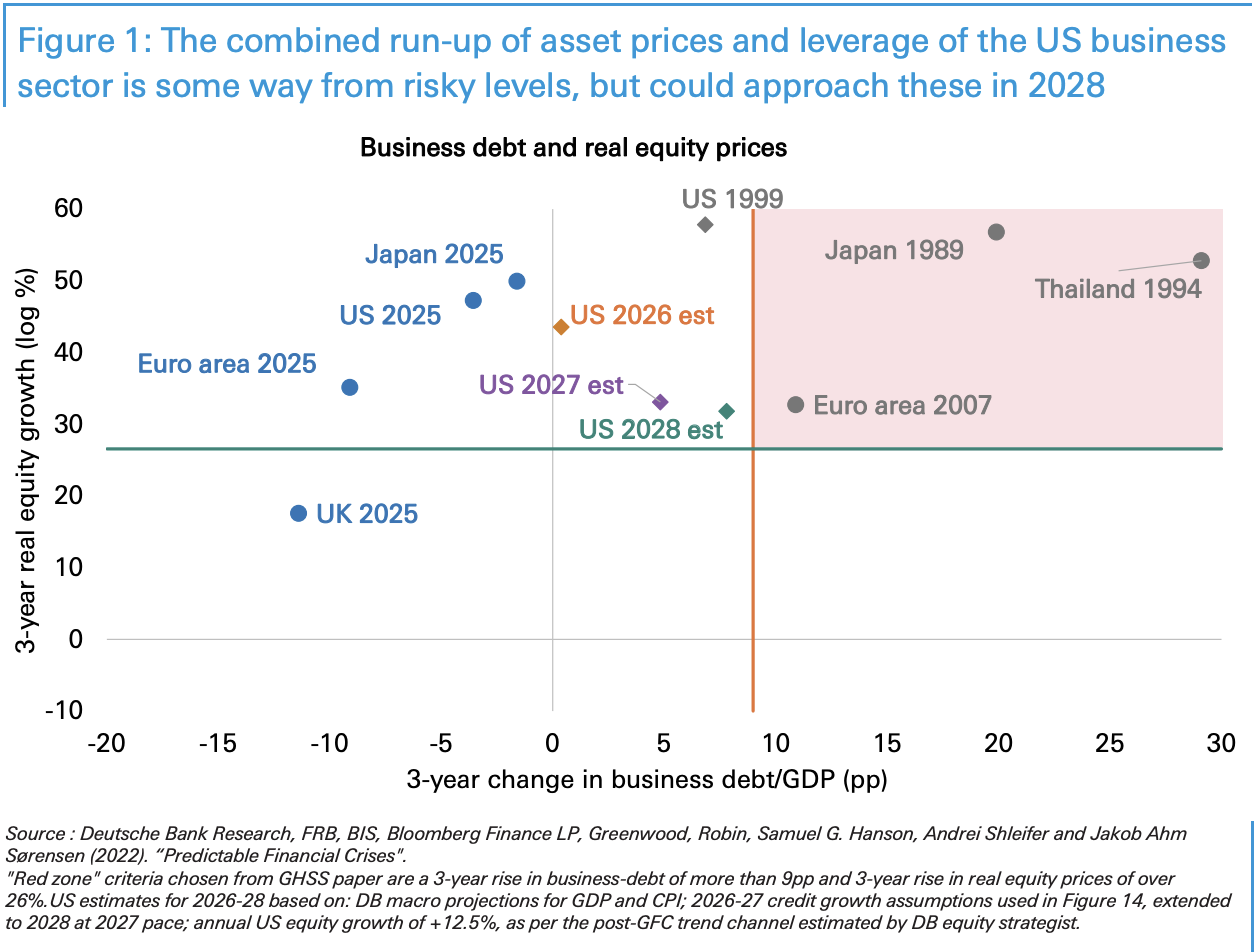
Deutsche Bank's calculations show that the US is currently in a relatively safe position on the coordinate chart, with corporate leverage growth still restrained as of 2025. According to their estimates, under the baseline assumption— including their macro GDP and inflation forecasts, projecting the credit growth rate of 2027 into 2028, and referencing a post-financial crisis trend of an annualized 12.5% stock price growth— the US will approach the "red zone" noticeably by 2028, but is expected to remain just outside the boundary.
The AI Boom: Investment-Driven or Debt Bubble?
The core debate in the current market is whether this round of the AI wave is a rational cycle of technological investment or another credit expansion bubble presenting in a different guise.
Deutsche Bank's analysis offers a relatively cautious judgment: so far, the driving force behind the AI boom has come more from rising stock prices and real capital expenditure rather than systemic leveraging behavior. This bears certain similarities to the situation during the internet bubble—where rising stock prices were a defining feature and debt accumulation was limited, ultimately leading to severe market corrections without triggering a comprehensive financial crisis.
However, the report simultaneously highlights a structural shift: the financing sources for AI-related capital expenditures are migrating from corporate-owned operational cash flow to external debt financing. If this trend continues, whether credit growth and stock price increases can maintain their current state will become a key variable in judging the risk direction in the next phase. As the report states, "how credit responds in this new stage of AI construction may become central."
Other Potential Risks: Private Credit and Sovereign Balance Sheets
In addition to AI-related risks, Deutsche Bank's report points to two other potential candidate areas for crises: the rapid expansion of the private credit market and the general stretching of global sovereign balance sheets.
The report notes that regulatory reforms and faster policy intervention mechanisms post-2008 have made the transmission and spreading of crises more difficult—this is also an important institutional reason for successfully avoiding major financial crises over the past decade. However, the private credit market has rapidly expanded in relatively weakly regulated gray areas, and sovereign debt levels have continued to rise after multiple rounds of fiscal expansion, both of which pose potential accumulation points for systemic risks that require continuous attention from investors.
Overall, Deutsche Bank's conclusion is not an alarm but a prospective stress test based on a quantitative framework. According to their estimates, 2028 is a noteworthy observation point. Before then, there is ample time for many variables to change; however, the key is that Minsky's logic has never lost its validity— the calmer it is, the more vigilance is needed.
免责声明:本文章仅代表作者个人观点,不代表本平台的立场和观点。本文章仅供信息分享,不构成对任何人的任何投资建议。用户与作者之间的任何争议,与本平台无关。如网页中刊载的文章或图片涉及侵权,请提供相关的权利证明和身份证明发送邮件到[email protected],本平台相关工作人员将会进行核查。


