The original text is from beincrypto.com, author Lockridge Okoth
Translated by|Speedy Xiang @Odaily Planet Daily
The crypto industry spent $195.8 million in 2024, hoping to gain a friendlier Congress. On Tuesday, the ballot handed both houses to the Democrats, while the industry that spent $40 million to stop them is set to return.
The impact of this is far beyond wallets. Bitcoin holders, crypto stock investors, and every exchange across the U.S. are waiting for the same thing: a federal law that specifies who will regulate crypto. Starting in January, this law must be pushed forward by a party that has been questioning the industry throughout the year, as well as the president's own party regarding crypto revenue.
Why is it now harder for the crypto industry's wish list to pass?
1. Every crypto bill now requires Democrats
According to PBS, the Democrats have secured Senate seats in Texas, Kansas, Iowa, and Ohio that were previously held by Republicans. CBS News predicts that the Democrats will control both houses concurrently. The new Congress will convene in January.
This is a mathematical flip for the crypto industry. Previously, under a Republican agenda, the industry needed to rally several Democrats to reach 60 votes in the Senate. Starting in January, which bills can proceed to a vote will be determined by the Democrats.
Ohio is where the elections had the most profound impact on the crypto industry. Sherrod Brown, former chair of the Senate Banking Committee and a long-time critic of the crypto industry, regained a seat. He led Republican Senator Jon Husted with 48.6% to 46.5% at a time when 87% of votes had been counted.
Two years ago, the crypto industry spent $40 million on ads attacking him, and he lost. This year, the same groups indicated they would spend more money to prevent his comeback. He still won.
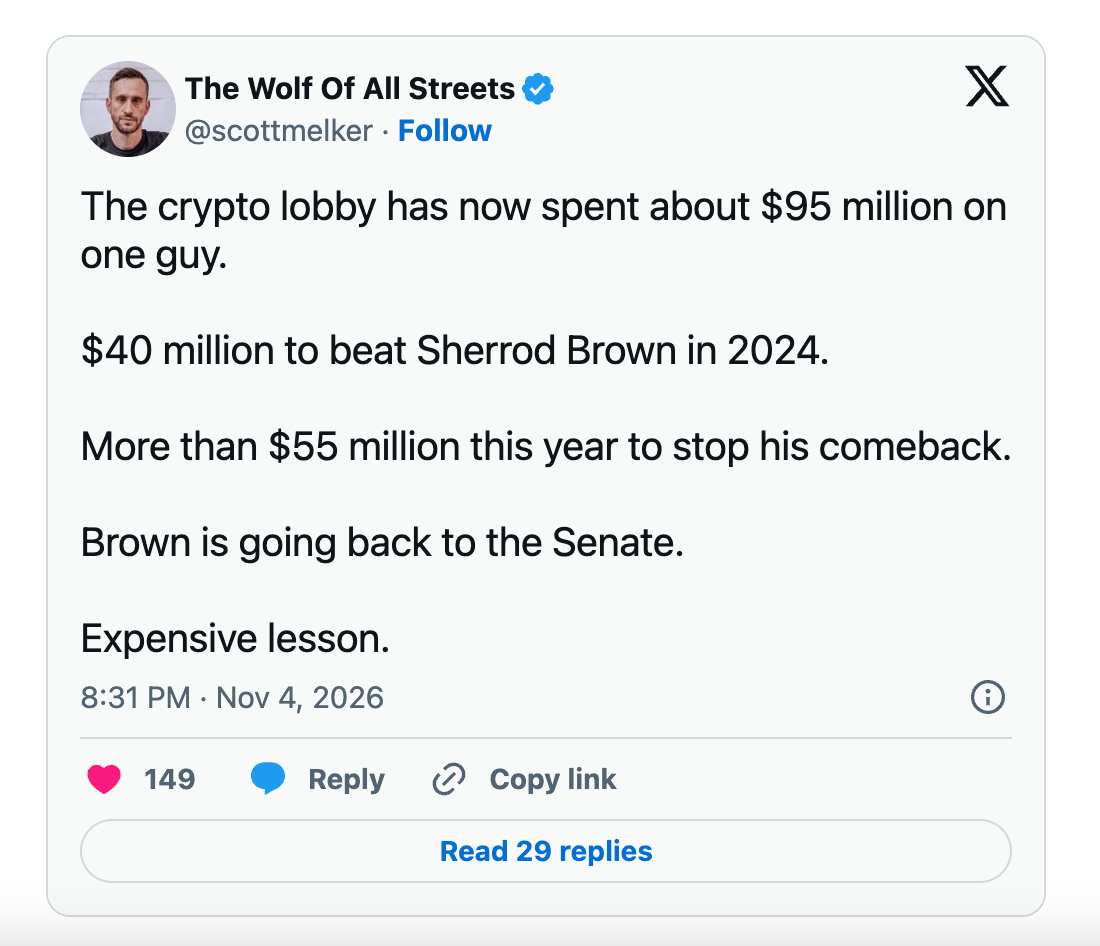
The crypto lobbying group has now spent about $95 million on one person. They spent $40 million in 2024 to defeat Sherrod Brown. They spent over $55 million this year to prevent his return. Brown is going back to the Senate. An expensive lesson. — The Wolf Of All Streets (@scottmelker) November 4, 2026
2. The CLARITY Act was already on life support
The CLARITY Act is the most important piece of legislation for the crypto industry. It will determine which regulatory body will oversee crypto tokens and trading platforms—the Securities and Exchange Commission (SEC) or the Commodity Futures Trading Commission (CFTC).
The House passed it in July 2025 by a vote of 294 to 134, with members of both parties supporting it. Then it encountered the Senate.
According to Orrick law firm, a procedural vote on September 15 ended in a 49 to 50 failure, not achieving the required 60 votes. At that time, both houses were controlled by Republicans.
It got stuck due to two power struggles. The first was an ethical issue. Lawmakers were at odds over the clause restricting "federal officials from holding and profiting from crypto assets while making rules."
The second was a financial issue. Crypto companies wanted to pay returns in stablecoins pegged to the dollar, while banks feared that these returns would pull deposits from their accounts.
The bill is not dead yet. Senator Thom Tillis intentionally voted against it so he could move to bring the bill back to the agenda. However, Orrick points out that the industry generally believes the chances of passing it this year are low.
3. Without law, the rules are merely temporary
Currently, the U.S. crypto business primarily operates under rules written by various agencies. With a change in government, these rules can be rewritten, and Trump's term ends in January 2029.
Orrick notes that, in the absence of federal law, other rulebooks will continue to govern most crypto activities. Only stablecoins have their own law—the GENIUS Act, passed in 2025.
Before the ballot results were revealed, crypto traders were already worried about a Democratic sweep. Mary Cull of Cryptex Finance told American Banker that Democratic control of the Senate would make this bill harder to pass. She also discussed the industry's situation under Trump.
"During this administration, I think crypto was the favorite child," Cull was quoted saying by American Banker.
Starting in January, who holds the fate of crypto?
4. The two sharpest critics of the crypto industry will hold chair positions
American Banker reports that Senator Elizabeth Warren is likely to become the chair of the Senate Banking Committee. This committee is responsible for reviewing crypto legislation in the Senate.
Warren has already been the Democratic lead on the committee. This year, she co-signed letters urging the Trump administration to respond to issues surrounding Binance and requested hearings on the Trump family's crypto revenue.
In the House, Congresswoman Maxine Waters is expected to become chair of the Financial Services Committee. Congressman Sean Casten may challenge her, but American Banker reports that her qualifications should prevail.
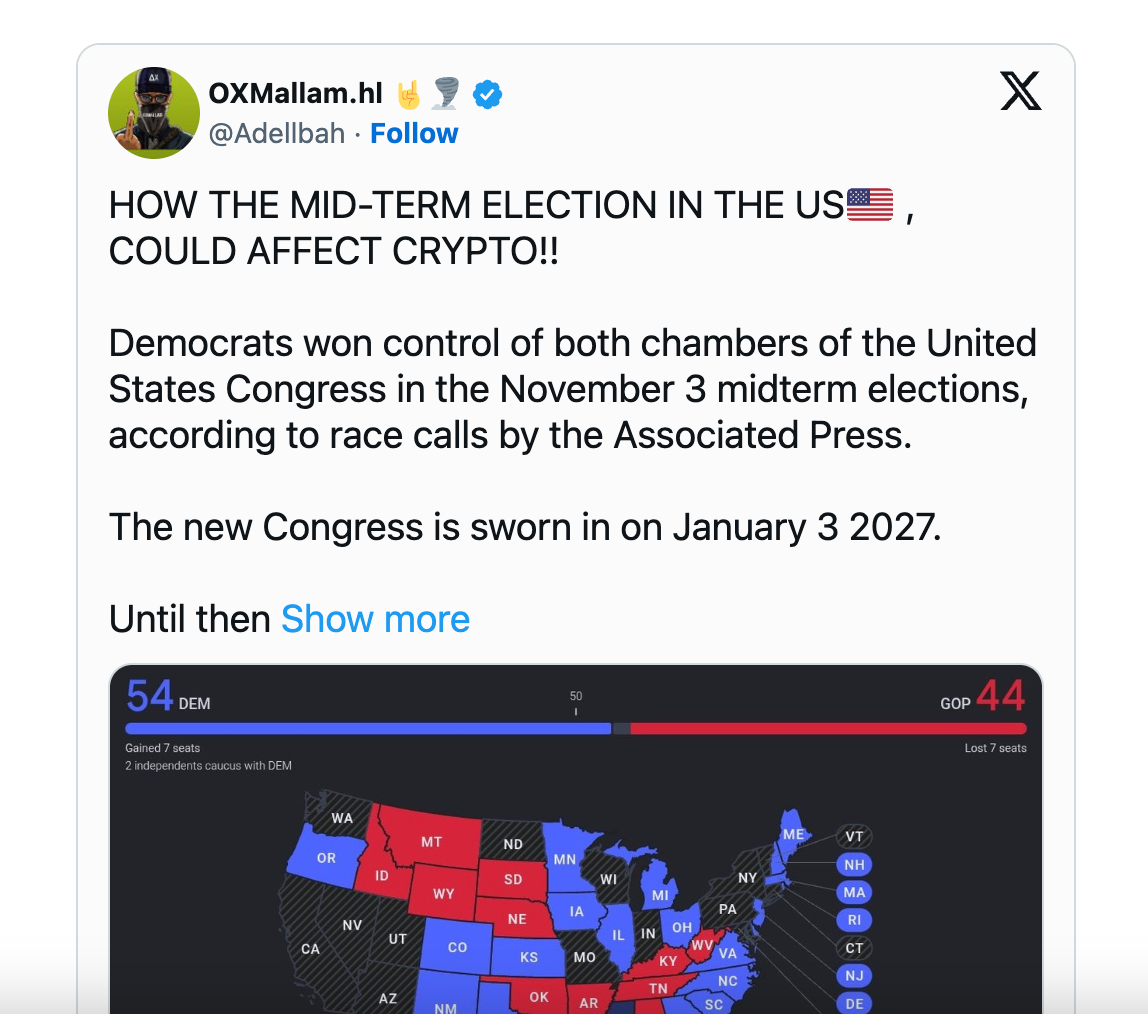
How the U.S. midterm elections will affect crypto According to state ballot counts by the AP, the Democrats won control of both houses in the midterm elections on November 3. The new Congress will be sworn in on January 3, 2027. Before that, the chairs hold real power: they decide which bills can go for hearings, can summon executives to testify, and can issue subpoenas—a legal order to produce documents. — OXMallam.hl (@Adellbah) November 4, 2026
5. Trump's crypto empire becomes a target
The figures involved are significant. According to AFP reports of financial disclosure documents, Trump made approximately $1.2 billion from crypto in 2025.
About $635 million of this came from royalties from the $TRUMP meme coin, which was issued just hours before his inauguration. Nearly $550 million came from the family crypto company World Liberty Financial.
Buyers of World Liberty's WLFI token are in a worse position. According to AFP, the token's price fell from 46 cents to 6 cents after it opened for trading in September 2025.
In July this year, five Senate Democrats, including Warren, listed the family's crypto revenue as $1.4 billion in an open letter. They demanded hearings and cited reports of the UAE buying a 49% stake in World Liberty.
Bart Naylor of the consumer organization Public Citizen expects the Democrats to take action against these businesses, possibly utilizing subpoenas. Public Citizen believes these transactions raise issues under the "emoluments clause," which prohibits the president from receiving payments from foreign governments.
Congress has already investigated World Liberty Financial. The White House has denied these criticisms. According to AFP, the White House stated that the president and his family have never been involved in conflicts of interest.
"Democratic control also brings subpoena power, scrutiny of Trump's associated crypto businesses, and influence over the nomination of future regulatory positions," a user on X pointed out.
6. Following the Binance hack, exchanges will face sharper scrutiny
Waters cited reports in a statement on October 30 regarding the hack of Binance last week, resulting in losses of about $6.3 billion. These reports connected the attack to North Korean state-level hackers.
She stated that millions of customers were unable to withdraw funds at that time, while Binance was raising billions of dollars for compensation.
Congresswoman Maxine Waters just reacted to the Binance hack incident She called it a "wake-up call for anyone who thinks the crypto industry can operate without strong accountability mechanisms." Her demands: stronger consumer protections, stricter cybersecurity standards, and real accountability—SJ (@patelsjxrp) October 31, 2026
Waters then shifted the focus to politics. She pointed out that Binance founder Changpeng Zhao (CZ) invested over $2 billion into World Liberty before he was pardoned by Trump. She also mentioned that the SEC dropped its fraud case against Binance and Zhao.
Senate Democrats raised similar concerns in February this year. Their open letter stated that Binance encouraged users to buy World Liberty's dollar-pegged stablecoin USD1.
Waters called for stricter consumer protections, financial crime prevention, and cybersecurity standards across the entire industry.
"Americans have the right to know their money is safe," she said.
Is this really bad news for Bitcoin?
7. History and regulatory trends point in the other direction
Not every Democrat is against crypto. The CLARITY Act passed in the House with bipartisan support, so dozens of Democrats voted in favor.
The industry has hedged its bets on both sides. In 2024, Fairshake spent about $14 million supporting Democratic candidates, according to FactCheck.
Regulatory bodies are also moving forward. The SEC proposed cryptocurrency rules on August 18. Orrick notes that the CFTC also submitted its own draft for White House review on September 17. However, binding rules may take more than a year to implement.
The market's reaction to the midterm elections has also been minimal. Since 1982, the S&P 500 index has risen after every midterm election, and Bitcoin has also gained after the most recent midterm elections. On the night when election results were rolling in, Bitcoin and U.S. stock index futures fluctuated with the news.
The crypto printing press has not slowed down either. According to FactCheck, Fairshake had already raised nearly $137 million for this year's elections by June 30. It still could not stop Brown.
The next test will come before January. If the CLARITY Act does not progress in the final weeks of this Congress, this most important piece of legislation for the crypto industry will have to start again under Warren and Waters.
免责声明:本文章仅代表作者个人观点,不代表本平台的立场和观点。本文章仅供信息分享,不构成对任何人的任何投资建议。用户与作者之间的任何争议,与本平台无关。如网页中刊载的文章或图片涉及侵权,请提供相关的权利证明和身份证明发送邮件到[email protected],本平台相关工作人员将会进行核查。


