Original Author: Zhao Ying
Original Source: Wall Street Journal
The sharp decline in the US stock market, triggered by technology stocks, is prompting a chain of de-leveraging in systematic strategy funds, with the scale and speed of selling pressure being so significant that it is difficult for the market to dissipate in the short term.
According to the Wind Trading Desk, a report released by the JPMorgan equity derivatives strategy team on November 5 indicated that the US stock market suffered its worst single-day performance since "Tariff Day," with the S&P 500 index plunging 4.4% and the Nasdaq 100 index collapsing 6.4%. Quantitative strategy funds played a key accelerating role during this decline—the CTA trend-following strategies and leveraged ETFs collectively sold off over $70 billion in stock exposure on that day.
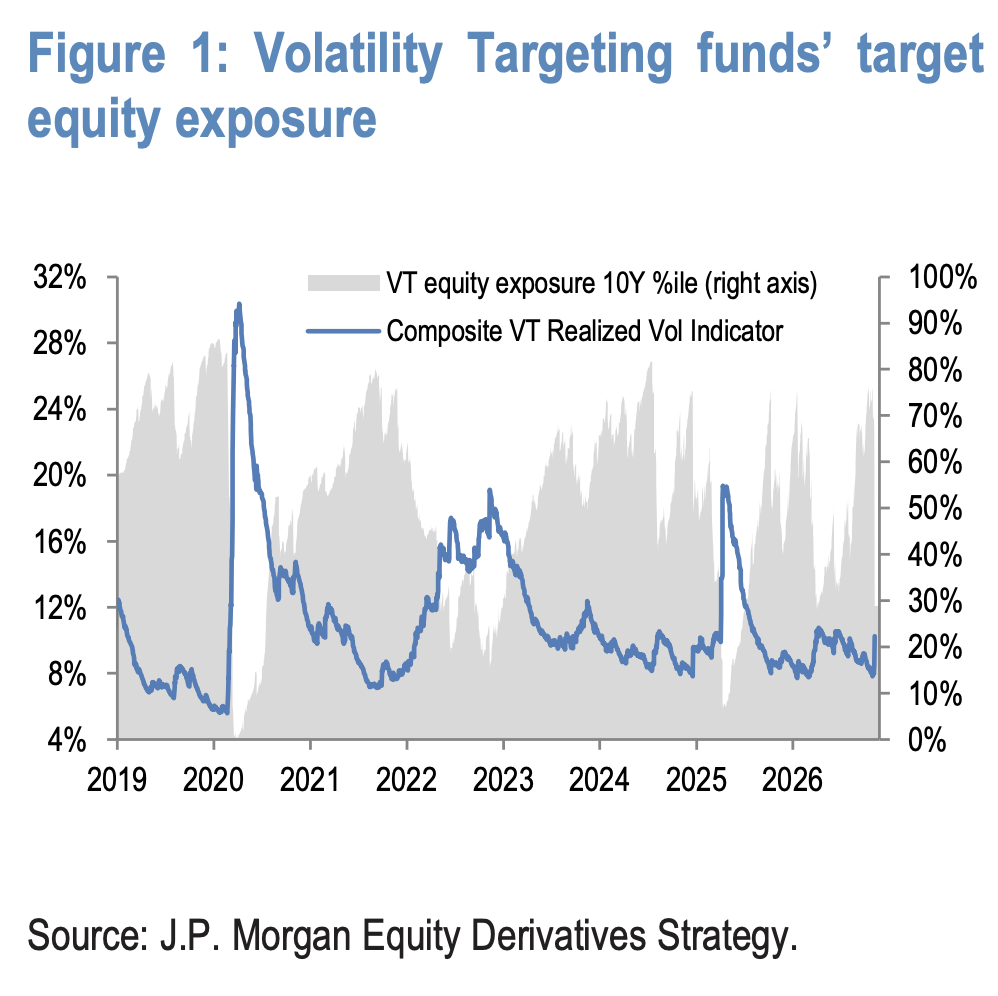
More concerning is that the selling pressure has not yet cleared. JPMorgan's model estimates that volatility targeting funds still have about $50 billion in stock exposure to sell in the coming days to reduce their target leverage from approximately the 67th percentile to the 30th percentile. This means that if the market continues to decline, systematic liquidation will exert persistent downward pressure.
CTA turns to net short positions, selling off $11 billion in 90 minutes after market open
The direct trigger for this round of decline was the momentum signals of CTA trend-following strategies being broken in bulk. JPMorgan's report pointed out that this downtrend broke several key momentum signals for major US stock indices during early trading, triggering systematic selling by CTAs, thus accelerating the market decline.
Specific data shows that within approximately 1.5 hours after the spot market opened, the net selling scale of S&P 500 futures reached about $11 billion. In terms of momentum signals, the CTA positions for the S&P 500, Nasdaq 100, and Russell 2000 have all flipped to net short positions.
JPMorgan's CTA momentum signal tracking table shows that the current price of the S&P 500 is around 7383 points, with a 1-month momentum signal in negative territory, and the CTA signal has turned to "short"; the same applies to the Nasdaq 100. Although the 12-month momentum remains positive for major US stock indices and the S&P 500 price hovers around the 200-day moving average, indicating that further de-leveraging depends on whether the market continues to break downward, the report also noted that because most signals have turned bearish, the flow of risk is currently biased upward.
Leveraged ETFs significantly de-leverage for the second time in a week, with technology stocks accounting for 90%
Leveraged ETFs are another major force in this round of selling. JPMorgan estimates that leveraged ETFs sold off more than $60 billion in stock exposure before the market closed that day, with about 90% concentrated in technology-related products, including semiconductors (Semis), Nasdaq 100 (NDX), and technology stock ETFs (XLK).
This marks the second significant de-leveraging of leveraged ETFs within a week, reflecting the recent market characteristic of continuous dominance by technology stocks in the downtrend. However, the report also suggests that the inflow of buy-the-dip funds during previous declines may partially offset the rebalancing selling pressure of the ETFs.
After this round of de-leveraging, the implied short gamma exposure of leveraged ETFs has decreased from about $7.5 billion per 1% volatility to about $6.5 billion, indicating that the scale of passive selling triggered by subsequent rebalancing will narrow.
$50 billion potential selling pressure, volatility targeting funds become the next focus
The biggest potential source of selling pressure in the current market is the volatility targeting funds. JPMorgan's model shows that as market volatility rises sharply, these funds need to reduce about $50 billion in stock exposure in the coming days to compress their target leverage from approximately the 67th percentile to the 30th percentile.
The operating logic of volatility targeting strategies is: when market volatility rises, risks are mechanically reduced in risk assets to maintain stable portfolio volatility. This mechanism often forms a negative feedback effect of "selling more as the market drops" during periods of sharp market volatility.
JPMorgan had previously warned in its report on Monday that macro systematic strategies face two-way flow risks, and there exists a potential for significant de-leveraging in scenarios of sharp declines and soaring volatility. The day’s market performance is a confirmation of this judgment, and the adjustment process may last several days. For investors, the market's pressure will likely remain unchanged in the short term until this $50 billion of passive selling is fully released.
免责声明:本文章仅代表作者个人观点,不代表本平台的立场和观点。本文章仅供信息分享,不构成对任何人的任何投资建议。用户与作者之间的任何争议,与本平台无关。如网页中刊载的文章或图片涉及侵权,请提供相关的权利证明和身份证明发送邮件到[email protected],本平台相关工作人员将会进行核查。


