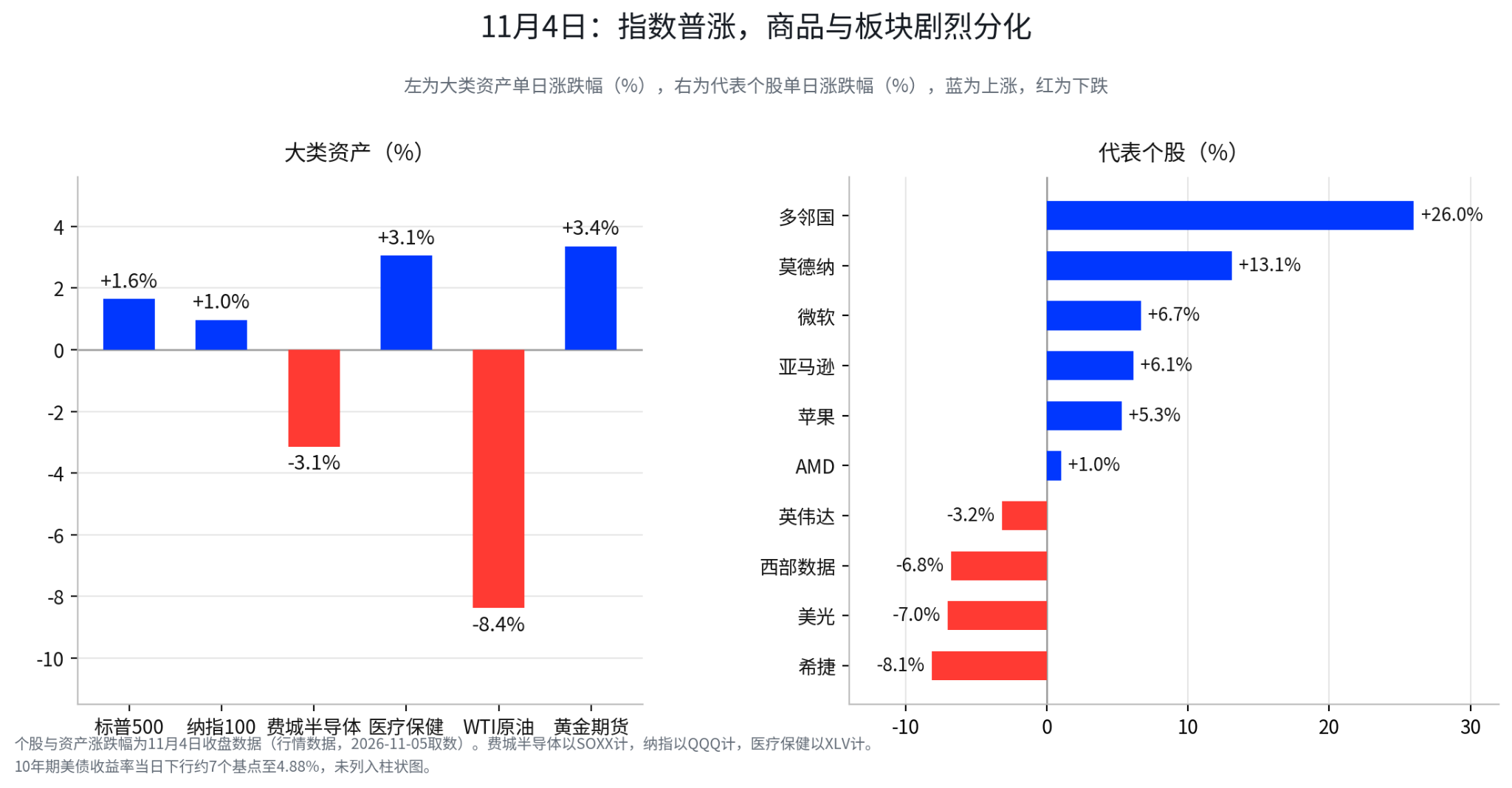
The results of the mid-term elections have basically been finalized. For the market, after the change in Washington's power structure, which policies can still be implemented, which cannot, and where the president will shift more policy space is more worthy of consideration than the fluctuations of the indices on the election day. The market on election day only provides a footnote: on the same day the Dow rose by 3.03% and the S&P 500 rose by 1.65%, the Philadelphia semiconductor index fell by 3.14%, and WTI crude oil fell by 8.4%. The seeds of divergence had already been sown before the election results were announced.
1. Both Houses Controlled by Democrats, the Steering Wheel Remains in Trump's Hands
The Democrats Gained Control of Congress, What They Really Got Was the Agenda, Funding, and Oversight
The new Congress will take office on January 3, 2027, when the Democrats will decide which bills enter the review process and strengthen oversight of the executive branch through committee investigations and hearings. A Democratic majority in the Senate also means that senior officials and judicial nominees proposed by the president will face stronger confirmation pressure (reported by PuYin International and various foreign media).
The governors of Texas and Georgia have also changed hands, directly translating this change into AI infrastructure. These two states are key areas for data centers and power investments in the U.S., and state governments have actual decision-making power over land, energy, environmental protection, tax incentives, and project permits. Projects that have already entered the construction phase are limited in impact; those without secured power supply, permits, and local tax incentives face significant policy uncertainties.
Trump Doesn’t Have Congress, but Tariffs and Executive Power Are Still in Hand
The Republican Party still controls the White House, and the Democrats do not have enough seats in Congress to overturn vetoes. Executive powers, such as tariffs, immigration enforcement, diplomacy, and military actions, are largely retained (reported by Axios and the Associated Press). Trump has publicly stated he wants to be “Mr. Veto” (reported by DW). Even if the Democrats control Congress, it will be difficult for them to fully convert their agenda into law.
The Democrats have taken Congress, but they haven’t taken full control of the policy direction. Trump has lost Congress, but he hasn’t lost executive power.
The First Tough Battle After the Elections is Scheduled for December 11
Before the new Congress takes office, there is a period of lame-duck session that is easy to overlook. From November to December, the old Congress will still handle the funding issues, and the temporary funding deadline on December 11 is the first hard node before the transfer of power. The old Senate still needs Democratic votes, and the probability of a short-term funding extension to avoid a shutdown is relatively high (reported by JPMorgan Asset Management). This also means that issues such as healthcare and defense are likely to be packaged into the same negotiation plan.
2. Congress Can’t Control All Policies, Three Channels Determine Asset Directions
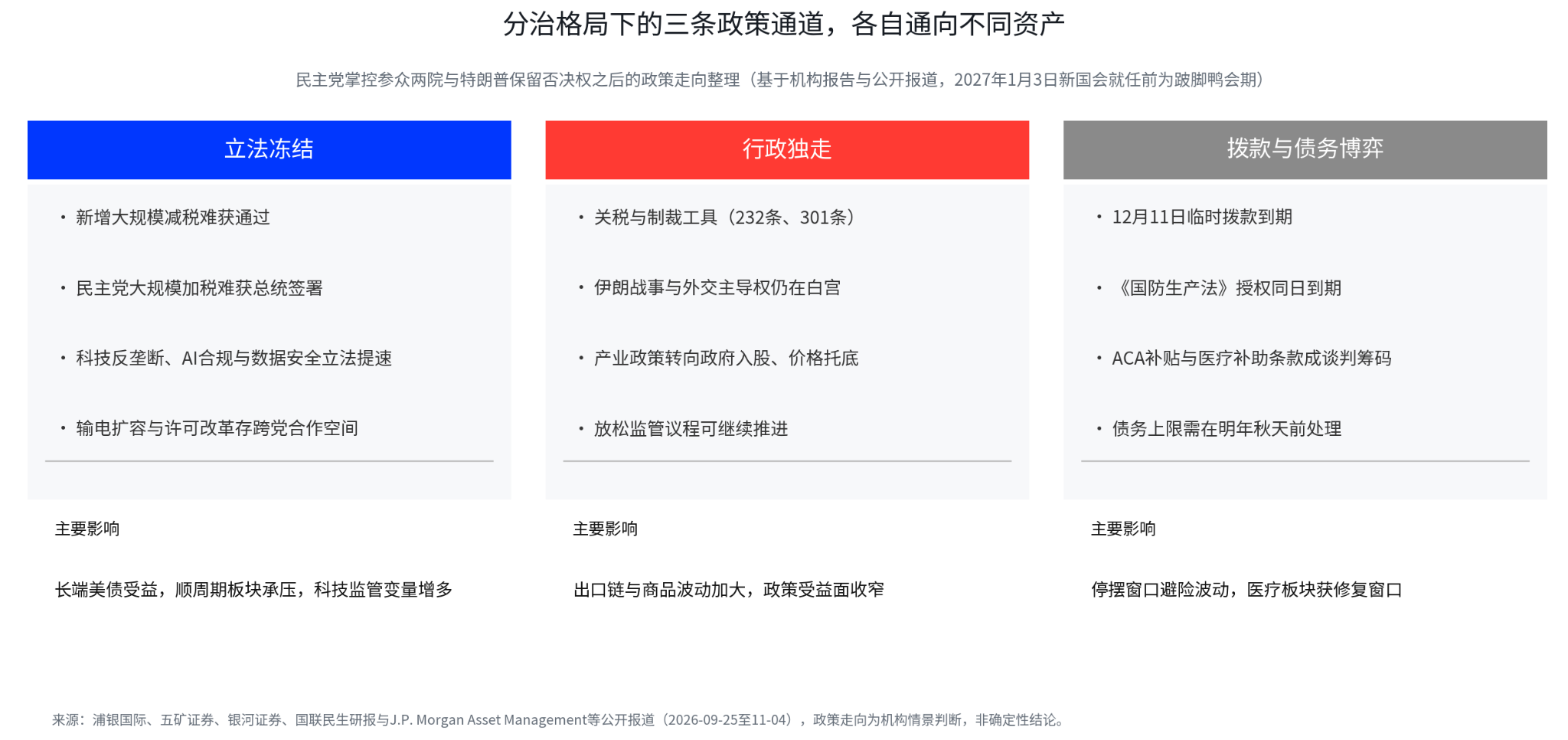
Legislative Freeze: Fiscal Stimulus Difficult to Increase, Treasuries the First Beneficiary
The Democrats controlling Congress does not equate to the implementation of tax increases proposed by them, as the president has veto power. Trump’s desire to push for a new round of large-scale tax cuts is also unlikely to replicate the efficiency of passage seen during the unified government era. Institutions such as JPMorgan Asset Management point to the same conclusion: the divided government will compress new fiscal expansion space, and existing tax and spending arrangements will continue to be implemented (reported). This is a relative benefit for long-term U.S. Treasuries; the biggest pressure on them in recent years has come from the continuous increase in fiscal deficits and long-term Treasury supply. After Congress becomes divided, the space for further expanding the deficit is limited.
Technology regulation is another line on this channel, with the pace of advancing antitrust, AI compliance, and data security potentially accelerating (reported by China Universal and Minsheng). What really needs to be observed is whether specific legislation emerges and whether regulation transitions from principle discussions into execution. Expanding transmission capacity and permit reform may allow for bipartisan cooperation (PuYin International), which is one of the few directions where policy consensus could form, especially as electricity becomes a bottleneck for U.S. data centers.
Administrative Decoupling: Tariffs and Industrial Policy, Trump Can Still Play His Own Cards
Based on existing authorizations under Sections 232 and 301, the White House still has considerable room for tariff adjustments without needing to pass through Congress every time. Over the next year, U.S. policy towards China may showcase seemingly contradictory situations; with stronger Congressional oversight, tariff policies can still be swiftly advanced by the executive branch. PuYin International even suggests that it's possible Trump might increase the use of tariffs after losing Congressional control.
The administrative characteristics of industrial policy are also strengthening. Over the past year, the White House exchanged $8.87 billion in chip act funding for approximately 9.9% of Intel's shares, invested $400 million in preferred stock in MP Materials, and provided $2.23 billion in loans to Lithium Americas (analyzing by Minmetals Securities). Policy support is increasingly concentrated on a few strategic enterprises, while general subsidies across the industry are decreasing.
Funding Gambit: December 11, Healthcare and Defense Become Bargaining Chips
The temporary funding deadline on December 11 coincides with the renewal of the Defense Production Act price stabilization authorization, and the Democrats may attach oversight conditions (Minmetals Securities). Enhanced ACA premium tax credits and Medicaid restrictions are two areas the Democrats most want to include in the negotiation (PuYin International); they may not be fully restored but could enter funding legislation in the form of temporary extensions, partial adjustments, or accompanying clauses. The debt ceiling is a more distant tail risk that must be addressed before next autumn, and whether the confrontation in Congress escalates into a hard risk for the financial markets will depend on whether both sides truly use the debt ceiling as a bargaining tool.
3. Don’t be Scared by 4.9%: 2018 is a More Relevant Reference Scenario
The 4.9% Historical Average Contains Recessions and Crises
The combination of a Republican president and Democratic control of both houses results in an average annual increase of about 4.9% for the S&P 500, ranking last among various power combinations (reported by Stock Trader's Almanac, according to Bloomberg and other reports). This figure cannot be directly used to predict 2027. There are not many historical years that fit this combination, and many coincided with recessions, financial crises, or cyclical downturns; low returns could stem from political division as well as a poor macroeconomic environment at that time.
2018 Shows Us that Falling First and Rising Later is Also Entirely Possible
In 2018, a Republican president faced a Democratic takeover of the House, coupled with Federal Reserve rate hikes and trade frictions. According to statistics from Minmetals Securities, the S&P 500 rose by 11.7% in the 12 months after the election, with a maximum pullback of 14.7% in the first three months, only reaching a bottom on December 24. Since 1946, in 20 mid-term elections, the S&P 500 has averaged a 12-month increase of about 14.4% (statistics from Minmetals Securities), indicating that the market environment following mid-term elections is generally not pessimistic.
“Market Up After Election Year” and “A Potential Significant Pullback in the Subsequent Months” Can Both Hold True; History Supports a Generally Bullish Outlook Amid Fluctuations.
4. U.S. Treasuries and Healthcare: The First Two Asset Classes to Reflect Election Results
U.S. Treasuries: Fiscal Freeze Opens Space, Federal Reserve Sets Limits
The core formula for U.S. Treasuries is that fiscal expectations open space, and the Federal Reserve determines how far that space can go. After the elections, the yield on 10-year U.S. Treasuries fell from about 4.96% to around 4.88%, as the market began pricing in limited fiscal stimulus and the expectation of reduced deficit expansion.
This logic cannot be separated from the Federal Reserve. Before the interest rate meeting on December 8-9, the market was still pricing in a roughly 77% probability of a rate hike (according to CME data, reported). The non-farm payroll on the evening of November 6 (with market expectations of about 50,000 to 65,000 jobs) and the CPI in mid-November (September year-on-year at 3.7%, core at 2.6%) directly affected these expectations. Weakening employment and declining inflation would lead to lower yields, which would be supported by interest rate sides. However, if inflation rises again and the Federal Reserve maintains a hawkish stance, the benefits from the fiscal freeze could be offset by interest rate pressures. An analysis cited by Morningstar also reminds that the government's high borrowing will continue, and the downward space for long-term yields shouldn't be taken too lightly.
Healthcare: The Election Is Just the First Transaction, December Funding is the Real Verification
The Democrats need to use funding power to push ACA subsidies and Medicaid issues, while the Republicans need to avoid a government shutdown, creating a compromise incentive for both sides. On November 4, the healthcare sector rose by 3.06%, the biotech ETF rose by 2.67%, and Moderna rose by 13.11%.
The increase on election day is just the first level of pricing; the next stage's catalyst lies in the specific terms of the December funding negotiations. If related subsidies gain extensions, directions like healthcare insurance, biotechnology, and healthcare services may continue to benefit. If the final plan is significantly below expectations, the election day's gains may face pressure to take profits. The verification point will be the legislation text around December 11.
5. The Biggest Variables in AI Hardware Have Shifted from Washington to State Governments
Why AI Hardware Plummeted: From Who Buys GPUs to Who Profits
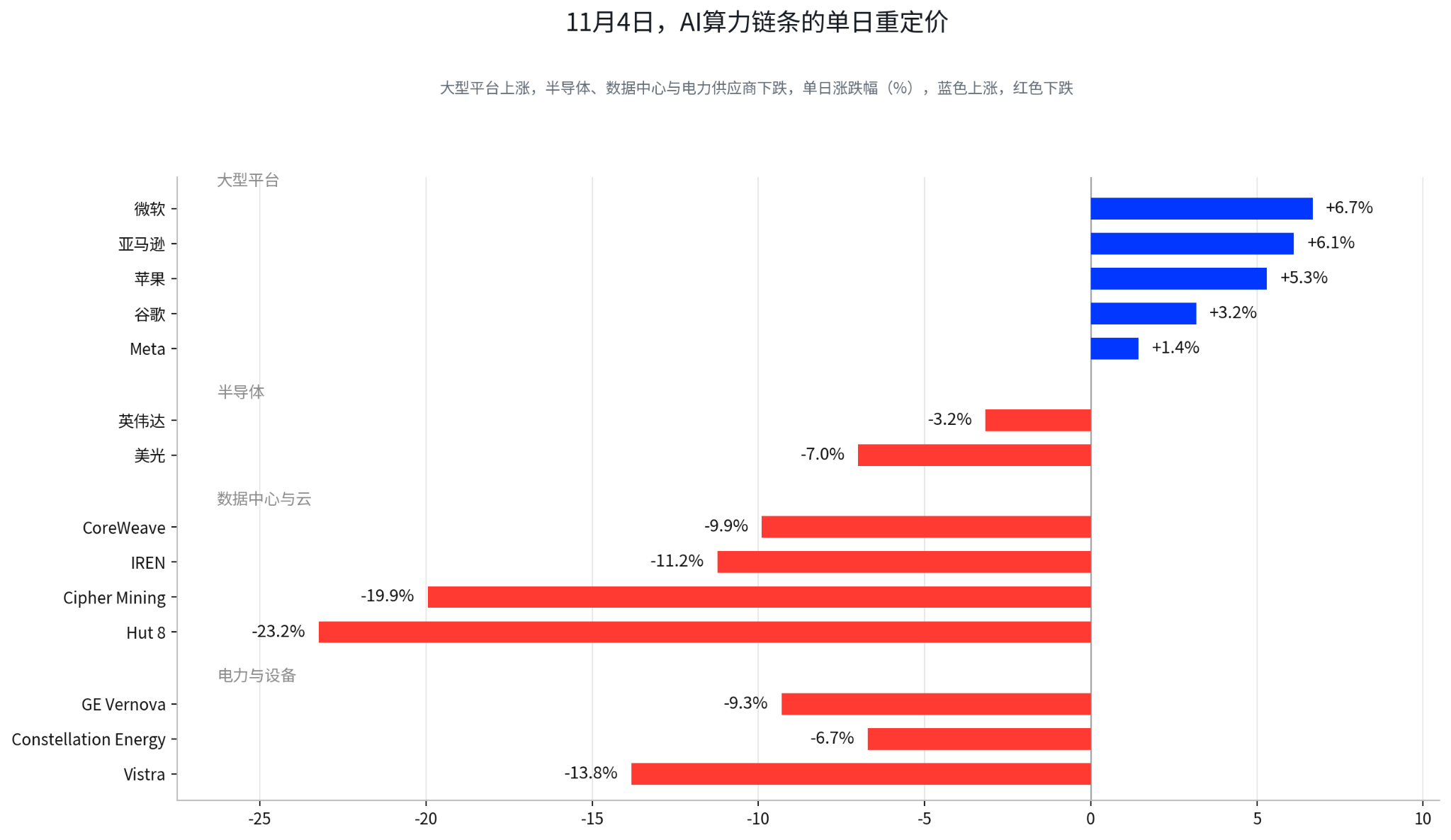
On the same day the S&P 500 rose by 1.65%, the Philadelphia Semiconductor Index fell by 3.14%, with Nvidia down 3.17%, Micron down 7.00%, CoreWeave down 9.90% hitting a new low since its listing, IREN down 11.24%, Hut 8 down 23.23%, and Cipher Mining down 19.95%. Microsoft, Amazon, and Apple rose by 6.68%, 6.12%, and 5.31% respectively, Google rose by 3.18%, Meta rose by 1.44%, and Duolingo rose by 25.99%. The combined market value of the five tech giants increased by approximately $850 billion in a single day. Power and equipment suppliers were also sold off, with GE Vernova down 9.30%, Constellation Energy down 6.71%, and Vistra down 13.83%. The market transactions are no longer simply about AI's positive or negative effects, but rather distinguishing who needs to continue investing heavily in infrastructure and who is already beginning to profit from AI investments.
The Scarcity of Computing Power is Another Explanation for This Round of Divergence
The backlash against the large platforms requires an explanation, as they are precisely the largest AI buyers in the market. John Flood from Goldman Sachs' trading desk (reported by media) stated that the most prominent theme that day was buying large clouds and selling semiconductors. A slowdown in new capacity means that computing power supply is scarcer; existing suppliers can sell services at higher prices, and slowing capital expenditures can free up funds for stock buybacks. B. Riley Wealth's chief market strategist Art Hogan provides another side to the same logic, indicating that large cloud vendors’ data centers are already completed while the pace of new construction slows, making existing assets more valuable and the growth rate of capital expenditures can also decrease.
With this logic, the day's market activity becomes understandable. The rise of the platforms is reflecting a revaluation of the scarcity of existing computing power, coupled with expectations of reduced capital expenditure pressures. The existing framework explains why Nvidia and Micron fell, while the scarcity framework explains why Microsoft and Amazon rose, and only combining the two frameworks gives a complete pricing perspective.
The story on the cost side is also clear. The investment director at Siebert Financial (reported by media) believes that AI infrastructure won’t disappear, but tax incentives may decrease, forcing companies to bear more costs for electricity and water, making construction more expensive and returns cramped; the most vulnerable are businesses that heavily rely on financing. This aligns with the deep downturns of CoreWeave and IREN.
Opposing voices are also worth noting. Adam McCarthy from LO:TECH (reported by media) warns that the sharp decline of data center concept stocks may be an overreaction; the Trump administration has always supported AI development, and tools like permits and federal land are still in the hands of the White House. UBS's strategy team (reported by media) points to state governments, as exit polls show voters strongly oppose the construction of data centers in their communities, with the most immediate variable for short-term impacts being tightened regulations at the state level. Evercore ISI aligns with this view, indicating that a tightening development environment will further dampen sentiment towards AI infrastructure-related stocks.
The Next Key for Data Centers: Availability of Power, Permits, and Tax Incentives
Whether data centers can secure power, land, tax incentives, and environmental permits is becoming increasingly crucial. Estimates from Goldman Sachs' chief economist Hazus (reported by multiple media) suggest that state and local election results may trigger pauses in data center construction, impacting approximately 45% of planned projects in the U.S., with Texas alone accounting for about 25% to 27%. Projects that have already been permitted, secured power supply, and commenced construction are less affected by policy changes, while those that haven't completed these stages face higher risks of delays. PuYin International shares this judgment, indicating that data center projects without secured power, permits, and tax incentives as of 2027 are more likely to be delayed.
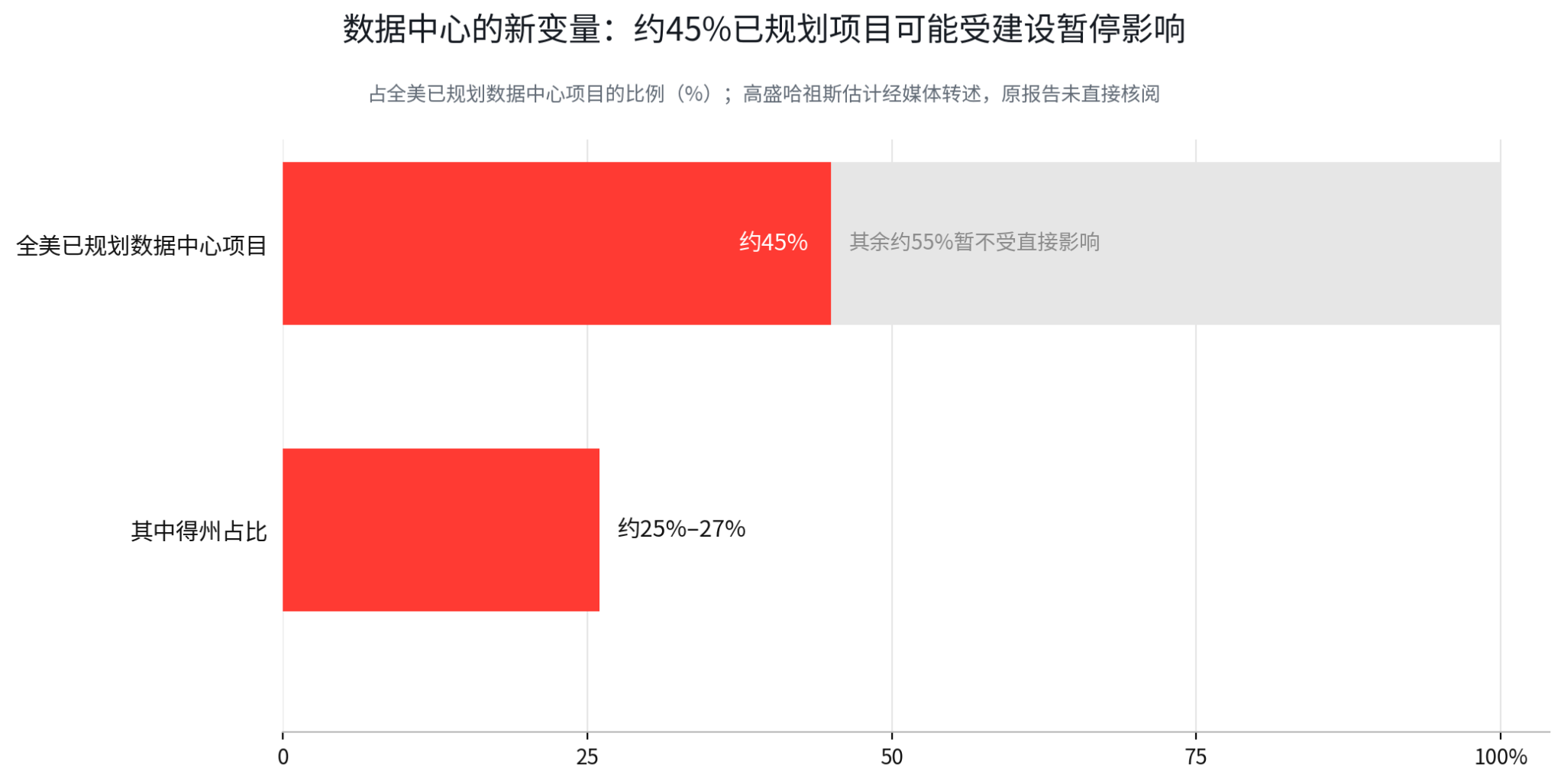
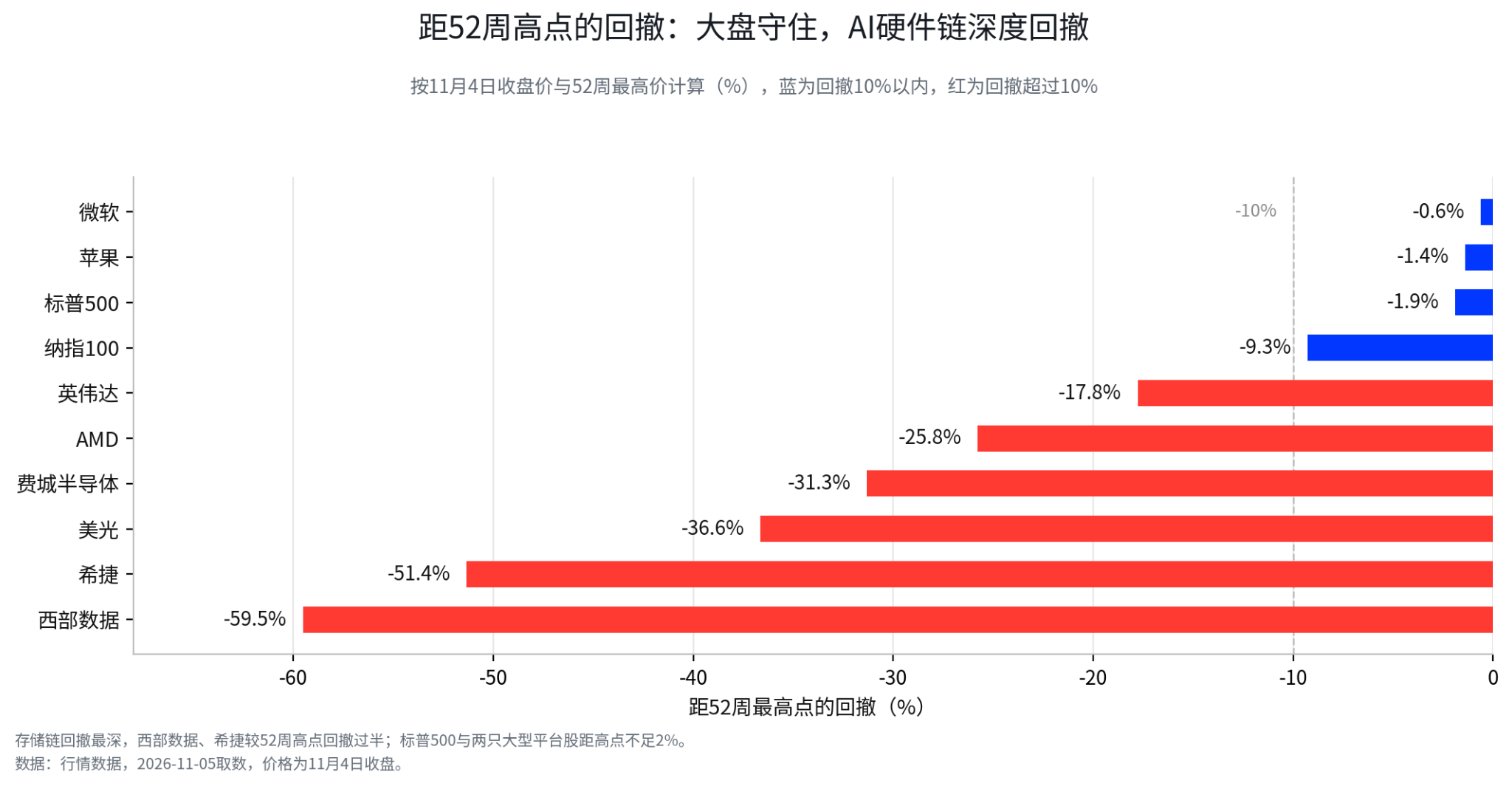
Two additional pieces of evidence make Texas's significance clearer. Research firm SemiAnalysis estimates (reported) that Texas accounts for about a quarter of the expected operational computing power in the U.S. by 2030, corroborating Hazus's estimates. There have also been voices at the federal level calling for pauses, with Democratic Congresswoman Yassamin Ansari advocating on social media to list a pause in advanced AI development and a ban on artificial superintelligence on the party's first-day agenda. Currently, this is merely a personal statement from a legislator without a legislative pathway.
November 17: Nvidia Insights—The Market Expects More Than Just Revenue Growth
Previously, AMD posted third-quarter revenue of $13.377 billion, a year-over-year increase of 45%, with data center revenue growing by 97%. However, its fourth-quarter revenue guidance of about $17 billion led to only a 1.01% rise in stock price that day. Although the numbers remain strong, the stock price reaction indicates that the market's demands surpass mere revenue growth, shifting to whether orders can be sustained, whether capital expenditures can convert to cash flow, and whether infrastructure development can proceed smoothly.
Evidence on the application side continues to accumulate. Duolingo has reduced the cost of each AI invocation from about $0.30 to about $0.01, with gross margins rising to about 73%. The decline in costs is already reflected in corporate profit statements. The market may gradually shift its focus from who buys the most GPUs to who can create more revenue at a lower cost.
6. Two Administrative Power Transactions: Oil Looks to Iran, Export Chains Eye Tariffs
Oil: The 8.4% Plunge Reflects Cooling Relations with Iran
After the Democrats took control of Congress, regulatory pressure on traditional oil and gas development may increase. If the situation in Iran continues to cool, the geopolitical risk premium will further shrink, and these two factors explain the 8.4% drop in WTI in a single day. Oil cannot be simply viewed as bearish; diplomatic and military dominance remains in the White House, and a negotiation failure or conflict escalation could lead to a rapid reversal in oil prices. In the coming months, oil is more suited as an event-driven asset to track, based on progress in negotiations with Iran and inventory data.
What truly deserves attention in energy policy is actually in the grid. There is bipartisan cooperation potential for expanding transmission capacity and permitting reforms (PuYin International), while traditional energy and grid equipment may face completely different policy treatments.
Export Chains: November 10 Provides the First Answer with 178 Tariff Exemptions
The extension of 178 exemptions on 301 tariffs against China until November 10, with decisions on renewal, adjustment, or cancellation all falling under the White House's authority (reported by Galaxy Securities). Galaxy Securities predicts that after a Democratic victory, Congress may push to constrain the president's broad tariff powers, but it will not be weak on industrial safety and forced labor issues towards China; enforcement and investigation will become more institutionalized. The U.S. launched a public consultation for about $30 billion in commodity tax cuts (covering low-controversy items) in June, including categories such as chemical plastics, industrial parts, and textiles. If this list is finalized, related product tax rates are expected to return to most-favored-nation levels (reported by Galaxy Securities).
For the export chains of Hong Kong stocks and A shares, the timeframe around November 10 is likely more worth observing than the election itself. On November 4, the Hang Seng Tech Index rose by 1.77%, while Asian assets face tailwinds from the dollar and U.S. Treasury yields with risks associated with the administrative use of tariff tools.
Gold and Crypto Assets: Ultimately, It's All About Interest Rates
The decline in expectations for fiscal expansion is beneficial to lower long-term interest rates; gold prices have rebounded from $3,898.9 on October 30 to around $4,132 in Asian hours on November 5. As long as inflation and the Federal Reserve remain hawkish, gold is unlikely to form a one-sided trend; future movements are more likely to be driven by macro data in a wide trading range.
Crypto assets face the dual uncertainties of accelerated regulatory legislation and Congressional oversight, ultimately remaining flat on election day. Crypto mining firms transforming into AI computing power saw target prices revised down by Bernstein by as much as 54%. 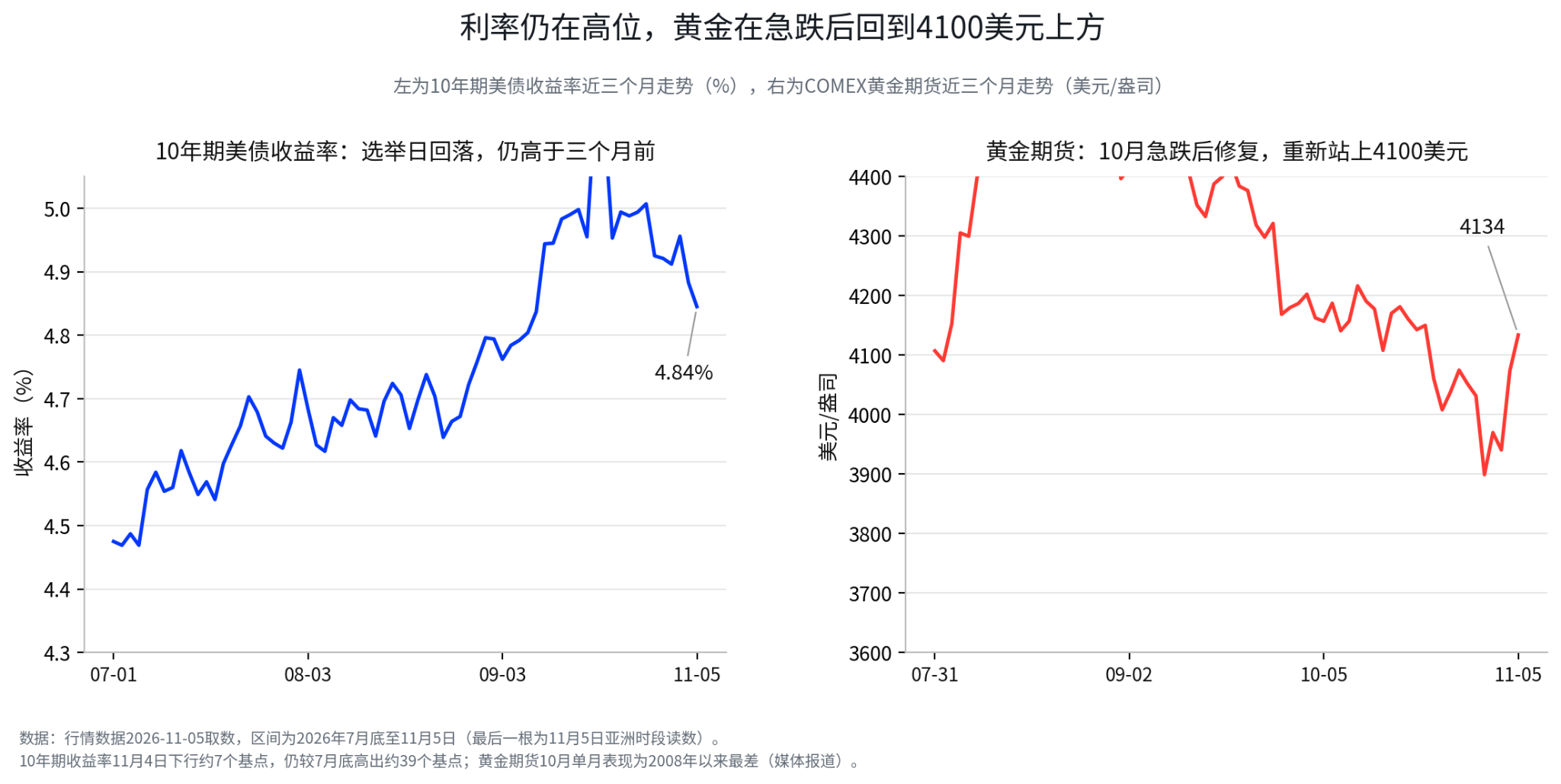
7. From November 10 to the Debt Ceiling: Just Focus on These Key Nodes in the Next 12 Months
The election has passed, and market pricing power will quickly shift to a few specific time points. 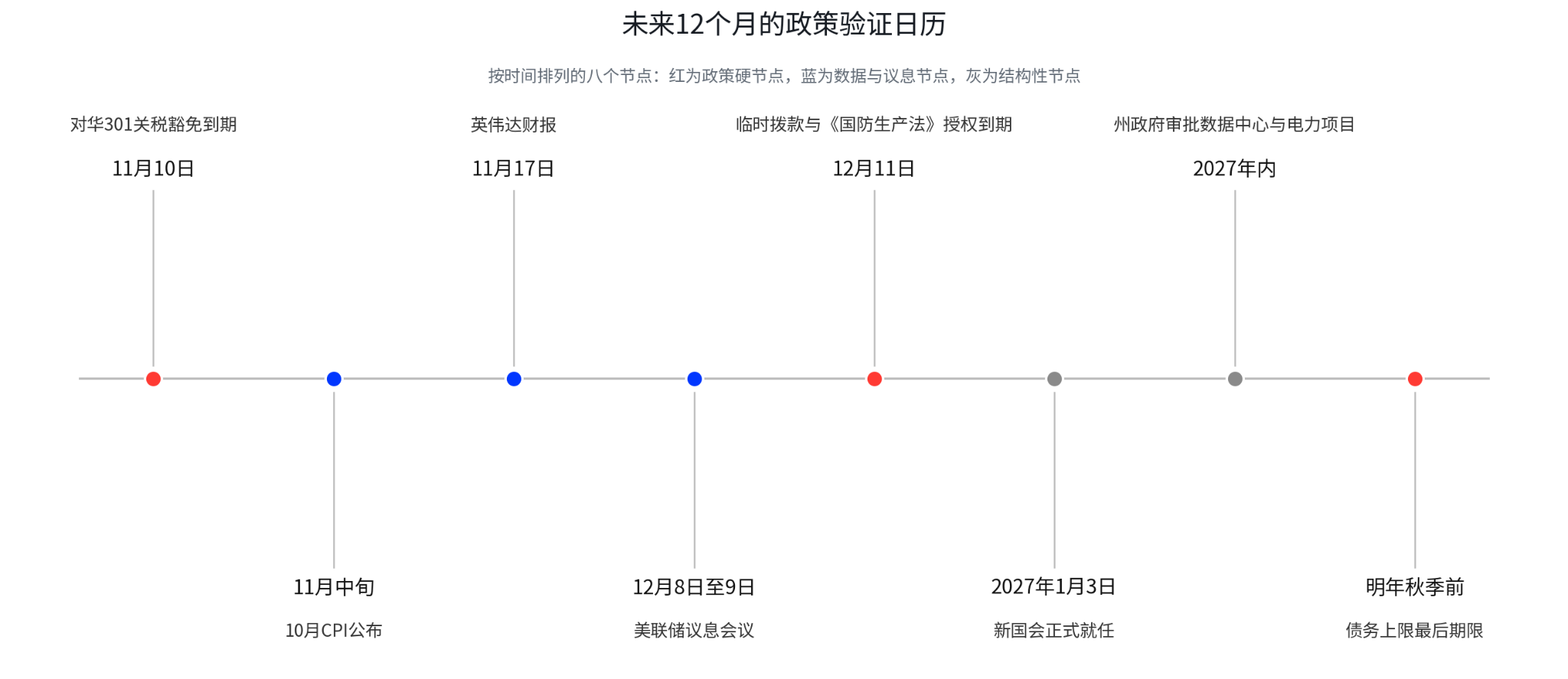
- November 10: Exemptions on 301 Tariffs Against China. Renewal or cancellation decisions rest with the White House, providing the first answer for export chains, linking to the dollar and global inflation expectations.
- Mid-November: October CPI. Whether inflation continues to decline will determine if the Federal Reserve has space, serving as the most direct macro verification point for U.S. Treasuries and gold.
- November 17: Nvidia's Earnings Report. Assessing demand for data centers, order visibility, and capital expenditures rather than revenue itself.
- December 8-9: Federal Reserve Meeting. The total switch for U.S. Treasuries, gold, the dollar, and growth stock valuations will be determined by employment and inflation data.
- December 11: Temporary Funding and the Defense Production Act Authorization. This is the most important political transaction window in the coming months, focused on the release of healthcare subsidies, defense, and shutdown risks.
- January 3, 2027: The New Congress Officially Assumes Office. The Democrats take over the agenda in both houses, and technology regulation, AI compliance, and investigations into the executive branch enter the execution phase.
- 2027: State Governments Determine the Next Round of AI Infrastructure Supply. In terms of computing power, data centers, and power equipment, actual approvals will be more important than verbal statements from Washington.
- Before Next Autumn: Debt Ceiling. A more distant tail risk that will decide whether long-term interest rates and risk assets will face a second policy shock.

Conclusion: Don't Trade on Election Optimism, Trade on Policy Implementation
The market's focus may shift from the election results themselves to the actual implementation of various policies. U.S. Treasuries with fiscal freezes and interest rate directions, December funding texts for healthcare, state and local approvals for AI infrastructure, negotiations over Iran impacting oil, and tariff decisions affecting export chains on November 10. Each asset has its own policy timetable.
The index can lean bullish, but don’t interpret bullishness as a broad rally. The experiences from 2018 have already demonstrated that a rise in the 12 months following an election can coexist with significant pullbacks in the preceding months. Opportunities in the coming year are more likely to arise from differentiation between sectors and assets, rather than a straightforward rebound following a simple election.
Disclaimer:
This content is for general information and market commentary only, compiled from publicly available information as of the time mentioned in the text. Relevant market data, expectations, and probabilities may change with market conditions. The views and investment strategies from third-party institutions, analysts, or others cited in this document represent the opinions of those third parties at a specific time, and do not reflect the views or recommendations of BIT. This document does not constitute investment advice, investment research, an offer, or a solicitation for any securities, investment products, or trading strategies, nor should it be the basis for any investment decision. Financial markets carry risks, and security prices and market performance can fluctuate, with past performance and historical trends not necessarily indicative of future results. Investors should independently assess the related risks based on their circumstances and seek professional advice when necessary. BIT's Hong Kong stock trading services are not offered to residents of Hong Kong or other jurisdictions with restrictions.
免责声明:本文章仅代表作者个人观点,不代表本平台的立场和观点。本文章仅供信息分享,不构成对任何人的任何投资建议。用户与作者之间的任何争议,与本平台无关。如网页中刊载的文章或图片涉及侵权,请提供相关的权利证明和身份证明发送邮件到[email protected],本平台相关工作人员将会进行核查。


