
Today, there are only some fragmented moments, so we won't beat around the bush; let's discuss one topic at a time.
- Politics: I don't think this is a one-time event; this marks a change in the political direction of the United States for the next two years.
I have mentioned before that the midterm elections serve as a testing ground. People will vote based on this to assess whether many of the policies from the past two years can continue to be implemented. Although the ruling party typically faces some issues in midterm elections, this time, it is clearly a significant victory for the Democratic Party.
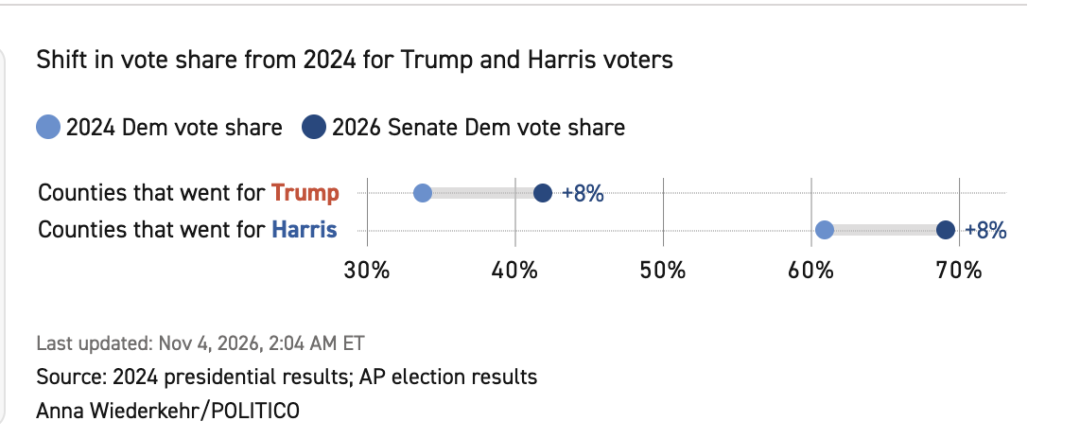
In 2024, regardless of whether areas vote for Trump or Harris, the Democratic Party’s votes increased by 8% this time around.
This is a clear shift in public opinion. To be fair, apart from prices, there haven't been many issues with the U.S. economy in the past two years. Of course, the other side of the coin could be that while the economy has been good, price control has not been effective.
According to the Republicans' perspective, the main reason for losing the election was the Iran issue. Twelve months prior, nobody thought the Democratic Party could sweep the Republican Party, but the Iran issue changed everything.
As observed, in areas with many data centers constructed, people voted for the Democratic Party. This is a very straightforward issue; as long as there is a data center near your home, your internet speed will not get faster, but your electricity bill could increase by a hundred to several hundred dollars a year, and if heating is electric, your home value might drop by 1-2%. So, while many appreciate the jobs brought by data centers, they do not want them next to their homes.
The issue of prices, or affordability, I believe is the reason the Republicans lost the election; this is the same for 2024. From this perspective, the tariff day in 2025, the interest rate cuts in the fall of 2025, and the Iran issue in March 2026 are three levels of accumulated dissatisfaction.
As a commodity trader, my instinct tells me that this is a warning signal. I believe that the Federal Reserve, the White House, and local governments in the U.S. will be more cautious in the next two years and will exercise more caution in many stimulus policies and in disrupting supply chains. In the overall outlook for commodities, I will shift from a dual easing of monetary and fiscal policies over the past few years, coupled with the dual benefits of supply chain disruptions, to focusing on demand logic only when we see interest rate cuts and balance sheet expansions, while holding more vigilance towards the disruptions in supply chains.
I believe there will come a day when commodity prices fall, and then people will return to a growth narrative. However, from my perspective at present, Americans, having experienced a few years of high growth, no longer cherish such growth but want to control inflation.
This is the soul-searching question of the Federal Reserve's dual mandate: at different times, is inflation more important, or is unemployment rate more important? Currently, the unemployment rate in the U.S. is not problematic; the dissatisfaction among the American public is certainly related to inflation. Therefore, in the next two years, when going long on commodities, I will be more cautious. I have no doubt that there is a high probability the Federal Reserve will return to a rate-cutting cycle within the next 24 months. I believe many structural long factors for commodities still exist, but when Americans are dissatisfied with inflation, I will be more cautious about going long on commodity indices.
- Geopolitics: Calm down, or escalate and then calm down.
In the short term, I think the outcome will be one of these two: Americans don't want to fight, and Iran's supreme leader has also said they are open to talks; if both sides cannot reach a consensus, there might be a brief escalation similar to the Shangganling Battle and the Fifth Campaign, but I feel that neither the U.S. nor Iran truly wants to engage in prolonged conflict.
The volatility of oil prices might be structural and long-term, but I think maybe in two months, we will see this war approach its final stage.
However, this doesn't mean the long-term problems will be resolved; I feel the Middle East has been fundamentally altered. For instance, if tomorrow the U.S. aircraft carrier starts bombing Iran and oil prices spike, at that point, will there be more people optimistic about a protracted war, or more who think this is merely the last gasp of the conflict? Are they buying the dip, or selling the rally? I find the answer to this question is very clear.
- Interest Rates: I think long-term U.S. Treasury yields may have peaked in the short term, but this could be a rebound within a bear market.
The core reason for the rise in long-term U.S. interest rates, in my view, is still the deficit rate and excessively high interest payments. Currently, I think the real rates are likely to have peaked in the short term because people do not believe AI can bring better growth; at least not in the short term. The inflation expectations, as mentioned earlier, I think have limited potential for further increases. The significant victory of the Democratic Party has also reduced uncertainty concerns regarding the dollar and U.S. Treasury bonds. While I am not an expert on interest rates, I believe that a ten-year Treasury yield of 4.5% or even below is entirely possible.
However, this does not fully resolve the issues regarding U.S. Treasuries; I think a range of 4.0-4.5%, or a bit more lenient, 3.5%-4.0%, could serve as a bottom range for the ten-year Treasuries for a long time ahead.
- Gold: I believe there is still a distance to reach when it comes to interest rate cuts; a rebound in gold is possible, but it has not yet reached its main upward wave.
The retreat of AI may have reduced the upward space for real interest rates. The anti-war sentiment in the U.S. could potentially diminish the volatility caused by Iran, and the likelihood of the Federal Reserve entering a rate-hiking cycle has been reduced. However, as mentioned previously, I believe that when Americans are unhappy about inflation, and inflation metrics are not meeting the target, the Federal Reserve is almost unlikely to cut rates quickly unless there is an economic risk. So I think a rebound in gold makes logical sense here. A retracement of around 35% from the peak is roughly around 3600; technical support levels at 3700-3800 are prominent. I don't see any issue with building a position; previously, I had planned to sell puts at lower levels, closer to 3700-3800. But since the market did not reach those levels, there is nothing we can do about it. Is this a time to heavily invest? I still have doubts; I believe the current political environment does not support large-scale monetary and fiscal easing. The U.S. is like this, and China also needs time. So this may be a process of rebound and volatility. If everything goes smoothly in the future, it means trading time for space, raising the base before rate cuts and rising after cuts. If problems arise, it simply means a dip before the buy. After the 2018 midterm elections, there was the issue of U.S. high-yield bonds; after 2022, there was the incident with SVB; the probability of a smooth journey during the rate-hiking cycle is not very high. Therefore, I believe it is not the time to heavily invest.
- Copper
Aside from the previously mentioned conflicts between macro and micro factors, I think copper can also be considered a U.S. stock issue. Today, due to concerns over regulation, the market basically feels that the construction of many data centers will face problems. Some neocloud and hardware manufacturers have also encountered risks. However, as long as major tech companies are still willing to invest (their costs have actually decreased), the narrative for AI and copper remains okay.
I believe the narrative surrounding the copper industry essentially revolves around whether, after upstream prices dip slightly, or when tech giants have the chance to consume overly aggressive neoclouds, they will continue to invest steadily in AI. I actually do not know the answer to this question. This may require AI to genuinely produce some commendable applications.
Additionally, I still maintain what was previously said: if macro factors push down copper, downstream inventories are not high, the outcome could resemble April 2025, albeit with possibly different slopes. If downstream replenishment is completed, say by March or April next year inventories return to 100,000 to 200,000 tons, and macro conditions remain as they are today, it might resemble the summer of 2023 when everyone found that expectations were not as good as anticipated, still quite distant from interest rate cuts.
To be frank, when considering the upcoming two years, there are two underlying narratives about copper that occupy my mind:
1. I know the future supply expectations may not go smoothly, and many disturbances will occur. Especially if the U.S. strategically recedes, resource nationalism will only increase, not decrease.
2. I believe the narratives of the past two years have been very advantageous for copper, but Americans have cast a vote against this narrative.
Putting all this together, my view on copper at this moment is that I am willing to buy in case of a significant drop, but if it doesn’t drop, I don’t find much interest because I think its upside potential is also limited.
Finally, as a closing thought, at the end of 2025, I once sketched out a four-quadrant chart, saying that the two most likely scenarios for 2026 are:
- Continuation of 2025, AI is strong, everything else is bad.
- Reversal of 2025, AI has some issues, interest rates fall, other sectors improve.
At that time, I felt the probability of the latter was slightly higher, resulting in two different trading logics across the year.
Today, regarding commodities, when I think about strategies for 2027, my first reaction is that when the U.S., and indeed many countries, are striving to control inflation, to go long on commodities broadly either requires inflation to be kept in check (perhaps with a strategy of going long oil while shorting everything else) or it necessitates a crisis. If this crisis occurs in emerging markets, it resembles 1997; if it happens in the U.S., it is more akin to 2018.
I believe in the past few months, due to the midterm elections and the rate hikes from the September FOMC, many commodity prices have shown significant declines. We might all wish to quickly return to that world of long positions. However, from a political perspective, this midterm election was a vote against the inflation that followed the rate cuts of the past few years. I think a rebound is entirely possible, but for me, until inflation is controlled to a level that makes the Federal Reserve happy, I find the logic of comprehensively going long to be questionable.
This is a very first-time thought; I have a long time to think more during my journey, and by the weekend, I believe I will have a more comprehensive perspective.
免责声明:本文章仅代表作者个人观点,不代表本平台的立场和观点。本文章仅供信息分享,不构成对任何人的任何投资建议。用户与作者之间的任何争议,与本平台无关。如网页中刊载的文章或图片涉及侵权,请提供相关的权利证明和身份证明发送邮件到[email protected],本平台相关工作人员将会进行核查。


