Recently, the Ethereum Foundation released a long-term technical roadmap named Strawmap on the X platform, breaking down an almost abstract vision of achieving Lean Ethereum by 2029 into clear engineering milestones: H* is marked as the last fork "without Lean features," essentially the final chapter of an old era; the subsequent I* plans to bring leanVM and Lean transactions to the mainnet, beginning the real slimming down of the execution layer; further along, J* will introduce Lean proofs, data availability sampling, and PCS, compressing and reshaping consensus and data layers, reserving technological space for the eventual realization of a complete Lean Ethereum in the L phase. At the same time, the cryptocurrency market is staging a high-leverage drama on the other end: as of November 5, 10:13 AM Beijing time, CoinGlass reported that about $983 million of positions had been liquidated across the network in the past 24 hours, involving around 130,900 traders, with short positions liquidated for approximately $582 million and long positions around $401 million, among which the largest was a $38 million ETH-USDT long position on HTX being forcefully closed. The juxtaposition of the long-term roadmap and short-term liquidation data creates a calm yet sharp contrast between Ethereum's technical narrative and the real market environment.
Relay From H* to L Forks
At the same moment when short-term leverage was ruthlessly liquidated, the Foundation drew another timeline for this chain: the fork sequence from H* to L. According to the annotations of Strawmap, H* is the last Ethereum fork that does not include any Lean features, marking a period's end—before this point, the protocol still follows the existing execution paradigm and transaction forms; after this point, the roadmap no longer allocates new major versions to "maintain the status quo," but continues to advance toward the goal of Lean Ethereum.
The baton clearly shifts direction in the hands of I*. According to the roadmap, I* plans to introduce leanVM and Lean transactions, which specifically translate the "slimming" vision into the execution layer and transaction layer: the former reshapes the computing environment, while the latter rearranges the transaction structure, layering both, reserving space for more aggressive compression and proof mechanisms in the future. The subsequent J* fork will build on this by adding Lean proofs, data availability sampling, and PCS, bringing the transformation of consensus and data layer to the forefront, making "how to prove, how to sample, how to submit" mesh seamlessly with "how to execute, how to package." The roadmap anticipates completing Lean Ethereum in the L phase, meaning that once the relay from H* to L is completed, Ethereum will structurally turn from "non-Lean" to "Lean Ethereum" at a clearly marked engineering milestone.
LeanVM and New Transactions: Reducing Burden on the Protocol Layer
In the Strawmap, not only "how to prove, how to sample" is re-engineered, but also "how to execute, how to account." The vision of Lean Ethereum is to first bring leanVM and Lean transactions onto the chain with the I* fork, allowing the protocol layer to retain a more streamlined and boundary-defined execution core. leanVM is envisioned as a virtual machine that reduces historical burdens, stripping away complexities unrelated to security that have accumulated in the underlying protocol; the accompanying Lean transactions are not merely a format change, but an attempt to make each state transition lighter and more organized before entering consensus, passing as much verifiable and sortable burdens to more appropriate layers. For nodes, this is a form of burden reduction: less ambiguous and redundant tasks undertaken, while more clear and verifiable tasks are handled.
The following J* fork is more straightforward in the roadmap—Lean proofs, data availability sampling, and PCS are packed as focus areas for the next stage, meant to catch the structural changes brought by the previous round of "burden reduction." Lean proofs aim to tighten the validation process itself, while data availability sampling and PCS are designed so that nodes no longer "bear all load" when processing data, but rather maintain a balance between safety and efficiency with smarter sampling and submission mechanisms. All these features are positioned within the rhythm of multiple forks, rather than being crammed into a single "big upgrade." The Ethereum Foundation clearly breaks them down into engineering milestones from H* to L in the Strawmap, as a declaration: LeanVM, Lean transactions, Lean proofs, data availability sampling, and PCS form a slowly advancing technological vision line before 2029, rather than being a short-term market strategy responding to liquidation data on a trading day.
$983 Million Liquidation Versus Ethereum's Long Run
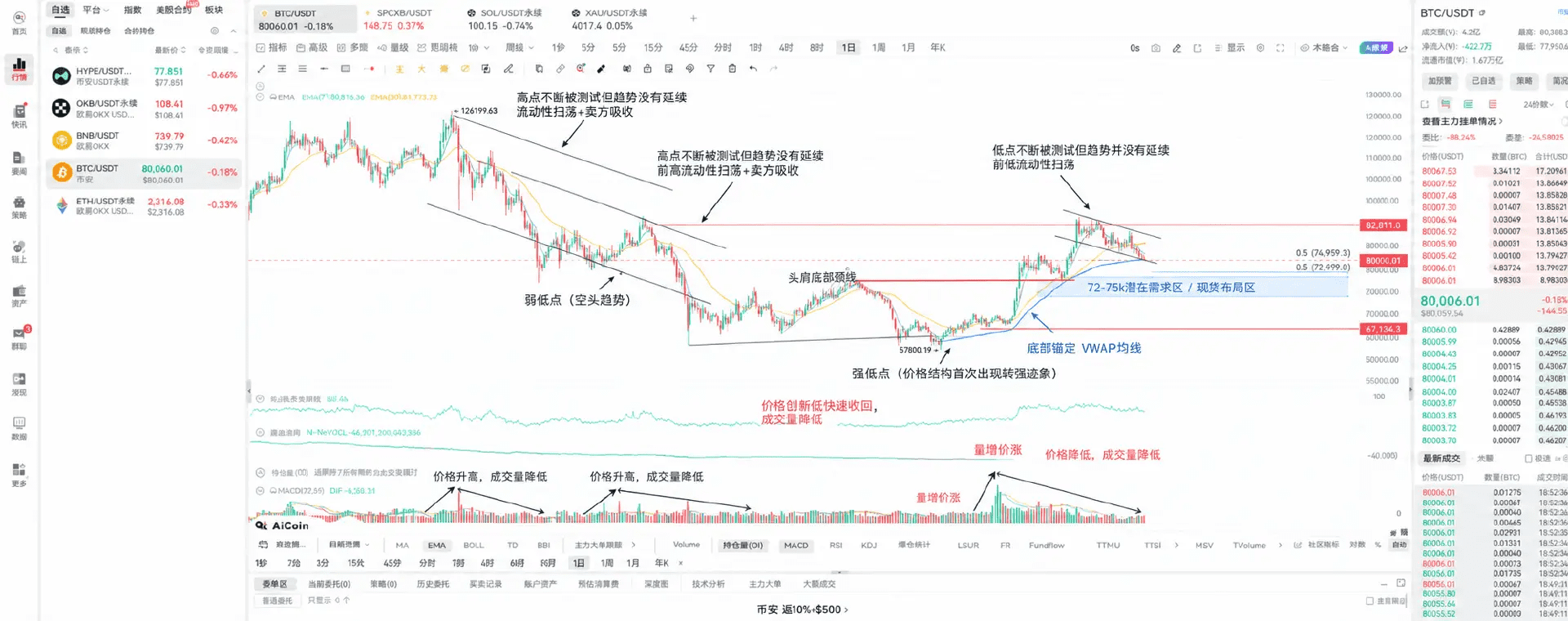
At the same time that the Foundation penned the technical milestones from H* to L into the Strawmap, the market provided a completely different picture: as of 10:13 AM Beijing time on November 5, a total of about $983 million had been liquidated across the network in the past 24 hours, with shorts liquidated for approximately $582 million, longs around $401 million, and about 130,900 traders swept out in this round of volatility. The largest liquidation came from the ETH-USDT trading pair on HTX, where a long position valued at about $38 million was directly wiped out by leverage. These numbers delineate a reality outside the chain's technical trajectory: high leverage, two-way liquidations, and severe price fluctuations form the everyday background of the current market.
This parallel appearance can easily be interpreted as a narrative structure of "technical roadmap responding to market conditions," but it is necessary to separate the narrative from the facts: existing information does not establish a direct causal link between the $983 million liquidation and the release of Strawmap; they more resemble two lines extending in different directions during the same period. One line repeatedly liquidates during a 24-hour settlement cycle, while the other line, with 2029 as its endpoint, breaks down leanVM, Lean transactions, Lean proofs, data availability sampling, and PCS into multiple fork stages, slowly advancing toward the Lean Ethereum node pointed to by L. For Ethereum, what truly deserves attention is not whether a particular liquidation triggered a certain roadmap, but rather how to adhere to a multi-year technological marathon in such a high leverage and high volatility environment.
Multiple Forks Replace One Big Bet
The Strawmap breaks down Ethereum's next phase transformation into a series of forks arranged alphabetically: H* is marked as the last fork containing no Lean features, I* starts to introduce leanVM and Lean transactions, followed by J* adding Lean proofs, data availability sampling, and PCS, until the L phase is described as the point of Lean Ethereum's completion. The Foundation clearly states in the roadmap that this is a plan that progresses gradually through forks, rather than relying on a single "big and comprehensive" hard fork to set the tone. Each letter node only undertakes partial changes; after the previous phase runs smoothly, more aggressive designs are introduced in the following phases, using verifiable engineering progress to replace the fantasy of one upgrade solving all problems.
For developers, this splitting implies a change in workflow from betting on a final showdown to doing phased integration and testing around the nodes H*, I*, J*, and L: each fork only affects a limited range of code, making it easier to correlate issues with versions, but it also requires more time to maintain and iterate in a multi-version parallel environment. For validators and operating nodes, the risk is no longer concentrated on a single "life-and-death fork," but spread across multiple upgrades: clients must keep up frequently, but the bulk and uncertainty of each change are compressed, relatively benefiting from discussions in the community, testnet rehearsals, and gradual deployments. The entire community will collaborate under a narrative progressing by letters—from acknowledging H* as still the "old Ethereum," to observing if I* and J* fulfill Lean's performance and security promises, and then evaluating whether the L phase is worthy of being called Lean Ethereum. The long-term route itself remains filled with uncertainties in execution and coordination: whether each fork node can land on time, whether consensus can be maintained in disputes, has no guarantees, but at least this Strawmap breaks uncertainty down into specific milestones that can be discussed, rolled back, and reconfigured.
2029 Countdown: Technological Vision and Market Game
The Strawmap sets the endpoint for Ethereum's Lean Ethereum in 2029: from H* as the last fork without Lean features, to I* and J* gradually introducing leanVM, Lean transactions, Lean proofs, data availability sampling, and PCS, to the L phase described as the expected completion node for Lean Ethereum. This route clearly marks the coordinates of the technological vision yet deliberately omits a detailed timeline of the specific execution rhythm. Concurrent with the announcement of the roadmap, the cryptocurrency market recorded approximately $983 million in liquidations over the previous 24 hours, with shorts and longs liquidated for about $582 million and $401 million, respectively, and around 130,900 traders swept into the whirlpool of leverage corrections, the largest single liquidation being even a long position worth about $38 million on HTX. Long-term narratives and short-term risks form a stark contrast within the same time window. For developers, holders, and speculators, 2029's Lean Ethereum will not automatically materialize with a mere Strawmap; it appears more like a storyline that needs to be repeatedly priced in every fork vote and every market fluctuation: the technical roadmap breaks the long-term goal into verifiable nodes like H*, I*, J*, L, while the community must continually answer a question in a high-leverage, high-uncertainty environment—whether Ethereum's mid-to-long-term narrative is truly worth believing in under such an execution path and market structure.
Join our community to discuss and grow stronger together!
AiCoin exclusive Hyperliquid benefits: https://app.hyperliquid.xyz/join/AICOIN88
AiCoin exclusive Aster benefits: https://www.asterdex.com/zh-CN/referral/9C50e2
On-chain Telegram community: https://t.me/AiCoinWhaleData
On-chain community: https://www.aicoin.com/link/chat?cid=N6OVMor5g
AiCoin on-chain Twitter: https://x.com/aicoinwhaledata
免责声明:本文章仅代表作者个人观点,不代表本平台的立场和观点。本文章仅供信息分享,不构成对任何人的任何投资建议。用户与作者之间的任何争议,与本平台无关。如网页中刊载的文章或图片涉及侵权,请提供相关的权利证明和身份证明发送邮件到[email protected],本平台相关工作人员将会进行核查。