Original source: Jin Ten Data
The results of the U.S. midterm elections are changing the political landscape of Texas and introducing new policy uncertainties for the rapidly expanding artificial intelligence (AI) infrastructure industry in the area.
Democratic candidate Gina Hinojosa defeated Republican incumbent Governor Greg Abbott, while Democrat James Talarico won against Republican candidate Ken Paxton in the federal Senate election.
This result ends the Republican dominance in the Texas governorship that has lasted for over thirty years. Talarico also becomes the first Democrat to win a Texas federal Senate election since 1988.
The relevant election results have been confirmed by media outlets such as The New York Times and CBS, but official election results still need to complete official certification.
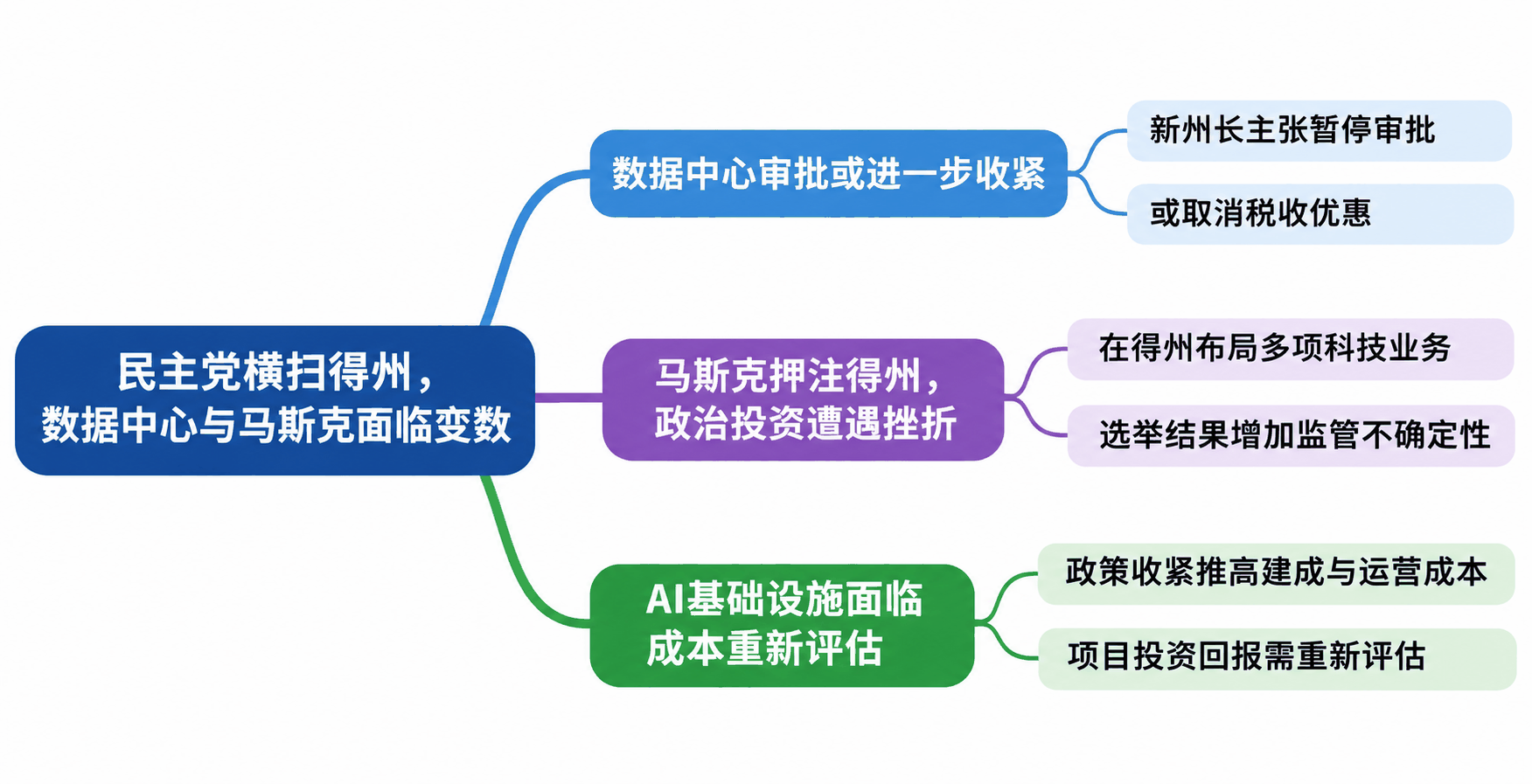
Approval of Data Centers May Tighten Further
Texas is an important region for AI infrastructure development in the United States, with technology companies like Microsoft (MSFT.O), Amazon (AMZN.O), and Nvidia (NVDA.O) laying out data center projects locally.
However, as the electricity demand for data centers grows rapidly, the impact of related projects on the power grid, residents' electricity costs, water resources, and the local environment has become a significant issue in local elections.
Hinojosa advocated during her campaign for a pause on new data center project approvals and the cancellation of tax incentives enjoyed by related facilities. She also criticized Abbott's previously announced measures to pause some data center constructions as inadequate.
In fact, Abbott had announced in September this year a pause on the approval of some data center projects and arrangements for grid access, but Hinojosa seeks to implement broader restrictions to buy time for formulating measures concerning residents' electricity costs and environmental protection.
Meanwhile, newly elected Senator Talarico also advocates for strengthened regulation of data centers.
This policy change means that future Texas AI projects may face stricter conditions regarding electricity access, environmental reviews, and tax incentives.
The current election results do not mean that existing data centers will cease operations immediately; the specific impact still depends on the policy formulation and implementation scope of the new government after taking office.
Musk Bets on Texas, Political Investments Face Setbacks
The change in Texas's political landscape has special significance for Tesla and SpaceX CEO Musk.
In recent years, Musk has relocated the headquarters of Tesla and SpaceX to Texas and is continually expanding local business operations.
SpaceX has an important launch base in southern Texas for its Starship rocket.
Additionally, Musk previously announced plans to build a large semiconductor manufacturing base named Terafab in Grimes County, Texas, with participation from both Tesla and SpaceX.
This project is one of Musk's significant plans to expand chip manufacturing capabilities.
Musk has invested nearly $450 million in this midterm election to support Republican candidates. Among those, the Texas Senate election is one of the key political battlegrounds he focused on.
Musk has previously criticized Talarico multiple times on the social platform X, calling him an "extreme left radical" and accusing him of harming Texas interests due to his political stance.
However, Talarico ultimately defeated Paxton, who received Trump’s support, meaning Musk's political investments in the area did not translate into the expected election results.
AI Infrastructure Faces Cost Reevaluation
The Texas election results also reflect a changing attitude in American society towards the construction of large data centers.
Previously, large tech companies typically viewed data center projects as important investments that could create jobs, increase local tax revenues, and promote economic growth.
However, as the scale of construction expands, residents are becoming more concerned about the impact of data centers on electricity prices, water resources, and public infrastructure.
According to statistics previously compiled by The Information, out of the 36 states holding gubernatorial elections this year, at least one major party candidate in 21 states supported pausing some data center construction.
This trend is not entirely divided along party lines, as some Republican candidates also advocate for strengthened related restrictions.
Brad Gerstner, CEO of investment firm Altimeter Capital, stated on election night that the Democratic victories may slow down the construction of data centers, but he believes the concerns over the impact of related policies may be overstated.
For tech companies, Texas still has advantages such as industrial clusters, energy resources, and existing infrastructure, but the new government may reevaluate the economic benefits and social costs of data centers.
In the future, it will be worth paying attention to whether Hinojosa fulfills her promise of broader approval pauses and whether new electricity and tax policies will change tech companies' investment plans in Texas.
This election has introduced new policy variables for the expansion of AI infrastructure in the U.S., but it is still insufficient to conclude that Musk's companies or local large data center projects will face direct restrictions.
免责声明:本文章仅代表作者个人观点,不代表本平台的立场和观点。本文章仅供信息分享,不构成对任何人的任何投资建议。用户与作者之间的任何争议,与本平台无关。如网页中刊载的文章或图片涉及侵权,请提供相关的权利证明和身份证明发送邮件到[email protected],本平台相关工作人员将会进行核查。


