
【MSX Research Institute·US Stock RWA Daily Observation】 is an iconic daily report produced by the leading RWA trading platform MSX. With our strong macro research capabilities, we capture the core pulse of global traditional US stocks, liquidity changes, and the RWA tokenization market, assisting you in forward-looking arrangements of quality assets.
Today's Observation
AMD is accelerating its transformation from a semiconductor company primarily focused on CPUs and gaming chips to an AI infrastructure platform covering CPUs, GPUs, networking, rack systems, and software.
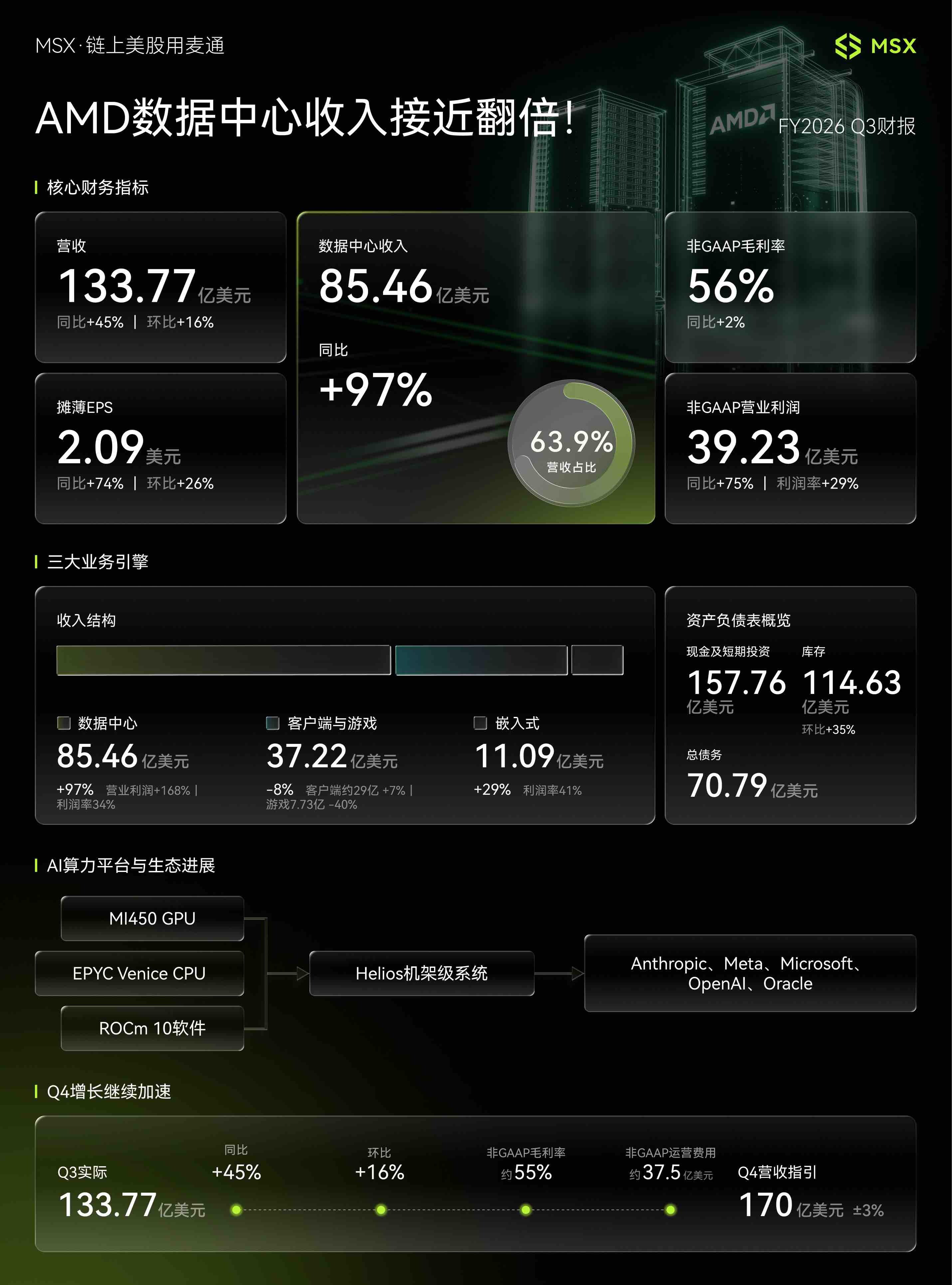
In the third quarter of FY2026, AMD's revenue reached $13.377 billion, a year-over-year increase of 45% and a quarter-over-quarter increase of 16%, exceeding market expectations of approximately $13.06 billion; adjusted EPS was $2.09, a year-over-year increase of 74%, higher than the market expectation of about $1.94. GAAP operating profit reached $2.832 billion, a year-over-year increase of 123%; adjusted operating profit reached $3.923 billion, a year-over-year increase of 75%. Adjusted operating profit margin increased from 24% in the same period last year to 29%, indicating that the expansion of the data center business not only drives revenue growth but also begins to release operational leverage.
More notable in this financial report is the data center business. Third-quarter data center revenue reached $8.546 billion, a year-over-year increase of 97% and a quarter-over-quarter increase of 27%, accounting for approximately 64% of the company’s total revenue. Operating profit for this division reached $2.882 billion, a year-over-year increase of 168%, with the operating profit margin rising from about 25% in the same period last year to around 34%.
Growth is also coming from EPYC server CPUs and Instinct AI GPUs. AMD has begun ramping up production of the MI450 series GPUs and Helios rack-level systems, with Anthropic, Meta, Microsoft, OpenAI, and Oracle Cloud Infrastructure running models or workloads on the first Helios systems. The next-generation "Venice" EPYC server CPUs have also begun to enter the ramp-up stage of mass production.
AMD expects fourth-quarter revenue to be about $17 billion, with a fluctuation of 3%, corresponding to a range of approximately $16.49 billion to $17.51 billion, with the median above the market expectation of about $16.23 billion. Based on the median, fourth-quarter revenue is expected to increase year-over-year by about 66% and quarter-over-quarter by about 27%.
Management anticipates that fourth-quarter data center revenue will increase by about 50% quarter-over-quarter, and AI GPU business scale will also for the first time exceed server CPU business. The company also expects total revenue growth of over 80% in 2027, with server CPU revenue nearly doubling, and the data center business will contribute over 80% of the company's revenue. After the financial report was released, AMD's stock price rose about 7.5% in after-hours trading.
Data in a Minute
• FY2026 Q3 revenue $13.377 billion, year-over-year increase of 45%, quarter-over-quarter increase of 16%;
• Market expectation revenue approximately $13.06 billion;
• Data center revenue accounts for approximately 63.9% of total revenue;
• Data center operating profit $2.882 billion, year-over-year increase of 168%;
• Data center operating profit margin approximately 33.7%, compared to approximately 24.7% in the same period last year;
• Client and gaming business revenue $3.722 billion, year-over-year decrease of 8%, quarter-over-quarter decrease of 3%;
• Among them, client revenue $2.949 billion, year-over-year increase of 7%;
• Gaming business revenue $773 million, year-over-year decrease of 40%;
• Client and gaming division operating profit $573 million, year-over-year decrease of 34%;
• Embedded business revenue $1.109 billion, year-over-year increase of 29%, quarter-over-quarter increase of 14%;
• Embedded business operating profit $453 million, year-over-year increase of 60%;
• Embedded business operating profit margin approximately 40.8%;
• Third-quarter operating cash flow $1.202 billion;
• Capital expenditure $648 million;
• Free cash flow $554 million, down from $1.530 billion in the same period last year;
• Free cash flow rate approximately 4%;
• Cash, cash equivalents, and short-term investments totaled $15.776 billion at the end of the quarter;
• Total debt $7.079 billion, including $4.75 billion senior debt financing completed in August;
• Market previously expected Q4 revenue approximately $16.23 billion;
• Q4 adjusted gross margin guidance approximately 55%;
• Management expects data center business to account for over 80% of company revenue by 2027;
• After the financial report was released, AMD's stock price rose about 7.5% in after-hours trading.
MSX View
Currently, AMD has three growth curves, the first being EPYC. Although AI data centers mainly use GPUs as the primary computing resource, each GPU system still relies on CPUs for system scheduling, network management, storage access, data pre-processing, and numerous general computing tasks. The larger the AI cluster, the higher the demand for high-performance server CPUs.
Thus, AMD's EPYC business benefits from two trends: one is the continued gain in market share from traditional server CPUs, and the second is the growth in total server demand brought about by the expansion of AI data centers. The next-generation "Venice" processors will utilize the Zen 6 architecture, and AMD expects this product to start ramping up production in the fourth quarter. Management anticipates that server CPU revenue will nearly double by 2027, indicating the company believes that AI infrastructure's demand for CPUs is not a short-term phenomenon.
The second growth curve is Instinct GPUs. The MI450 series is a key product for AMD trying to narrow the gap with Nvidia. Compared to earlier sales of single accelerator cards, the MI450 and Helios begin to be delivered as complete rack systems, integrating GPUs, EPYC CPUs, networking chips, interconnects, cooling systems, and ROCm software on the same platform.
This change is very important. Large AI customers are purchasing not just chips, but a computing system that can be directly installed, networked, and used to run models. The scale of individual contracts for rack-level products is larger, with greater requirements for supply chain coordination, network technology, software compatibility, and delivery capability. AMD states that Anthropic, Meta, Microsoft, OpenAI, and Oracle Cloud Infrastructure have already been running models or workloads on the first Helios systems. This indicates that Helios has moved past the simple product demonstration stage and into customer validation and initial deployment.
The third growth curve is a complete AI platform. AMD has primarily relied on customers to procure CPUs, GPUs, and other components for integration by server manufacturers. Now the company is expanding upwards to Helios rack systems while strengthening its offerings in networking, software, and dedicated inference chips. The company has released ROCm 10 and launched the Helion reference architecture aimed at intelligent systems. AMD also plans to acquire World Labs and Taalas: World Labs can supplement spatial intelligence and world model research capabilities, while Taalas focuses on customized inference chips. These investments show that AMD wants to be involved not just in the GPU market but in a complete AI infrastructure system from models, software to chips and rack systems.
This strategy also brings new risks. First, AMD needs to invest simultaneously in GPU architecture, CPUs, networking, software, rack design, and customer support, significantly increasing R&D and operational complexity. This quarter, adjusted operating expenses grew 29% year-over-year to $3.560 billion, and the growth rate remains fast.
Second, some large AI agreements include customer warrants. AMD confirmed about $1.097 billion in non-cash expenses related to the fair value change of customer warrants this quarter, which expanded the difference between GAAP and adjusted profits.
Warrants can help AMD bind large customers but may also pose potential equity dilution. Determining whether these agreements create value for shareholders requires comparing the revenues, profits, and cash flows generated by customers against the costs of warrants and related investments.
Third, revenue and profit growth has not yet synchronously translated into free cash flow. AMD's adjusted net profit reached $3.471 billion in the third quarter, but free cash flow was only $554 million. The main reason is not operational losses but that the company is preparing inventory and expanding working capital for rapid ramp-up. This quarter, inventory increased by approximately $2.995 billion, accounts receivable increased by approximately $1.928 billion; accounts payable increased by about $2.313 billion, partially offsetting cash occupancy. Inventory at the end of the quarter reached $11.463 billion, a quarter-over-quarter increase of 35%.
Preparing chips, packaging, memory, and system components in advance before MI450, Helios, and Venice enter large-scale ramp-up is commercially reasonable. If fourth-quarter and 2027 orders are delivered as planned, this inventory will transform into revenue and cash flow. However, if customer data centers are delayed, supply chains become mismatched, or product demand changes, high inventory may also lead to slower turnover and impairment risks. Therefore, inventory growth is both a pre-signal for accelerated future revenue and a risk indicator that must be continuously monitored.
In the past, the main question from the market regarding AMD was whether Instinct products could transition from limited trials to large-scale procurement. Now, with data center revenue approaching a doubling, MI450 and Helios starting to contribute revenue, and several leading customers entering system verification and deployment stages, fourth-quarter data center revenue is expected to increase by about 50% quarter-over-quarter.
About MSX:
MSX is a leading RWA trading platform dedicated to providing secure, efficient, and transparent access to global financial markets. As one of the earliest on-chain US stock trading platforms, MSX has always been at the forefront of the industry, leading market transformations with continuous innovation.
The platform deeply integrates blockchain technology and compliance frameworks, comprehensively providing spot and derivatives trading for nearly 400 tokenized stocks and Pre-IPO assets, perfectly bridging the gap between traditional finance and the digital asset industry.
Centering around the core mission of “enabling quality assets to flow freely,” MSX has currently built a diverse digital financial service system that includes US stock spot and perpetual contracts, crypto-to-crypto trading, Pre-IPO, and the MSX Research Institute, aiming to provide global investors with around-the-clock, high-performance access to quality asset participation.
Official Website: https://msx.com/
Chinese TG:https://t.me/MSXOfficial
Global TG:https://t.me/MSXGlobal
Risk Disclaimer: Macroeconomic conditions and US stock market fluctuations are severe, and the content of this article is for academic and research observation reference only and does not constitute any investment advice.
免责声明:本文章仅代表作者个人观点,不代表本平台的立场和观点。本文章仅供信息分享,不构成对任何人的任何投资建议。用户与作者之间的任何争议,与本平台无关。如网页中刊载的文章或图片涉及侵权,请提供相关的权利证明和身份证明发送邮件到[email protected],本平台相关工作人员将会进行核查。


