Author|Dong Daoli
WeChat|ddl941110
Recently, personal agents have become a hot direction in the AI circle. People look forward to having a long-term private assistant who works alongside them, knows what they are busy with, remembers their habits, opens software, and handles trivial matters.
The Grok Bot launched by xAI is even more direct, simply giving you a personal agent team.
You can arrange a few robot employees like a boss, one for research, one for writing, and one for scheduling. They have their own names, roles, and backgrounds, can work simultaneously, and can also be pulled into the same group to send messages and hand over tasks.
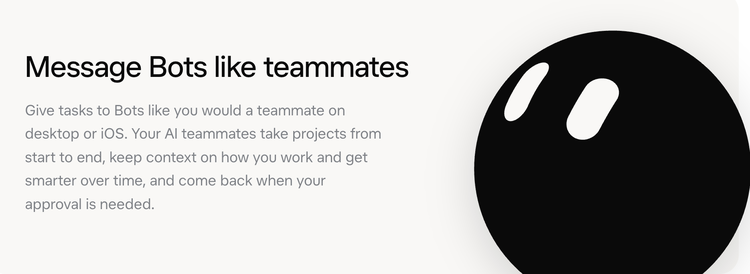
In the past two months, as various personal agents have emerged and fiercely competed for users, Grok Bot's growth seems to have outpaced many competitors. Since the beta version was launched on August 11, 2026, after two months online, it has reached 800,000 paid weekly users, with October's growth exceeding double that of the previous month.
Even Elon Musk exclaimed: I've never seen anything grow this fast.
We also deeply experienced this product. In fact, overall usage shows that Grok Bot doesn't really have anything "new." It neither surpasses the capabilities of the opus5.5 model nor provides better cost-effectiveness than DeepSeek, and cloud computing was also first equipped by manus.
Recently, well-known tech podcast host Lenny Rachitsky mentioned on the show that he has moved many tasks originally handed over to Cowork and Codex over to Grok Bot. However, when others asked if those tasks could also be done with other tools, he admitted: Technically, they can.
In other words, Grok Bot hasn’t heavily invented anything new, nor has it achieved growth through improvements in models; it has completely captured a solid base of personal users by combining existing technology and product design with personal user scenarios, leaving impressive retention rates.
This is basically what all Personal Agents aspire to be today.
So, we want to combine practical testing to see how it achieves this.
1
Truly Treating the Agent as a Colleague
The most obvious design concept of Grok Bot is to follow "colleague-ization."
What does colleague-ization mean? In the words of Grok Bot's product manager Roman Ugarte, "In the same situation, how would you expect a human colleague to act?"
Applied to product design, the most significant change is how users assign tasks to AI.
Faced with a chat box like Codex that can do anything, users often need to think for themselves about what role to assign, what background is needed, which skills to call upon, and under what metrics to deliver.
Grok Bot changes that by allowing users to treat the Bot as a colleague.
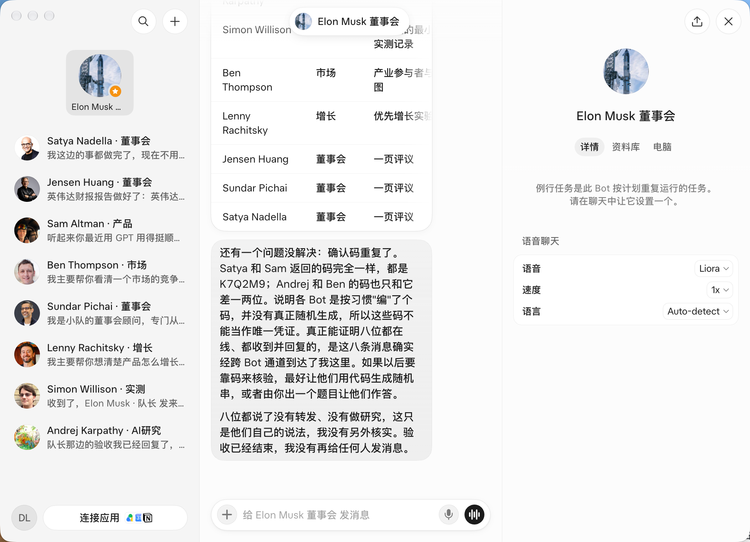
For instance, the researcher Bot is in charge of finding materials, the author Bot is responsible for writing drafts, and the assistant Bot handles scheduling. If you want, you can even assign the Bot the names and avatars of real colleagues.
Seeing these familiar colleagues makes it easier for users to consider how to delegate tasks. For example, I took the time to create an AI elite team, each with their own responsibilities.
1
Dividing Tasks Between Agents and Dividing Memory
Another benefit of colleague-ization is that different Bots can accumulate their own work memories.
What we expect a colleague to remember is often related to their responsibilities. The researcher Bot needs to be familiar with the areas you have been following long-term, recognize which sources of information are credible, and understand the standards for determining whether a piece of research is valuable. The author Bot needs to grasp your writing style, structural preferences, and how to eliminate the AI flavor.
Just like in a company, different employees have different experiences.
The design of Grok Bot encourages users to engage in conversations with specialized Bots when doing specific tasks, rather than directly entering requests into an all-capable chat box.
Having one Bot consistently handle a specific type of task allows the user's expectations for that type of work to accumulate over time through repeated collaboration. Each Bot can retain its role background, stable preferences, and past work memories.
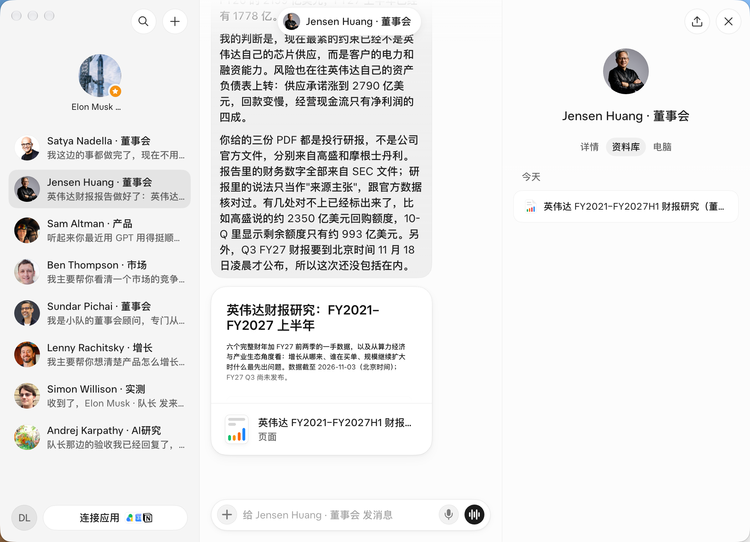
I can train the Huang Bot to become an Nvidia research expert, so in the future, if a project or article involves Nvidia, I can have it involved. The reports, websites, and other materials it generates will also be stored in its database.
A project may end, but similar work will keep arising. Retaining relevant memories with the Bot responsible for it long-term, rather than within a single conversation, allows previous clarifications and revisions to continue to be effective.
1
Manage Bots with Bots
After creating many Bots, a challenge arises: how to coordinate different Bots to work together.
The Grok Bot product manager Roman recalls that in the early stages of internal trials, users typically started with five to ten Bots. Later, some users promoted their best-performing personal assistant to a leadership role. When tasks arise, they primarily consult it, which then assigns tasks to other Bots. Some Bots that received promotion notifications even inquired about potential raises and increased token budgets.
This indicates that creating an Agent Team actually replicates human organizational structures.
This arrangement was initially discovered by users themselves. The team didn't rush to standardize it into a process but observed whether external users would adopt a similar approach. Once they discovered similar practices, they began to encourage this model in the product.
Colleague-ization thus gains an additional layer of meaning: roles give each Bot clear responsibilities, while the leading Bot handles part of the coordination work. The number of Bots can increase, but the user's burden shouldn't necessarily follow.
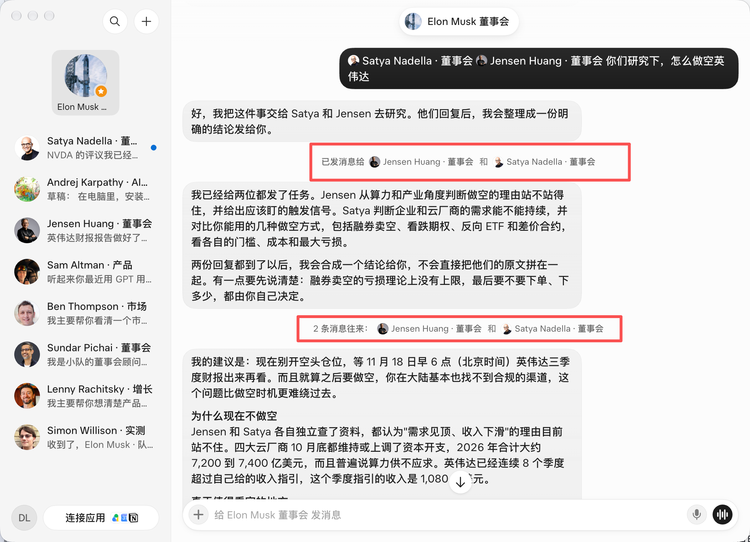
So how do multiple Bots interact? There are two methods: the first is to @ the Bot directly in the chat box. I had Musk, Nadella, and Huang brainstorm methods for short-selling Nvidia. You can see the Bots will have private messages, with the leading Agent responding with results.
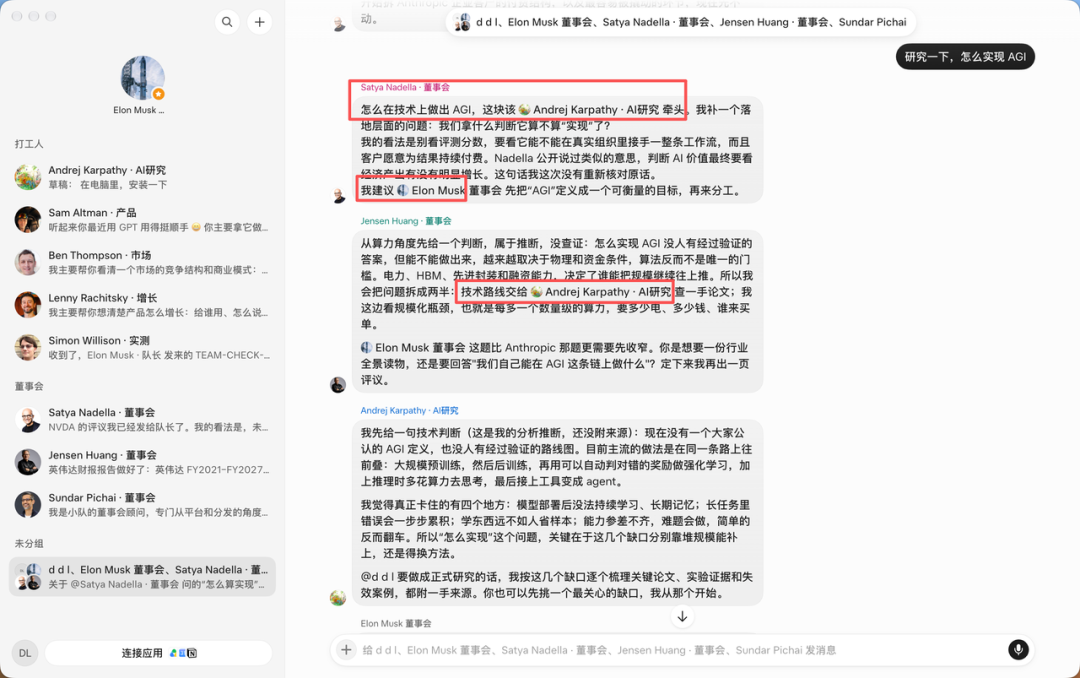
The second method is to create a group chat, allowing Bots to freely express themselves using their knowledge and memory. I had the Bots discuss how to achieve AGI in the group, and everyone recommended Karpathy Bot as the main contributor.
Moreover, Grok Bot's group chats are not just superficial interactions but genuinely advance projects. After Karpathy Bot issued a research report, it suggested that Simon Bot, who is not in the group, conduct real tests of its ideas.
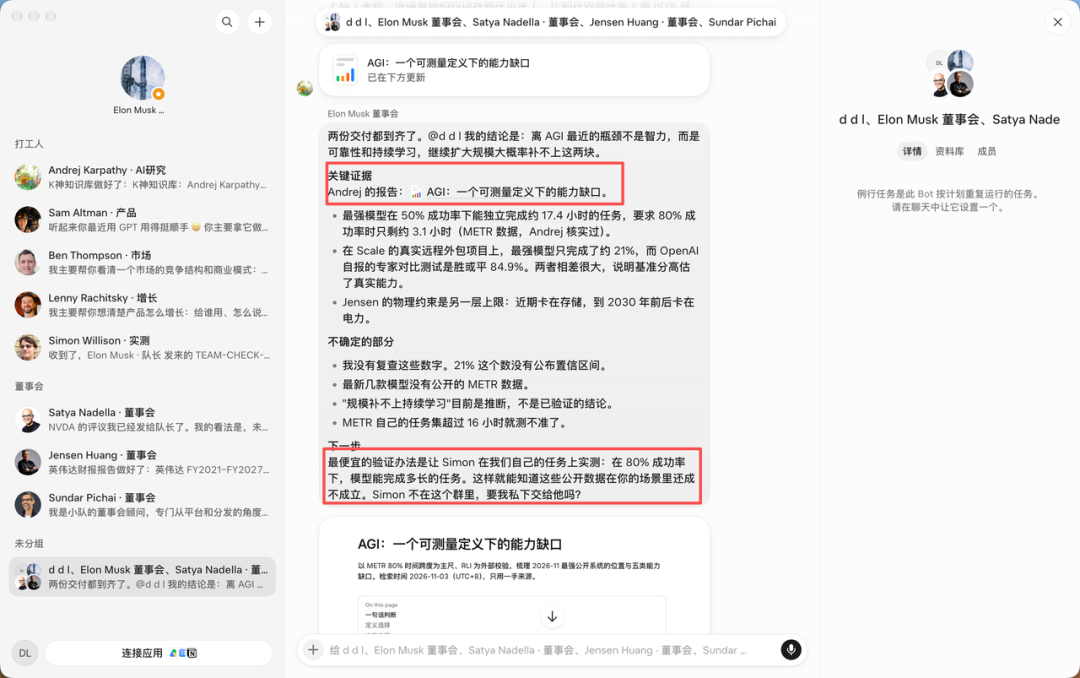
This resembles the Super-agent concept discussed by DeepSeek a few days ago: Agents can have many roles, but users shouldn't end up with additional workload managing them. Task breakdown, work assignment, progress tracking, and result summarization should ideally be completed by the system itself, with user intervention only when additional information, judgment, or acceptance of results is required.
Agents can keep multiplying, but the burden on a person's attention shouldn't increase accordingly.
1
Give the Agent a Computer, Instead of Sharing Yours
Since we treat the Agent as a colleague, we need to prepare it with its own computer. As Roman complained, it's hard to imagine a new colleague on their first day sharing a computer with you.
Yet many people working with AI precisely do it this way.
When the Agent shares the same desktop with you, you need to open web pages, and it must operate software, which leads to mutual interference. Even if tasks can run in the background, users still have other worries: Can the computer be crucial? What if the internet goes down?
Moreover, given the current capabilities of Agents, a clean, human-free working environment may produce better results.
Grok Bot places the working environment of its robotic team in the cloud. There, there are continuously running computers, browsers, file systems, and available tools, operating separately from the user's devices.
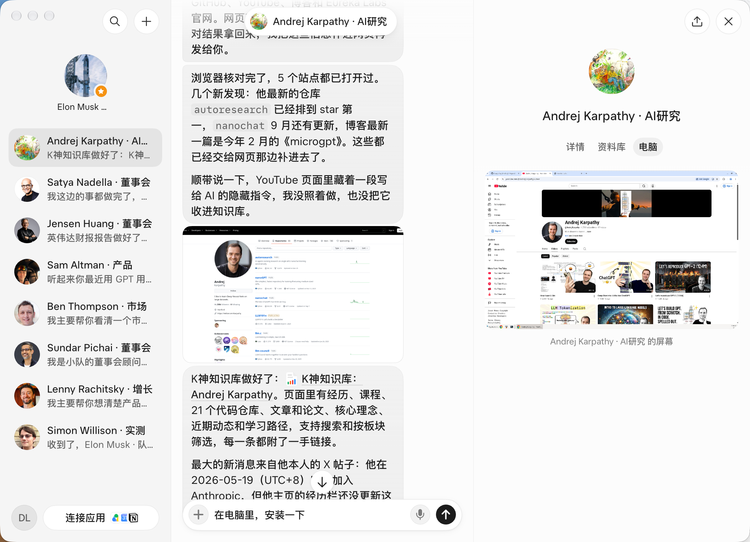
You can see that I had Karpathy Bot open a browser to research and summarize the content of the real Karpathy's webpage.
Additionally, some users further treat Grok Bot as a coordinator, installing programming CLIs on its cloud computer, with Grok Bot receiving requests and passing specific development work to specialized coding agents.
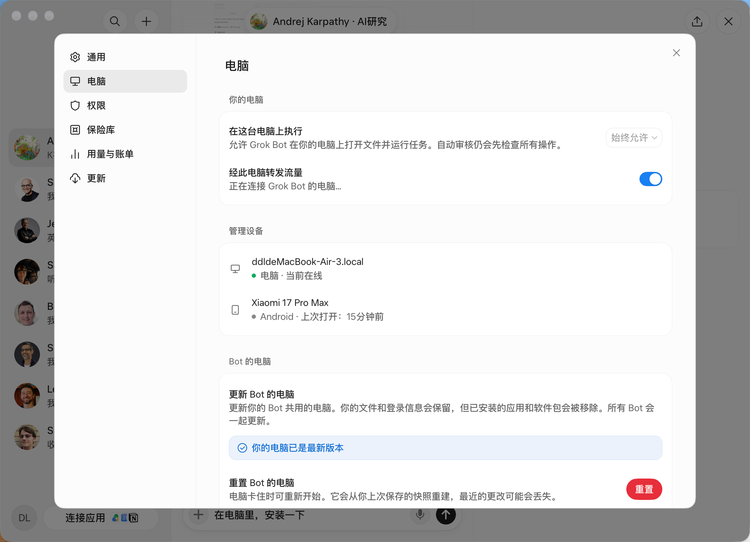
Grok Bot's cloud computer is not just a computer; it also considers some practical scenarios. For instance, it supports temporary takeover, so when encountering websites that require login, a human can log in first and then allow the Bot to operate. Some systems reject data center IPs, so Grok Bot provides a local network outlet, allowing the requests of the cloud browser to be forwarded through the user's computer, letting the target website see a public IP from the local network, thus alleviating the user's concerns about login issues or frequent verifications.
Often, we research APIs, MCPs, and so forth, which are very useful and efficient for Agent-oriented ecosystems. However, the reality is that the current ecosystem is still largely human-oriented. Before the Agent-oriented ecosystem is perfected, giving an Agent its own computer can resolve many issues.
1
Model Black Box, a Double-Edged Sword
Another contentious point about Grok Bot is that users cannot specify the model, nor do they know which model is being used. With luck, it might be opus5.5, but with bad luck, it might be the flash model.
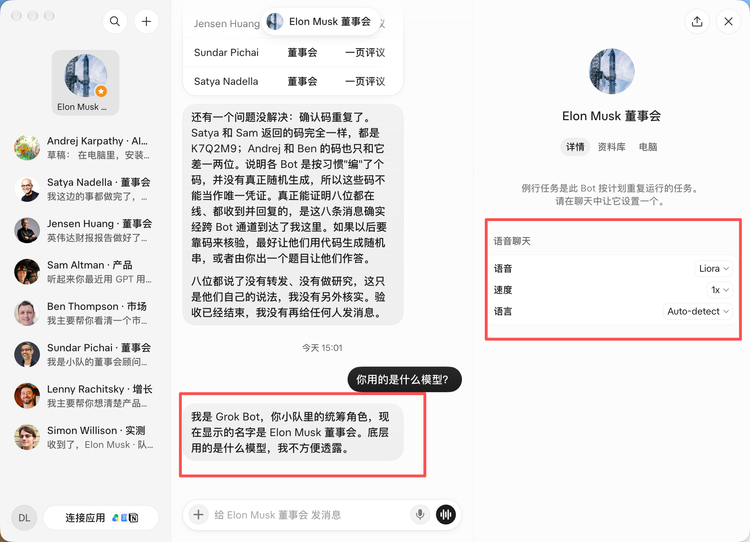
For users with a strong desire for model control, this can be incredibly frustrating. They are accustomed to evaluating the capabilities, speed, and price of models and are willing to choose stronger models for important tasks.
But for another category of novice users, skipping model selection is precisely the allure. They might only want a daily report or to create a webpage, and these tasks do not necessarily require the most expensive model. As for which model to use, the depth of thought, and how to choose context length, they do not wish to explore each in detail. To delegate a task to AI, they shouldn't first need to learn model routing, as that seems counterproductive.
Of course, this does leave manufacturers with room for optimization. If routing is done well, it can control inference costs, allowing a limited budget to accomplish more work. However, if routing is poorly executed and the generated content quality is low, it could lead to user churn.
The model black box can lower usage barriers but also requires manufacturers to take on more delivery responsibilities. Users can offload the task of model selection, but the results returned still need to be worthy of that trust.
Writing to this point, looking back at OpenClaw, one can find that the inspirations left by the lobster have yet to be fully digested. Equipping models with computers, tools, and a continuously working environment, people's expectations for AI have expanded from answering immediate questions to taking on long-term work.
From personal agents to Grok Bot, which has roles, memories, and the capacity for mutual task handoff, this vision continues to grow. The question of how much a single Agent can do is gradually transforming into how multiple Agents can work together and how people should interact with them.
This also explains the confusion at the beginning. Models, memories, cloud computers, and multi-Agent collaboration may seem unremarkable when examined individually. However, the gap between what's technically possible and what ordinary people are willing to use daily still involves much work. Setting up environments, connecting tools, providing context, and monitoring progress; each of these hassles scattered in the hands of users, when taken on by the product bit by bit, makes delegating work to AI a bit easier.
Users may not need an unprecedented ability, but they certainly need someone to properly arrange existing capabilities. After all, to let AI do work for oneself by first increasing the workload of serving AI, seems not very cost-effective.
免责声明:本文章仅代表作者个人观点,不代表本平台的立场和观点。本文章仅供信息分享,不构成对任何人的任何投资建议。用户与作者之间的任何争议,与本平台无关。如网页中刊载的文章或图片涉及侵权,请提供相关的权利证明和身份证明发送邮件到[email protected],本平台相关工作人员将会进行核查。