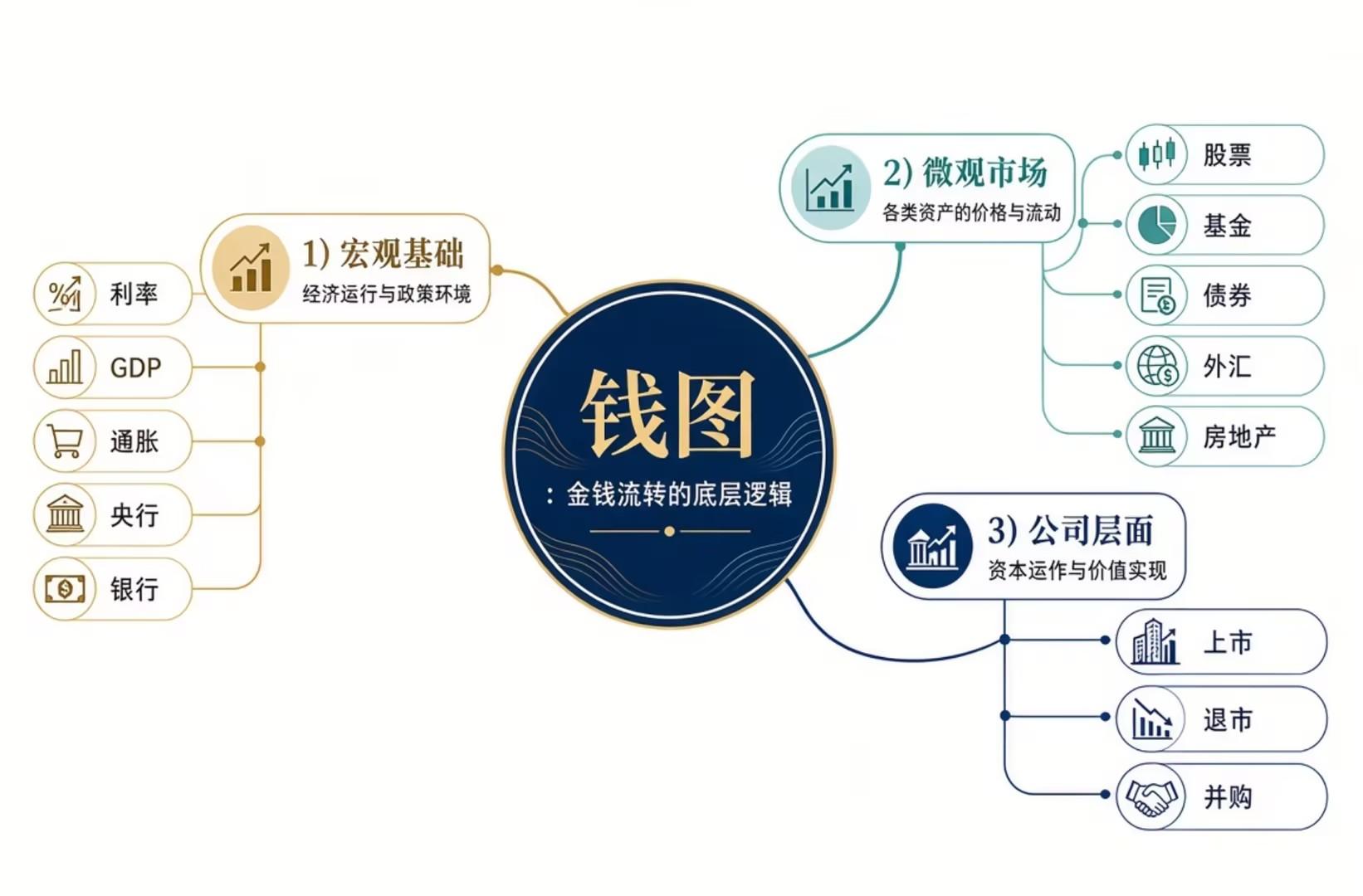
It’s not about teaching you how to make money, but understanding how money flows.
Many people see terms like “Federal Reserve interest rate hike”, “quantitative easing”, and “GDP growth rate”. They recognize each word but cannot clearly explain how it relates to them. In "Money Chart", Xiaolin uses a fictional “Xiaolin’s Milk Tea Shop” to put these chains into relatable scenarios. Below, we will explain several core macroeconomic concepts through the business story of this shop.
How the milk tea shop feels interest rates: The cost of borrowing has changed
Assume Xiaolin opens a milk tea shop. The rent, equipment, and raw materials all require money. If she doesn’t have enough cash, she must borrow money from the bank. The interest rate is the price of borrowing money.
When the central bank lowers interest rates, the loan interest rate for the milk tea shop typically also decreases. Assuming the original annual interest rate was 5%, reduced to 3%, borrowing 1 million Yuan would mean paying 20,000 Yuan less in interest per year. Xiaolin would be more inclined to borrow a bit more, to open a second shop, buy better equipment, or stock up on more raw materials. Many businesses do the same in the economy, so overall investment and consumption will increase; that’s the role of interest rates as the “accelerator”.
Conversely, when the central bank raises interest rates, loan interest rates increase. Borrowing the same 1 million Yuan now means paying more interest. Xiaolin would recalculate: opening a second store may not be profitable anymore, expansion plans may be postponed, or even inventory reduced. For the average person, mortgages work the same way. Assuming you have a mortgage of 1 million Yuan for 30 years, if the interest rate rises from 3.5% to 4.5%, monthly payments would increase by several hundred Yuan. The exact increase depends on the remaining principal and remaining term, but the direction is clear: rising interest rates increase monthly payment pressure.
Quantitative easing is a different operation. When interest rates are already low and there’s limited room to lower further, the central bank directly purchases government bonds and other assets, injecting funds into the banking system. With more funds available to banks, they are more willing to lend to businesses like milk tea shops, and long-term interest rates are also suppressed. Xiaolin can more easily borrow cheap money in the short term, but the overall debt level in society is also increasing. The book uses the metaphor “pressing the accelerator all the way and needing to spray extra fuel” to describe this operation.
It’s not that raising interest rates necessarily leads to a decline in housing prices and the stock market, but raising interest rates increases borrowing costs, and the impact on different assets depends on their sensitivity to interest rates and market expectations.
Inflation: The price of milk tea raw materials is rising, and the same amount of money buys less
Assuming last year the raw material cost of one cup of milk tea was 5 Yuan, this year it rises to 5.5 Yuan, and other costs are also increasing. If Xiaolin does not raise prices, her profits will be squeezed; if she raises prices, customers may find it expensive. This is the micro-level manifestation of inflation: a persistent rise in the overall level of prices, leading to less being bought with the same amount of money.
The same applies to individuals. If you keep 100,000 Yuan in cash or low-interest deposits, with an annual inflation rate of 3%, in ten years the real purchasing power of that 100,000 Yuan will be roughly equivalent to 74,000 Yuan today. This is the opportunity cost of holding cash long-term. If the milk tea shop owner only keeps the money in a bank earning low interest while the costs of raw materials and rent continue to rise, the real purchasing power is also declining.
GDP: Selling more milk tea does not mean everyone is wealthier
GDP measures the value of final products and services produced within a country over a specific period. If all milk tea shops in the country sell more cups of milk tea this year and contribute more output, the GDP figure will increase. However, GDP growth does not equate to simultaneous increases in the wages of Xiaolin's employees, nor does it mean every customer’s income has increased. Some shops earn more, while others may experience decreasing profits due to intense competition; some individuals’ incomes grow faster than inflation, while others do not.
The book reminds readers not to look at a single number in isolation but to consider it alongside employment, income distribution, and prices. A thriving milk tea business might stimulate suppliers of raw materials, delivery riders, and shop renovations, but ultimately how much each person benefits depends on the specific distribution and competitive landscape.
Banking and corporate borrowing: Why the milk tea shop grows bigger and loves borrowing more
Banks convert deposits into loans, which is the primary channel for funds to flow from savers to those who need money. Xiaolin deposits her money in the bank, which then lends it to another milk tea shop wanting to expand; this is maturity transformation.
As the milk tea shop grows larger and its cash flow becomes increasingly stable, Xiaolin is more inclined to borrow money. One reason is that interest on debt is generally tax-deductible, reducing the actual cost of financing; another reason is that moderate leverage can amplify returns. For instance, if borrowed money is used to open a new store and that new store’s profits exceed interest costs, shareholder returns will be magnified. However, if customer traffic suddenly declines or raw materials dramatically increase in price, the same leverage will also amplify losses.
When a company chooses to go public or be acquired, it is often adjusting its capital structure and acquiring funds or resources. If Xiaolin wants to rapidly open more stores, she can introduce external funding; if she feels more comfortable operating independently, she can remain private. These choices are not inherently “good” or “bad”; the key is whether the capital structure matches future cash flows.
What can you take away from these contents
Using the example of a milk tea shop, several macroeconomic concepts can be correlated with specific actions: changes in interest rates affect the willingness and cost of borrowing; inflation affects the real burden of raw materials and rent; GDP growth does not equal simultaneous increases in everyone’s income; and corporate borrowing leverages returns while also amplifying risks.
When you see “Federal Reserve interest rate hike”, you might ask: has the cost of borrowing increased, and is the milk tea shop still willing to borrow more money to expand? Which assets are more sensitive to interest rates? When you encounter “quantitative easing”, you could ask: banks have more money, but is the debt level also rising? When you see news about corporate financing or acquisitions, you might ask: is this optimizing the capital structure, or is it overextending for the future?
These frameworks will change with policy tools and market environments. The duration of personal funds, risk tolerance, and cash flow status vary; understanding the mechanism does not guarantee making better investment decisions. For readers wanting to minimize the impact of headline emotions and establish basic causal chains, using a milk tea shop to string together the logic of interest rates, inflation, and borrowing provides a sufficient starting point for comparison.
免责声明:本文章仅代表作者个人观点,不代表本平台的立场和观点。本文章仅供信息分享,不构成对任何人的任何投资建议。用户与作者之间的任何争议,与本平台无关。如网页中刊载的文章或图片涉及侵权,请提供相关的权利证明和身份证明发送邮件到[email protected],本平台相关工作人员将会进行核查。