1. U.S. GDP Grows 3.4% in the Third Quarter, Economic Resilience Remains Strong
The U.S. economy has once again delivered a report card that exceeds market expectations.
On October 29, the U.S. Department of Commerce's Bureau of Economic Analysis released the preliminary estimate of third-quarter GDP. The data shows that the actual GDP grew at an annualized quarterly rate of 3.4% in the third quarter, higher than the 2.2% in the second quarter, and also surpassing the market expectation of 3.2%, marking the fastest growth rate in a year.
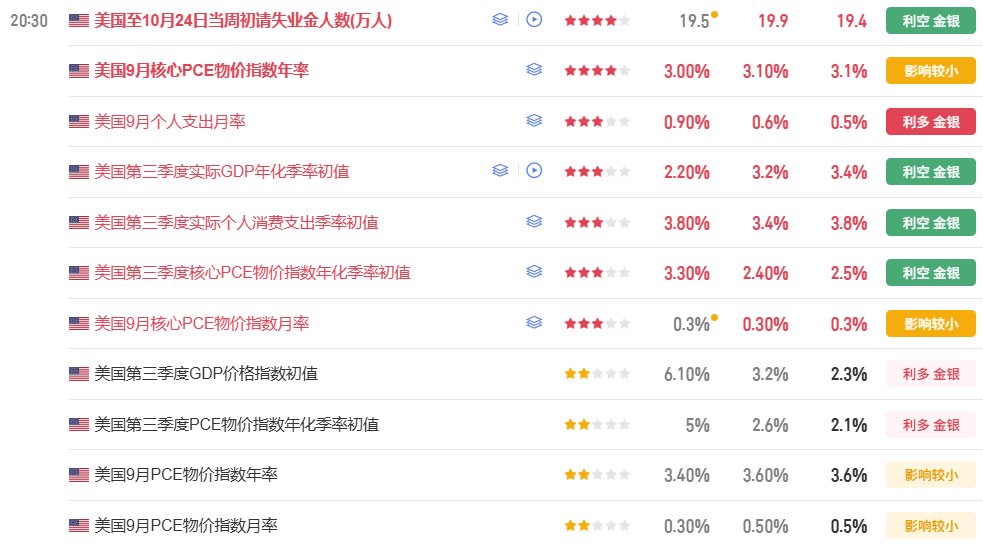
It is important to note that 3.4% is the annualized quarterly growth rate and does not indicate that the U.S. economy actually grew by 3.4% in the third quarter. When calculated on a quarterly basis, the actual growth is about 0.8%.
In terms of the components of economic growth, business investment, household consumption, and government spending all supported GDP, with investment growth and consumption resilience particularly noteworthy.
Despite rising energy prices and sustained high borrowing costs, the U.S. economy continues to expand, indicating that there has not been a significant slowdown in the current economic environment.
However, strong GDP growth does not mean that all sectors of the economy are pressure-free. Especially against the backdrop of still relatively high inflation, the more resilient the economic growth, the less urgency the Fed may feel to ease monetary policy.
This is also the most important significance of this GDP data for the financial markets: the U.S. economy is stronger than expected, but this may not be everything that risk assets want to see.
2. AI Investment and Household Consumption Become Important Supports of U.S. Economic Growth
This GDP data also shows a noteworthy structural change: corporate investment, especially in computing equipment and related infrastructure, is becoming an important driver of economic growth.
As the artificial intelligence industry continues to expand, companies are increasingly investing in data centers, computing equipment, and related infrastructure. These expenditures not only drive demand for chips, computer equipment, and industrial products but also bring new orders to some traditional industries.
Data from the Bureau of Economic Analysis also shows that equipment investment grew significantly in the third quarter, with information processing equipment, mainly including computers and peripherals, being an important source of contribution.
It is important to note that U.S. economic growth cannot be attributed entirely to AI. Corporate inventories, other equipment investments, government spending, and household consumption all contributed to GDP growth.
Household consumption is another important support.
In the third quarter, U.S. household consumption expenditures grew at an annualized rate of 3.8%, unchanged from the second quarter, maintaining a rapid growth rate for two consecutive quarters. Considering that personal consumption accounts for more than two-thirds of the U.S. economy, maintaining resilience in consumption is significant for overall economic growth.
However, further examination of September data reveals a concerning change.
In September, U.S. nominal personal consumption expenditures grew by 0.5% month-on-month, lower than August's 0.9%; after excluding price factors, real consumption expenditures remained flat month-on-month.
In other words, while the overall consumption performance remained strong in the third quarter, there are signs of a slowdown in actual consumption growth as of September.
This suggests that the U.S. economy is not simply overheating but that overall growth still has support, though consumers are beginning to feel the impact of rising living costs.
For the market, whether AI investment can continue and whether household consumption can remain resilient will become important variables for judging the future trajectory of the U.S. economy.
📌 If you want to continuously track the impact of BTC, ETH, and macro data on the market, you can follow the public account "Crypto Lao Ding," which explains important market changes and the logic behind them every day.
3. PCE Inflation Heats Up Again, Fed's Rate Hike Risk Increases for December
Compared to the better-than-expected GDP growth, what really drew the market's attention to monetary policy was the September PCE inflation data released on the same day.
The data shows that the overall PCE price index in the U.S. rose by 0.5% month-on-month in September, higher than August's 0.3%; year-on-year, it increased by 3.6%, exceeding August's 3.4%.
Excluding food and energy prices, the core PCE rose by 0.3% month-on-month and 3.1% year-on-year, also higher than August's 3.0%.
PCE is one of the key inflation indicators the Fed focuses on, and the Fed's long-term inflation target is 2%.
Based on the current data, both the overall PCE and the core PCE have clearly exceeded the 2% target year-on-year, indicating that inflationary pressures are still not fully controlled.
At the same time, rising energy prices have also become one of the important factors contributing to the current inflationary heat. Energy costs not only directly affect household fuel expenditures but may also further impact the prices of other goods and services through transportation, logistics, and business operating costs.
This presents a tricky problem for the Fed:
On one hand, the U.S. economy is growing strongly, with support for consumption and corporate investment; on the other hand, inflation has not shown a clear return to target levels.
If monetary policy is relaxed too early at this point, inflation could heat up again; however, if high interest rates are maintained, the cost of financing may continue to suppress corporate investment and household consumption.
Just a day before the release of this economic data, the Fed decided to keep the interest rate unchanged at a range of 3.75% to 4.00%.
This decision passed with 10 votes in favor and 2 against, with two officials advocating for an immediate rate hike of 25 basis points. This also indicates a difference of judgment within the Fed regarding inflation risks.
Reuters reported that after the September PCE was announced, market bets on the Fed's rate hike in December increased further. According to the CME FedWatch data at that time, the market was pricing a December rate hike probability of about 84.6%. However, this is just market expectation and does not mean the Fed has made a decision.
4. Why Stronger Economic Growth Might Bring Pressure on BTC?
Many investors might initially react to the U.S. GDP growth exceeding expectations by thinking the economic performance is good, and the market should be better supported.
But for risk assets like BTC, the relationship between economic growth and market performance is not simply positively correlated.
The key lies in whether economic growth will change the Fed's judgment on interest rates.
This transmission logic can be understood as:
Strong economic growth, high inflation → Fed maintains a tightening stance → Interest rate expectations rise → The dollar and U.S. Treasury yields may strengthen → Risk assets face valuation pressure.
First, high interest rates increase corporate financing costs. For tech companies that rely on external funds for expansion, rising financing costs may impact future capital expenditures and investment returns.
Second, when U.S. Treasury yields are at a high level, the attractiveness of bonds for some investors may increase, which could affect the relative appeal of risk assets.
For BTC, while it is not entirely determined by interest rates, market liquidity, the dollar's trajectory, and investors' risk appetite will influence capital allocation.
If the market revises its expectations for a Fed rate hike upward, the dollar and U.S. Treasury yields may find support, and some funds may also reduce their allocation to high-volatility assets.
However, this does not mean that stronger U.S. GDP growth will necessarily lead to a decline in BTC.
Economic growth could also improve corporate profit expectations and support confidence in financial markets. Meanwhile, if related rate hike expectations have already been priced in, new data might not lead to an equivalent negative reaction.
Therefore, what needs to be observed is not just the single GDP figure but the changes in economic growth, inflation, and interest rate expectations, as well as whether funding has begun to adjust its risk exposure.
📌 If you want to continuously track the impact of BTC, ETH, and macro data on the market, you can follow the public account "Crypto Lao Ding," which explains important market changes and the logic behind them every day.
5. What Key Variables Need Attention Next?
After the third-quarter GDP and September PCE were released, the market's focus will gradually shift to economic data before the Fed's December meeting.
First is the subsequent inflation performance.
If PCE continues to exceed expectations, especially if core inflation remains high, the pressure on the Fed to tighten policies further may increase. Conversely, if core inflation gradually cools, market concerns about the December rate hike may also ease.
Second is the labor market.
Employment data can help determine whether the U.S. economy still maintains sufficiently strong demand. If employment remains resilient while inflation does not show a significant decline, the Fed may have more room to maintain higher rates.
Third is household consumption.
Although consumption grew rapidly in the third quarter, real consumption expenditures have remained flat month-on-month in September. It will be important to observe whether this slowdown continues. If consumption continues to cool, the foundation for U.S. economic growth may change.
Finally, there is the actual reaction of the financial markets.
For BTC, three directions can be closely monitored:
U.S. Treasury yields: Whether they continue to rise due to increased rate hike expectations.
Dollar trends: Whether they are supported continuously, and whether global financial conditions tighten as a result.
Crypto market capital flows: Whether BTC spot buying, ETF fund flows, and leverage positions show changes.
Considering these variables together can help investors determine whether macro pressures are further transmitting to the crypto market.
📌 Mr. X of Web3: The More Resilient the U.S. Economy, the Harder It Is for the Fed to Easily Shift to Easing
The U.S. GDP growth of 3.4% in the third quarter reflects that corporate investment and household consumption continue to support the economy. However, at the same time, September's overall PCE rose by 3.6% year-on-year, and core PCE rose by 3.1% year-on-year, indicating that the inflation issue still exists.
This presents a more complex policy environment for the Fed: economic growth has not clearly stalled, yet price pressures have not been fully controlled.
For financial markets, what really needs attention is not just the better-than-expected GDP growth itself, but whether this growth will lead the Fed to maintain its tightening stance for a longer time.
For BTC, the market still needs to determine whether the macro environment is changing through the dollar, U.S. Treasury yields, interest rate expectations, and its own capital flows.
Strong economic growth does not necessarily benefit BTC directly; rising inflation does not mean BTC will inevitably decline. What truly affects the market is how this data changes the judgment of funds regarding future policies and risks.
—— I am Mr. X of Web3, with 6 years of experience in Web3, focusing on Bitcoin, the crypto market, macroeconomics, and industry trends. If you want to continuously track BTC, ETH, HYPE, and the impact of macro data on the market, you can follow the public account "Crypto Lao Ding." Understand the hot topics, insight the logic, and establish your own judgment, rather than just staring at price fluctuations.

免责声明:本文章仅代表作者个人观点,不代表本平台的立场和观点。本文章仅供信息分享,不构成对任何人的任何投资建议。用户与作者之间的任何争议,与本平台无关。如网页中刊载的文章或图片涉及侵权,请提供相关的权利证明和身份证明发送邮件到[email protected],本平台相关工作人员将会进行核查。