1. The Federal Reserve pauses interest rate hikes, but the market does not receive a clear answer
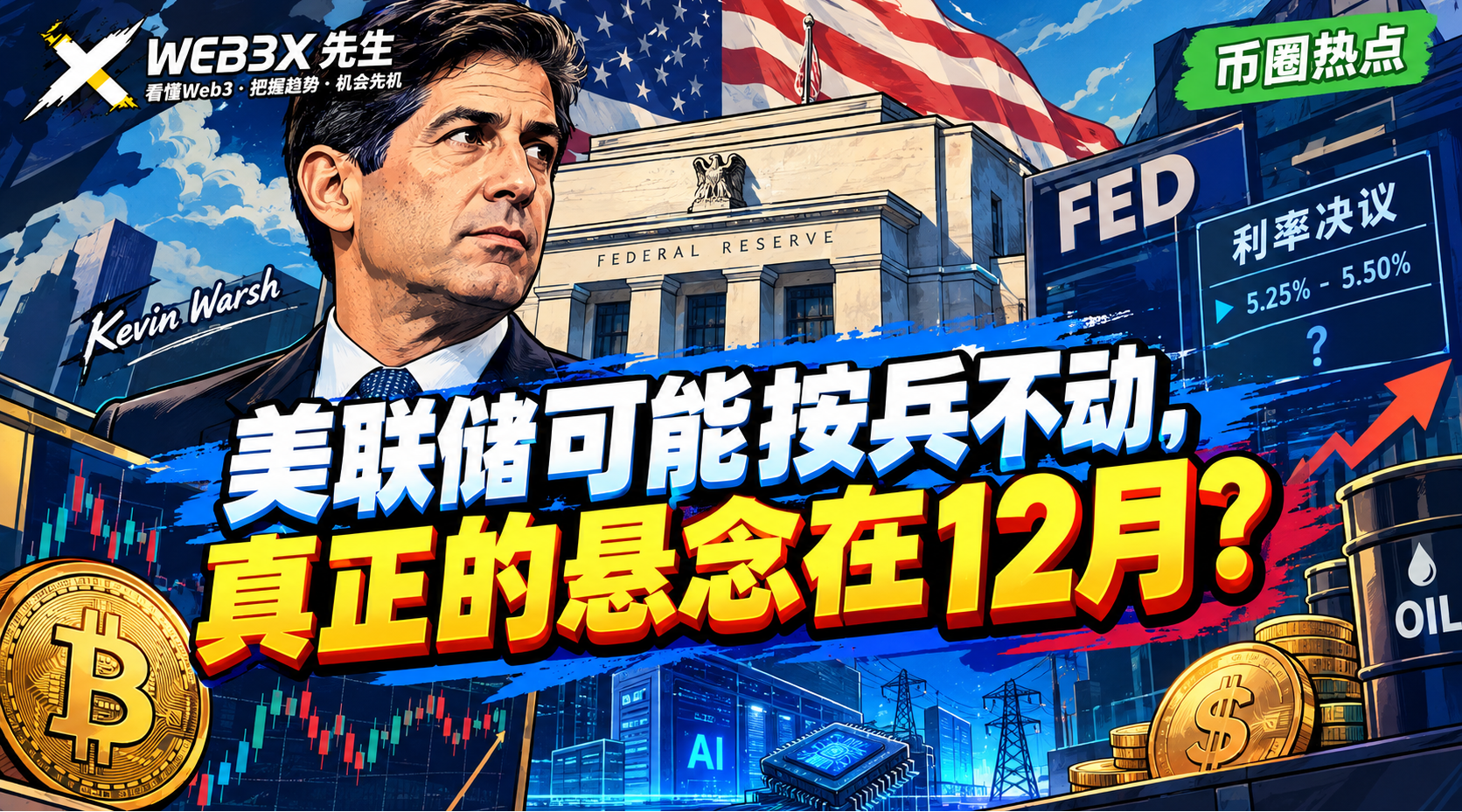
The Federal Reserve's latest interest rate decision chose to maintain the federal funds rate target range between 3.75% and 4%. However, more noteworthy than the rate itself are the signals released by the new chairman Kevin Walsh at the press conference.
This decision passed with 10 votes in favor and 2 against. Federal Reserve Governor Lisa Cook and Cleveland Fed President Beth Hammack both advocated for a 25 basis point increase.

This means that while the Federal Reserve temporarily halted further tightening of policy, there is not complete consensus internally regarding the assessment of inflation risks.
At the same time, Walsh did not provide a clear policy roadmap for the December meeting. He stressed that the Federal Reserve needs to gather more economic information to determine what actions should be taken next.
In other words, the market cannot directly conclude that the tightening cycle has ended just because there was no rate hike this time.
The real change lies in the Federal Reserve's unwillingness to commit in advance to the next steps, instead hoping to make decisions based on subsequent data.
2. Why is Walsh downplaying forward guidance?
Forward guidance, simply put, is the central bank's way of signaling to the market the potential policy direction it may take in the future through public remarks, policy statements, and other means.
For example, when the market believes that the Federal Reserve is about to lower interest rates, the pricing of the dollar, U.S. Treasury yields, and risk assets may react in advance. Even if a rate cut has not yet occurred, the market might adjust positions based on expectations of future policy.
Therefore, how the central bank communicates can itself influence the financial market.
However, Walsh made it clear that unless a crisis occurs, the market should not overly rely on the Federal Reserve's forward guidance. He emphasized that the outcomes of each meeting should not be pre-set.
This does not mean that the Federal Reserve will no longer signal policy intentions in the future, but rather indicates that investors cannot solely rely on the chairman's speech to determine the outcome of the next meeting.
For the market, this way of communicating may bring about two changes.
First, interest rate expectations will be more dependent on economic data. Indicators such as inflation, employment, consumption, and economic growth may all influence the market's judgment of the next decision.
Second, short-term market volatility may become more pronounced. When the policy direction is not predetermined, new economic data or official statements can trigger adjustments in interest rate expectations.
Therefore, to understand Walsh's policy thinking, one should not only look at whether he sends hawkish or dovish signals but also observe how he manages the relationship between inflation, growth, and financial conditions.
📌 If you want to continuously track the impact of BTC, ETH, and macro data on the market, you can follow the public account "Crypto Lao Ding," which daily explains important market changes and the logic behind them.
3. Inflation remains the core issue, why has the risk of a December rate hike not disappeared?
Although the Federal Reserve chose to maintain the status quo this time, inflationary pressures are still the focal point of policy discussions.
Walsh made it clear that the Federal Reserve's long-term inflation target, as measured by the personal consumption expenditures price index (PCE), remains at 2%, with no so-called "soft version" target.
This indicates that the Federal Reserve has not abandoned its requirement for price stability just because economic growth remains strong.
Meanwhile, rising energy prices have also increased the uncertainty around inflation. If oil prices remain high, fuel and transportation costs may gradually be passed on to other goods and services, potentially impacting inflation performance.
However, it is essential to distinguish between two concepts: rising energy prices do not necessarily mean that overall inflation will continue to accelerate; likewise, a one-time decline in inflation data does not sufficiently prove that price pressures have been completely alleviated.
The Federal Reserve needs to monitor inflation trends rather than the short-term changes of a single data point.
Another factor worth noting is the resilience of the U.S. economy. Walsh pointed out that U.S. economic activity continues to expand at a strong pace, and third-quarter economic growth could exceed 3%. Meanwhile, most officials do not believe that the U.S. economy has overheated.
This complicates policy judgments: if economic growth is robust, the labor market remains resilient, and inflation stays above target, the Federal Reserve may lack sufficient reason to quickly shift to a more accommodative policy.
Thus, whether to raise rates in December will still depend on subsequent data and policy evaluations. The fact that two officials advocated for a rate hike at this meeting reflects that there is indeed an internal viewpoint for further tightening, but this should not be interpreted as the entire committee having decided to raise rates in December.
4. What is the connection between AI investment and high interest rates?
Another easily overlooked detail from this press conference was Walsh's discussion of the relationship between AI investment, productivity, and interest rates.
In recent years, corporate investments in artificial intelligence, data centers, and related infrastructure have been continuously drawing market attention. Such investments typically require significant capital and are also affected by changes in financing costs.
Walsh pointed out that interest rates directly or indirectly influence nearly all economic activities. The recent widening of credit spreads and cautious corporate capital allocation indicate that higher financing costs have begun to transmit to the technology sector and other asset classes.
This means that even if AI investments continue to drive economic growth, it does not imply that high interest rates have no impact on the market.
If financing costs remain high, some companies may need to reassess their investment return cycles, and financial markets may also reevaluate the fair prices of high-valuation assets.
However, Walsh did not determine how significant the productivity improvements brought by AI will ultimately be. He noted that some of the observed productivity improvements occurred before the large-scale application of AI, so the actual effects of AI on future growth, inflation, and employment are still to be seen.
For investors, there is an important distinction here: AI may enhance the economy's long-term productive capacity, but its short-term market performance is still affected by interest rates, financing conditions, and valuation changes.
The long-term growth potential of the economy and the short-term price performance of assets are not the same thing.
📌 If you want to continuously track the impact of BTC, ETH, and macro data on the market, you can follow the public account "Crypto Lao Ding," which daily explains important market changes and the logic behind them.
5. What does Walsh's adjustment of the FOMC meeting arrangement mean?
In addition to the interest rate decision and policy communication, Walsh also announced adjustments to the future schedule of Federal Open Market Committee (FOMC) meetings.
According to the announced schedule, the Federal Reserve will still hold 8 meetings in 2027, one of which will be dedicated to discussing monetary policy strategy without conducting an interest rate vote; in 2028, there will be two meetings for strategic discussions, also without a policy interest rate vote.
This arrangement reflects that the Federal Reserve aims to leave more room for discussion on long-term policy frameworks and strategic issues.
However, this should not be simply understood as these meetings being unimportant. Even without an interest rate vote, strategic discussions may still influence the market's understanding of the future monetary policy framework.
For the market, it is worth observing whether this arrangement will change the rhythm of the Federal Reserve's external communication and how investors interpret changes in the policy framework.
Yet, before the specific impacts become evident, the current data on inflation, employment, and economic growth remains more crucial.
6. What does this mean for BTC? The real impact on the market is interest rate expectations
The reason the Federal Reserve's policy changes garner attention in the crypto market is that interest rates affect the cost of funds, the dollar's trajectory, bond yields, and investors' willingness to take on risk.
For crypto assets like BTC, this transmission relationship can be understood from three aspects.
First, pay attention to U.S. Treasury yields.
If inflationary pressures persist and expectations for further tightening by the Federal Reserve rise, U.S. Treasury yields may be supported. Higher bond yields increase the relative attractiveness of holding bonds and may exert valuation pressure on some risk assets.
However, the actual changes in yields also depend on how much policy expectations the market has already factored in and how economic data performs.
Second, pay attention to the dollar and overall financial conditions.
If the market re-anticipates that interest rates will remain high, the dollar and financing conditions may change accordingly, thus affecting global capital allocation. However, the dollar is not solely influenced by the Federal Reserve; the policies, safe-haven demand, and capital flows of other major economies are also significant.
Third, pay attention to whether the market has already priced in expectations.
Even if the Federal Reserve issues hawkish signals, if the market has already fully accounted for related expectations, asset prices may not necessarily continue to decline. Conversely, if actual policies or economic data exceed market expectations, price responses may be more pronounced.
Therefore, one cannot simply equate "the Federal Reserve not lowering interest rates" with "BTC must decline," nor can one interpret a pause in rate hikes as an imminent rise in the crypto market.
The real need to track is whether interest rate expectations, the dollar, U.S. Treasury yields, and the capital flows within the crypto market show consistent changes.
📌 If you want to continuously track the impact of BTC, ETH, and macro data on the market, you can follow the public account "Crypto Lao Ding," which daily explains important market changes and the logic behind them.
7. What should we focus on next?
As the December interest rate decision approaches, the market needs to pay attention not only to the speeches of Federal Reserve officials but also to whether subsequent economic data can change the current policy assessment.
First is the PCE inflation data. As one of the inflation indicators that the Federal Reserve focuses on, it helps judge whether price pressures continue to ease.
Next is the performance of employment and consumption. If the job market remains resilient and consumption continues to grow, the Federal Reserve may have more time to maintain its current policy stance; if the economy shows significant cooling, policy discussions may experience new changes.
Third is energy prices. If oil prices continue to rise, inflation expectations may again be impacted; if energy prices decline, some inflation pressures may ease, but confirmation from other data is still needed.
Lastly, the actual reactions of financial markets, including the dollar, U.S. Treasury yields, and the trends of risk assets.
These variables collectively determine how the market reassesses the interest rate path for December, rather than being decided by any single speech.
📌Mr. Web3 X: The Federal Reserve does not provide answers in advance; investors need to understand the data better
The most noteworthy aspect of this meeting is not just that the Federal Reserve kept interest rates unchanged, nor merely that two officials advocated for rate hikes, but that Walsh clearly downplayed reliance on forward guidance.
This implies that the market needs to focus more on the actual changes in economic data and financial conditions, rather than trying to find a definite policy answer from each speech.
Inflation remains elevated, U.S. economic growth shows resilience, and AI investments are changing the discussion about productivity and capital demand. Meanwhile, higher financing costs will still impact corporate investment and the pricing of financial assets.
For BTC, the key moving forward is not to predict in advance whether there will be a rate hike or cut in December, but to observe whether inflation, employment, the dollar, and U.S. Treasury yields collectively point to a certain trend.
Understanding the hotspots, gaining insight into the logic, and establishing judgment is crucial. More important than guessing the outcome of the next meeting is comprehending why the market is re-pricing.
—— I am Mr. Web3 X, with six years of growth in Web3, focusing on Bitcoin, the crypto market, macroeconomics, and industry trends. If you wish to continuously track the impact of BTC, ETH, HYPE, and macro data on the market, you can follow the public account "Crypto Lao Ding." Understand the hotspots, gain insights into the logic, and build your judgment, rather than just fixating on price fluctuations.

免责声明:本文章仅代表作者个人观点,不代表本平台的立场和观点。本文章仅供信息分享,不构成对任何人的任何投资建议。用户与作者之间的任何争议,与本平台无关。如网页中刊载的文章或图片涉及侵权,请提供相关的权利证明和身份证明发送邮件到[email protected],本平台相关工作人员将会进行核查。