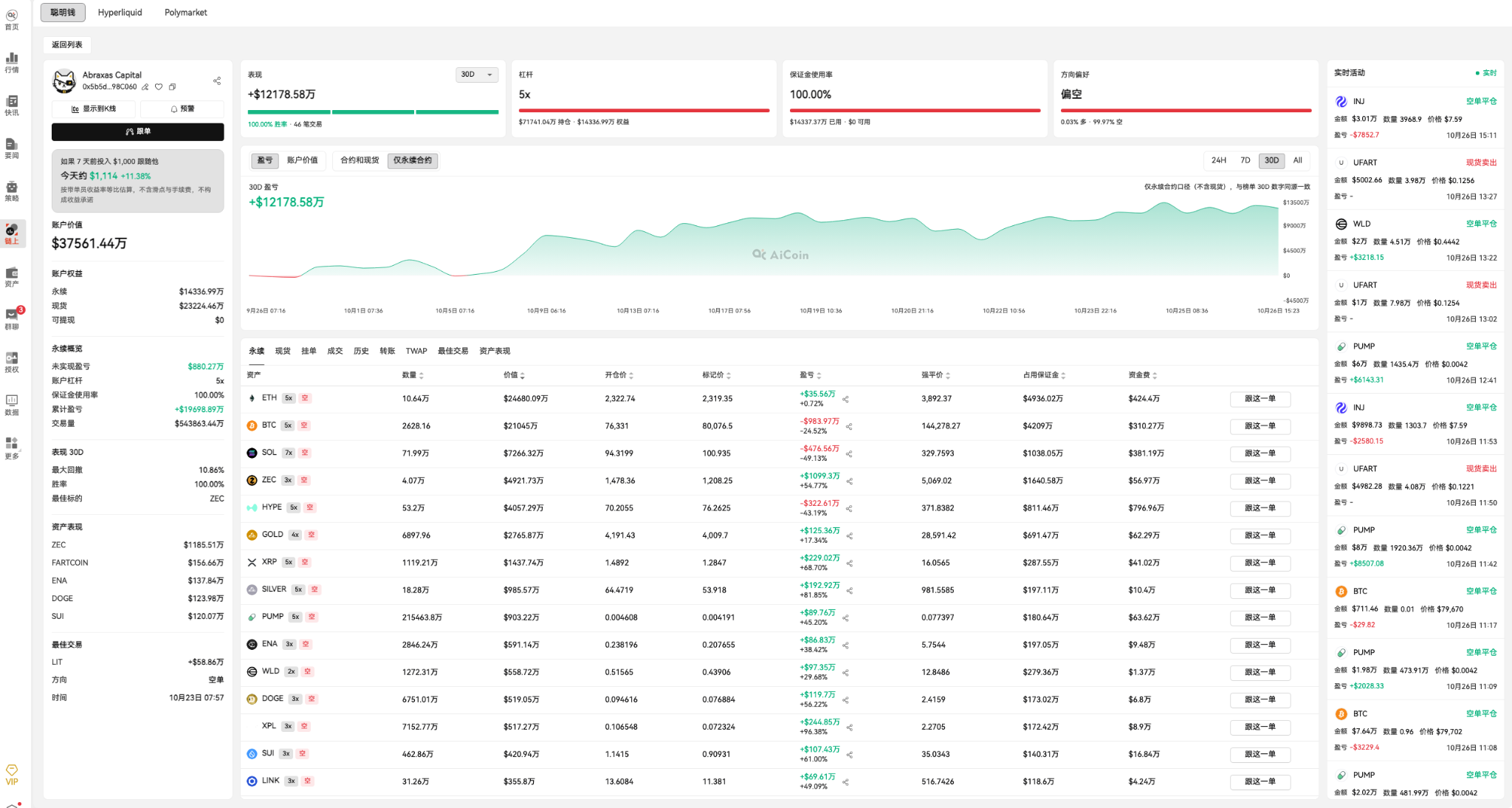
Seeing "institutions holding over $1.29 billion in short positions on Hyperliquid," many people's first reaction is: Abraxas Capital is heavily shorting BTC and ETH.
However, this may be the most common misinterpretation.
Account One
https://www.aicoin.com/zh-Hans/hyper-detail/0x5b5d51203a0f9079f8aeb098a6523a13F298C060
Account Two:
https://www.aicoin.com/zh-Hans/hyper-detail/0xb83de012dba672c76a7dbbbf3e459cb59d7d6e36
Attributed to Abraxas Capital, the two Hyperliquid accounts have accumulated profits exceeding $353 million, while still holding over $1.29 billion in short positions. These two accounts primarily short ETH and BTC, but since they are recognized as hedging accounts, the shorts are likely used to hedge the spot market rather than merely betting on a price decline.
What is truly worth noting is not whether to short, but why institutions are willing to place such large-scale risk management footprints in an on-chain perpetual market.
A nominal short position of $1.3 billion may not represent a net short of $1.3 billion; it is more like a window allowing the average user to see for the first time how institutions manage unseen spots, options, or cross-market positions with perpetual contracts.
1. Separate "short positions" from "net short"
A single account holding a short position does not imply that the entire investment portfolio is net short.
If an institution holds a large amount of BTC or ETH in the spot market, a price drop will reduce the paper value of the spot holdings. It can open a short perpetual position on Hyperliquid to transfer a portion of the price risk onto the short positions.
The goal of such a structure is not to profit from the decline but to reduce the overall portfolio's sensitivity to changes in underlying prices.
The simplest expression is:
Spot long + perpetual short ≈ Reduce portfolio delta exposure
If the spot value rises, the short may incur losses; if the spot value falls, the short may generate profits. What ultimately needs to be observed is not how much the short leg earned, but the performance of the entire portfolio under different price paths.
More complex institutional portfolios may also include positions from other exchanges, options, lending, staked assets, market-making inventories, and over-the-counter positions. The on-chain accounts only show part of this.
2. Abraxas's public strategy indeed supports the "hedging" explanation
Abraxas Capital's official website positions its Elysium Global Arbitrage Fund as a market-neutral strategy in the digital asset space, with core methods focusing on cross-market arbitrage aimed at reducing direct exposure to cryptocurrency prices and volatility.
This does not prove that the two addresses identified by Lookonchain necessarily represent the complete trading ledger of the fund, nor does it prove that the $1.29 billion in short positions corresponds entirely to a batch of spots.
However, it indicates that "hedging and arbitrage" are not just terms to make news sound appealing but align with the strategy direction publicly disclosed by this institution.
From the trading structure perspective, these accounts may be doing several things:
- Hedging spot longs against price risk with perpetual shorts;
- Taking advantage of price and funding rate differences between different trading venues;
- Managing cross-market inventory to reduce portfolio net delta;
- Dynamic rebalancing between spot, perpetual, and other derivatives;
- Utilizing the continuous opening hours of the on-chain market to adjust risk.
The commonality among these strategies is: It's difficult to determine the true direction of a trade when viewed in isolation.
For the average user, the most dangerous behavior is to directly interpret a partial position of a certain institutional account as "the institution is shorting, I should follow."
3. The cumulative profit of $353 million is not necessarily replicable income
$353 million is the cumulative profit data from the two accounts.
It may include results from different markets, time periods, and transaction legs, but it does not automatically equate to cash profits already extracted, nor does it directly represent the net returns for Abraxas fund investors.
At least four criteria need to be distinguished:
First, the cumulative PnL of the account does not necessarily equal the net profit of the fund. The fund also incurs management fees, performance fees, financing costs, custody costs, cross-platform trading costs, and other ledger gains and losses.
Second, the profits of one account may correspond to losses in another account or another exchange. If the strategy is cross-market arbitrage, the profits seen on-chain are only part of the portfolio.
Third, the current nominal value of short positions is not equal to margin and does not equate to net risk. The $1.29 billion is an estimated measure of position size, not necessarily indicating that the same amount of cash was invested in the account, and it cannot be directly subtracted from the $353 million to derive a rate of return.
Fourth, historical profits do not guarantee that the current positions are still safe. Positions are in constant flux, as prices, funding rates, margin rates, and liquidation distances can change. The Hypurrscan address page shows a large number of orders, liquidations, and new position records, indicating that these accounts are not simply holding static short positions.
Therefore, the correct reading approach is not "the institution made $353 million, I should replicate its short," but rather to observe: How is it adjusting nominal positions? Are spot balances changing simultaneously? Do the funding rates support the holdings? Are shorts being opened and closed in batches? Are account equity and liquidation distances changing in sync?
4. Why is Hyperliquid suitable for hosting such observable hedging structures?
Hyperliquid is officially described as a transparent, open, and high-performance on-chain financial infrastructure. The official documentation emphasizes that transaction, order, and settlement records are on a public ledger, and anyone can view and verify them in real-time.
This does not mean that institutional trading will publicly disclose complete strategies, but at least allows the market to observe a portion of verifiable behavior:
- Which markets the addresses are opening positions in;
- How the nominal value of positions is changing;
- Whether trades are executed continuously or as one-time large transactions;
- Whether funds and collateral move between accounts;
- Whether liquidations, order cancellations, and re-listings occur frequently.
Traditional institutional positions are often scattered across brokers, custodians, multiple trading venues, and internal systems. On-chain accounts expose part of the execution layer records directly.
This does not mean that on-chain data is more complete than internal institutional ledgers. Its value lies in: Increased transparency and lowered observation barriers.
Hyperliquid's perpetual contracts do not have expiration dates, liquidity is concentrated in a single instrument, and there is no physical settlement involved. This makes it suitable for expressing directional risk and also feasible for institutions to continuously hedge beyond just spot or other assets.
However, "suitable for hedging" does not equate to "hedging must succeed." Perpetuals still carry risks relating to funding rates, marked prices, liquidity, slippage, oracles, and liquidation risk.
5. Ordinary users should learn institutions' "views" rather than replicate their "positions"
If you want to learn executable methods from this trade, the focus should be on the observational framework rather than directional judgments.
The first step is to look at the context of the positions. When an address opens a short position, it is essential to observe the spot, HYPE, or other collateral assets alongside changes in account equity. Viewing just the shorts will likely lead to incomplete conclusions.
The second step is to monitor the speed of position changes. Institutions typically adjust their hedges based on changes in prices, inventories, and risk exposures. Continuously adding shorts, closing them in batches, or switching between multiple assets can mean entirely different things.
The third step is to check funding rates and holding costs. A short position could be directionally accurate but may harm the portfolio’s returns if the unfavorable funding rate is paid over time. Conversely, certain arbitrage accounts might actually earn funding rate differentials, rather than betting on price declines.
The fourth step is to examine open interest (OI) and liquidation distance. An increase in OI could suggest more directional leverage or more hedging combinations. Judgments should be made in conjunction with pricing, funding rates, and significant order movements.
The fifth step is to acknowledge the blind spots in on-chain observations. You cannot see institutions' positions in spot, options, loans, and over-the-counter transactions on other platforms, so any address attribution and net risk assessments must retain a degree of uncertainty.
AiCoin is well-suited for this layer of observation: first examine the price structures of BTC, ETH, and HYPE, and then combine it with OI, funding rates, significant order movements, smart money addresses, and liquidation data to assess whether a position appears more like a directional trade or part of a hedging combination.
If you need to execute trades on Hyperliquid, you can use the exclusive entry:
https://app.hyperliquid.xyz/join/AICOIN88
Invitation code: AICOIN88. Qualifying transactions will receive a 4% fee rebate, specifics regarding eligibility, scope, and timing of funds will be subject to the event rules. The rebate only reduces a portion of trading costs and does not offset funding rates, slippage, leverage, and liquidation risks.
Conclusion: The most valuable thing on-chain is not "what the whales say," but how they actually manage risk
The most worthy aspect to study about these two accounts from Abraxas is not whether they successfully predicted a certain direction.
What is truly valuable is that the market can see part of the risk management footprints left by a large digital asset management institution on Hyperliquid: accumulated profits exceeding $353 million, currently holding over $1.29 billion in shorts, while the accounts are still making dynamic adjustments.
This changes the way ordinary users read whale data.
Large short positions can indicate bearish sentiment but may also represent spot hedges; accumulated profits can reflect gains on one leg while possibly corresponding to larger portfolios on the other side; high nominal positions might reflect high confidence, or they may just indicate institutions are managing inventories and delta.
Therefore, the on-chain data truly provides not a simple buy/sell signal but a set of observational methods closer to professional trading:
Do not merely ask which direction the institutions are betting on; ask what they are protecting against, what they are hedging, and which part of the position you have not yet seen.
Exclusive Benefits for AiCoin Users
👉 Enter invitation code AICOIN88 when binding your Hyperliquid account to enjoy a 4% fee rebate.
🔗 Exclusive registration link:
https://app.hyperliquid.xyz/join/AICOIN88
📖 Beginner's Guide:
“AiCoin PC Hyperliquid Authorization Trading Tutorial”:
https://www.aicoin.com/zh-Hans/article/514197
“AiCoin Mobile Hyperliquid Authorization Trading Tutorial”:
https://www.aicoin.com/zh-Hans/article/541383
“Zero Basics Entry! Detailed Illustrated Guide to First Trade on Hyperliquid”:
https://www.aicoin.com/zh-Hans/article/510225
📖 Community Interaction:
Telegram:
Discord:
AiCoin Group Chat:
https://www.aicoin.com/link/chat?cid=N6OVMor5g
The content of this article only represents the author's personal views and does not represent the platform's stance. The viewpoints, conclusions, and suggestions in the article are for investor reference only and do not constitute any investment advice related to the platform. Investing in US stocks still requires bearing market risks, regulatory risks, and compliance risks related to local laws and regulations (especially foreign exchange controls, overseas investment declarations, etc.).
免责声明:本文章仅代表作者个人观点,不代表本平台的立场和观点。本文章仅供信息分享,不构成对任何人的任何投资建议。用户与作者之间的任何争议,与本平台无关。如网页中刊载的文章或图片涉及侵权,请提供相关的权利证明和身份证明发送邮件到[email protected],本平台相关工作人员将会进行核查。