Every day at work, diligently working, striving for promotions and salary increases, why has it been years and while income has increased a bit, life seems to have changed very little?
Upon careful reflection, many people's ways of making money have actually not changed: exchanging time for wages, exchanging energy for income.
If you want to earn more, you have to work more. When work is already full, it becomes difficult to squeeze out new sources of income. Even if salaries increase, living expenses might also rise.
More realistically, once you stop, income may also decrease.
Recently, I saw a viewpoint that offers ordinary people another way of thinking: use AI to increase productivity, use self-media to amplify influence, and then invest the surplus funds in long-term investments.
These three things together create a closed loop worth studying carefully.
AI allows a person to do more, self-media allows the results produced to reach more people, and investments enable the accumulated funds to participate in long-term asset growth.
They cannot guarantee success for everyone, but at least they point to a direction worth considering: besides working hard, can we allow our abilities, works, and funds to gradually accumulate longer-lasting value?

1. AI: On the same 8-hour workday, why can some people produce more results?
In the past, when a person wanted to do something for themselves, they often got stuck on execution.
If you want to write an article, you need to research materials, organize logic, and revise repeatedly; if you want to create a product, you might need to learn design, programming, and testing. Many plans do not lack ideas, but before they even start, they are blocked by time and skill barriers.
AI is lowering these barriers.
It can help you organize information, analyze data, write code, make images, and assist in completing article drafts and repetitive tasks. Tasks that previously required multiple skills can now be accomplished by one person producing preliminary results.
But there is a difference: some people chase after new tools every day, while others have integrated AI into their workflows.
The former may have learned many functions but might not have saved much time; the latter might only use a few tools to compress a task that originally took several hours into a shorter time.
Thus, ordinary people learning AI don’t need to rush to become tech experts. First, find the tasks you frequently do that consume a lot of time, and see if AI can help.
If you create content, use it to assist in gathering information and checking article logic; if you often handle data, study how to automate repetitive tasks; if you want to try a small project, use AI to create a prototype and verify if there is a demand.
Remember, AI-generated materials and conclusions still need to be verified, and real judgment cannot be entirely outsourced.
The best place to utilize AI is to allow you to accomplish more valuable work in the same amount of time.
After improving efficiency, the next question arises: can what you produce be seen by more people?
2. Self-media: Don't let your experience only be useful to a few people around you
When many people hear "self-media," they think of making videos, gaining followers, and accepting advertisements.
In fact, you can start from simpler things: share the knowledge and experience you already possess.
Designers can share methods for solving problems; technicians can document their experiences at work; those who regularly study business and investments can write down their process of analyzing a company.
You don’t need to have a very unique viewpoint from the outset. Being able to explain a problem clearly and help others avoid a detour provides a starting point for creation.
In the past, if you spent two hours solving a problem, that experience might only stay within your own work. Now, by organizing it into an article or video, it has the chance to be seen by more people.
After a piece of content is published, it might quickly sink away, or it may still be read months later. It can become your work and may also allow strangers to understand your professional abilities.
This is the leverage of self-media.
Of course, content may not necessarily be viewed, and followers may not turn into income. Continuous output, understanding reader needs, and establishing trust all take time.
But if you have already accumulated experience in a certain field, sharing it at least offers a different way for those experiences to have an effect.
When AI and self-media combine, the cost of personal creation has the opportunity to further decrease: AI assists in organizing information and modifying drafts, while you handle topics, judgment, and final expression.
One person can now accomplish tasks that previously required more time, then spread them through platforms.
AI solves output problems, while self-media solves dissemination problems. One improves efficiency, while the other expands reach.
If this method gradually works, what you accumulate will be not only content, but also personal branding, professional recognition, and potential future collaborations and income opportunities.
And when income truly increases, the third aspect can start to take effect.
3. Investments: Don't just think about how to spend the money you earn
Increased income does not necessarily mean that wealth will increase.
If the extra money you earn each month eventually turns into higher consumption, after several years, there may still be little left in your account.
Therefore, in addition to finding ways to increase income, it is also essential to consider how to arrange the surpluses.
Here, I prefer a simple order: first prepare emergency funds, handle high-interest debt, then consider investing temporarily unused money into long-term assets.
For ordinary investors, you can first research broad index funds and ETFs. For example, the S&P 500 index covers large publicly listed companies in the U.S., while the Nasdaq 100 index is more skewed towards large non-financial companies, with a higher weighting in technology and growth-oriented firms.
The industry composition and risk characteristics of the two are different, and both can experience significant pullbacks. Regular investments cannot guarantee profits, and long-term holdings do not mean there won’t be losses.
If you want to research individual stocks, start with familiar companies and see how they earn money, how their financial reports perform, and whether their current valuations are reasonable.
You don’t need to trade every day, nor do you need to chase every hot trend. First, understand what you are buying, why you are buying, and what extent of loss you can tolerate.
Where can you start if you want to understand U.S. stocks?
If you usually pay attention to U.S. stocks, you can further explore the U.S. stock-related assets supported by the Binance platform.
If you don't have a Binance account, you can register using the link below, and then learn about the relevant functions based on your situation.
https://jump.do/zh-Hans/xlink-proxy?id=3
(Invitation code: aicoin668, enjoy a 10% rebate)
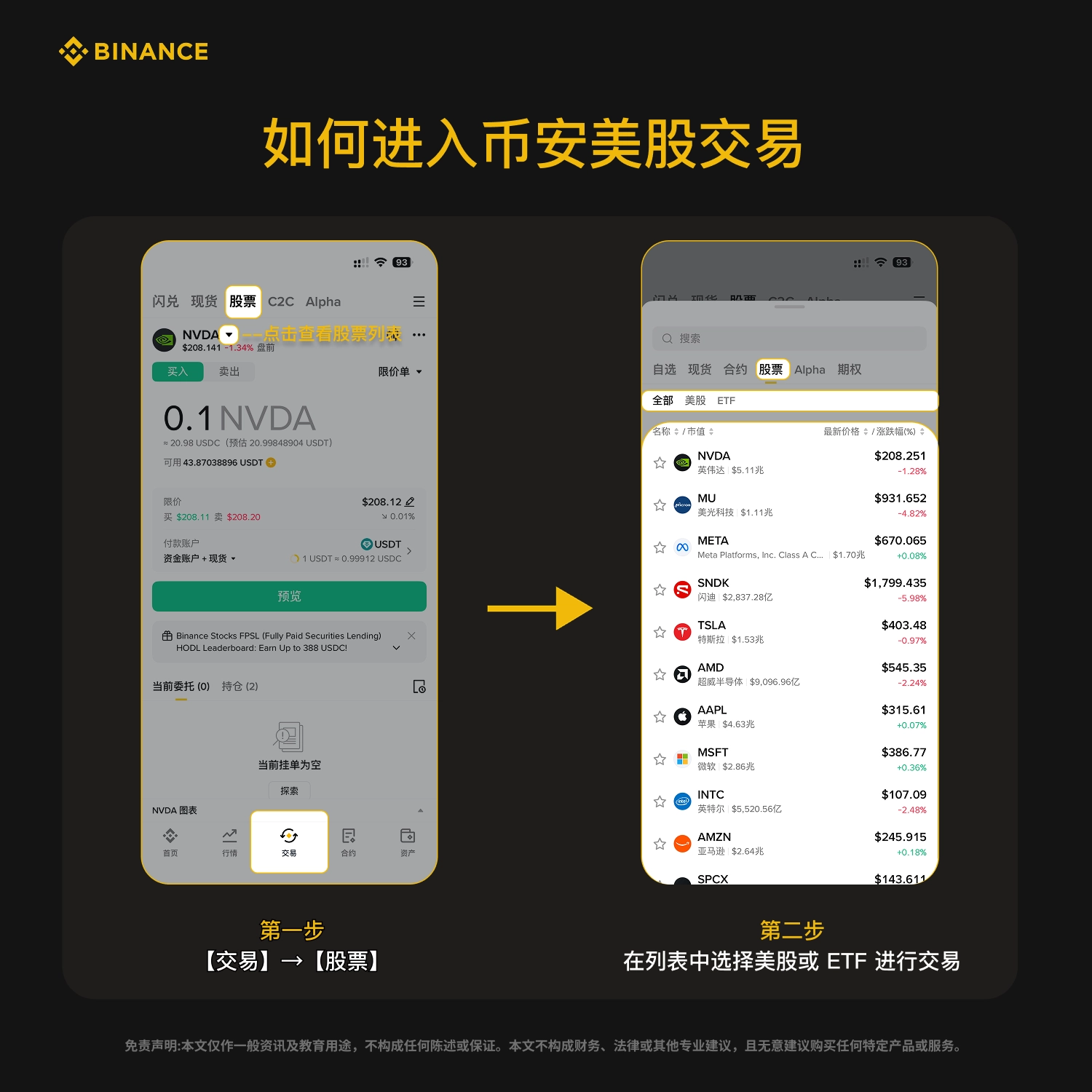
Please refer to the platform's official description for specific product structures, applicable regions, and trading rules.
Researching U.S. stocks is not just for buying. Reading financial reports, analyzing company revenue and profitability, understanding market valuation, are all skills worth accumulating.
How else can the money earned be arranged?
As income gradually increases and there’s a surplus in the account, you can consider different asset arrangements based on your funding needs and risk tolerance.
For example, Binance savings guarantees principal while earning coins. Eligible users can check the actual available products on the platform to understand the earnings rules, redemption conditions, and associated risks.
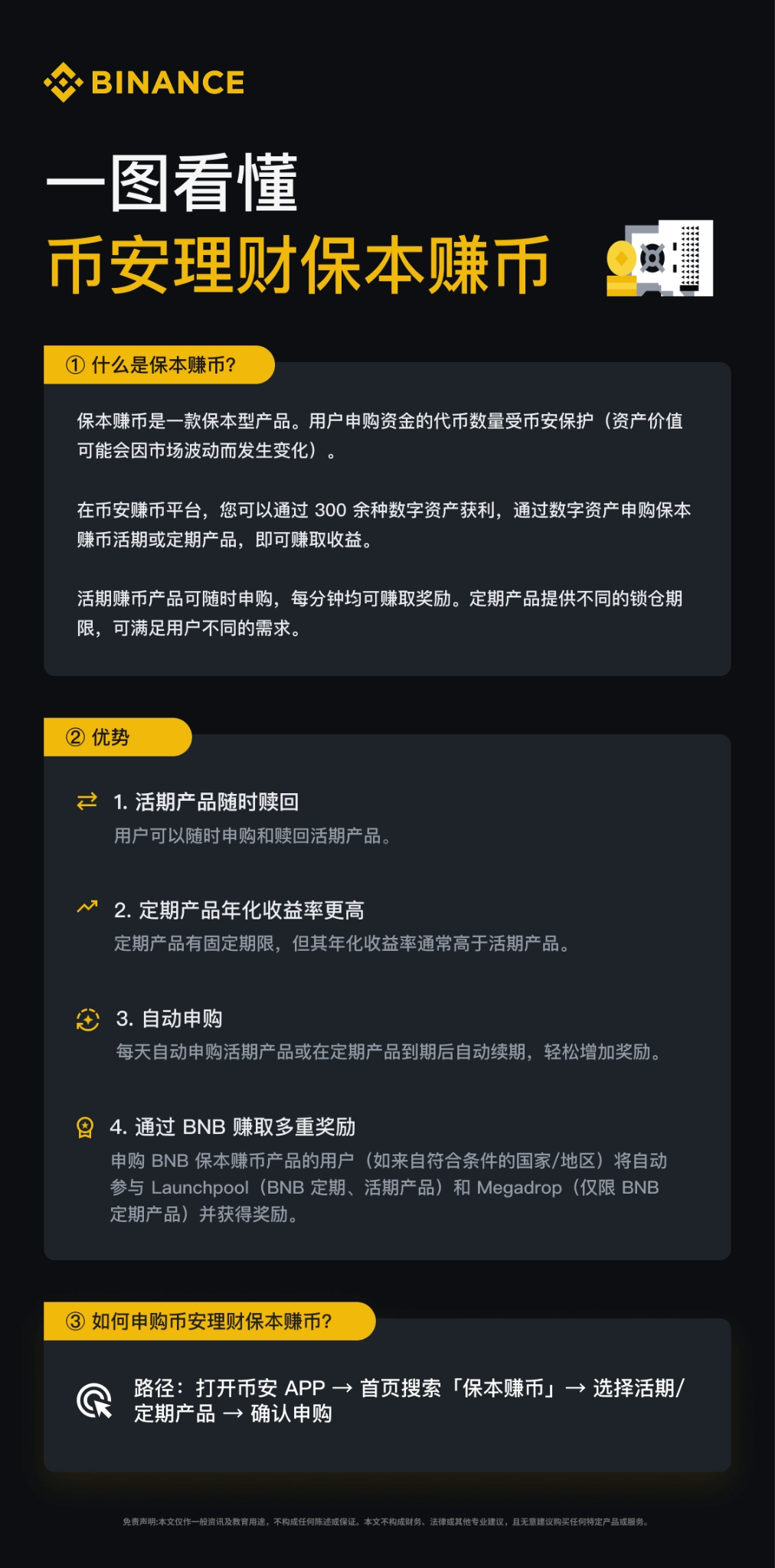
If interested in cryptocurrencies like Bitcoin, you can first study their operating mechanisms, price volatility, and potential losses, before deciding if they are suitable for you.
Here, a special reminder: digital asset finance is not bank deposits; returns are not guaranteed, and principal loss is possible; the price volatility of cryptocurrencies can be significant, and they are not suitable for using essential living funds to bear risks.
There is also no need to transfer all the money earned from U.S. stocks to buy cryptocurrencies, or to rush to invest funds just to obtain a financial product reward.
Different assets come with different risks, and funds should also have different purposes. It's best to consider living reserves, long-term investments, and high-risk allocations separately.
Investing is not about putting every penny at risk but learning to manage funds gradually.
4. Connecting these three things is the key
Looked at individually, AI, self-media, and investments are not new concepts.
What is truly worth pondering is how they can complement each other.
AI helps you improve efficiency, enabling you to complete more work; self-media allows your results to be seen by more people, increasing opportunities for cooperation, employment, or monetization; as income increases and expenditure is controlled, surplus funds can gradually enter long-term asset planning.
The core of this logic is not to give up work, nor to expect to rely on self-media or investments to make a fortune overnight.
Income from work remains the financial foundation for many people. However, when conditions allow, it is possible to gradually invest some of your energy into things that can continuously accumulate.
Works can be read repeatedly, professional skills can improve continuously with practice, and funds can participate in long-term investments under the premise of taking reasonable risks.
Of course, this process will not succeed automatically. Content may not attract traffic, AI projects may not monetize, and the market may decline.
So, it's worth setting more realistic goals.
First, use AI to improve a daily task, then continuously share the knowledge you are familiar with; when income and savings conditions allow, establish an investment plan that suits you.
Each step doesn’t have to be large, but it’s best to leave room for accumulation.
Finally
Ordinary people find it hard to gain more time out of thin air.
But we can try to change the way we use time: not just completing the work at hand but also accumulating things that can have long-term effects for ourselves.
Learn to use AI to enhance efficiency, organize experiences into works, and then reasonably save and invest a portion of your income.
These three things do not guarantee financial freedom but can help us improve our situation from different directions.
What is truly worth pursuing is not to never work again, but one day, not having to rely solely on increasing work hours to continue growing your income.
From this perspective, AI, self-media, and investments indeed deserve the time of ordinary people to study seriously.
Join our community to discuss and become stronger together!
Official Telegram community: https://t.me/aicoin_support
AiCoin Chinese Twitter: https://x.com/AiCoinzh
Binance benefit group: https://www.aicoin.com/link/chat?cid=gmLgwvKD1
Risk Warning: Investing in U.S. stocks carries market risks, regulatory risks, and compliance risks with local laws and regulations (especially foreign exchange controls, overseas investment reporting, etc.). This content is only a market observation sharing and does not constitute investment advice. The cryptocurrency market is highly volatile, please participate within your own risk tolerance range.
免责声明:本文章仅代表作者个人观点,不代表本平台的立场和观点。本文章仅供信息分享,不构成对任何人的任何投资建议。用户与作者之间的任何争议,与本平台无关。如网页中刊载的文章或图片涉及侵权,请提供相关的权利证明和身份证明发送邮件到[email protected],本平台相关工作人员将会进行核查。