The current market is presenting a rare paradox of "bull-bear coexistence": the S&P 500 index is just a step away from its historical high, yet oil prices remain high above $100 per barrel, the yield on the 10-year U.S. Treasury bond hovers around 5.12%, inflationary pressures remain above the Federal Reserve's 2% target, and geopolitical conflicts in the Middle East have persisted for over 200 days. This leaves many investors confused—fundamentals appear to deteriorate, yet the index is close to record highs.
In fact, this is what we refer to as a "stealth bear market." The index is driven by a few tech giants, while the vast majority of constituent stocks have already entered significant corrections or even bear market territory. In sectors such as real estate, materials, utilities, and discretionary consumption, over 90% of stocks have retraced more than 10% from their respective highs, with nearly 60% of stocks retracing more than 20%. This structural divergence is not a precursor to a market crash, but rather provides a historic allocation window for selecting quality companies. If geopolitical conflicts ease, oil prices retreat, and interest rate expectations shift, the index is likely to gain additional upward space; even if conflicts persist, the relative appeal of quality assets remains prominent.
For novice investors, the key is not to forecast macro turning points, but to establish a set of simple, repeatable, and clearly defined buying rules. Below, we have distilled four highly practical strategies based on the practical logic of professional institutions, accompanied by step-by-step diagrams and candlestick charts, to help you maintain discipline in a complex environment.
1. Macro Background: Why "Stealth Bear Market" Constitutes an Opportunity
At the beginning of 2026, the market generally expected the Federal Reserve to cut interest rates at least three times within the year. By mid-October, the reality was drastically different: the Federal Reserve raised rates once, and the market priced in about 75-100 basis points more in potential rate hikes by mid-2027, with overall interest rate expectations rising more than 150 basis points. Oil prices surged significantly from the early-year lows, with diesel prices once increasing by over 80%, while the fiscal deficit approached $2 trillion. These factors should have suppressed stock market valuations.
However, the index remains close to high levels, primarily due to resilience in earnings and structural divergence. A few tech leaders (such as Nvidia, Microsoft, Apple, and Google) have contributed most of the gains in the index since the low in late March, with the remaining approximately 490 stocks contributing only about 30%. This means that for truly high-quality companies in a bear market, current prices already reflect a high margin of safety. Novice investors need not chase the already priced-in leaders but should focus on fundamentally solid companies that have been wrongly penalized.
History repeatedly shows that debt cycles, geopolitical conflicts, and technological revolutions often occur in tandem. As long-term debt cycle analysis reveals, when government debt service costs begin to squeeze necessary expenditures and debt supply exceeds demand, interest rates and currency values will face pressure. The experience of Japan indicates that the long-term returns of bonds and currencies in high-debt countries may significantly lag behind physical assets like gold. Therefore, in the current environment, selecting companies with strong balance sheets and stable cash flows, coupled with clear risk controls, is more reliable than purely betting on macro directions.
2. Practical Buying Rules: Four Simple and Executable Strategies
The following strategies emphasize "good companies, buy late, buy after selling pressure is exhausted, and have clear risk levels." They do not rely on complex indicators; novices only need to grasp fundamental screening and price action observation to implement them.
Strategy 1: Only buy "Good Companies"—Fundamental Priority Screening Criterion
A good company is not the stock with the highest emotional fervor but a business with sustainable competitive advantages (moats), stable profitability, excellent management, and a healthy balance sheet. The specific screening steps are:
- Check whether the free cash flow has consistently been positive over the past four quarters and whether capital expenditures are controllable.
- Return on equity (ROE) has been consistently above the industry median without relying on excessive leverage.
- Industry position: Does it rank in the top three in core submarkets, or have pricing power?
- Debt levels: Net debt/EBITDA is below 3 times, and interest coverage is above 5 times.
- Management's ownership and capital allocation record: Is repurchasing or dividends reasonable and not blind expansion?
Novices can start with consumer essentials, healthcare, and certain industrial and technology sub-sectors while avoiding high-leverage cyclical stocks. Good companies often can maintain or expand their share under macro pressure, making rebounds easier after corrections.
Strategy 2: Buy Late Principle—Avoid Chasing Highs, Wait for Confirmation
"Buy late" means not entering on breakthrough days or emotional peaks, but rather waiting for prices to retest key support and confirm renewed buying interest before acting. This greatly reduces the risk of being caught.
Operating steps:
- Identify healthy pullbacks in an uptrend (typically a 10%-20% retracement that does not break major moving averages).
- Observe whether trading volume shrinks during the pullback.
- Wait for prices to stabilize near support with candlesticks (like long lower shadows, bullish engulfing patterns).
- Enter only after confirmation, rather than prematurely "bottom fishing."
Buying late sacrifices some potential profits but brings higher win rates and clearer risk levels. For novices, this is more sustainable than frequent chasing of highs.
Strategy 3: Buy After Selling Pressure is Exhausted—Signaling Exhaustion of Selling Pressure
Trading volume is a confirmation tool for pricing. When prices pull back, if selling volume continues to shrink (selling pressure exhaustion), it indicates that fewer participants are willing to sell at low prices, and selling pressure is weakening. If a volume surge coincides with price stabilization or increases afterward, it often presents a reliable entry window.
Key observations:
- Volumes during the pullback fall gradually below the 20-day average volume, or even only represent 30%-50% of the average volume.
- Prices test a certain range repeatedly and do not make new lows.
- Subsequently, one or more bullish candlesticks appear with increased volume.
Buying at this time usually offers a better risk-reward ratio. It is essential to emphasize that volume itself does not predict direction but only confirms changes in supply and demand. Novices should use it in conjunction with trends and support levels, rather than relying solely on it.
Strategy 4: Must Have a Clear Risk Level—Set Stop Loss Before Position Size
Any purchase must define "where to exit if the judgment is wrong" beforehand. Risk levels are typically set 1%-2% below key support or below recent swing lows. Once prices close below the risk level, stop loss immediately; do not hold onto hope.
Position control rules: Risk on any single trade should not exceed 0.5%-1% of total account funds. For example, for an account of $100,000, the maximum loss per trade would be $500-$1,000. Calculate the number of shares based on the distance from the entry price to the stop loss price. This ensures that even with consecutive misjudgments, the account will not suffer a devastating blow.
Tokenization of U.S. Stocks: A New Way to Implement Rules
Tokenizing U.S. stocks maps traditional stock prices to blockchain tokens, enabling 24/7 trading, fragmented holdings, and faster settlement. Binance's bStocks is currently a leading product, managing over $1 billion in assets, with a cumulative trading volume exceeding $40 billion, supporting nearly 100 underlying assets. They track underlying prices at a 1:1 ratio, can trade with USDT, support withdrawals to wallets, but do not represent direct ownership of stock (no voting rights, etc.). Primarily targeted at non-U.S. users.
Advantages for novices include:
- Low barrier to entry for fragmented buying (can start with very small amounts).
- 24-hour trading, not restricted by U.S. stock market hours.
- Liquidity-rich mainstream assets (such as NVDAB, AAPLB, TSLAB).
- Traditional technical analysis can be directly applied to token price behavior.
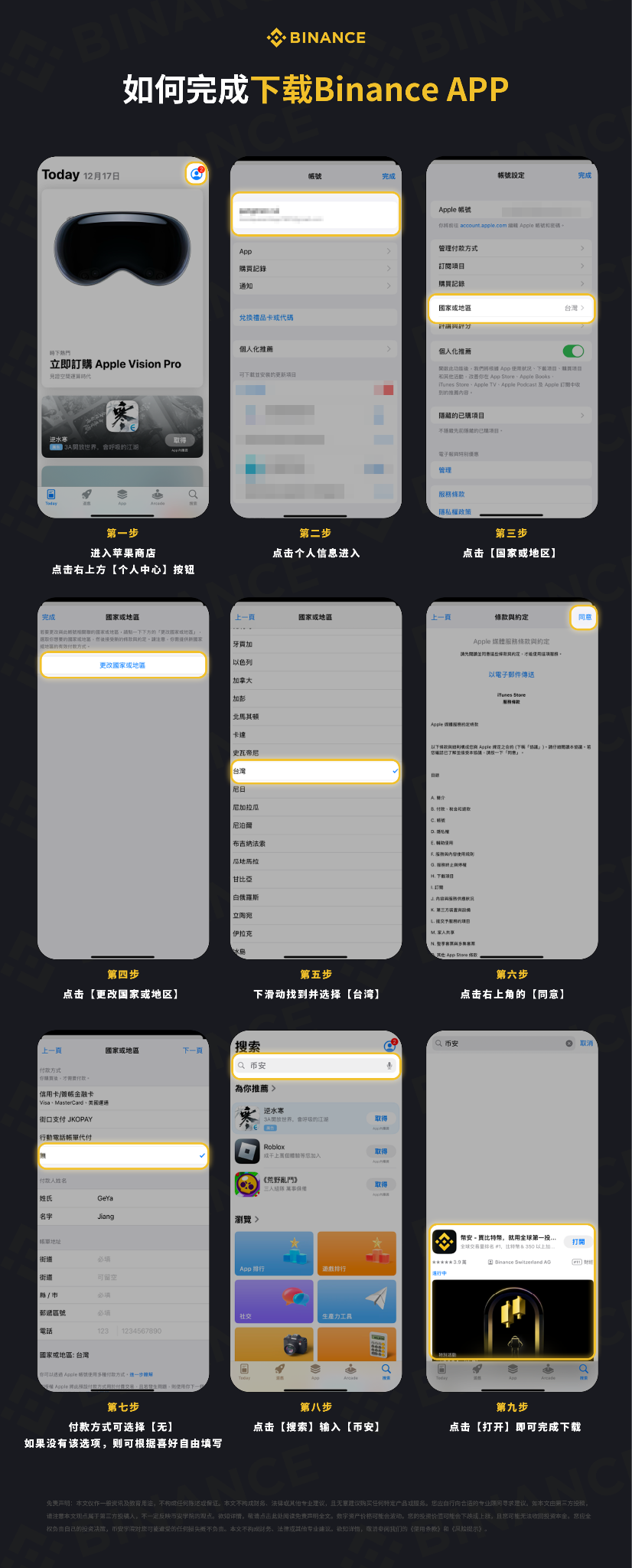
Binance Referral Link: https://jump.do/zh-Hans/xlink-proxy?id=3
Or log into the Binance app and simply fill in the invitation code aicoin668, the following are exclusive generous registration benefits for AiCoin invitation codes:
Benefit 1: Up to $440 for new customers
1. Deposit $100 + trade $100 → receive a $100 position voucher
2. Deposit $1,000 + trade $50,000 → receive another $300 position voucher
3. Deposit $3,000 + trade $200,000 → receive another $40 cash voucher
Three tiers can be stacked, so by depositing $100 you can receive the first tier.
Benefit 2: Open blind boxes, up to 25 RE tokens
1. Register + deposit $50 + trade $100 + log into the app
2. After completion, receive a blind box for the campaign, randomly select RE tokens, up to 25 pieces.
This equates to a new user completing tasks and receiving double benefits.
Individual Stock Case: NVDAB (Tokenized NVIDIA)
NVIDIA as a core of AI computing power has strong fundamentals, ample free cash flow, and a deep moat. In a stealth bear market, if its token price shows a healthy pullback and volume shrinks and stabilizes thereafter, the late-buying rule can be applied. The risk level is set below crucial support. Similar logic applies to AAPLB (Apple, consumer electronics and services ecosystem) and TSLAB (Tesla, electric vehicles and energy). These assets can be traded directly on Binance, and novices can execute based on fundamental screening and price behavior.
Other cases include Micron (storage chips), AMD, and other semiconductor-related tokens, or consumer and financial assets. The core principle remains unchanged: first confirm the characteristics of good companies, then wait for volume and price confirmation.
Detailed Step-by-Step Diagrams and Execution Process
The following is a complete buying process (applicable to Binance bStocks):
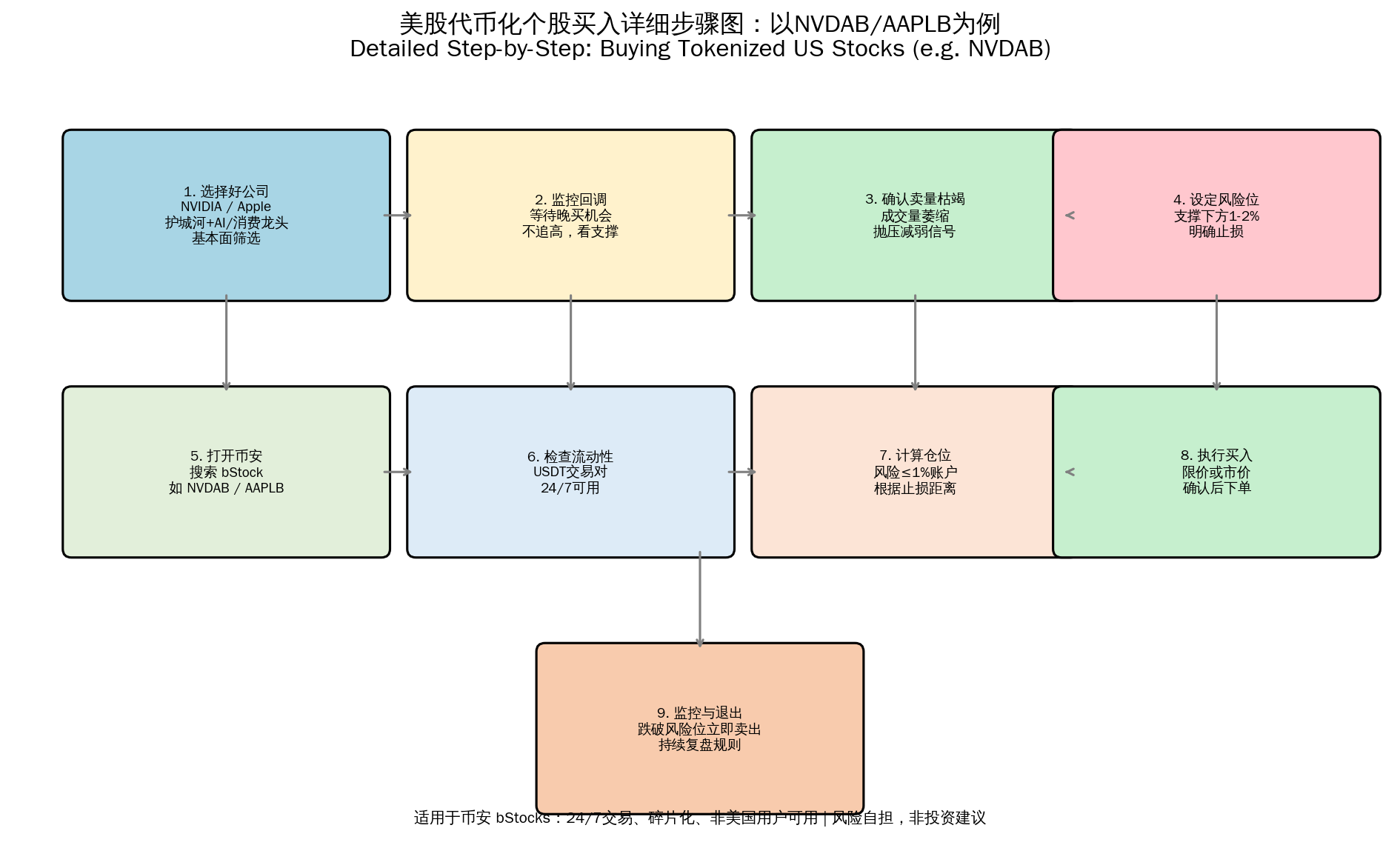
Process explanation:
- Screen for good companies (such as NVIDIA, Apple), confirm fundamentals.
- Monitor pullbacks, wait for late-buying opportunities, do not chase highs.
- Observe whether selling volume is exhausted (indicating significant volume shrinkage).
- Set clear risk levels below support.
- Open the Binance app or website, enter Spot trading, search for bStock (such as NVDAB).
- Check the liquidity and spread of the USDT trading pair.
- Calculate position size based on risk ratios (risk ≤ 1% of the account).
- Execute buy at limit or market price.
- Continuously monitor; if it falls below the risk level, sell immediately and review.
3. Corresponding Step-by-Step Diagrams and Candlestick Chart Analysis
The following charts provide sample data to illustrate the rules above, helping novices understand intuitively.
First, the overall process flow diagram:
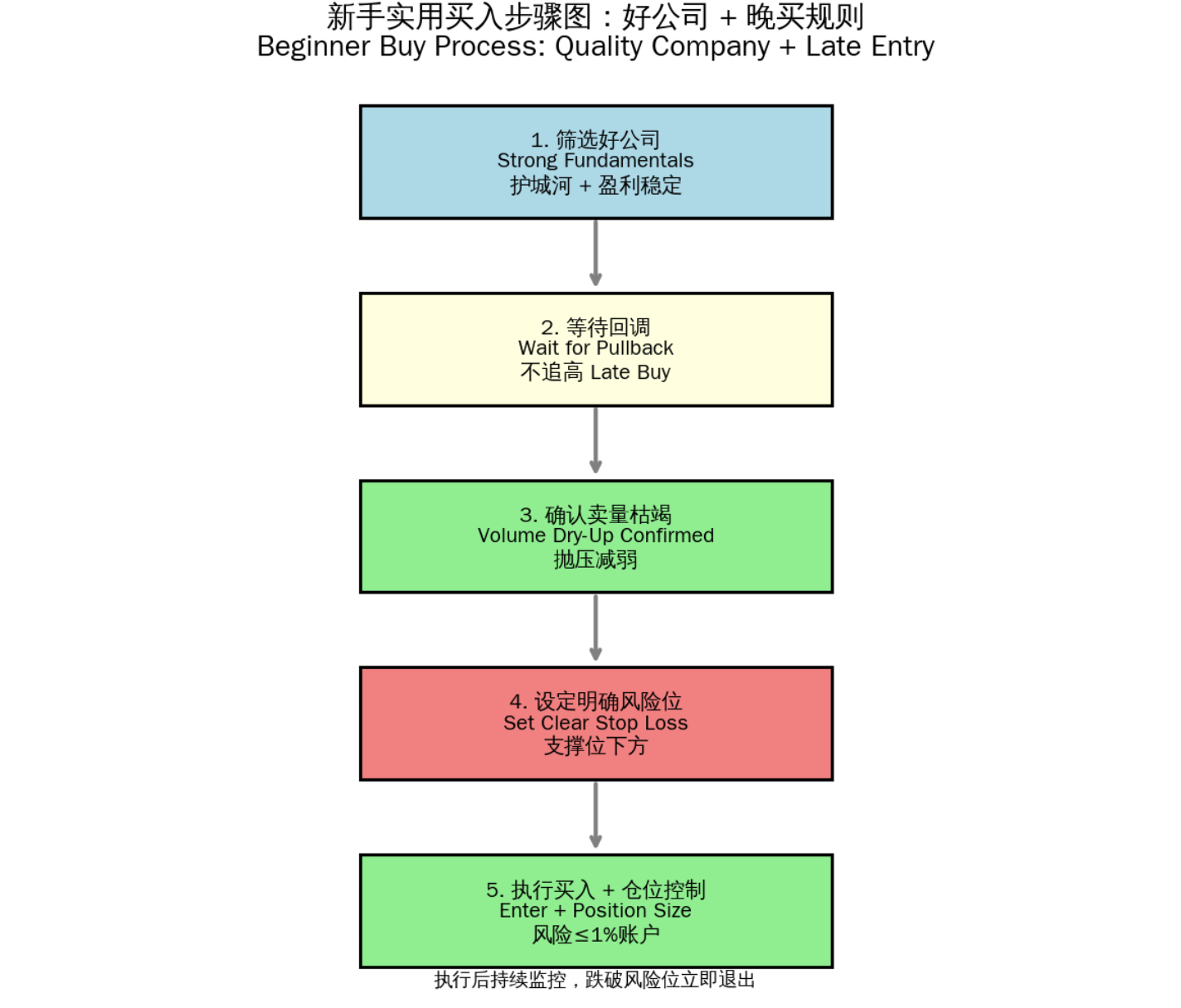
This diagram clearly outlines the complete loop from screening good companies, waiting for pullbacks, confirming exhaustion of selling volume, setting risk levels, to executing buys. Novices can print it or screenshot it as a daily checklist.
Next, here is a candlestick example of buying after selling pressure is exhausted:
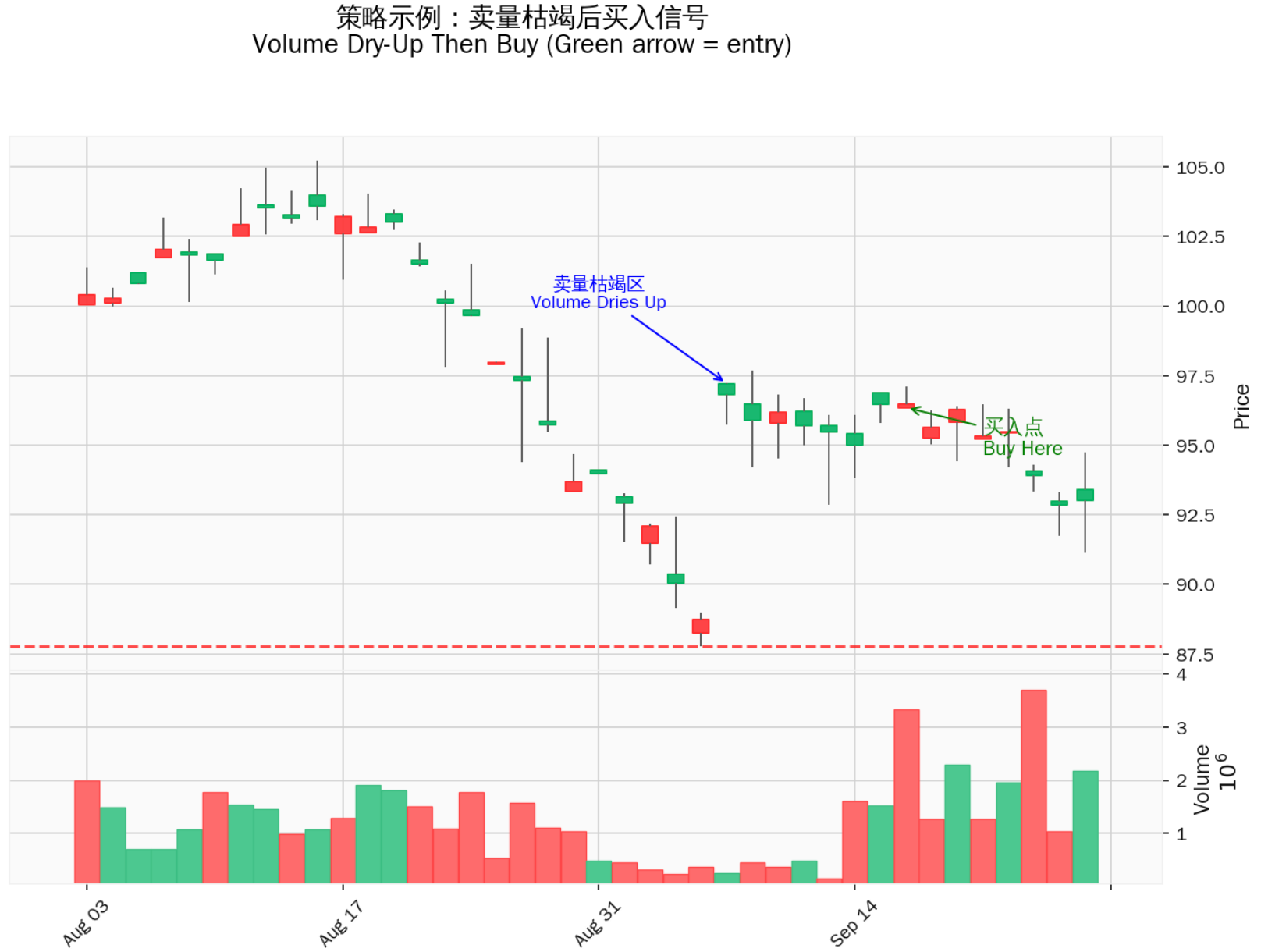
In the image, we can see that price enters a horizontal band after a period of decline, with the volume bars significantly shrinking (indicating selling pressure exhaustion), followed by price stabilization accompanied by volume increase, with the green arrows denoting ideal entry zones. The red dashed line represents the risk level; if broken, exit.
Next, let's look at an example of late buying and clear risk levels:
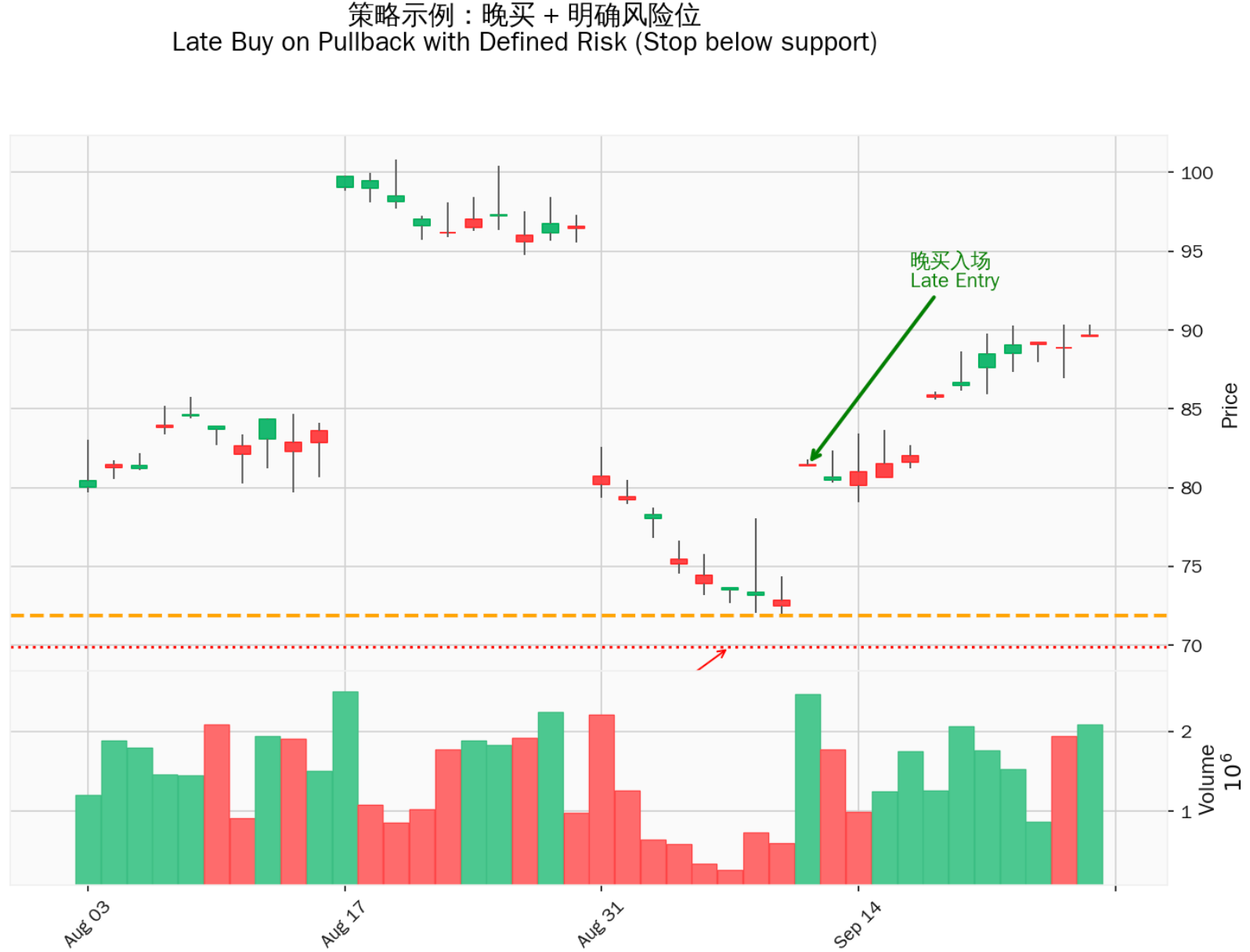
The price first rises then retests support (orange dashed line), and volume shrinks during the pullback. The late buying entry point is after support confirmation, with the red dashed line representing the predetermined stop loss risk level. This structure makes risks fully visible and significantly reduces psychological pressure.
4. Practical Details and Risk Control
Daily/Weekly Routine Check (about 30-45 minutes)
- After market close from Monday to Friday, scan holdings and good companies on the observation list for signs of pullback + volume shrinkage.
- Mark potential support and risk levels.
- Only consider building positions when all conditions are met simultaneously.
- Review weekly: Which trades adhere to the rules? Which diverged due to emotional factors?
Position and Portfolio Recommendations
In the early stages, novices can divide their funds into 5-8 parts, each corresponding to a good company. Avoid having a single stock account for too high a percentage. While holding quality companies for the long term, you can use a small portion of funds to practice the timing rules discussed above. In terms of macro hedging, consider allocating a small amount to gold or cash to counteract debt cycle pressures.
Common Questions
Q: What is the difference between tokenized stocks and real stocks?
A: bStocks track prices, but holders are not direct shareholders and have no voting rights. Suitable for price exposure but not for those pursuing company governance rights. Please confirm whether it is available in your location.
Q: How do you operate on Binance?
A: Complete KYC (qualifying users), enter the Spot market to search for "bStock" or the specific code (NVDAB, etc.), and trade with USDT. Limit orders are supported, and stop losses can be set. The platform offers 24/7 depth.
Q: What if my judgment is wrong?
A: Strictly execute stop loss at the risk level. Continuous small losses are much better than a single large drawdown. The value of the rules lies in discipline rather than single accurate predictions.
Q: Is now a suitable time to enter?
A: The stealth bear market provides a window for selecting wrongly penalized quality assets. Gradually executing according to rules is preferable to remaining in cash waiting for a perfect moment. Historical evidence shows that disciplined approaches tend to be effective in hindsight.
Q: Why not just buy the index or market leaders?
A: The index is driven by a few stocks, and most constituents are already in bear markets. Good companies often have a higher margin of safety after retracements, and the late-buying rule can further improve entry costs.
Q: What if the price continues to drop after selling pressure is exhausted?
A: This is precisely the purpose of having risk levels. Strictly implement stop losses, accept small losses, and protect your capital. Historical data shows a higher success rate for stabilization after volume shrinkage, but it is not 100% guaranteed.
Q: How to determine if a "good company" will go bad?
A: Track free cash flow and debt changes each quarter. If deterioration occurs for two consecutive quarters without reasonable explanations from management, re-evaluate. Do not refuse to stop loss just because it "used to be a good company."
Q: Given the poor macro environment, is now a suitable time to buy?
A: The stealth bear market precisely provides a window for selecting wrongly penalized quality assets. As long as the rules are clear and risks controllable, executing in batches is better than waiting for a perfect moment. Historical instances (such as the early 1990s U.S. fiscal reform period) indicate that disciplined buying is often proven correct in hindsight.
Q: What is the greatest enemy for novices?
A: Emotion and overtrading. The design of late buying and clear risk levels is meant to combat the two human weaknesses of "fear of missing out" and "unwillingness to admit mistakes."
Platform Recommendations and Final Advice
For novices who hope to implement the rules mentioned above, Binance is currently one of the most mature and liquid platforms for tokenized U.S. stocks. Its bStocks product has leading scale management, supports mainstream technology and consumer assets, offers fragmented 24/7 trading, and interfaces deeply with USDT. Non-U.S. users can easily access it (specifics subject to platform compliance requirements). It is recommended to practice the rules with a small amount of capital first and gradually increase after familiarizing yourself with the interface and price behavior.
In the stealth bear market, opportunities belong to investors who choose good companies, adhere to late buying, wait for selling pressure to exhaust, and set strict risk levels. Tokenization of U.S. stocks makes these simple rules easier to execute. Start with bStocks on the Binance platform, replace emotion with discipline, and use rules to protect capital. In the long term, the ability to navigate cycles comes from repeatable methods rather than perfect predictions.
Risk Warning: This article is for educational analysis only and does not constitute any investment advice. The market poses risks of loss, and tokenized products may face additional risks such as liquidity, regulation, or price deviations. Please conduct your own research, assess your risk tolerance, and comply with local laws. Be sure to read the platform terms before investing.
免责声明:本文章仅代表作者个人观点,不代表本平台的立场和观点。本文章仅供信息分享,不构成对任何人的任何投资建议。用户与作者之间的任何争议,与本平台无关。如网页中刊载的文章或图片涉及侵权,请提供相关的权利证明和身份证明发送邮件到[email protected],本平台相关工作人员将会进行核查。