Author: AiPlot Research Institute
Focus: RWA / Digital Assets / In-depth Analysis of Financial Infrastructure
Website: https://aiplot.com/?utm_source=aicoin
The regulation of stablecoins in the United States is transitioning from "whether to allow" to "how to incorporate them into the financial system."
On October 21, the Office of the Comptroller of the Currency (OCC) released the final rules for the GENIUS Act. U.S. Treasury Secretary Scott Bessent subsequently stated on X that this legislation is a "watershed moment" for the U.S. financial sector, similar to the National Currency Act that established the national bank currency framework in 1863, which will create a federal framework for payment-oriented stablecoins in the digital age.
The rules will take effect on January 18, 2027, covering aspects such as reserve assets, redemption, custody, risk management, auditing, reporting, issuance applications, and regulation.
What it fundamentally changes is the positioning of stablecoins: stablecoins are no longer just a dollar alternative on exchanges but may become a dollar settlement layer used in common by banks, payment institutions, asset managers, and on-chain protocols.
As of October 22, AiPlot's page shows that, categorized by asset class, U.S. Treasury bonds are valued at approximately $14.5 billion, ranking first; followed by commodities at about $5.27 billion, active strategies at around $4.28 billion, and stocks at approximately $3.5 billion.
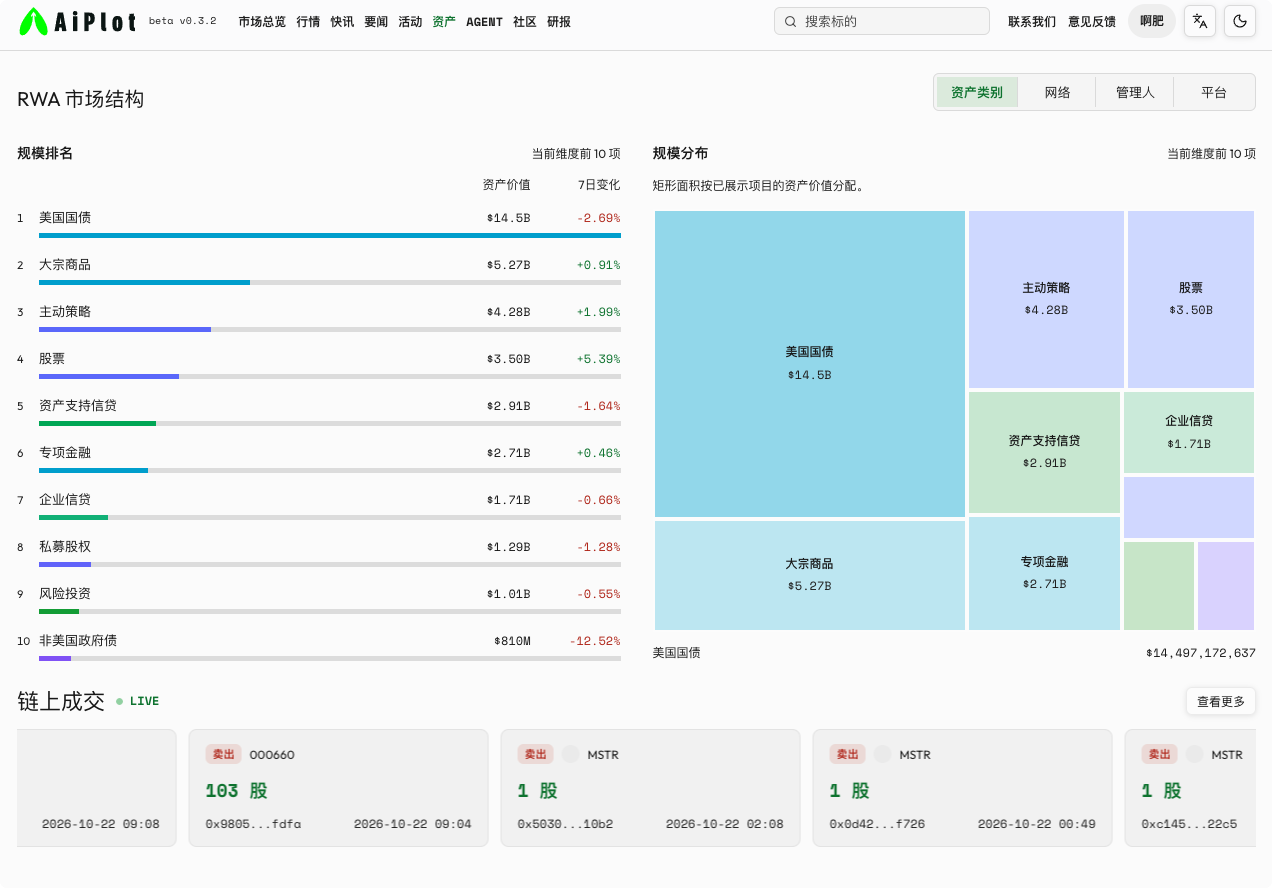
Among the top ten asset classes, U.S. Treasury bonds account for about 38.2%, and the combined percentage of U.S. Treasury bonds and stocks is about 47.4%. This indicates that the main line of RWA is not stock tokens or real estate but rather the financial infrastructure composed of dollar reserves, Treasury bonds, repurchase agreements, and stablecoins.
1. What Exactly Has the GENIUS Act Changed
The core of the OCC's final rules is to integrate payment-oriented stablecoins into a clear issuance and regulatory framework.
According to the OCC announcement, the rules apply to licensed issuers of payment-oriented stablecoins under OCC jurisdiction, foreign issuers of payment-oriented stablecoins, and certain custody activities carried out by OCC-regulated entities. The rules cover reserve assets, redemption procedures, risk management, auditing and reporting, custody, registration applications, regulation of foreign issuers, and capital and operational backup mechanisms.
The GENIUS Act itself requires that payment-oriented stablecoins must be backed by reserve assets at a one-to-one ratio. Allowable reserves include U.S. dollars in cash, bank demand deposits, certain U.S. Treasury bonds, compliant repurchase agreements, specific money market funds, and certain qualifying federal assets. Issuers need to disclose their redemption policies, report on reserve composition monthly, and undergo auditing or review.
The significance of this set of rules is not to make stablecoins more like ordinary crypto tokens but to make them resemble a regulated digital dollar liability. Users care about whether they can redeem at face value, issuers must prove the provenance of reserves, and regulators need to know who has issuance authority, who is responsible for custody, and who bears operational risks.
However, it is crucial to differentiate between "the rules have been published" and "the market has been fully opened." The OCC's dedicated page clearly indicates that, as of now, it has not started accepting applications or exemption requests from issuers of payment-oriented stablecoins, and relevant information collection procedures must await approval.
Thus, January 18, 2027, marks the effective date of the regulatory framework, not the date when all issuers automatically obtain licenses, nor the time when stablecoin funds are guaranteed to flow in on a large scale.
2. Why U.S. Treasury Bonds Have Become the Largest Asset Class in RWA
AiPlot's asset class page shows a valuation of U.S. Treasury bonds at approximately $14.5 billion, significantly higher than commodities, active strategies, and stocks.
There are three reasons behind this.
First, Treasury bonds are the most natural asset for stablecoin reserves. Payment-oriented stablecoins need to maintain stable prices and timely redemptions, so reserves must have high liquidity, low credit risk, and strong dollar-denominated attributes. Short-term U.S. Treasury bonds, cash, and highly liquid money market instruments are naturally suited to fulfill this function.
Second, Treasury bonds also have income attributes. Stablecoins themselves typically cannot pay interest directly to holders, but issuers can invest compliant reserves in Treasury bonds or similar assets to earn returns on the asset side. The business model of stablecoin issuers largely relies on the interest rate spread between issuance scale and reserve asset returns.
Third, Treasury bonds are low-friction assets that connect traditional finance with on-chain finance. Compared to private equity, real estate, or corporate credit, the valuation, duration, liquidity, and market perception of Treasury bonds are more standardized, making them easier to package as on-chain funds, digital money market instruments, or stablecoin reserve certificates.
Therefore, U.S. Treasury bonds in RWA are not a standalone investment category. They may also serve as the asset side of the stablecoin system, the underlying asset of on-chain cash management tools, and low-volatility collateral for DeFi liquidity.
3. The Structural Differences in AiPlot's Three Sets of Data That Are Easily Overlooked
AiPlot's page provides dimensions of asset classes, networks, and platforms. These three figures cannot simply be added together, but viewed together, they can help understand the different layers of RWA.
The asset class dimension shows that U.S. Treasury bonds are the largest single category, valued at about $14.5 billion.
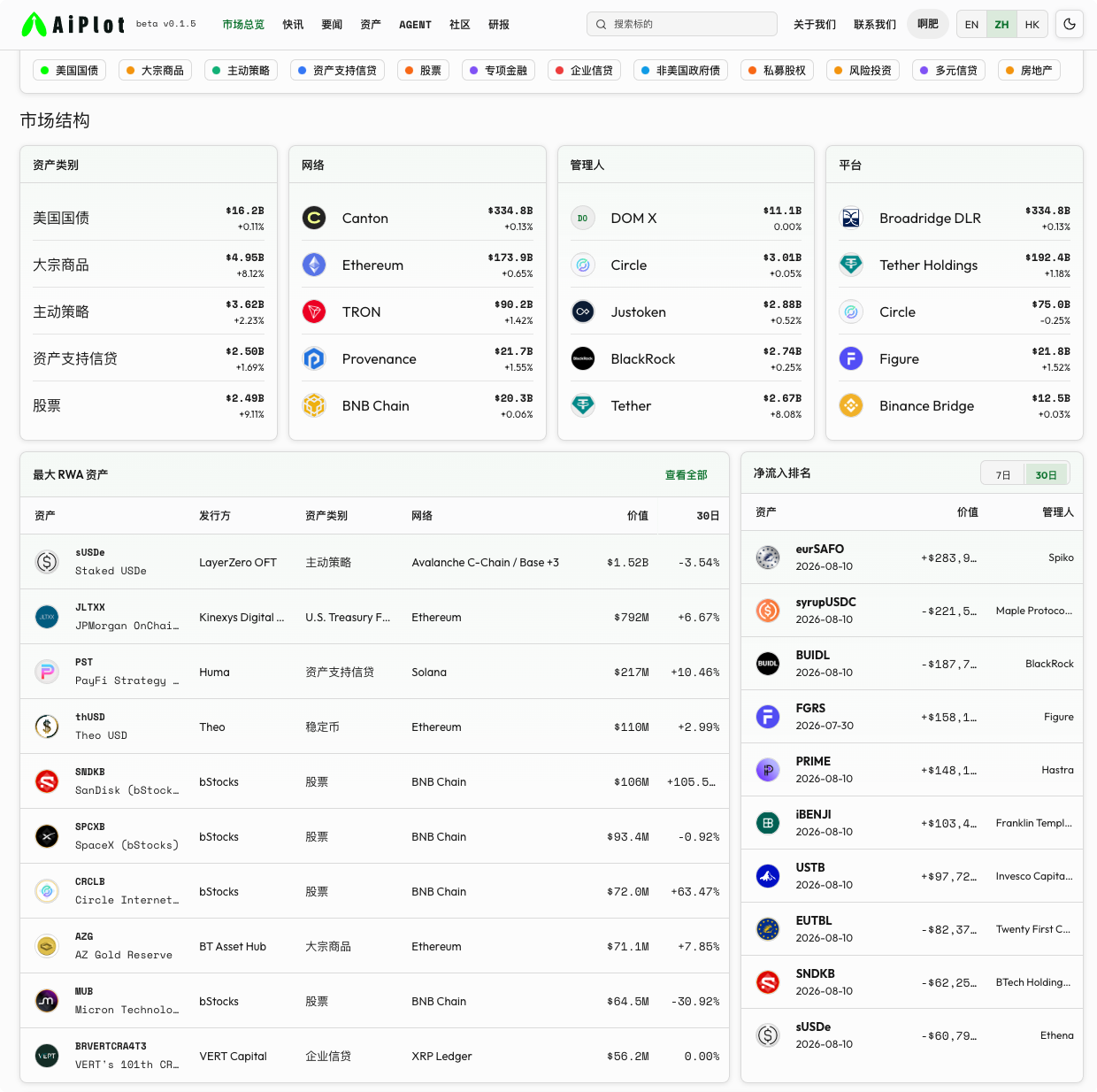
In the network dimension, Canton shows approximately $321.7 billion, Ethereum about $163.6 billion, TRON around $92.2 billion, and Provenance approximately $24.6 billion. In the platform dimension, Broadridge DLR also shows about $321.7 billion, Tether Holdings around $18.44 billion, and Circle about $7.31 billion.
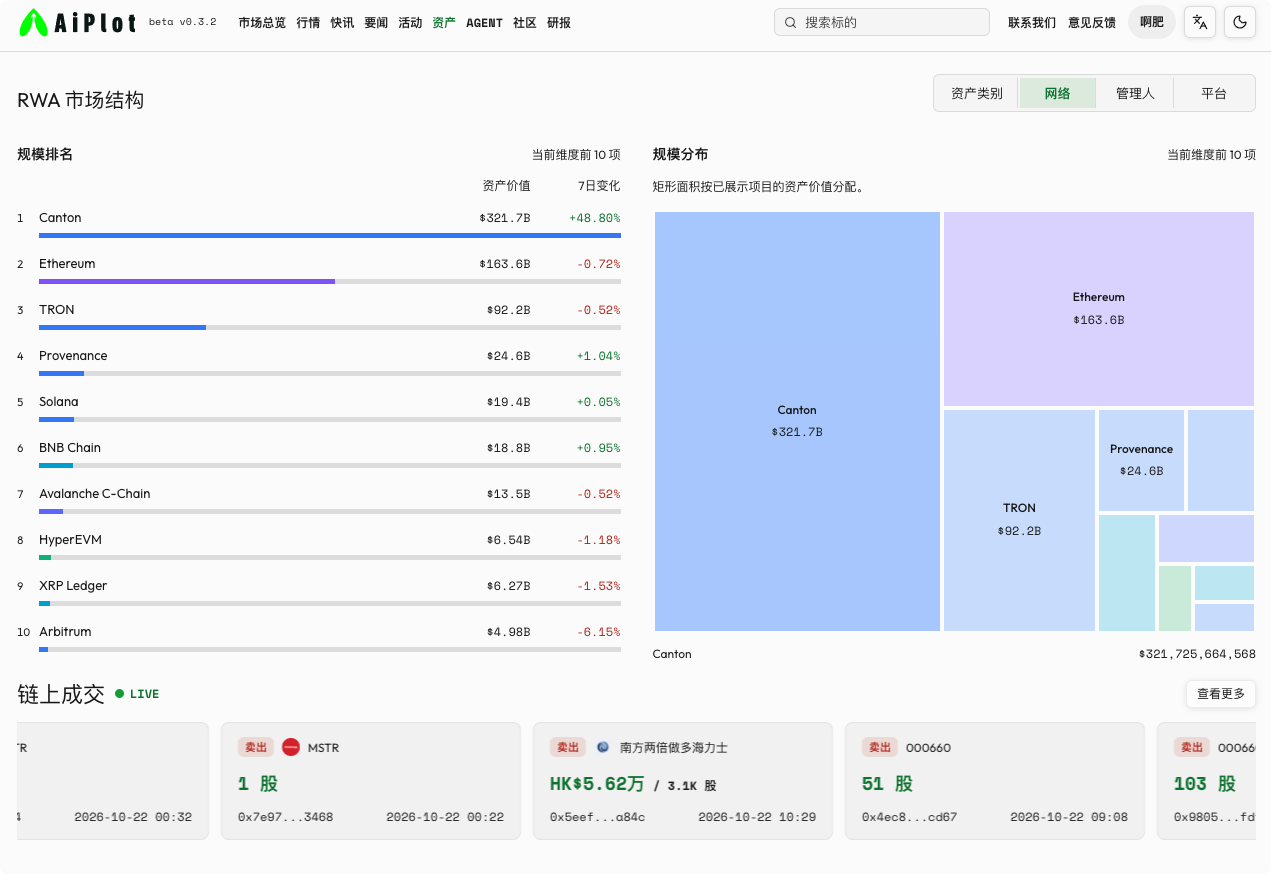
These figures seem significantly higher than the $14.5 billion valuation of Treasury bonds in the asset class dimension. They do not imply that AiPlot's data contradict each other, but rather indicate that the asset ranges included in different dimensions vary.
In AiPlot's RWA asset list, products such as Broadridge DLR repurchase agreement assets, USDT, USDC, Figure HELOC, USYC, Ondo USDY, BlackRock BUIDL, and USDG also appear.
In other words, the network and platform dimensions cover a broader range of tokenized financial assets and stablecoin distribution, while the asset class dimension ranks based on specific RWA types. Data from different dimensions cannot be directly merged into a "global RWA total market value."
However, this discrepancy itself is quite valuable. It indicates that the RWA market consists of at least three layers:
- Asset Layer: Treasury bonds, repurchase agreements, commodities, stocks, credit, and funds;
- Settlement Layer: Stablecoins such as USDT, USDC;
- Network and Distribution Layer: Canton, Ethereum, TRON, Broadridge, Tether, Circle, etc.
The GENIUS Act primarily regulates the issuance of stablecoins and payment settlements, but the ultimate impact will be on the entire three-layer structure.
4. Why Stablecoins Could Become the "Entry Assets" of RWA
The role of stablecoins in RWA is not just as trading pairs. They actually serve three functions.
First, they are on-chain dollars. Users can use stablecoins to purchase tokenized Treasury bonds, stocks, commodities, or credit products without going through traditional banking systems for dollar settlement each time.
Second, they serve as asset settlement tools. Subscription, redemption, interest payments, and secondary trading of RWA products all require a stable pricing unit. Stablecoins provide a dollar settlement environment that operates around the clock.
Third, they act as liquidity routers. Stablecoins such as USDT and USDC can circulate across networks, entering different trading platforms, lending protocols, and asset issuance systems. The issuance scale and network coverage of a stablecoin could determine whether specific RWA products can quickly gain users.
The role of the GENIUS Act is to reduce institutional uncertainty regarding the participation of banks and payment institutions in this system. The law requires compliant issuers to hold a one-to-one reserve and establish redemption and reporting mechanisms. For institutions, this is easier for internal reviews and risk management than fully relying on stablecoin systems from exchanges or offshore issuers.
This is also why Scott Bessent compared the GENIUS Act to the 1863 National Currency Act. His statement does not imply that stablecoins are equivalent to bank deposits, but emphasizes that the United States is attempting to establish a nationwide regulatory framework for privately issued digital dollars.
5. The Final Rules Are More Flexible Than the Draft, But Not a Comprehensive Relaxation
The market has discussed the changes of the final rules compared to the proposals, including the terms of reserve assets, handling in extreme redemption situations, and the review methods for third-party rewards.
The OCC's final rule materials indicate that some opinions oppose freezing or extending redemptions during spikes in redemption requests, as this may exacerbate bank runs. There are also significant differences among commentators regarding third-party reward arrangements: one side wants to expand the prohibition, while the other argues that overly broad presumptions could cover commercial rewards not intended for stablecoin holders.
Therefore, the final rules leave some space for product innovation in the market but do not eliminate the core restriction: issuers cannot directly pay interest or returns to users simply because they hold, use, or retain payment-oriented stablecoins. Third-party rewards are also not exempt from comprehensive review but must be assessed against specific arrangements to determine if they constitute indirect interest payments.
This will directly influence the competition among stablecoins.
In the future, issuers may rely more on payment networks, trading distribution, merchant incentives, platform tokens, and ecological subsidies, rather than simply promising fixed returns to holders. The competition among stablecoin issuers may shift from "who offers a higher yield" to "who has a broader payment entry, more on-chain liquidity, and stronger institutional distribution capability."
6. Who May Become the First Beneficiaries
Looking at the RWA industry chain, the most direct beneficiaries may not be a specific crypto token, but rather compliant issuance, reserve custody, auditing, payment distribution, and on-chain settlement infrastructure.
Stablecoin issuers like Circle and Tether are in the most obvious position, but the outcomes they face are not entirely the same. Clear regulation can reduce compliance uncertainty but also increase costs for reserves, disclosure, auditing, and capital management. A larger market size does not necessarily equal rising profit margins for issuers.
Banks and payment institutions may gain a clearer pathway to entry. They can participate in issuance, custody, exchange, and settlement but need to meet applicable licensing, reserve, and risk management requirements.
Tokenization platforms for Treasury bonds and on-chain money market funds may also benefit. Products such as USYC, USDY, BUIDL, iBENJI, WTGXX, JLTXX listed on AiPlot highlight how U.S. Treasury bonds are entering the chain through various issuers and multiple networks.
Finally, the underlying networks such as Canton, Ethereum, TRON, Provenance, Solana, and others may determine their competitive position in the next phase depending on their ability to support stablecoin transfers, RWA subscriptions, and institutional-level settlements.
However, "carrying assets" does not equal "capturing all value." Networks may earn transaction fees and usage demand, issuers gain reserve spreads, distribution platforms collect service fees, and custody and auditing agencies earn service income. The value capture in RWA will be dispersed along the entire chain rather than automatically concentrated on public chain tokens.
7. The Biggest Risk in the RWA Market Is the Confusion Between Scale Statistics and Financial Rights
AiPlot's data can help observe market structure, but three pitfalls need to be avoided when using it.
First, different dimension figures should not be added directly. Asset classes, networks, and platforms may have overlapping statistics. The $321.7 billion from Canton and Broadridge DLR likely reflects the distribution of the same large asset across network and platform dimensions, rather than indicating two separate assets.
Second, tokenized values should not be taken as full ownership of the underlying assets. Some products represent fund shares, some represent repurchase agreements or credit rights, and some may only provide economic exposure. Investors should review issuer documents, custody arrangements, redemption conditions, and holder rights.
Third, the effective date of regulatory rules should not be taken as indicative of funds already flowing in. The OCC has issued final rules, but issuance applications have not yet begun to be accepted. The future scale of funds will truly depend on which issuers are licensed, how reserve assets are allocated, whether banks and payment institutions are willing to connect, and whether users are willing to transfer off-chain dollars to on-chain.
Conclusion: The True Impact of the GENIUS Act Is That RWA Now Has a More Stable Dollar Base
U.S. Treasury bonds are already the largest single category in AiPlot's RWA asset classes, while stablecoins occupy an important position in the network and platform dimensions. The two are not coincidentally listed together; they represent the asset side and settlement side of the same financial structure.
Treasury bonds provide reserve and income fundamentals for stablecoins, and stablecoins offer on-chain pricing and settlement tools for Treasury bonds and other RWAs. Networks and platforms are responsible for distributing these assets to institutions, traders, and DeFi users.
The significance of the GENIUS Act's final rules is to bring the most critical dollar settlement layer in this chain into the federal regulatory framework. It will not immediately cause all RWA products to explode, nor will it automatically create value for any token, but it may significantly lower the institutional barriers for banks, payment institutions, and asset managers to enter the on-chain market.
Thus, the next phase of RWA growth should focus less on "which project tells the best tokenization story" and more on three specific questions:
Who can legally issue digital dollars? Who can efficiently convert reserve assets into on-chain liquidity? Who can direct stablecoin liquidity toward real Treasury bonds, stocks, commodities, and credit assets?
If U.S. regulations can be smoothly implemented, RWA may no longer just be a narrative of the crypto industry but gradually become a digital extension of the U.S. dollar financial system.
For more data and analysis, please follow AiPlot:
https://aiplot.com/?utm_source=aicoin
📖 Community Communication:
-Telegram:
https://t.me/+IIYMcJigBAo4Mjg1
The content of this article solely represents the author's personal views and does not reflect the position of this platform. The views, conclusions, and suggestions in the text are for investors' reference only and do not constitute any investment advice related to this platform. The market carries risks, and investment should be undertaken with caution.
免责声明:本文章仅代表作者个人观点,不代表本平台的立场和观点。本文章仅供信息分享,不构成对任何人的任何投资建议。用户与作者之间的任何争议,与本平台无关。如网页中刊载的文章或图片涉及侵权,请提供相关的权利证明和身份证明发送邮件到[email protected],本平台相关工作人员将会进行核查。