SpaceX's AI revenue has surpassed Starlink, and Musk has confirmed that SpaceX and Tesla have established a special committee to discuss the possibility of a potential merger. However, no definitive transaction agreement has been reached, and it remains uncertain whether the merger can proceed.
More noteworthy than the merger news is SpaceX's recently announced third-quarter results: revenue grew by 161% year-on-year, with a net profit of $4.4 billion, and AI-related revenue reaching $7.56 billion.
Meanwhile, capital expenditure for the quarter approached $19.6 billion, with approximately $16.4 billion directed towards AI activities.
Revenue is rapidly growing, and investment is sharply increasing. In the next phase of AI investment, the market will not only look at growth rates but also at whether these investments can continue to translate into profits and cash flow.
SpaceX has already delivered its results. Next, Tesla, Meta, and IBM will release their third-quarter financial reports on October 22 at midnight (UTC+8), and the performance of these three companies will test the progress of AI commercialization from different perspectives.
1. SpaceX: AI has become a growth engine, but investment returns still need observation
When mentioning SpaceX in the past, the market first thought of rocket launches and Starlink satellite internet. Now, the AI business is changing the company's revenue structure.
According to the financial report released by SpaceX, the total revenue for the third quarter was $14.575 billion, with AI-related revenue at $7.56 billion, connectivity business revenue at $5.248 billion, and aerospace business revenue at $1.767 billion. The AI business now accounts for more than half of total revenue.
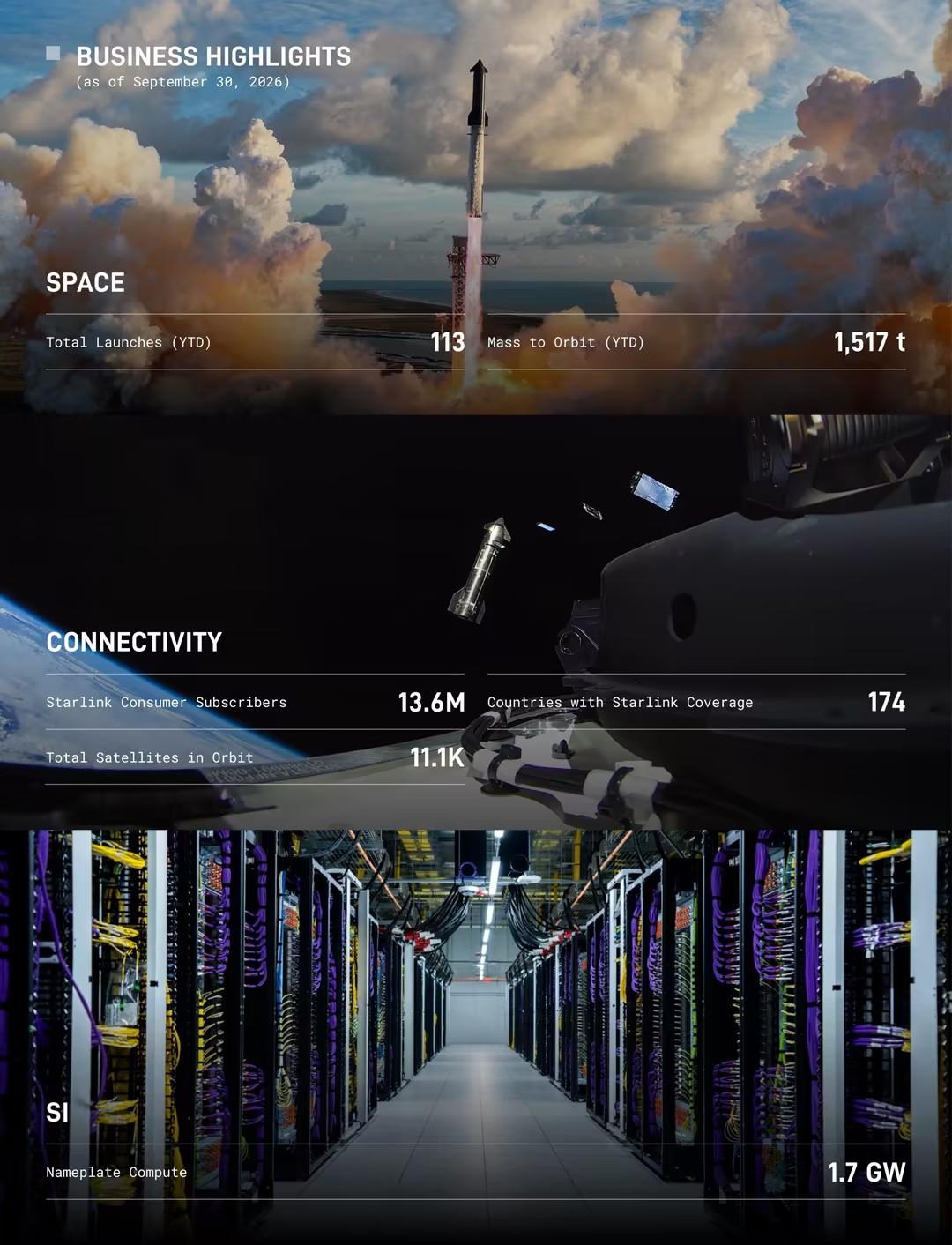
This growth primarily comes from cloud service contracts, expansion of computing infrastructure, and contributions from businesses like Cursor. SpaceX is extending beyond traditional aerospace and satellite communications into AI computing and software services.
However, an increase in revenue size does not mean that investment returns have been fully realized.
In the third quarter, SpaceX's AI business operating profit was approximately $431 million, while related capital expenditures reached $16.444 billion. These are not directly comparable accounting metrics: capital expenditure is a long-term investment, while operating profit reflects current business performance. But they indicate that SpaceX is still making large-scale investments for future computing needs.
Three aspects are worth observing moving forward:
- Can revenue continue to grow: Will cloud service contracts and computing rental demand continue, and is customer demand sufficient to support the current pace of expansion?
- Can profit margins improve: As infrastructure investments gradually convert into usable computing power, can business utilization and profitability increase?
- Can capital expenditure bring corresponding returns: After continued investment in data centers, chips, and computing facilities, can stable operating cash flow form?
SpaceX's results indicate that AI-related businesses can already contribute substantial revenue, but whether they can maintain growth and improve profit margins will require more quarterly data for verification.
2. Tesla: Automotive business is the foundation, Robotaxi and robots are the next test
Tesla's third-quarter financial report will be released on October 22 at midnight (UTC+8). Unlike SpaceX, Tesla already has a mature automotive business, but market long-term valuations are increasingly impacted by expectations for autonomous driving, Robotaxi, and humanoid robots.
To analyze this financial report, we can look at two lines.
First line: Profitability of the automotive business.
Delivery volume is an important indicator, but it does not fully reflect business quality. Automotive revenue, gross margin, pricing strategy, inventory changes, and free cash flow are also worth watching.
If delivery volume increases but requires lower prices to obtain sales, profit margins could come under pressure; if revenue grows while profits and cash flow remain stable, Tesla will have more resources to support future R&D and expansion.
Therefore, this financial report should not only look at how many cars were sold, but also how much profit each car brings and whether the company’s overall cash flow is healthy.
Second line: How far are new businesses from commercialization?
Robotaxi and robots have long-term development potential, but transitioning from technology demonstration to scalable commercial operation still involves several aspects that need validation, including technical reliability, regulatory requirements, operational costs, service coverage, and whether customers are willing to continue paying.
In the financial report and conference call, what's worth paying attention to is not just the visionary ambitions presented by management but whether there is a clearer commercialization timeline, actual operational data, and how related businesses will generate revenue in the future.
Regarding the potential merger between SpaceX and Tesla, Musk has stated that both sides have established a special committee to discuss the relevant possibilities, but no definitive transaction terms have been set. Even if future advancements are made, it cannot be directly equated to an improvement in Tesla’s existing business profitability.
For Tesla, the cash generation ability of the automotive business and the commercialization progress of new businesses need to be assessed separately. Long-term vision can influence valuations, but ultimately it still requires operational data to support it.
3. Meta: Can AI investment continue to improve the efficiency of advertising business?
Meta's business model is different from that of SpaceX. It already has a mature advertising business, and one of the key goals of AI investment is to enhance content recommendations, user engagement, and advertising efficiency.
Therefore, analyzing Meta's financial report requires looking at both revenue growth and cost changes.
If AI can improve advertising conversion effects, increase advertising pricing, or make the platform more effective at allocating traffic, then related investments have the opportunity to yield returns through existing business. Conversely, if spending on computing, data centers, and infrastructure rises sharply while revenue and profit improvements are limited, the market might reassess the return cycle of these investments.
The focus can be on three areas:
- Advertising business: How is advertising revenue growth, and what changes are there in ad impressions and unit pricing?
- Capital expenditure: Is continued investment in AI infrastructure increasing, and what guidance does management provide regarding future spending?
- Profitability: Can revenue growth translate into profit growth, and will additional investments suppress future profit margins?
Meta's advantage lies in its existing mature cash flow sources. It does not need to start from scratch to find a business model for AI; rather, it needs to prove that AI can further enhance the profitability efficiency of its core business.
This also makes Meta's financial report an important window for observing AI commercialization: the market will not only look at how much money the company invested but also whether these investments can improve the operational performance of its advertising business.
4. IBM: With AI orders growing, can they truly convert into revenue?
IBM faces a different challenge.
Enterprise AI projects typically involve consulting, software, cloud services, and systems integration. After clients sign contracts, they still need to go through the processes of project deployment, system integration, and actual application. Therefore, order growth does not mean that all revenue will be recognized in the current quarter.
When analyzing IBM's financial report, it is crucial not only to look at AI-related orders or cooperation cases, but also whether these businesses are gradually reflected in revenue and profit.
Several indicators worth noting include:
- Software and consulting revenue: Is the related business maintaining growth, and is AI starting to contribute more significant revenue?
- Order fulfillment: Can signed projects gradually convert into actual revenue, rather than just remaining at the order scale?
- Client deployment progress: Are enterprises moving from small-scale pilots to broader actual applications?
- Full-year performance guidance: Has management's expectation for revenue, profit, and cash flow improved?
If order growth is rapid but revenue recognition is slow, a further assessment of the project's delivery cycle and commercial value will be needed; if revenue, profit, and cash flow improve simultaneously, AI's contribution to IBM's business will become clearer.
Compared to Meta, IBM needs to prove that enterprise clients are willing to continually pay for AI services; compared to SpaceX, its focus is not on how much computing power to build but on whether it can convert enterprise demand into sustainable business revenue.
5. When looking at the reports of the four companies together, how should they be evaluated?
Although the four companies have different businesses, the same framework can be used to analyze them: revenue growth, profit quality, capital investment, and future guidance.
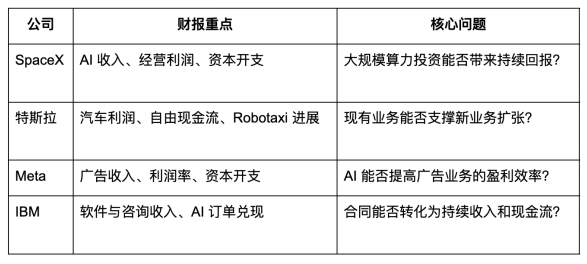
It is also essential to differentiate between two questions: How well is the company operating, and is the stock worth its current market price?
Performance exceeding expectations does not equal that stock prices will rise.
Stock prices reflect not just the data already released, but also the market's previous expectations, valuation levels, and future judgments. If investors have already anticipated strong growth, even if the company's performance hits new highs, as long as the future guidance does not meet expectations, the stock price may still face pressure.
Conversely, if current performance is not particularly outstanding, but future guidance is better than market expectations, the stock price may respond positively.
Therefore, to analyze financial reports, at least two things need to be done:
First, evaluate the quality of the business itself, including whether revenue growth is sustainable, whether profit is improving, and whether cash flow is healthy.
Second, compare actual results against market expectations, paying special attention to management's guidance for the next quarter and the full year.
This is more helpful in understanding market reactions after the financial reports are released than merely comparing who has the fastest revenue growth.
In conclusion
SpaceX has provided a clear case: AI-related business revenue is rapidly expanding, but the company is also investing heavily in computing power and infrastructure.
Next, Tesla, Meta, and IBM will each face different challenges: Tesla needs to balance automotive business profitability with new business commercialization, Meta must prove that AI can further improve advertising efficiency, and IBM needs to gradually convert enterprise AI orders into revenue.
When these financial reports are viewed together, what matters is not which company tells the bigger AI story, but whether each business's data keeps pace with investments and expectations.
As AI investments enter the next phase, growth remains important, but the relationship between revenue, profit, and cash flow may increasingly influence how the market values the company.
After the financial reports are released, in addition to focusing on whether the numbers exceed expectations, it is essential to look at the future guidance provided by management and how the market reassesses the growth potential of these companies.
For further insights into related markets and trading tools, you can visit Binance to learn about and purchase US stocks supported by the platform.
👉 Click the link to register on Binance:
https://jump.do/zh-Hans/xlink-proxy?id=3
(Invitation code: aicoin668, enjoy a 10% rebate)
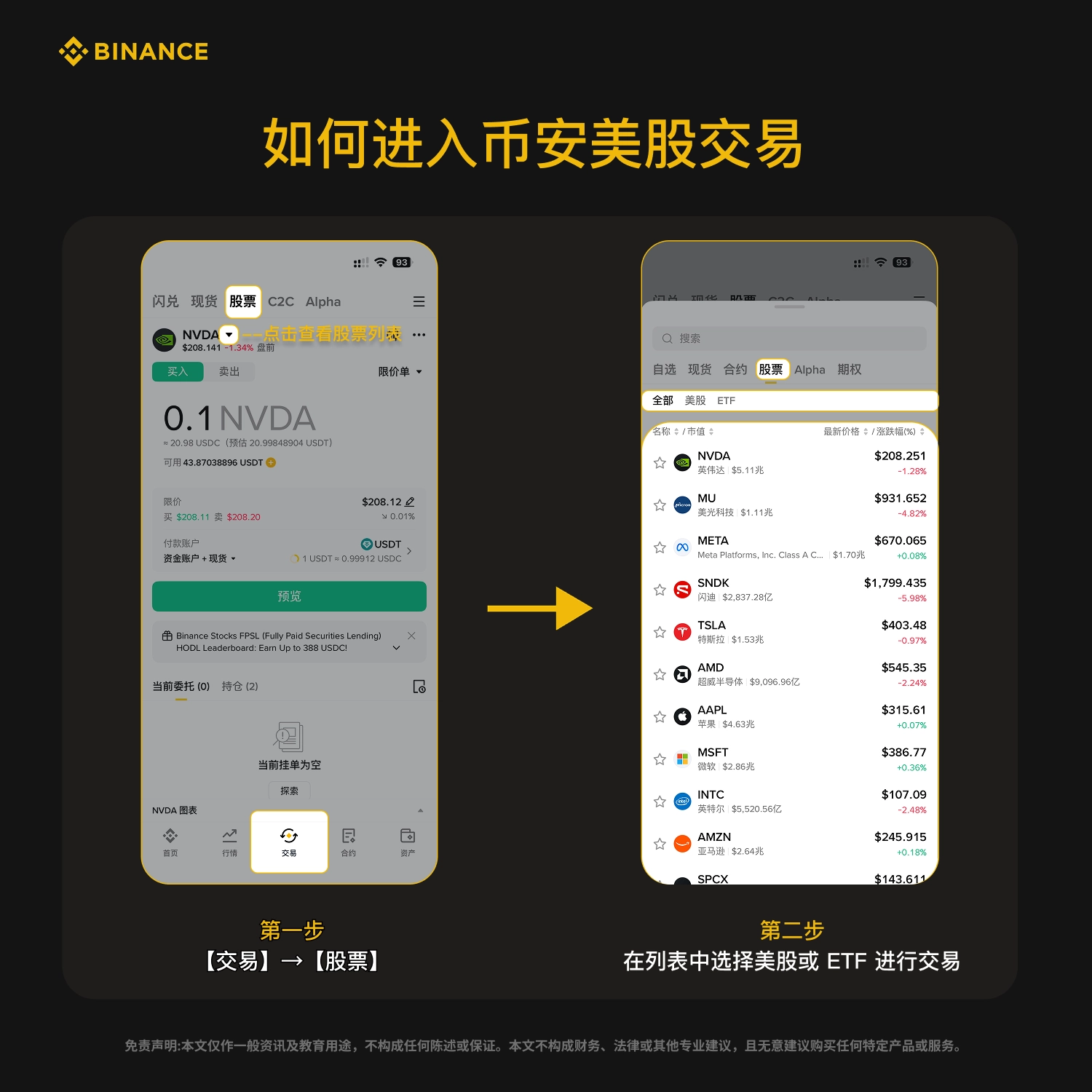
Specific products, trading rules, and available regions are based on the actual display of the Binance App.
Join our community to discuss together and become stronger!
Official Telegram community:
AiCoin Chinese Twitter:
Binance welfare group:
https://www.aicoin.com/link/chat?cid=gmLgwvKD1
Risk warning: Investing in US stocks still requires assuming market risk, regulatory risk, and compliance risk of local laws and regulations (especially foreign exchange controls, overseas investment declarations, etc.). This content is for market observation sharing only and does not constitute investment advice. The cryptocurrency market is highly volatile, please participate within your risk tolerance.
免责声明:本文章仅代表作者个人观点,不代表本平台的立场和观点。本文章仅供信息分享,不构成对任何人的任何投资建议。用户与作者之间的任何争议,与本平台无关。如网页中刊载的文章或图片涉及侵权,请提供相关的权利证明和身份证明发送邮件到[email protected],本平台相关工作人员将会进行核查。